

How the Iran Conflict Reshapes Global Migration Patterns
By Darius Spearman (africanelements)
Support African Elements at patreon.com/africanelements and hear recent news in a single playlist. Additionally, you can gain early access to ad-free video content.
The Middle East currently sits at a precarious turning point. Following large-scale military strikes on Iran on February 28, 2026, the region has been plunged into a volatile state of direct conflict. This escalation involves the United States and Israel, and it follows the recent death of Supreme Leader Ayatollah Ali Khamenei. This moment is the culmination of decades of sanctions, proxy battles, and ideological clashes that define the modern era (trendsresearch.org, securitycouncilreport.org). This is not an isolated event. It is a historic shift that is echoing across the globe, from the streets of Lagos to the halls of international policy organizations.
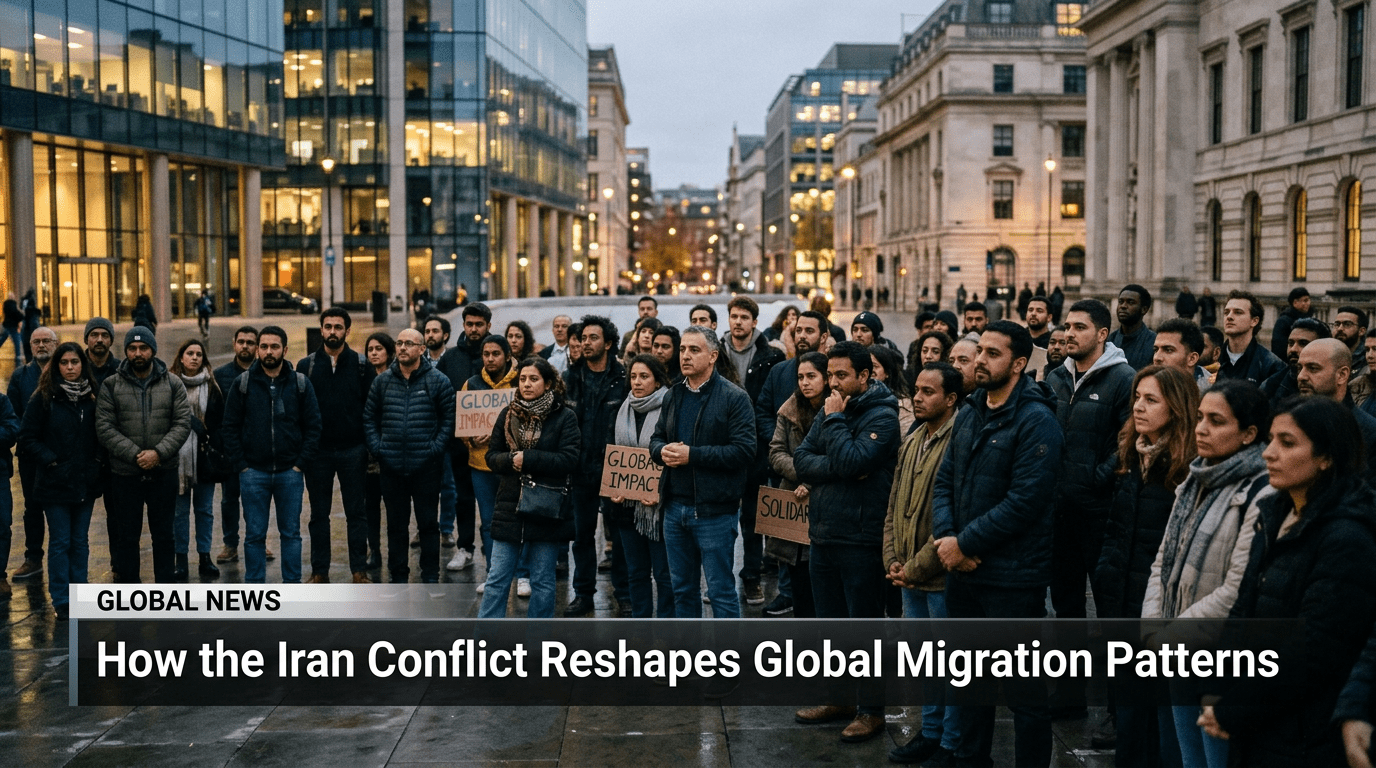
Global diaspora communities are currently serving as the epicenter for these tensions. They are holding rallies and calling for civilian protection while highlighting the broader implications of this war. Leaders within the African and Iranian diaspora are pointing toward the “imperialist psychology” of the conflict. They argue that this war is a symptom of a colonial mindset that seeks to punish sovereign nations for refusing to submit to Western hegemony. This viewpoint suggests that the ripple effects of such conflicts are massive. They impact global migration, food security, and human rights in ways that demand our attention (blackagendareport.com, blackpeoplesunion.org).
A Historical Powder Keg
The current escalation is the climax of over four decades of systemic friction between the Islamic Republic and Western powers. The 1979 Iranian Revolution serves as the primary turning point. This event fundamentally altered the regional balance of power. It transformed Iran from a Western ally into a defiant adversary of United States influence in the Middle East (trendsresearch.org). Understanding this history is crucial, much like how people often study the systemic failures of the past to grasp the current struggles for equality.
For many years, the United States maintained a policy of economic strangulation and sanctions. This strategy was intended to curb the regional ambitions and nuclear development of Iran. Analysts note that this long-term policy of isolation created a siege mentality within the Iranian state. This mindset fueled a reliance on regional proxies, such as groups in Lebanon, Iraq, and Yemen, to project power and deter direct invasion (trendsresearch.org). History proves that when direct state-on-state conflict is avoided, the Middle East conflict manifests through proxy wars. However, the events of early 2026 have shifted this paradigm. We are now seeing a direct, kinetic military confrontation between Iran, the United States, and Israel (securitycouncilreport.org).
Regional Displacement Trend
Millions are currently living in internal displacement across the Middle East (19 Million Total).
Figure represents cumulative regional displacement as of early 2026 (Source: IOM).
The Diaspora Response
The global diaspora acts as a mirror, reflecting the complexities of the current crisis. It is not a monolith. Instead, it has split into distinct camps that demonstrate the difficulty of the situation. Leaders within the African diaspora, particularly in Nigeria and across the continent, frame the current conflict through the lens of imperialist psychology (blackagendareport.com, africanews.com). They argue that Western intervention in Iran is a symptom of a colonial mindset. This viewpoint posits that powerful nations feel entitled to intervene in the internal affairs of weaker nations to maintain global dominance (blackpeoplesunion.org). It is a worldview where powerful nations believe they have the right to enforce their political will on smaller or peripheral nations (blackpeoplesunion.org).
This perspective is deeply rooted in the history of the Global South. By shedding colonial influences and embracing a critical analysis of foreign intervention, activists in Lagos are positioning the conflict as an extension of their own struggles. They view the defiance of Iran as a symbol of dignity for oppressed nations. The imperialist psychology argument highlights that the destabilization of the Middle East creates ripple effects in Africa. These effects include food insecurity, rising energy prices, and the diversion of global resources away from development (blackagendareport.com, blackagendareport.com).
Conversely, significant portions of the Iranian diaspora operate from a standpoint of deep internal frustration with the regime. While some groups protest against external military strikes, others highlight that the policies of the regime created the internal fragility that exacerbated the crisis. They point to the suppression of protests in December 2025 as evidence of this fragility (miragenews.com). These activists emphasize that the Iranian people have been agitating for internal change, such as economic reform and political freedom. They argue this desire for change exists independently of the actions of foreign powers (blackagendareport.com).
The Economic Shockwaves
The ripple effects of the current conflict are measured in human lives and economic stability. Following the late-February strikes, global oil prices surged. Nigeria, for instance, saw its Bonny Light crude reach 80 dollars per barrel. This is an increase from 70 dollars in early February. This rise signals the immediate strain on emerging economies (jakartaglobe.id, africanews.com).
Bonny Light Crude is a high-grade, low-sulfur variety of petroleum produced in Nigeria. It is the primary benchmark for the Nigerian oil industry. The connection to the life of an average person is clear. Despite being a major crude oil producer, Nigeria relies heavily on importing refined petroleum products for domestic use. Consequently, when international prices for Bonny Light rise, the cost of importing fuel increases. This drives up the cost of petrol, transportation, food, and electricity for the average household (jakartaglobe.id).
Economic Volatility: Bonny Light Crude
Price fluctuation impact on the Nigerian economy.
Rising costs directly impact the price of transportation and food.
Furthermore, major shipping companies have suspended passage through the Strait of Hormuz. This is a critical artery through which 20 percent of the world’s oil supply passes. This suspension creates an immediate bottleneck in global trade. It complicates the economic landscape for nations that are already struggling with inflation. These economic realities cannot be separated from the geopolitical ones (jakartaglobe.id).
Human Rights and Migration
The human cost of this escalation is staggering. The International Organization for Migration (IOM) reports that over 19 million people are currently living in internal displacement across the Middle East. This figure is expected to rise sharply as the conflict intensifies (iom.int). This displacement is not a new phenomenon, but it is a dire one. It represents years of overlapping, protracted crises. The current military escalation serves to exacerbate this situation significantly (iom.int).
The internal enduring strength and resilience of families caught in these conflicts is often tested to its absolute limit. In January 2026, prior to the February military escalation, the Human Rights Activists News Agency reported at least 2,615 deaths during the government crackdown on internal protests (miragenews.com). These numbers provide a glimpse into the human reality behind the headlines. They represent thousands of lives disrupted and families fractured by the combination of state repression and foreign military intervention.
Diaspora leaders are currently highlighting a critical intersection. This intersection is the link between military intervention and global migration. They argue that when Western powers intervene in Middle Eastern domestic affairs without clear, sustainable strategies for peace, the resulting power vacuums inevitably create new waves of refugees. This process displaces millions. It also forces emerging economies in the Global South to bear the brunt of the instability (europa.eu).
The Human Cost
2,615+ lives impacted by the January 2026 crackdown.
The Imperialist Psychology of Conflict
What does it mean to say a conflict has an imperialist psychology? In this context, it refers to a sociopolitical framework. Critics of Western foreign policy use this term to describe a mindset where powerful nations feel entitled to intervene in the internal affairs of weaker nations to maintain global hegemony. It posits that this behavior is a recurring pattern. It views non-Western nations as legitimate targets for exploitation or regime change (blackpeoplesunion.org).
This mindset allows Western powers to rationalize military and economic aggression. They often frame these actions as the protection of human rights or the spreading of democracy. However, the reality on the ground often tells a different story. Critics argue that this mindset undermines the principle of national sovereignty. It suggests that the sovereignty of a nation is conditional based on its compliance with the interests of powerful states (blackpeoplesunion.org).
The rallies currently taking place are not merely expressions of sympathy. They are a manifestation of a growing global awareness. There is a recognition that the imperialist psychology of the current conflict has consequences that reach far beyond the borders of Iran. The tendency to prioritize military might over the stability of nations creates a global environment where peace is elusive (blackpeoplesunion.org, blackagendareport.com).
The rallies also highlight a sense of solidarity within the Global South. This solidarity is rooted in a long history of anti-colonial movements. Many Black anti-imperialist organizations frame the United States pressure on Iran as part of the same machinery that has historically oppressed African nations. They argue that defending the sovereignty of Iran is a litmus test for opposing what they characterize as neocolonial attempts to control natural resources (blackagendareport.com).
Conclusion
The history behind the headlines is the story of a region that has been systematically denied stability. This denial comes through both internal repression and external military force. The current crisis is not an isolated incident. It is part of a larger, ongoing cycle of intervention and resistance (securitycouncilreport.org).
Diaspora leaders are calling for a shift in perspective. They argue for a move away from the imperialist psychology that dominates international relations. They advocate for strategies that prioritize the sovereignty of nations and the human rights of citizens over the geopolitical interests of major powers. The challenges facing the world in 2026 are complex. Addressing them requires a deep understanding of history, an acknowledgment of the economic impacts of war, and a commitment to protecting the most vulnerable populations (europa.eu, blackagendareport.com).
As the conflict intensifies, the world watches. The voices of the diaspora will continue to be a vital part of the conversation. Their rallies, their advocacy, and their analysis provide a necessary counter-narrative to the dominant discourse. They remind the global community that every military strike has a human cost, and every act of intervention shapes the future of global migration and stability for years to come (iom.int).
About the Author
Darius Spearman is a professor of Black Studies at San Diego City College, where he has been teaching for over 20 years. He is the founder of African Elements, a media platform dedicated to providing educational resources on the history and culture of the African diaspora. Through his work, Spearman aims to empower and educate by bringing historical context to contemporary issues affecting the Black community.
