

How US Remote Warfare in Somalia Fuels a Quiet Air War
By Darius Spearman (africanelements)
Support African Elements at patreon.com/africanelements and hear recent news in a single playlist. Additionally, you can gain early access to ad-free video content.
On July 13, 2026, the silence of the skies over Sablaale, Somalia, was shattered. Operating in close coordination with the Federal Government of Somalia, the United States Africa Command executed a targeted airstrike against al-Shabaab militants (hiiraan.com, africom.mil). Sablaale sits approximately 190 kilometers southwest of the capital city of Mogadishu (hiiraan.com). According to official military releases, the operation sought to degrade the capacity of the terrorist group to plan and execute attacks throughout the region (africom.mil). Yet, this tactical intervention was not an isolated event in a distant land. It represented the seventy-fourth documented U.S. airstrike in the East African nation within the year 2026 alone (antiwar.com).
To comprehend this ongoing conflict, one must look beyond the immediate headlines. The strike in Sablaale is the modern face of a highly evolved, decades-old approach to warfare. This strategy relies heavily on high-tech remote operations and local proxy forces. This model minimizes the physical risks to American personnel while projecting devastating military power across the African continent. This article explores the deep historical currents that brought the United States military back to the skies of Somalia. It traces how past trauma and changing political landscapes shaped a perpetual, quiet air war.
The Shadows of Mogadishu (1992–1994)
To understand the modern footprint of the United States in East Africa, one must return to the early 1990s. The collapse of the authoritarian regime of Major General Mohamed Siad Barre in 1991 plunged Somalia into a devastating civil war (wikipedia.org). The complete breakdown of central authority coincided with a catastrophic man-made famine. This dual crisis prompted a massive international humanitarian intervention. In late 1992, President George H.W. Bush launched Operation Restore Hope (wikipedia.org). This mission deployed thousands of American troops under the Unified Task Force to secure food distribution networks and protect aid workers.
The initial humanitarian focus did not last. The mission transitioned to a United Nations-led nation-building experiment known as UNOSOM II, which sought to disarm rival factions and rebuild state institutions (wikipedia.org). This mandate brought international forces into direct conflict with powerful Somali clan warlords, particularly Mohamed Farrah Aidid (wikipedia.org). On October 3, 1993, the hunt for Aidid’s top lieutenants led to the Battle of Mogadishu (wikipedia.org). In an intense eighteen-hour firefight, Somali militia members shot down two American UH-60 Black Hawk helicopters (wikipedia.org). The battle resulted in the deaths of eighteen American soldiers and up to one thousand Somalis (wikipedia.org). The public reaction to the disturbing media coverage of the event forced President Bill Clinton to withdraw all American combat forces by March 1994 (wikipedia.org). The trauma of this defeat birthed the “Somalia Syndrome,” a deep-seated political reluctance to deploy American ground troops to foreign humanitarian crises (wikipedia.org).
The Paradigm Shift and the Rise of Al-Shabaab (2001–2008)
The complete withdrawal of international forces left a deep security vacuum. Various regional clans and local Islamic factions competed for control of the fractured nation. In the early 2000s, a coalition of local religious courts organized into the Islamic Courts Union (wikipedia.org). The group successfully restored order to Mogadishu in 2006 (wikipedia.org). However, policymakers in Washington viewed this consolidation of power through the lens of the post-September 11 security environment. They feared the country would become a safe haven for international terrorist networks (wikipedia.org). To prevent this, the United States supported a late-2006 military invasion by Ethiopian forces to dismantle the Islamic Courts Union (wikipedia.org).
The Ethiopian intervention succeeded in ousting the religious coalition, but it sparked a violent asymmetric insurgency. This intervention paved the way for the rise of a highly radicalized splinter group known as al-Shabaab (wikipedia.org). Originally the youth wing of the Islamic Courts Union, al-Shabaab transformed into a formidable insurgent force fighting against foreign occupiers and the weak, internationally backed transition government (wikipedia.org). In 2008, the United States State Department designated al-Shabaab as a Foreign Terrorist Organization (state.gov). By 2012, the group formalized its global identity by pledging allegiance to al-Qaeda (wikipedia.org). This pledge cemented the status of Somalia as a primary kinetic theater in the ongoing global counterterrorism campaign. This intervention represents another chapter in a long history of external interference that has shaped the continent, deeply connected to a broader narrative of history of Africa and its struggles with sovereignty.
Evolution of U.S. Involvement in Somalia
Designing the African Command (AFRICOM)
As security challenges on the African continent multiplied, United States policymakers recognized the need for a dedicated military command structure. In October 2007, President George W. Bush established the United States Africa Command, commonly known as AFRICOM (wikipedia.org, wikipedia.org). Headquartered in Stuttgart, Germany, this command assumed responsibility for all American military operations, intelligence coordination, and security partnerships across the continent, with the exception of Egypt (wikipedia.org, wikipedia.org). The primary focus of AFRICOM quickly centered on the Horn of Africa, where the threat of al-Shabaab continued to grow.
Rather than deploying large conventional troop divisions, AFRICOM developed a highly specialized, remote approach to warfare. The campaign evolved from coordinating intelligence into a sustained program of counterterrorism airstrikes (africom.mil, africom.mil). This strategy allowed the United States to target leadership figures and disrupt militant training camps without maintaining a large physical presence on the ground. This shift aligned with efforts to avoid direct ground engagement, relying instead on high-altitude operations to project influence. Many observers view these remote interventions as a continuation of historical exploitation that has long impacted African nations under the guise of security.
The Danab Brigade: Private Contractors and Proxy Forces
Airstrikes alone could not completely secure territory or rebuild a functioning state. The broader Somali National Army struggled with institutional corruption, division, and inadequate training (iiss.org). To build an effective local partner, negotiations began in 2013 to form a highly trained Somali elite force (longwarjournal.org). This led to the creation of the Danab, or “Lightning,” Brigade in 2014 (longwarjournal.org). This specialized unit was designed to work alongside American forces, combining local ground knowledge with advanced western training.
The United States State Department funded the establishment of this brigade by outsourcing key training and logistical roles to private entities. A major partner in this effort was Bancroft Global Development, a Washington, D.C.-based security consulting firm (shabellemedia.com). Private international contractors employed by Bancroft provided initial recruitment, vetting, and mentoring services (shabellemedia.com, greydynamics.com). This proxy arrangement allowed Washington to build a highly lethal local counterterrorism force. It avoided the domestic political backlash of placing American military trainers directly in hostile territories.
Unlike typical units of the Somali National Army, the Danab Brigade operates on a strict multi-clan ethos (wikipedia.org). Somali society is structured around a patrilineal kinship network divided into five major families: the Hawiye, Darod, Rahanweyn, Dir, and Isaaq (wikipedia.org, wikipedia.org). Historically, military units integrated along clan lines suffered from competing loyalties, frequently prioritizing local interests over national command (wikipedia.org). By recruiting balanced numbers from various clans based on merit, the Danab Brigade avoids being viewed as an occupying force of a single dominant tribe (wikipedia.org). This non-clan identity has made the unit a highly professional tool for high-risk operations. During the July 13, 2026 operation, Danab commandos executed a synchronized midnight ground raid in Sablaale, destroying multiple al-Shabaab ideological and recruitment facilities (shabellemedia.com).
Structural Comparison: Somali Defense Models
Traditional Clan Militias
- Structured strictly along regional kinship lines
- Prone to competing local and tribal loyalties
- Struggles to integrate into national military structures
- Prone to corruption and fragmentation
The Elite Danab Brigade
- Vetted multi-clan recruitment ethos
- Unified command structure without tribal bias
- Heavy training from external specialists
- Capable of complex, nationwide operations
The Shifting Rules of Engagement
The volume and intensity of the remote air campaign in Somalia have fluctuated based on the political leadership in Washington. These shifts are governed by internal military directives known as the rules of engagement (brennancenter.org). Under the Obama administration, strict guidelines established in 2013 required high-level presidential approval and a “near certainty” that no civilians would be harmed before executing a strike outside designated war zones (brennancenter.org). This centralized oversight restricted the frequency of remote bombardments in East Africa.
This approach changed in March 2017 when President Donald Trump designated parts of southern Somalia as “Areas of Active Hostilities” (brennancenter.org). This designation lowered the targeting threshold to a “reasonable certainty” that civilian casualties would not occur (brennancenter.org). It also allowed commanders to target lower-level militants based solely on affiliation rather than an imminent threat to American lives (justsecurity.org). This relaxation of guidelines led to a massive spike in airstrikes during the first Trump term. When President Joe Biden took office, his administration reinstated tighter centralized controls, resulting in a total of forty-eight strikes over four years (antiwar.com). However, the return of Donald Trump in 2025 led to another major escalation. The United States conducted a record-breaking 132 airstrikes in 2025 (antiwar.com). By mid-July 2026, the count had already reached seventy-four strikes, putting the year on a path to match or exceed the previous record (antiwar.com).
U.S. Airstrikes in Somalia by Political Era
Source: Compiled operational reports of recorded strikes in East Africa.
The True Toll on Somali Civilians
The human cost of this intensified air campaign is a subject of intense dispute. For many years, official statements from the United States military maintained that its remote operations had resulted in zero civilian casualties (amnestyusa.org). It was only after extensive on-the-ground investigations by groups like Amnesty International in 2019 that AFRICOM admitted to accidentally killing civilians (amnestyusa.org). Independent monitoring organizations, such as Airwars, estimate that between 87 and 163 Somali civilians have been killed by American operations since 2007 (antiwar.com).
Human rights organizations criticize the methods used by the military to evaluate these incidents. Assessors rarely conduct physical investigations or interview local witnesses, relying instead on remote imagery and intelligence reports (civiliansinconflict.org, civiliansinconflict.org). Although AFRICOM established an online portal for civilians to report casualties, critics note that it is poorly translated and virtually inaccessible to rural populations lacking internet access (civiliansinconflict.org). Furthermore, despite public acknowledgments of civilian deaths, the United States military has not paid financial compensation or ex gratia payments to the affected families (civiliansinconflict.org, civiliansinconflict.org). This lack of accountability creates a deep sense of resentment among local communities who continue to bear the brunt of external military actions.
The Legal Battleground: Stretching the AUMF
The domestic legal authority for this long-running air war rests on a statute passed a quarter-century ago. Successive presidential administrations have relied on the 2001 Authorization for Use of Military Force, which was originally enacted to target the planners of the September 11 attacks (brennancenter.org). Over time, the executive branch expanded the legal interpretation of this statute. It classified al-Shabaab as an “associated force” of al-Qaeda, bringing the group within the scope of the original authorization (justsecurity.org, brennancenter.org).
Additionally, the military frequently utilizes the concept of “collective self-defense” under Article II of the Constitution (justsecurity.org, justsecurity.org). This doctrine allows commanders to launch airstrikes to protect local partner forces, such as the Danab Brigade, even when no American personnel are directly threatened. International legal scholars argue that this expansive interpretation of self-defense diverges from the standards established under public international law and the United Nations Charter (justsecurity.org, justsecurity.org). The sharing of power between the legislative and executive branches has become highly unbalanced, allowing perpetual military actions without explicit congressional approval.
U.S. Security Assistance to Somalia (Since 2001)
The Perspective of Somali Citizens
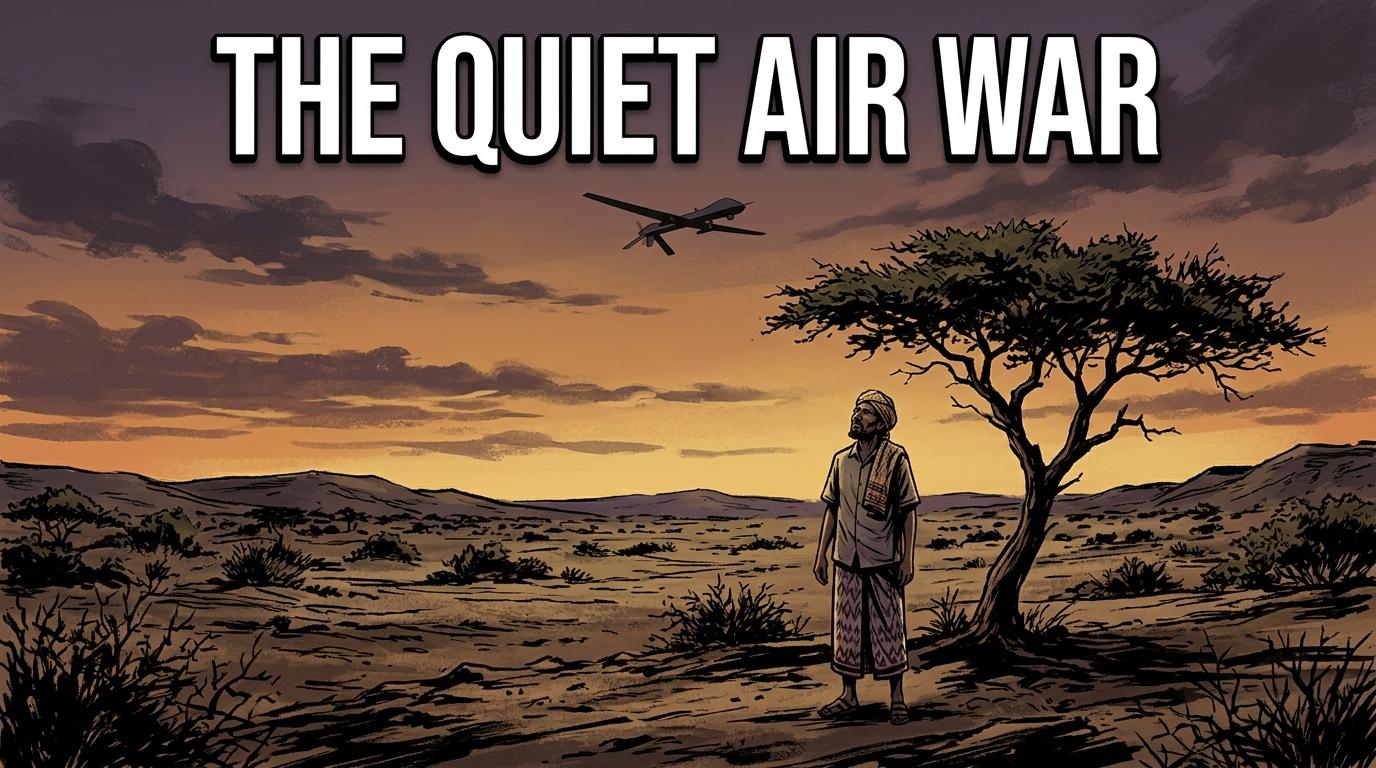
For average Somali citizens, the foreign military presence is a source of profound division and anxiety. While many respect the Danab Brigade as a professional and disciplined force, the constant presence of foreign aircraft generates widespread dread. The persistent high-pitched hum of drones flying overhead causes significant psychological distress in southern communities (amnestyusa.org). Airstrikes have destroyed homes, schools, and local infrastructure, severely disrupting fragile local economies (usaid.gov, amnestyusa.org).
Furthermore, civilians in targeted areas are often trapped in a perilous position. They live in constant fear of sudden aerial explosions, yet they also face execution by al-Shabaab if they are suspected of acting as informants or guides for the targeting systems (civiliansinconflict.org, amnestyusa.org, protectionofcivilians.org). Al-Shabaab has actively capitalized on civilian deaths, using traditional oral poetry and local media to frame the drone campaign as a neocolonial invasion (meer.com, wordpress.com). This messaging helps the group recruit new fighters, offsetting the losses caused by the airstrikes. Local populations are left to navigate these modern challenges, caught between the terror of insurgent violence and the devastation of remote military strikes.
Conclusion: The Enduring Cycle of Remote Warfare
The strike near Sablaale on July 13, 2026, is not merely a brief news entry (hiiraan.com). It is a clear manifestation of a persistent military paradigm. Haunted by the direct combat losses of the 1993 Battle of Mogadishu, the United States has spent decades refining a remote, low-risk model of counterterrorism (wikipedia.org). By combining advanced aerial technology with specialized local proxy forces like the Danab Brigade, Washington has managed to sustain a highly kinetic campaign with minimal American casualties (shabellemedia.com, africom.mil).
However, this tactical approach has not produced a decisive victory. Despite thousands of neutralized militants and billions of dollars in security assistance, al-Shabaab remains a resilient and highly adaptable force (antiwar.com). The record-breaking air campaigns of 2025 and 2026 reveal a state of enduring stalemate (antiwar.com). While remote bombings may disrupt immediate threats, they do not resolve the deep-seated political and economic instability that allows militancy to thrive. Until those underlying issues are addressed, the skies over Somalia are likely to remain a quiet, endless battlefield.
About the Author
Darius Spearman is a professor of Black Studies at San Diego City College, where he has been teaching for over 20 years. He is the founder of African Elements, a media platform dedicated to providing educational resources on the history and culture of the African diaspora. Through his work, Spearman aims to empower and educate by bringing historical context to contemporary issues affecting the Black community.
