


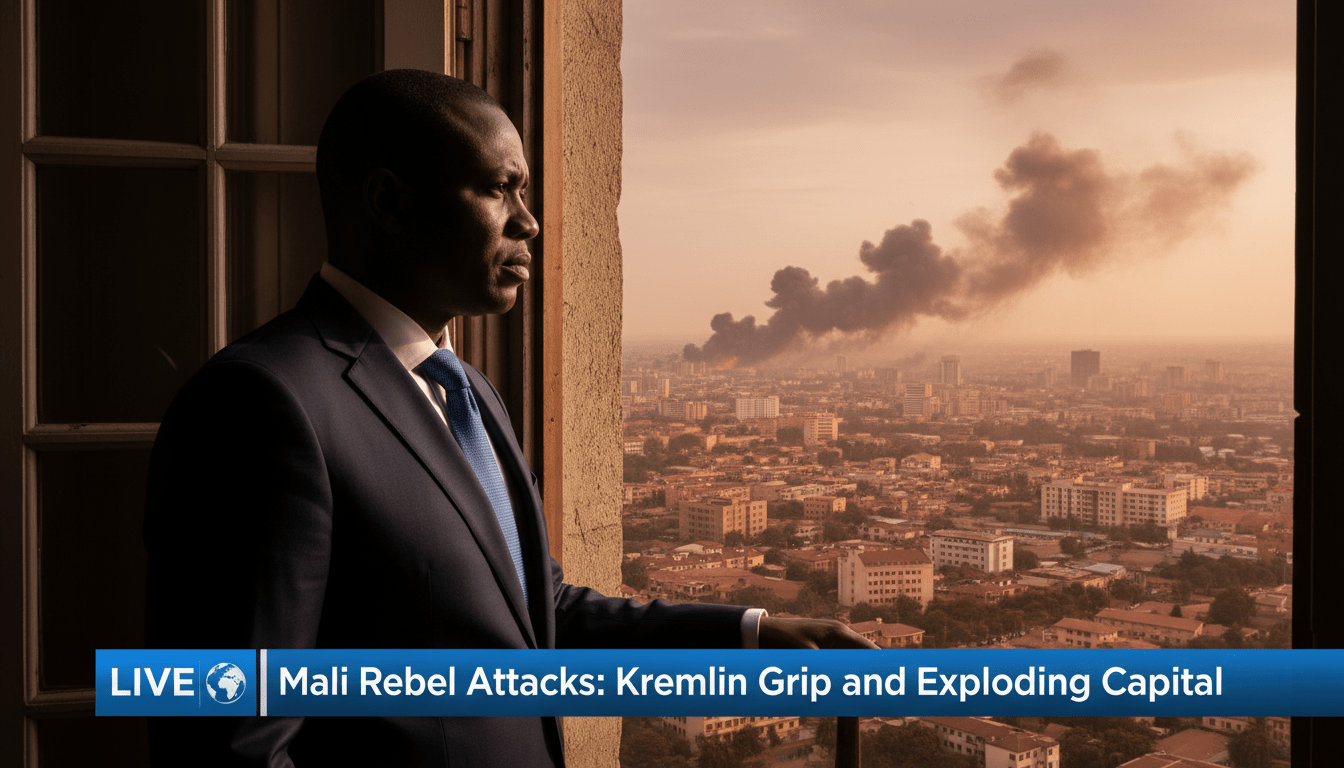
Mali Rebel Attacks: Kremlin Grip and Exploding Capital
By Darius Spearman (africanelements)
Support African Elements at patreon.com/africanelements and hear recent news in a single playlist. Additionally, you can gain early access to ad-free video content.
Bamako woke to loud explosions in the early morning hours. A massive, coordinated attack recently struck the capital city of Mali. Militants targeted the absolute heart of the Malian government. The assault successfully breached secure zones and killed Defense Minister Sadio Camara at his residence. This violent event marks a monumental shift in West African geopolitics. The attack forces the global community to ask why this happened right now. The answer lies deep within decades of unresolved regional conflict and broken promises. Understanding the present requires examining the painful history of the Sahel region.
The Sahel is a massive geographic belt spanning the African continent. It stretches 3,300 miles from the Atlantic Ocean to the Red Sea. The region serves as a critical transition zone between the Sahara Desert and the tropical savannas. The ongoing conflict fundamentally altered the security architecture of this entire area. The recent attack on the capital is the climax of numerous political miscalculations. State leaders abandoned diplomacy and trusted foreign military forces. This decision ultimately brought the war directly to their own doorsteps.
The Roots of Rebellion in the North
The violence in Mali has deep historical roots that predate the current government. The conflict centers heavily around the northern regions of the country. This massive desert area is culturally distinct from the southern administrative center of Bamako. The semi-nomadic Tuareg people live throughout this northern territory. They refer to their ancestral homeland as Azawad. Since Mali gained independence in 1960, the north has experienced five major uprisings. Rebellions occurred in 1962, 1990, 2006, 2012, and the present day. Each uprising stemmed from deeply held local grievances. Tuareg communities felt marginalized by the central government. They believed the state completely neglected their economic and social development.
The light-skinned Tuareg and Arab populations clashed frequently with the Black-majority southern government. This complicated dynamic created severe ethnic tensions over several decades. The Tuareg people fought fiercely for an independent state or greater autonomy. Their demands were consistently met with overwhelming military force from the state. This endless cycle of violence continued without any permanent resolution. The central government struggled constantly to maintain control over the vast northern desert. The failure to address these historical grievances laid the foundation for the current nationwide crisis. (wikipedia.org)
The Collapse of Mali and the Algiers Accord
The present crisis traces its exact origins back to the year 2012. Tuareg secessionists launched a powerful rebellion during that pivotal time. They formed the National Movement for the Liberation of Azawad. This organized group quickly overwhelmed government forces across the north. However, Al-Qaeda-linked jihadist groups soon hijacked the secular Tuareg rebellion. Extremist groups like Ansar Dine took total control of the newly captured territory. This sudden takeover forced a massive international military response. France launched an aggressive military intervention called Operation Serval in 2013. The intervention pushed the extremist groups out of the major northern cities.
The military intervention eventually led to the 2015 Algiers Peace Accord. This complex agreement promised northern autonomy in exchange for lasting regional peace. It offered a temporary pause in the widespread violence. However, the peace agreement did not hold for very long. Several jihadist factions merged in 2017 to form a highly dangerous new group. This powerful organization became known as Jama’at Nusrat al-Islam wal-Muslimin. A former Tuareg rebel named Iyad Ag Ghaly led this new coalition. The group blended extremist religious ideology with genuine local grievances. This combination made them a formidable force. The Malian state could neither defeat them militarily nor integrate them politically. (clingendael.org)
A Changing of the Guard in Bamako
The political landscape in the capital shifted dramatically during the year 2020. The military organized a sudden coup to remove President Ibrahim Boubacar Keïta. Colonel Assimi Goïta led this aggressive government takeover. He initially installed a civilian-led transitional government to appease the international community. However, Goïta orchestrated a second coup in May 2021. He detained the interim president and officially declared himself the ultimate leader. This aggressive move firmly established a military junta in Mali. Goïta framed himself publicly as a revolutionary leader for the common people. He promised to reclaim Malian dignity from the former colonial power of France.
This anti-colonial rhetoric resonated strongly with many people in the African Diaspora. The public completely rejected the paternalistic legacy of French colonial rule. Many observers initially saw this rejection as a positive step toward Black sovereignty. The junta boldly expelled French forces and the United Nations peacekeeping mission. They ended Operation Barkhane and created a massive security vacuum across the nation. Defense Minister Sadio Camara orchestrated an entirely new security strategy. He traveled directly to Moscow to negotiate a highly controversial deal. Camara successfully arranged for thousands of Russian mercenaries to enter Mali. (themoscowtimes.com)
2023 Violence Increase in Central Sahel
The High Cost of the Russian Pivot
The Malian government hired the Wagner Group to provide nationwide state security. This Russian paramilitary organization is now officially rebranded as the Africa Corps. The deliberate rebranding signals a direct link to Russian foreign policy objectives. The mercenaries remain highly controversial due to severe, documented human rights violations. They frequently target Black African civilians during aggressive military operations. Human Rights Watch documented a horrifying massacre in the town of Moura in 2022. Malian forces and Wagner mercenaries allegedly killed over 300 unarmed civilians there. United Nations investigators also reported widespread sexual violence across the countryside. The foreign operatives use brutal torture to aggressively intimidate rural populations. (middleeasteye.net)
Social justice advocates view this dynamic as a new form of exploitation. Foreign entities exploit local political conflicts to access valuable natural resources. Russian forces often trade their military security services for direct gold mine access. The rapid shift away from France did not reduce violence in the region. Instead, civilian targeting reached absolute record highs under the new military regime. The Armed Conflict Location and Event Data Project carefully tracks this political violence. Their verified data shows that political violence fatalities increased dramatically in 2023. The violence disproportionately targets ethnic minorities like the Fulani people. State-sponsored violence simply shifted its allegiance from one foreign power to another. (acleddata.com)
Breaking the Accord and Forging New Enemies
The military junta made a highly aggressive move in early 2024. They officially terminated the historic 2015 Algiers Peace Accord in January. The government formally declared an all-out war on the northern rebel groups. The Malian army captured the strategic northern city of Kidal in late 2023. Russian mercenaries heavily supported this major, coordinated military operation. Kidal had served as a highly symbolic stronghold for the Azawad independence movement. Taking the city represented a massive public victory for the central government. However, this aggressive, uncompromising strategy created a severe unintended consequence for the state.
The military offensive forced desperate enemies to completely unite. Secular Tuareg separatists joined forces directly with Al-Qaeda-linked jihadist groups. The Tuareg groups reorganized themselves as the Azawad Liberation Front. They formed a tactical marriage of convenience with the religious extremists. Both armed groups now view the Russian mercenaries as dangerous foreign occupiers. They also see the Goïta regime as a shared existential threat to their survival. This strategic coordination absolutely prioritizes basic survival over deep ideological differences. The government inadvertently united its most capable and dangerous opponents. The combined forces quietly prepared to strike back against the central state. (wikipedia.org)
Displacement Crisis (Late 2023 – 2024)
The Battle of Tinzaouaten Shifts the Tide
The rebel alliance tested their new combined strength in July 2024. A joint force completely ambushed a military convoy near the town of Tinzaouaten. The targeted convoy consisted of Malian soldiers and heavily armed Russian mercenaries. The rebels launched a devastating, coordinated attack against the state forces. The battle resulted in historic, massive losses for the Russian fighters. Dozens of highly trained mercenaries died in the brutal desert ambush. This significant defeat completely shattered the myth of Russian military invincibility. It proved definitively that the newly formed rebel alliance was a severe regional threat.
The Wagner Group faced massive internal problems during this exact period. The sudden death of their founder caused widespread organizational chaos. The mercenary group lacked the intelligence capabilities to predict the massive ambush. The rebels easily recognized that the foreign fighters were terribly overstretched. They saw clearly that the Russian forces lacked adequate logistical support. The overwhelming victory at Tinzaouaten emboldened the entire rebel coalition. They realized they could defeat the government forces in open combat. This profound confidence led them to plan even larger military operations. The violence soon spread far beyond the remote northern fringes. (clingendael.org, themoscowtimes.com)
Battle of Tinzaouaten Casualties
The Alliance of Sahel States and Regional Isolation
Mali exists within the vast, deeply troubled geographical region known as the Sahel. This vital area serves as a major transition zone across the African continent. The region currently faces a massive, highly destructive tri-state border crisis. Mali, Burkina Faso, and Niger all experience extreme, daily insurgent violence. The ruling military juntas of these three nations recently formed a new coalition. They officially created the Alliance of Sahel States in 2023. The alliance explicitly aims to provide mutual defense against external threats. This aggressive political move further isolated Mali from the broader international community. (moderndiplomacy.eu)
The three nations aggressively broke ties with established regional democratic blocs. They completely rejected the influence of the Economic Community of West African States. The juntas chose deliberately to rely entirely on their own military strength. They promised their anxious citizens total security and complete national sovereignty. However, the grim reality on the ground contradicts these incredibly bold promises. The military governments desperately lack the resources to secure their vast territories. The local gendarmerie forces often find themselves completely overwhelmed by rebel attacks. The strategy of aggressive military reconquest ultimately failed to protect the general population. The state remained incredibly vulnerable to highly coordinated, deadly assaults. (voaafrica.com)
Explosions in Bamako and Future Fallout
The escalating violence finally reached the absolute heart of the Malian state. Militants launched a series of coordinated, highly destructive attacks across Bamako. The heavily armed fighters also assaulted the nearby garrison town of Kati. The nationwide offensive tragically killed Defense Minister Sadio Camara at his secure residence. This targeted assassination represents a strategic decapitation of the national military leadership. Camara was the primary architect of the massive pivot toward Russia. His death sends a terrifying, clear message to the Malian public. The current security strategy has completely failed to protect the fragile nation. (clingendael.org)
The state security apparatus is clearly no longer safe in its own strongholds. The massive explosions in Bamako represent the climax of numerous fatal miscalculations. The junta completely abandoned diplomacy and relied exclusively on foreign mercenaries. They trusted a paramilitary force that lacks the genuine support of the local population. This massive policy failure effectively ended the era of Russian-guaranteed stability. The nation now faces a terribly prolonged and highly fragmented civil war. The brutal cycle of violence will continue to heavily devastate the civilian population. The deep historical grievances of the north remain entirely unresolved today. (wikipedia.org)
About the Author
Darius Spearman is a professor of Black Studies at San Diego City College, where he has been teaching for over 20 years. He is the founder of African Elements, a media platform dedicated to providing educational resources on the history and culture of the African diaspora. Through his work, Spearman aims to empower and educate by bringing historical context to contemporary issues affecting the Black community.
