

Military Boat Strikes in the Caribbean: A Fatal Shift
By Darius Spearman (africanelements)
Support African Elements at patreon.com/africanelements and hear recent news in a single playlist. Additionally, you can gain early access to ad-free video content.
A Violent Shift in Maritime Policy
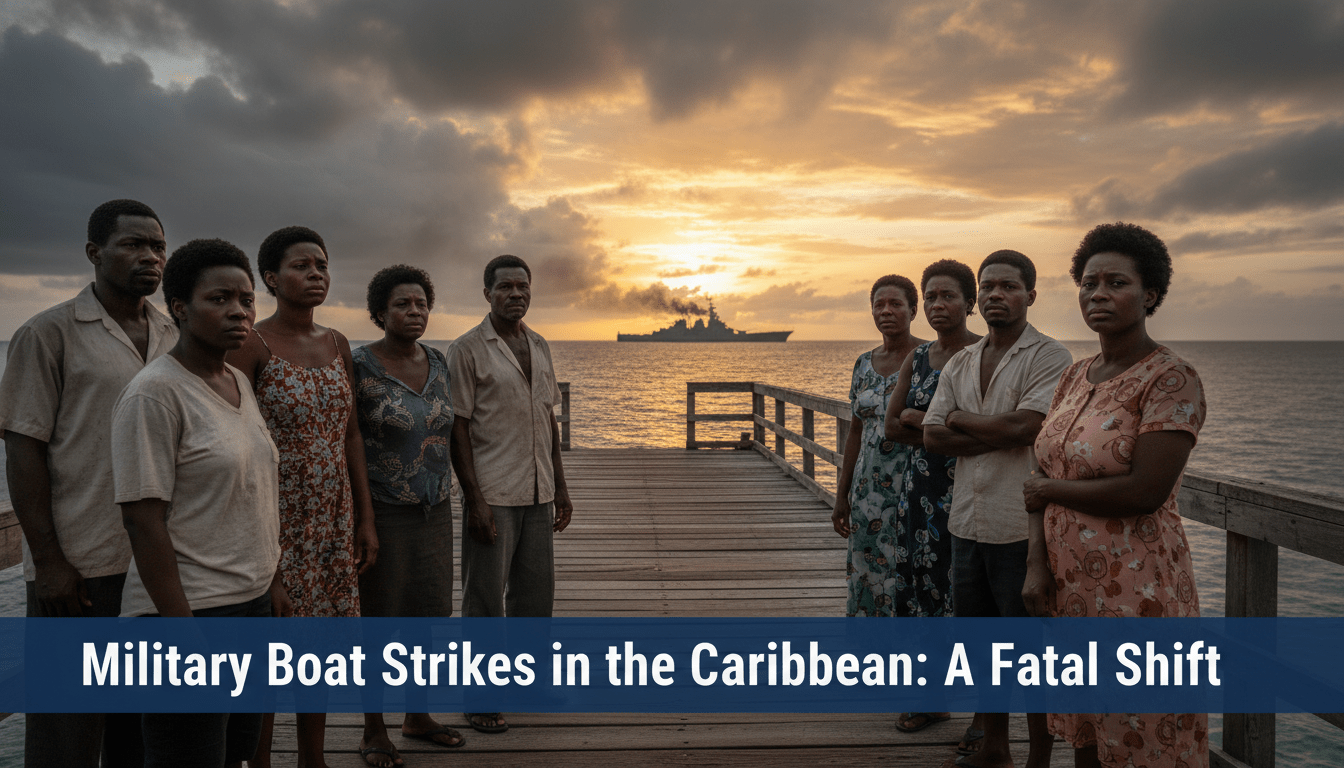
The United States military confirmed another deadly strike in the Caribbean Sea yesterday. This recent attack destroyed a suspected smuggling vessel and killed two individuals. It brings the total confirmed death toll to 188 people since September. The current mission represents a drastic change in maritime law enforcement. Officials call this campaign Operation Southern Spear. The military now utilizes lethal kinetic strikes against suspected drug smuggling vessels instead of traditional arrests.
Lethal kinetic strikes involve traditional physical force. The military uses weapons such as missiles and bombs during these encounters. These attacks aim to produce destructive effects and neutralize targets on the spot. Military doctrine describes them as direct physical attacks resulting in tangible destruction (dtic.mil, justsecurity.org). The shift from peaceful interdiction to explosive strikes alarms human rights advocates worldwide. It turns a civilian policing matter into a deadly military conflict without a formal declaration of war.
Operation Southern Spear: Fatality Escalation
The Origins of Narcoterrorism
To understand this violent shift, one must look at the history of the region. The concept of narcoterrorism dates back over forty years. Peruvian President Fernando Belaúnde Terry first coined the phrase in 1983. He used it to describe violent attacks by drug traffickers against local police officers. For decades, officials used the term primarily as a rhetorical tool. It highlighted the dangerous connection between violent cartels and local insurgent groups.
The militarization of the drug war began earnestly in 1982. President Ronald Reagan created the South Florida Task Force during this period (reaganlibrary.gov). This initiative marked a major step in combining military resources with civilian drug enforcement. However, the military strictly focused on interdiction and detection at that time. The military provided radar, equipment, and intelligence support. Meanwhile, the Coast Guard and the Drug Enforcement Administration made the actual arrests. The focus remained on bringing suspects to trial rather than executing them at sea.
The New War Paradigm
Things look vastly different today under the current administration. President Donald Trump has radically changed how the military operates in the Caribbean. In early 2025, his administration designated several Latin American cartels as Foreign Terrorist Organizations. These groups include the violent Venezuelan gang Tren de Aragua and the Cartel de los Soles. An official executive order categorized these cartels as an unusual and extraordinary threat to national security.
This terrorist designation carries heavy legal consequences. It allows the military to treat suspected gang members as enemy combatants. Consequently, the government can target them with lethal force without a trial. The previous law enforcement paradigm required officials to use force as an absolute last resort. Suspects were considered innocent until proven guilty in a court of law. The new armed conflict paradigm removes the arrest and trial phases entirely. Experts argue this dangerous approach leads directly to extrajudicial killings (idi.org.il, icrc.org).
The Geopolitics of the Venezuela Factor
The deadly campaign is deeply tied to international politics and foreign policy. Operation Southern Spear connects directly to United States efforts to pressure the Venezuelan government. The government labels the Cartel de los Soles and Tren de Aragua as terrorist organizations. These specific designations allow officials to frame the military strikes as an urgent national security necessity. The Cartel de los Soles allegedly involves high-ranking individuals within the Venezuelan military and government.
Analysts suggest the massive naval buildup serves a dual purpose. It aims to stop illegal drug shipments while intimidating foreign leaders. The deployment of the USS Gerald R. Ford represents the largest naval buildup in the region since 1994. Some observers view this military posture as a prelude to more direct action against foreign officials. The intertwining of drug enforcement and foreign regime change complicates the situation. It creates a chaotic environment where innocent lives easily become collateral damage.
The Shift in Tactics (1980s vs 2020s)
International Outrage and Legal Battles
The international community fiercely criticizes Operation Southern Spear. Global leaders express deep concern over the lack of transparency and evidence. Volker Türk, the United Nations Human Rights Chief, condemned the strikes in October 2025. He stated that these deadly attacks find no justification under international law. He argued strongly that lethal force remains permissible only as an absolute last resort to protect human life.
The outrage extends far beyond formal statements and speeches. By November 2025, the United Kingdom stopped sharing maritime intelligence with the United States. British officials cited major concerns that their intelligence data facilitated extrajudicial killings. In response to the growing body count, families of victims are fighting back in the legal system. Relatives of the deceased are filing novel wrongful death lawsuits. They rely on the Death on the High Seas Act to seek justice for their lost loved ones (washingtonpost.com, wikipedia.org).
The Posse Comitatus Act Connection
Domestic laws usually prevent the military from acting like local police officers. The Posse Comitatus Act of 1878 stands as a key safeguard in American law. It strictly prohibits the use of federal troops to execute civilian laws unless Congress expressly allows it. This law historically ensured a strict separation between military power and civil authority. It protected citizens from dangerous military interference in routine local matters (ebsco.com, wikipedia.org).
However, lawmakers have steadily eroded these vital legal protections over time. In 1981, Congress amended the Posse Comitatus Act to allow the military to share intelligence with law enforcement. By 1989, the Department of Defense became the lead agency for monitoring drug trafficking. Today, the executive branch heavily relies on Article II of the Constitution. This article designates the president as the Commander-in-Chief. Officials use this inherent executive authority to bypass congressional approval and conduct deadly strikes (populismstudies.org, cornell.edu).
Impact on Caribbean Communities
Operation Southern Spear creates severe consequences for Afro-descendant populations. The lethal strikes heavily impact people from Caribbean and South American countries. Confirmed fatalities include citizens from Trinidad and Tobago, Colombia, and Ecuador. Many of these victims belong to nations with significantly large Black populations. Human rights advocates consistently criticize the total lack of transparency regarding the identities of the deceased.
The narcoterrorist framework also creates serious risks for immigrants residing in the United States. Framing the drug trade as a national security threat drastically increases surveillance and profiling. Customs agents apply more aggressive enforcement at borders and ports of entry. This heightened scrutiny directly impacts diaspora neighborhoods across the country. These actions reflect a troubling history where government policies disproportionately target marginalized communities. Historically, these oppressive practices often intersect with efforts to suppress the black vote and limit political freedom.
Militarized Policing at Home and Abroad
The brutal tactics used in the Caribbean deeply mirror domestic policing strategies. Operation Southern Spear represents a dangerous hybrid of the War on Drugs and the War on Terror. Analysts closely compare these international military actions to domestic policing programs. The controversial 1033 Program operates on a very similar philosophy of overwhelming force. This program transfers billions of dollars in surplus military equipment to local police departments.
This aggressive militarization directly harms Black and Brown neighborhoods every single day. Police departments frequently use armored vehicles and advanced military surveillance tools during standard operations. These tactics essentially bring the brutality of war home to local communities. The distinct line between criminal justice and total war completely disappears under these harsh conditions. The aggressive stance at home and abroad shows a unified strategy of overwhelming force. It thoroughly reflects the complex dynamics between Black politics and anti-Black politics in modern society (drugpolicyfacts.org, hsdl.org).
Demanding Transparency and Accountability
The shocking current death toll of 188 people demands immediate answers from government officials. The military sinks suspected vessels completely, which destroys all potential physical evidence. Officials cannot properly verify the cargo or confirm the identities of those killed in the strikes. This policy creates a massive void of accountability in the Caribbean Sea. Critics rightly call these deliberate actions sanctioned murder under the convenient guise of national security.
The long history of African American labor and struggle teaches the vital importance of vigilance. Marginalized people must continuously demand absolute transparency from powerful institutions. The sudden shift from standard law enforcement to military annihilation sets a dangerous precedent for future global operations. Citizens everywhere must question the strict legality and morality of these extreme measures. Without intense public scrutiny, the government will ruthlessly continue to operate a deadly kill zone in international waters.
About the Author
Darius Spearman is a professor of Black Studies at San Diego City College, where he has been teaching for over 20 years. He is the founder of African Elements, a media platform dedicated to providing educational resources on the history and culture of the African diaspora. Through his work, Spearman aims to empower and educate by bringing historical context to contemporary issues affecting the Black community.
