

Nelson Mandela Digital Rights: Why Connectivity Is a Human Right
By Darius Spearman (africanelements)
Support African Elements at patreon.com/africanelements and hear recent news in a single playlist. Additionally, you can gain early access to ad-free video content.
The Nelson Mandela Foundation took a bold step forward today in South Africa. The organization launched a new report called “Action from the Ground Up.” This document explains how digital inequality is the new frontier for civil rights. It argues that technological access is a fundamental human right. For many in the global Black community, this struggle feels very familiar. It mirrors the long history of fighting for basic resources and dignity. The report shows how collaboration can bridge the gap for the most marginalized people (nelsonmandela.org).
In the modern world, being offline means being invisible. The current administration under President Donald Trump oversees a global landscape where digital access is essential for trade and education. Without the internet, children cannot learn and adults cannot find work. The Foundation argues that connectivity is a prerequisite for life in the twenty-first century. This initiative is a response to years of systemic exclusion. It looks at the history behind the headlines to find a better way forward for everyone (nelsonmandela.org).
The Vision of a President: 1995 to Now
The fight for digital rights did not start today. President Nelson Mandela saw this coming over thirty years ago. In 1995, he spoke at a major conference in Geneva. He told the world that the capacity to communicate would become a key human right. He warned that the world must bridge the gap between information-rich and information-poor nations. This vision was far ahead of its time. It laid the foundation for everything the organization does today (nelsonmandela.org).
Mandela knew that political freedom was only the first step. True liberation requires economic and social tools. When he stepped down as President in 1999, he created his foundation to keep this work alive. In the early years, the focus was on physical buildings. The foundation helped build 140 schools across rural South Africa. They used private partnerships to put roofs over the heads of students. However, they soon learned that a building is only the start of the journey (wikipedia.org, nelsonmandela.org).
By 2005, the Foundation realized that many of these new schools were still struggling. This led to a shift in how they thought about progress. They moved away from a “bricks and mortar” approach. They started focusing on the people inside the buildings. They looked at how educators and communities could work together. This shift was a turning point. It moved the focus to human-centered methodologies that respect local needs and voices (nelsonmandela.org).
Source: TradingEconomics & DataReportal
Beyond Bricks and Mortar: The New Foundation Model
The 2026 report marks a sophisticated evolution in strategy. It is led by Dialogue Coordinator Nomahlozi Ramohloki. The report highlights a move toward structural transformation. It suggests that isolated projects are no longer enough to solve deep-seated problems. Instead, the focus is now on creating entire ecosystems of support. This means bringing together different parts of society to work as one unit (nelsonmandela.org).
This model uses a four-way partnership. First, civil society groups mobilize resources. Second, educators tailor technology to the real needs of students. Third, community members take ownership of the projects. Finally, private partners provide the technical tools. This collaborative model ensures that technology does not just sit in a box. It becomes a living part of the community. This approach helps ensure that racial inequality in education does not continue into the digital age.
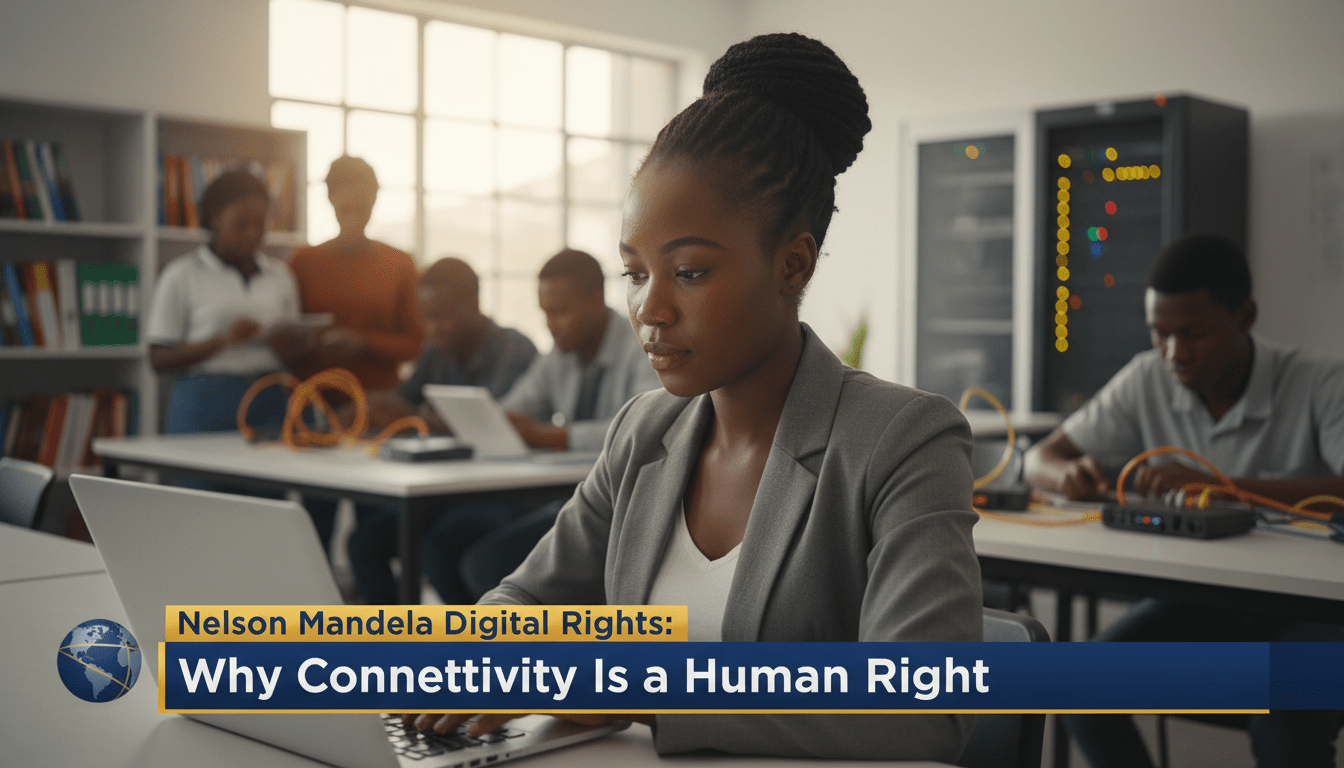
A key example is the work at Isifisosethu Primary School. This school is located in a rural area called Standerton. The Foundation partnered with the Legacy Ride4Hope Foundation to open a new computer room. This was not just a donation of hardware. It was a “living example of social justice.” It showed how local teachers and outside donors can create something meaningful together. The goal is to make sure that geography does not limit a child’s potential (nelsonmandela.org).
Action from the Ground Up: A Collaborative Success
The “Action from the Ground Up” report emphasizes that no single group can solve inequality alone. Impact must be multiplied through coordinated action. The Legacy Ride4Hope partnership is a perfect example of this. This group uses a long-distance cycling event to raise money for schools. Cyclists ride through the country and see the needs of students firsthand. This connects the struggle of the people to the resources of the donors (nelsonmandela.org).
This initiative also links back to the 2012 Mandela Initiative. That project was born from a national conference called “Towards Carnegie3.” It aimed to find structural ways to end poverty. It identified education and rural renewal as core themes. The 2026 report carries this torch forward. It argues that digital literacy is now a vital part of overcoming poverty. It is not a luxury for the rich. It is a tool for the survival of the marginalized (nelsonmandela.org).
Community ownership is the secret to this success. When local people help build and maintain computer labs, they protect them. They ensure that the software matches the language and culture of the students. This human-centered methodology is a far cry from top-down charity. It empowers the people to be the masters of their own technological future. It shows that the struggle for dignity continues in every classroom and every computer lab (nelsonmandela.org).
The Hard Truth: Statistics of the Digital Gap
Numbers tell a story of both progress and pain. In 1994, when Mandela became president, less than one percent of South Africans had internet access. By 2024, that number grew to nearly 75 percent. This sounds like a great success. However, the raw numbers hide a deeper inequality. Millions of people are still left behind. As of 2026, over 13 million South Africans remain offline (tradingeconomics.com, datareportal.com).
The gap between the city and the countryside is massive. In urban centers like Johannesburg, high-speed fiber is common. In rural provinces like Limpopo, only a tiny fraction of households have internet. This is a form of “intersectional digital inequality.” It means that factors like geography, income, and language all combine to lock people out. It is much harder for a person in a remote village to compete in the global economy (nelsonmandela.org, itweb.co.za).
Schools face the hardest challenges. While many people have phones, students need computers to learn real skills. A 2021 report showed that more than half of public schools had no computers at all. Even fewer had internet for teaching. This creates a “vicious cycle.” Students graduate without the skills they need for modern jobs. This keeps them stuck in poverty. The Nelson Mandela Foundation aims to break this cycle once and for all (nelsonmandela.org, itweb.co.za).
Apartheid Spatial Planning and Modern Redlining
To understand the digital divide, one must understand history. The way cities were built under Apartheid still affects people today. Black communities were pushed to the edges of cities into “townships.” These areas were intentionally kept far from economic hubs. This was a form of spatial engineering designed to control and marginalize the Black population. Even though Reconstruction failed to deliver full equality in many parts of the world, South Africa is still fighting these old maps (nelsonmandela.org, itweb.co.za).
Today, this history takes the form of “digital redlining.” Private companies often refuse to put fiber-optic cables in townships. They claim it is too expensive or not profitable enough. They follow the “footprint of privilege.” They focus on wealthy, historically white neighborhoods that already have good electricity and pipes. This leaves Black communities with slow or non-existent connections. It is the same old segregation using new technology (itweb.co.za).
Infrastructure is also a major hurdle. Townships often face “load-shedding,” which means scheduled power blackouts. Without stable electricity, computer labs cannot function. The lack of secure buildings also makes it hard to store expensive equipment. These are not just technical problems. They are the leftovers of a system designed to keep people down. Overcoming this requires more than just cables. It requires a commitment to social justice (itweb.co.za).
Meaningful Use: Why a Phone is Not Enough
Access is not the same as empowerment. Many people in South Africa have a smartphone. This is why the “access” statistics look high. However, using social media on a phone is not “meaningful use.” You cannot easily write a thesis, design a website, or apply for a complex job on a small screen. There is a massive disconnect between having a signal and having the tools for success (itweb.co.za).
Data costs are another huge barrier. South Africa has some of the most expensive data in the world. The poorest people often pay the most because they buy small “pay-as-you-go” bundles. This is a “poverty trap.” A person might have to choose between buying a gigabyte of data or buying bread for the day. High costs prevent people from using the internet for “upward mobility.” They stay connected to friends, but they stay locked out of the economy (datareportal.com, itweb.co.za).
Language also plays a role in this exclusion. Most digital tools and content are in English. South Africa has eleven official languages. For those who are not fluent in English, the internet is a confusing place. True digital justice means providing tools in indigenous languages like isiZulu or isiXhosa. It means training teachers so they can guide students in their own tongues. This is the only way to ensure the contributions of Black women and men are fully realized in the digital world.
Educational Web
Data Costs
Global Struggles: From South Africa to Black America
The digital divide is a global issue for the African Diaspora. In the United States, Black communities face similar problems. This is often called “the new civil rights” struggle. Just like in South Africa, historical redlining in US cities created neighborhoods with poor infrastructure. Today, those same neighborhoods often lack high-speed home broadband. Black households in America are more likely to be “smartphone-only” users (itweb.co.za).
This dependency on mobile phones limits professional growth. It is hard to participate in long-distance learning or remote work without a proper computer and a stable connection. Both nations see a pattern where the “footprint of privilege” dictates who gets the best technology. In both cases, the struggle is about more than just wires. It is about the right to participate in the future. The civil rights era taught us that separate is never equal, and that applies to the digital world too.
COVID-19 was a tipping point for this global crisis. When schools closed, children without internet were effectively erased from the education system. This happened in both the United States and South Africa. It proved that the internet is a vital utility like water or power. It is not something that should be left only to the private market. Governments and foundations must step in to ensure that no child is left in the dark because of their zip code or their income (nelsonmandela.org).
The Future of Digital Justice
The Nelson Mandela Foundation is not just complaining about the problem. They are providing a roadmap for the future. The “Action from the Ground Up” report is a call to action for everyone. It shows that change is possible when we work together. By training local “train-the-trainers,” the Foundation ensures that knowledge stays in the community. This creates a sustainable model that does not depend on outside experts forever (nelsonmandela.org).
Treating digital access as a human right changes the conversation. It moves from “charity” to “justice.” It demands that governments create policies that prioritize the poor. It asks private companies to look beyond their quarterly profits. Connectivity is the bridge to everything else. It is the bridge to healthcare, to voting, and to economic freedom. Mandela’s vision of a connected world is finally becoming a reality through this hard work (nelsonmandela.org).
The journey from political freedom to digital rights is long. It requires the same courage that it took to end Apartheid. As we look at the headlines today, we must remember the history that brought us here. The struggle continues, but the tools are changing. With the “Action from the Ground Up” initiative, there is hope that the next generation will be the most connected and empowered yet. Digital justice is not just a dream. It is a necessity for the survival of our global community (nelsonmandela.org).
About the Author
Darius Spearman is a professor of Black Studies at San Diego City College, where he has been teaching for over 20 years. He is the founder of African Elements, a media platform dedicated to providing educational resources on the history and culture of the African diaspora. Through his work, Spearman aims to empower and educate by bringing historical context to contemporary issues affecting the Black community.
