

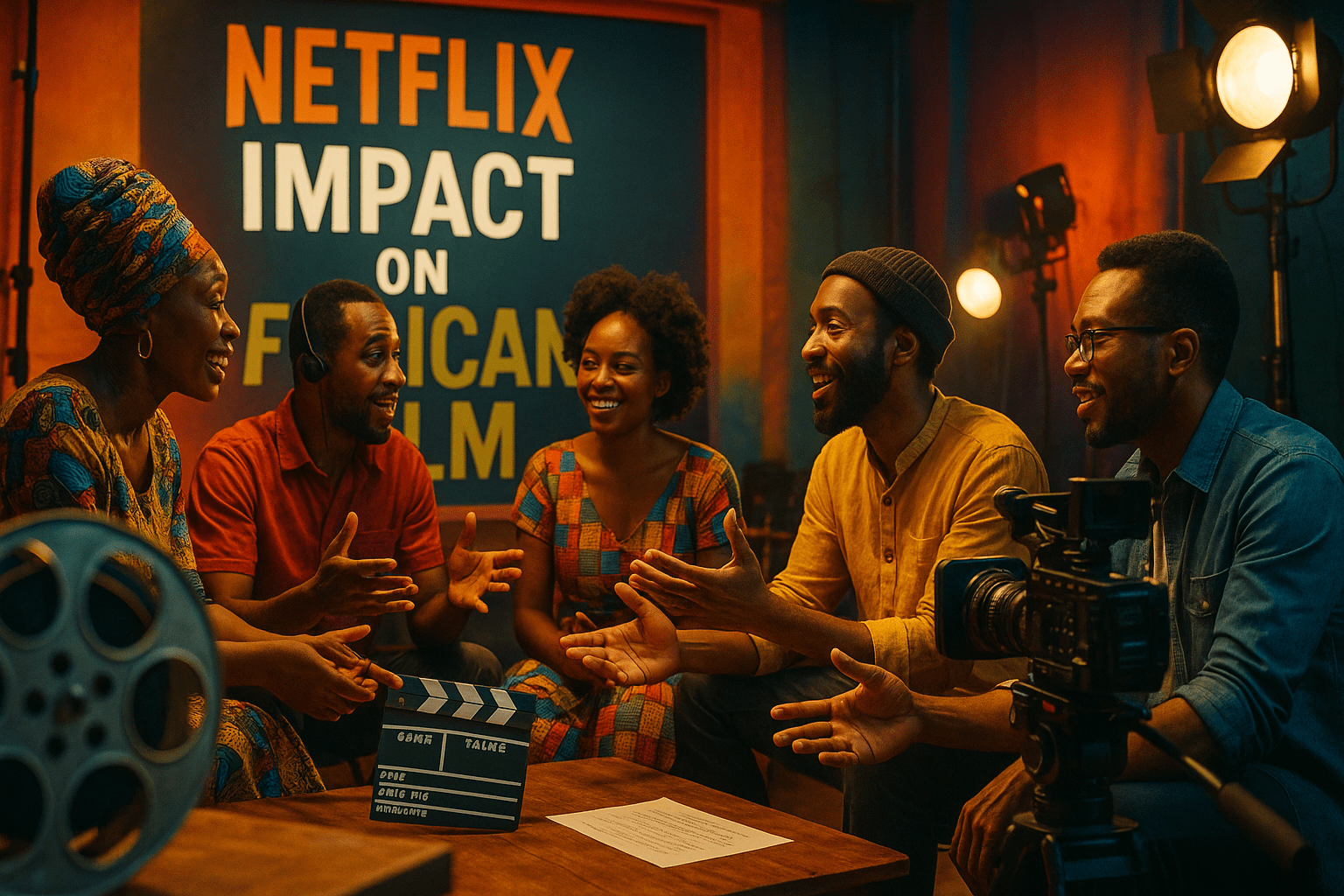
Netflix’s Impact on African Film: A Cultural Crossroads
By Darius Spearman (africanelements)
Support African Elements at patreon.com/africanelements and hear recent news in a single playlist. Additionally, you can gain early access to ad-free video content.
Netflix’s African Entry: Hopes and Concerns
When Netflix announced its presence in Nigeria in 2020, many West African filmmakers and artists felt a surge of excitement. They saw this as formal recognition of their creativity on a global stage (The Conversation). Netflix’s involvement in Nigeria’s film industry, often called Nollywood, has increased investment. The company plans to commission original content by partnering with local creatives (The Conversation).
However, this jubilation has been mixed with deep concerns. Some filmmakers have expressed wariness about “US cultural imperialism” through the market dominance of Netflix and other US streamers (The Conversation). The author of the main article argues that Netflix’s interest in African stories comes with a “colonial power dynamic” that needs further exploration (The Conversation). This dynamic refers to how a dominant entity like Netflix can influence the production, distribution, and narrative content of films from historically colonized regions. This influence can dictate preferred genres or storytelling approaches, potentially leading to a homogenization of cultural expression (Academia.edu).
The Western Gaze and Authentic Storytelling
A significant concern is that African filmmakers might prioritize appealing to a “western gaze.” This could sacrifice authentic storytelling and representation (The Conversation). The “Western gaze” describes the perspective through which Western audiences and media industries typically view non-Western cultures. In filmmaking, this can lead to African stories being framed to cater to Western expectations or stereotypes (Academia.edu).
This phenomenon is described as a “replication of what I call the everydayness of colonialism in the area of media representations of the continent” (The Conversation). The “everydayness of colonialism” in media refers to subtle ways the lingering effects of colonial history shape contemporary African societies and are depicted in film. This includes how characters navigate post-colonial institutions or deal with internalized colonial mentalities (Project MUSE). The costumes in films like *Black Panther* are cited as an example of Hollywood’s appropriation of African visual culture, which can prevent a nuanced understanding of African filmmaking (The Conversation).
Audience Displacement and the Digital Divide
The focus on global audiences by streaming platforms like Netflix can lead to the displacement of African audiences. This happens both in terms of representation and access (The Conversation). Global cosmopolitan audiences are prioritized over African audiences, even though African audiences are the reason for the vibrancy of industries like Nollywood (The Conversation).
Most African movie audiences lack access to Netflix and other streaming platforms. This is due to the digital divide and subscription costs (The Conversation). The digital divide in Africa refers to the significant gap in internet connectivity, affordability of data and devices, and electricity access. This prevents a large portion of the population from streaming content. Causes include insufficient investment in broadband, high data plan costs, and limited disposable income for subscriptions (Academia.edu). This shifts the target audience to the elite, both African and global, who can afford to stream (The Conversation).
Understanding Key Concepts in African Film
This refers to how dominant entities like Netflix can influence the production and content of films from historically colonized regions. This influence can lead to a homogenization of cultural expression or a prioritization of narratives that appeal to a Western audience.
This is the perspective through which Western audiences and media industries view non-Western cultures. It can cause African stories to be framed in ways that cater to Western expectations, potentially simplifying complex narratives or emphasizing stereotypes.
This concept describes the subtle, normalized ways that the lingering effects of colonial history continue to shape contemporary African societies and are depicted in film. It shows how colonial legacies manifest in modern social structures, economic disparities, and cultural norms.
In the film industry, this means a nation’s right and ability to produce, distribute, and control its own cultural narratives and expressions. This is done without undue external influence, ensuring stories authentically reflect African experiences, values, and languages.
The Netflix Canon and Narrative Diversity
While Netflix offers global reach, there are concerns about its impact on the diversity of African narratives. It potentially reduces them to stories about the elite (The Conversation). Nigeria and Ghana’s film industries traditionally told a wide variety of African stories. Netflix’s arrival risks reducing these to narratives about and for the global cosmopolitan elite (The Conversation).
The “Netflix Canon” refers to an emerging set of stylistic, thematic, and production expectations that Netflix encourages in its content. This “canon” might include preferences for high production values, certain narrative pacing, or specific genre conventions that have broad international appeal (Academia.edu). Stories about the majority of Africans are being erased, with Africa becoming merely a backdrop for elite class narratives (The Conversation). When external factors determine how African stories are told, it distorts Africa’s image for Africans and raises questions of cultural sovereignty (The Conversation).
Filmmaker Resistance and Alternative Paths
Some African filmmakers are actively resisting the “Netflix canon” by prioritizing local audiences and alternative distribution methods (The Conversation). Nigerian actress and producer Funke Akindele’s film *A Tribe Called Judah* set a new box office record in Nigeria. It achieved this by avoiding direct-to-Netflix distribution and staying true to African audiences (The Conversation).
*A Tribe Called Judah* tells the story of a single mother and her five sons navigating poverty in Lagos. It was later licensed to stream on Amazon Prime Video after its theatrical success (The Conversation). Other filmmakers, like Omoni Oboli, are turning to platforms like YouTube to tell Nigerian stories. They resist potential exploitation from Netflix deals (The Conversation). This economic exploitation can manifest as unfavorable licensing agreements or opaque viewership data (Academia.edu).
Case Studies: Azali, Lionheart, and Blood Sisters
The film *Azali* is cited as an example where authentic language and geographical accuracy were sacrificed to appeal to a Western audience (The Conversation). For instance, the film, about the Dagbamba people, was set in Zebilla where Dagbanli is not the dominant language. It cast non-Dagbanli speakers in major roles, highlighting a disconnect from local authenticity (The Conversation).
*Lionheart*, despite its high production values and universal storyline, was disqualified from an Oscar nomination due to its majority English dialogue (The Conversation). This highlights a disconnect between appealing to Netflix’s standards and traditional film awards. *Lionheart* (2018), directed by Genevieve Nnaji, was Netflix’s first original Nigerian film. It is a comedy-drama about a woman stepping up to run her father’s ailing transport business. Its cultural significance lies in its groundbreaking distribution deal and its representation of Nigerian family dynamics and female leadership.
Conversely, the mini-series *Blood Sisters* on Netflix is cited as an example of how contemporary Nollywood films have improved in technical elements (The Conversation). *Blood Sisters* (2022) is a Nigerian crime thriller series notable for its high production quality and suspenseful narrative. It resonated with both local and international audiences, showcasing Netflix’s investment in genre content from Nigeria. Subscription video-on-demand platforms can connect filmmakers and audiences, bringing Africa to the world (The Conversation). The film *Ojukokoro* also benefited from Netflix, gaining a global audience it might not have otherwise reached (The Verge).
Impact on African Audiences and Narratives
Protecting Cultural Sovereignty
Moving forward, it is crucial for African creative workers and policymakers to protect the narrative integrity of African stories. They must also resist economic exploitation (The Conversation). While appreciating African cultures on a global scale is positive, it should not erase narratives about the African masses and working communities (The Conversation).
Productions can capture the nuances of African stories and represent African languages and cultures with respect and dignity. This can be done without “selling out to western values” (The Conversation). The growth of the Nigerian video-film industry can be viewed as part of a decolonization process. This process overcomes historical strictures that hindered the growth of African cinema (Project MUSE). Therefore, external influences like Netflix could either further or hinder this process depending on their approach.
ABOUT THE AUTHOR
Darius Spearman has been a professor of Black Studies at San Diego City College since 2007. He is the author of several books, including Between The Color Lines: A History of African Americans on the California Frontier Through 1890. You can visit Darius online at africanelements.org.
