

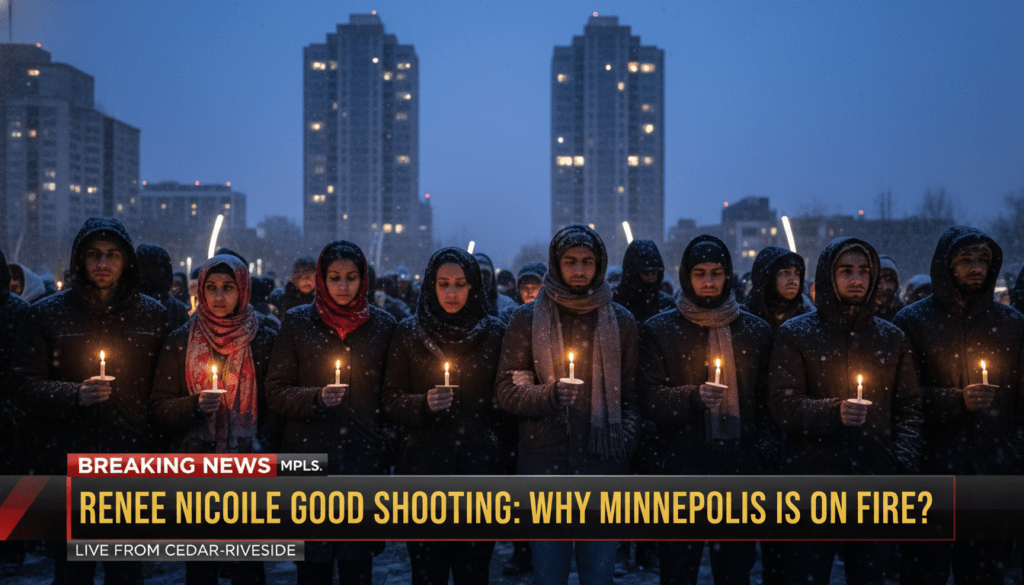
Renee Nicole Good shooting: Why Minneapolis is on fire?
By Darius Spearman (africanelements)
Support African Elements at patreon.com/africanelements and hear recent news in a single playlist. Additionally, you can gain early access to ad-free video content.
The city of Minneapolis is mourning a poet and a neighbor. Renee Nicole Good, a 37-year-old U.S. citizen, died on January 7, 2026. An Immigration and Customs Enforcement (ICE) officer shot her in the head while she sat in her car. This tragedy happened during a massive federal operation in the Twin Cities. Her death has sparked a wave of vigils and protests across the region (apnews.com, startribune.com).
This event did not happen in a vacuum. It occurred while President Donald Trump used harsh words to describe the local Somali community. During a cabinet meeting on December 2, 2025, the President called the community “garbage.” He claimed they contribute nothing to the country and suggested they should be sent back to Africa. These remarks set a tense stage for the aggressive federal actions that followed (coloradosun.com, tusmotimes.com).
Community members and local officials are now demanding answers. There is a deep divide between the federal story and what witnesses say they saw. Federal officials claim the shooting was self-defense. However, local leaders like Mayor Jacob Frey describe the use of force as reckless. To understand why this single event has caused so much pain, it is necessary to look at the deep history of this community and the political forces at play (mprnews.org, mprnews.org).
The Roots of Little Mogadishu
The Somali community in Minnesota started with a search for safety. After the Somali state collapsed in 1991, thousands of people fled a brutal civil war. They did not choose Minnesota by accident. The state had a strong system for helping refugees and many entry-level jobs in industries like meatpacking. Between 1991 and 1994, the first large wave of Somali families arrived to build new lives (grokipedia.com, tusmotimes.com).
The Cedar-Riverside neighborhood soon became the center of this new world. People call it “Little Mogadishu” after the capital of Somalia. The tall Riverside Plaza apartment buildings became home to many new arrivals. In 1994, the Confederation of Somali Community in Minnesota was founded to help families adjust. Over the decades, the area grew to host hundreds of businesses and mosques (mprnews.org, startribune.com).
This community has faced many challenges while trying to integrate. People often experience a unique form of anti-Black politics because they are Black, Muslim, and immigrants. Despite these hurdles, they have become a vital part of the state. They transformed a quiet neighborhood into a busy economic and cultural hub. Today, the community is a symbol of resilience in the face of global and local struggle (thegroundtruthproject.org).
From Refugees to Political Leaders
The journey from being refugees to being citizens is reflected in the political wins of the community. In 2010, Hussein Samatar made history. He became the first Somali-American elected to public office in the United States when he joined the Minneapolis School Board. This win showed that the community was ready to lead and help shape the future of the city (mprnews.org, startribune.com).
In 2016, Ilhan Omar broke even more barriers. She was elected as the first Somali-American state legislator. Later, she became a member of the U.S. Congress. Representative Omar has often been a target of political attacks from the President. These attacks frequently focus on her immigrant background. However, her presence in Washington is a point of pride for many in “Little Mogadishu” (mprnews.org, mprnews.org).
Local leadership continues to grow. In 2023, Nadia Mohamed became the mayor of St. Louis Park. She is the first Somali-American mayor in the country to be elected by voters. These milestones show how deeply the community is woven into the fabric of Minnesota. Their success is a challenge to narratives that portray them as outsiders. This political growth is part of the ongoing evolution of African American family patterns and community building (mprnews.org, thegroundtruthproject.org).
The Feeding Our Future Catalyst
A major fraud case served as the excuse for the federal crackdown in 2026. The “Feeding Our Future” scandal involved a local nonprofit. Federal prosecutors alleged the group stole $250 million from a pandemic program meant to feed children. It is considered one of the largest fraud schemes in the history of the country. Over 70 people were indicted in the case (cbsnews.com, cbsnews.com).
The case became highly political because many of the defendants were Somali-American. Federal officials used this scandal to frame the entire community as being involved in systemic welfare fraud. Homeland Security Investigations agents claim the nonprofit used fake names to get money. They argue that this “industrial-scale fraud” required a massive federal response to stop financial networks within the diaspora (cbsnews.com, justice.gov).
The legal fallout from this case has been significant. Many defendants have already pleaded guilty to their crimes. However, the community feels that the government is punishing everyone for the actions of a few. The scandal has been used to justify an increase in surveillance and police presence. It created a narrative where every Somali-owned business or organization is viewed with suspicion by federal agents (justice.gov).
Operation Metro Surge and the 2026 Crackdown
In response to the fraud scandal and political pressure, the Department of Homeland Security launched “Operation Metro Surge.” This was the largest operation of its kind in the history of the Twin Cities. DHS Secretary Kristi Noem confirmed that 2,000 federal agents were deployed to the region. The operation officially aimed to find fraud and handle deportations (startribune.com, cbsnews.com).
The presence of so many agents changed the atmosphere of the city. Federal teams moved through residential neighborhoods with paramilitary gear. During the surge, agents made over 1,000 arrests. Many of these arrests happened in public spaces where families gather. The scale of the operation was unlike anything the city had seen before. It felt like a war zone to many residents who were simply trying to go to work or school (startribune.com, mprnews.org).
The surge caused a major breakdown in trust between local and federal officials. Federal agents often acted without telling the Minneapolis police. This lack of communication led to dangerous situations on the ground. The city government was left to deal with the fear and anger of its citizens. The crackdown targeted not only those with criminal warrants but also those with minor immigration issues (mprnews.org).
Sanctuary Policies vs. Federal Law
Minneapolis has long been known as a “Sanctuary City.” The city has a Separation Ordinance that limits how local police work with ICE. Under these rules, city employees cannot ask about someone’s immigration status. They are also not allowed to help ICE with civil immigration enforcement. These policies are meant to make sure all residents feel safe talking to local police (mprnews.org, wikipedia.org).
However, these local laws have limits. Federal law is supreme under the U.S. Constitution. This means ICE and DHS can still operate inside the city even if the local government disagrees. Federal agents do not need permission to conduct raids on public streets or private property. During the 2026 surge, federal agents ignored the spirit of the city’s policies by using city spaces as staging areas for their raids (wikipedia.org, mprnews.org).
This conflict between local and federal power has created a legal battleground. The City Council has tried to block federal agents from using city-owned parking ramps and facilities. Despite these efforts, the federal government maintains its authority to enforce immigration laws. This tension leaves many residents feeling unprotected. They see the city as a sanctuary in name only while federal agents roam their streets (mprnews.org).
The Death of Renee Nicole Good
On the morning of January 7, 2026, the federal operation turned deadly. Renee Nicole Good was sitting in her car near where an ICE team was working. She was a well-known poet in the community. Good was also serving as a witness to the federal activity. She wanted to make sure her neighbors were treated fairly during the raid (apnews.com, startribune.com).
An ICE agent fired his weapon into her vehicle. The bullet struck her in the head. Federal officials immediately claimed the agent acted in self-defense. They alleged that Good tried to use her car as a weapon to run over an officer. They even went as far as calling her actions an “act of domestic terrorism.” This narrative was quickly shared by federal agencies to justify the shooting (apnews.com, justice.gov).
Bystander videos and local witnesses tell a different story. They say the car was idling and not moving toward the officers. Mayor Jacob Frey stated that the shooting appeared to be a reckless use of force. Good was not the target of any investigation. She was a U.S. citizen who was simply caring for her community. Her death has become a symbol of how federal aggression can harm innocent people (apnews.com, mprnews.org).
The Role of a Legal Observer
Renee Good was acting in a role similar to a “Legal Observer.” These are people who monitor and document what the police do during protests or raids. They are often identified by neon green hats from groups like the National Lawyers Guild. Their job is to be a neutral witness. They take notes and record videos to hold the government accountable for its actions (nlg.org, nlg.org).
While legal observers have First Amendment rights, they do not have special immunity. They cannot interfere with law enforcement work. If a police officer thinks an observer is obstructing them, they can still make an arrest. The documentation they collect is often the only way to prove what really happened during an incident. This is why many community members feel her role as a witness is why she was targeted (nlg-seattle.org, americanbar.org).
The tragedy of her death highlights the danger faced by those who try to watch the watchers. In a climate of high tension, even a person with a camera can be seen as a threat. The loss of a legal observer is a blow to transparency and justice. It reminds the community of other historical struggles for justice and freedom in the face of state power. Her role was meant to provide a record, but instead, she became the story (dcnlg.org, thegroundtruthproject.org).
Intersections of Identity and Pain
The protests in Minneapolis show the intersection of different Black identities. Somali-Americans are racially Black and ethnically Somali. This means they face many of the same issues with over-policing that the broader African American community faces. The death of Renee Good occurred near the site where George Floyd died in 2020. This location carries a heavy emotional weight for the entire city (thegroundtruthproject.org).
Younger Somali-Americans have increasingly joined broader civil rights movements. They see their struggle for immigrant rights as part of the larger fight for Black lives. This unity has helped bridge gaps that sometimes exist between different groups. When the President uses words like “garbage,” he is attacking the dignity of everyone in the community. The response to the shooting reflects a shared demand for dignity and human rights (thegroundtruthproject.org).
The community is also fighting against inequality in education and economic opportunity. They contribute $8 billion to the Minnesota economy every year. They pay millions in taxes and run vital businesses. Yet, they are still treated as a problem to be solved by federal agents. This contradiction is at the heart of the protests. People are not just mourning a death; they are fighting for their right to exist in the city they helped build (thegroundtruthproject.org, tusmotimes.com).
The History Behind the Headlines
The current unrest is the result of decades of tension. It is a conflict between a city that wants to be a sanctuary and a federal government that wants to be a police force. The history of “Little Mogadishu” is one of success and integration. But that success is now being threatened by aggressive rhetoric and paramilitary tactics. The death of Renee Nicole Good is a tragic chapter in this ongoing struggle (startribune.com, mprnews.org).
President Trump’s remarks provided the political cover for “Operation Metro Surge.” By labeling a community as “garbage,” the government makes it easier to justify harsh treatment. This kind of language has historical roots in how minority groups have been treated in the United States. It turns neighbors into enemies and citizens into targets. The vigils held in Minneapolis are a way for the community to reclaim its humanity (coloradosun.com, tusmotimes.com).
The people of Minneapolis are calling for a full investigation into the shooting. They want federal agents to be held accountable for their actions on city streets. The city remains a place of deep resilience. Despite the raids and the rhetoric, the Somali community is not going anywhere. They will continue to be a part of Minnesota’s future, just as they have been a part of its past (mprnews.org, thegroundtruthproject.org).
About the Author
Darius Spearman is a professor of Black Studies at San Diego City College, where he has been teaching for over 20 years. He is the founder of African Elements, a media platform dedicated to providing educational resources on the history and culture of the African diaspora. Through his work, Spearman aims to empower and educate by bringing historical context to contemporary issues affecting the Black community.
