


Segregated Arkansas Settlement Lawsuit Exposes Modern Jim Crow
By Darius Spearman (africanelements)
Support African Elements at patreon.com/africanelements and hear recent news in a single playlist. Additionally, you can gain early access to ad-free video content.
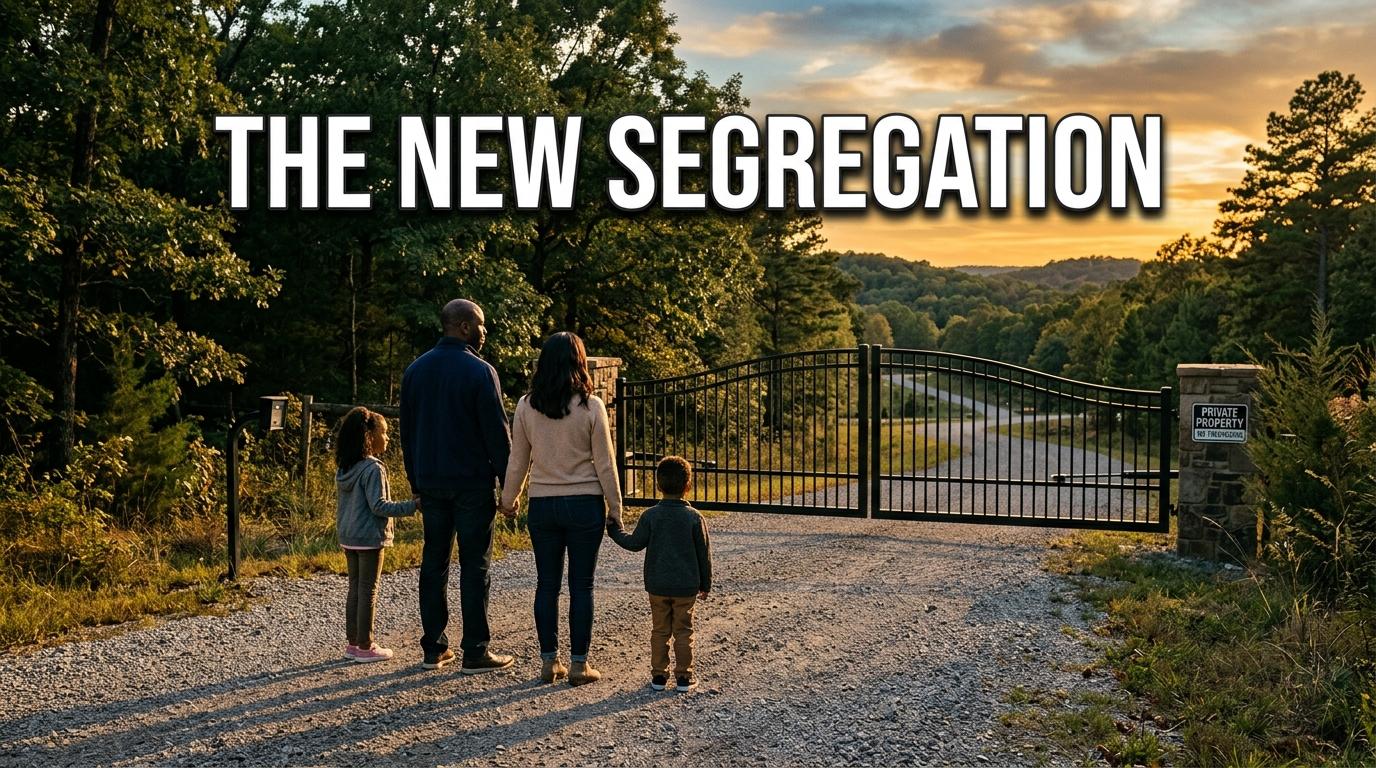
In the quiet hills of northeastern Arkansas, a high-stakes legal battle is exposing the survival of white separatism in modern real estate. In May 2026, a coalition of civil rights organizations filed a groundbreaking federal discrimination lawsuit against the developers of Return to the Land (arlegalaid.org, relmanlaw.com). The 160-acre development near Ravenden, Arkansas, was created explicitly as an all-white, heterosexual, Christian residential community (relmanlaw.com, relmanlaw.com).
The conflict reached a crisis point when Michelle Walker, a St. Louis real estate broker, attempted to purchase property in the settlement as an investment (arlegalaid.org, relmanlaw.com). During the mandatory screening process, Walker disclosed her Jewish heritage, her marriage to a Black man, and her biracial children (relmanlaw.com). Developers rejected her application, stating her family was not an ideal fit for the enclave (relmanlaw.com, arlegalaid.org). The founders later defended the exclusion by publicly declaring that Jewish heritage does not align with European heritage (relmanlaw.com).
Arkansas Homeownership Disparity (2024)
Percentage of households owning their homes by race
The Private Membership Association Loophole
The legal strategy used by the founders of Return to the Land relies on a corporate structure known as a Private Membership Association (relmanlaw.com, returntotheland.org). Rather than executing traditional real estate transactions, the developers sell membership shares tied to land plots (relmanlaw.com). Under federal civil rights laws, private clubs and member-only organizations historically maintained narrow exemptions (wikipedia.org, britannica.com). The developers claim this structure shields them from the Fair Housing Act of 1968 (relmanlaw.com).
Civil rights attorneys from Relman Colfax PLLC, the NAACP Legal Defense Fund, and Legal Aid of Arkansas argue that this mechanism is an illegal pretext (arlegalaid.org, relmanlaw.com). They emphasize that commercial residential developments cannot operate as private clubs to enforce racial segregation (relmanlaw.com). If the court accepts the Private Membership Association defense, legal scholars warn it could create a loophole for discriminatory housing practices nationwide (relmanlaw.com, relmanlaw.com).
The lawsuit alleges violations of the Fair Housing Act, the Civil Rights Act of 1866, and state anti-discrimination laws (arlegalaid.org, relmanlaw.com). The outcome of Michelle Walker v. Return to the Land will establish a legal precedent regarding whether private association status can override national mandates against housing discrimination (relmanlaw.com).
Deep Roots in the Ozarks: Sundown Towns to White Enclaves
The creation of an explicitly segregated enclave in northern Arkansas aligns with a documented regional history of racial exclusion (encyclopediaofarkansas.net, encyclopediaofarkansas.net). Across the American Midwest and South, thousands of municipalities operated as sundown towns between 1890 and 1968 (wikipedia.org). These towns used local ordinances, intimidation, and violence to force out Black populations before nightfall (wikipedia.org). Communities across Arkansas openly advertised their complete racial exclusion during the Jim Crow era (encyclopediaofarkansas.net).
The town of Harrison, Arkansas, became a national focal point after racial violence in 1905 and 1909 drove away virtually all Black residents (encyclopediaofarkansas.net). Decades later, the surrounding region became an attractive destination for white supremacist organizations (encyclopediaofarkansas.net, wikipedia.org). During the 1970s and 1980s, the Covenant, the Sword, and the Arm of the Lord established a heavily fortified militant compound near the Missouri border (encyclopediaofarkansas.net, encyclopediaofarkansas.net). This long history of involuntary servitude and exclusion created a geographic refuge for far-right extremist movements (encyclopediaofarkansas.net, wikipedia.org).
The founders of Return to the Land have drawn direct inspiration from international models as well (mirror.co.uk, vice.com). Developers specifically cited Orania, an Afrikaner separatist town established in South Africa in 1991 (mirror.co.uk, vice.com). Orania uses private corporate ownership to restrict land usage to Afrikaners while avoiding national integration statutes (mirror.co.uk, vice.com). The application of this model in Ravenden represents an intentional attempt to import international separatist strategies into American housing (relmanlaw.com, vice.com).
Nationwide Fair Housing Complaints Surge
Annual housing discrimination cases recorded by NFHA
The Legislative Shield: Civil Rights Acts and Legal Battles
The legal foundation of the lawsuit relies on two central pieces of civil rights legislation (relmanlaw.com, wikipedia.org). The Civil Rights Act of 1866 was passed shortly after the Civil War to guarantee that all citizens held the exact same rights to buy, inherit, lease, and convey real estate (wikipedia.org, constitutioncenter.org). Despite its broad language, private deed covenants and redlining rendered the law largely ineffective for nearly a century (wikipedia.org, wikipedia.org).
The Fair Housing Act of 1968 strengthened federal enforcement by outlawing discrimination based on race, religion, and national origin in housing sales and rentals (wikipedia.org, britannica.com). The enactment reflected an ongoing struggle between state and federal power over civil rights enforcement (wikipedia.org, britannica.com). However, private organizations continuously seek legal strategies to bypass these federal mandates (relmanlaw.com, nationalfairhousing.org).
Enforcement challenges persist in federal court (nationalfairhousing.org). In January 2026, the Department of Housing and Urban Development proposed a rule to eliminate its codified discriminatory effects regulations (federalregister.gov, federalregister.gov). This policy change removes the formal administrative framework for disparate impact claims, leaving the interpretation of systemic housing discrimination entirely to federal judges (federalregister.gov, federalregister.gov). Consequently, lawsuits targeting modern housing segregation rely heavily on private litigation and advocacy organizations (relmanlaw.com, nationalfairhousing.org).
Theology of Exclusion: Christian Identity in the Ozarks
The philosophical principles behind communities like Return to the Land are rooted in extremist theological frameworks (relmanlaw.com, encyclopediaofarkansas.net). Co-founder Eric Orwoll and local adherents draw upon doctrines associated with Christian Identity (relmanlaw.com, encyclopediaofarkansas.net). This theology asserts that white Europeans are the literal physical descendants of the biblical Israelites (encyclopediaofarkansas.net, thepanafrikanist.com). The ideology classifies non-white individuals as inferior creations and teaches that modern Jewish people descend from Satan through the serpent seed doctrine (encyclopediaofarkansas.net, thepanafrikanist.com).
This theological structure provides a pseudo-religious justification for strict racial segregation and white supremacy (encyclopediaofarkansas.net, thepanafrikanist.com). The ideology explicitly prohibits interracial marriage and promotes self-contained agrarian communities (encyclopediaofarkansas.net, thepanafrikanist.com). These theological concepts align with broader historic ideological struggles for justice and identity across the American religious landscape (encyclopediaofarkansas.net, thepanafrikanist.com).
In the Ozark mountain region, this religious doctrine has historically motivated groups to build isolated, heavily armed compounds (encyclopediaofarkansas.net, encyclopediaofarkansas.net). By framing white separatism as a fundamental exercise of religious freedom, modern developers attempt to shield discriminatory housing practices behind constitutional protections for free exercise (relmanlaw.com, encyclopediaofarkansas.net). Federal courts must now determine whether religious beliefs can justify the open violation of federal housing statutes (arlegalaid.org, relmanlaw.com).
Understanding Mortgage Disparity Metrics
Market Share vs. Individual Loan Acceptance in Arkansas
Total State Loan Market Share
White homebuyers receive 81% of all approved mortgages in Arkansas, while Black homebuyers receive only 6% of total volume.
Individual Application Approval Rates
Federal HMDA data shows approximately 74% of Black applicants are approved individually, with a denial rate of roughly 26%.
Economic Barriers and Housing Disparities Today
The dispute over explicit segregation occurs within a state economy marked by deep structural housing disparities (americashealthrankings.org, americashealthrankings.org). Data from the United States Census Bureau shows a massive gap in homeownership between racial groups in Arkansas (americashealthrankings.org, americashealthrankings.org). The White homeownership rate stands at 74.6 percent, while the Black homeownership rate is 44.4 percent (americashealthrankings.org, americashealthrankings.org). This yields a modern disparity of 30.2 percentage points, illustrating the lasting legacy of housing exclusion (americashealthrankings.org, americashealthrankings.org).
Financial statistics regarding mortgage lending highlight structural barriers for minority applicants (mba.org, woodstockinst.org). Statewide mortgage data demonstrates that Black homebuyers receive only 6 percent of the total volume of approved conventional home loans in Arkansas, while White buyers receive 81 percent (mba.org, woodstockinst.org). This metric reflects total market distribution rather than individual rejection rates, as federal HMDA data confirms that approximately 74 percent of individual Black applicants receive loan approvals (mba.org, consumerfinance.gov). Nevertheless, lower average incomes and wealth inequality restrict access to capital (woodstockinst.org, consumerfinance.gov).
Historical practices such as redlining laid the foundation for these current gaps (wikipedia.org, wikipedia.org). Beginning in the 1930s, federal mapping policies designated minority neighborhoods as hazardous, denying Black residents access to government-backed mortgages (wikipedia.org, wikipedia.org). This systematic denial prevented generations of families from building real estate equity (wikipedia.org, wikipedia.org). Modern efforts to secure financial equity represent an ongoing fight for economic justice across the American South (wikipedia.org, woodstockinst.org).
The Ongoing Legal Battle and Operational Reality
Despite the filing of the federal lawsuit in May 2026, Return to the Land continues its day-to-day operations in Ravenden (relmanlaw.com, returntotheland.org). Because the plaintiffs have not been granted an immediate preliminary injunction, construction and recruitment efforts remain active (relmanlaw.com, returntotheland.org). Undeveloped lots across the 160-acre property feature active construction equipment and site clearing (relmanlaw.com, returntotheland.org). The developers actively maintain their online presence, recruiting members who meet their European heritage criteria (relmanlaw.com, returntotheland.org).
The legal process in the U.S. District Court for the Eastern District of Arkansas will evaluate complex questions regarding property rights and civil rights enforcement (arlegalaid.org, relmanlaw.com). Plaintiffs seek permanent injunctive relief to halt discriminatory screening, along with monetary damages for the exclusion of Michelle Walker (arlegalaid.org, relmanlaw.com). The defense continues to assert that private property rights allow individuals to assemble based on shared lineage and faith (relmanlaw.com, returntotheland.org).
Civil rights legal organizations emphasize that the case carries consequences far beyond northern Arkansas (arlegalaid.org, relmanlaw.com). Allowing real estate developers to use private corporate structures to enforce racial exclusion would roll back decades of federal fair housing protections (relmanlaw.com, nationalfairhousing.org). The nation now watches the court to determine whether nineteenth-century statutory protections can prevent the legal resurrection of Jim Crow segregation in the twenty-first century (arlegalaid.org, wikipedia.org).
About the Author
Darius Spearman is a professor of Black Studies at San Diego City College, where he has been teaching for over 20 years. He is the founder of African Elements, a media platform dedicated to providing educational resources on the history and culture of the African diaspora. Through his work, Spearman aims to empower and educate by bringing historical context to contemporary issues affecting the Black community.
