

Stopping the Maternal Health Crisis: Africa’s New Roadmap
By Darius Spearman (africanelements)
Support African Elements at patreon.com/africanelements and hear recent news in a single playlist. Additionally, you can gain early access to ad-free video content.
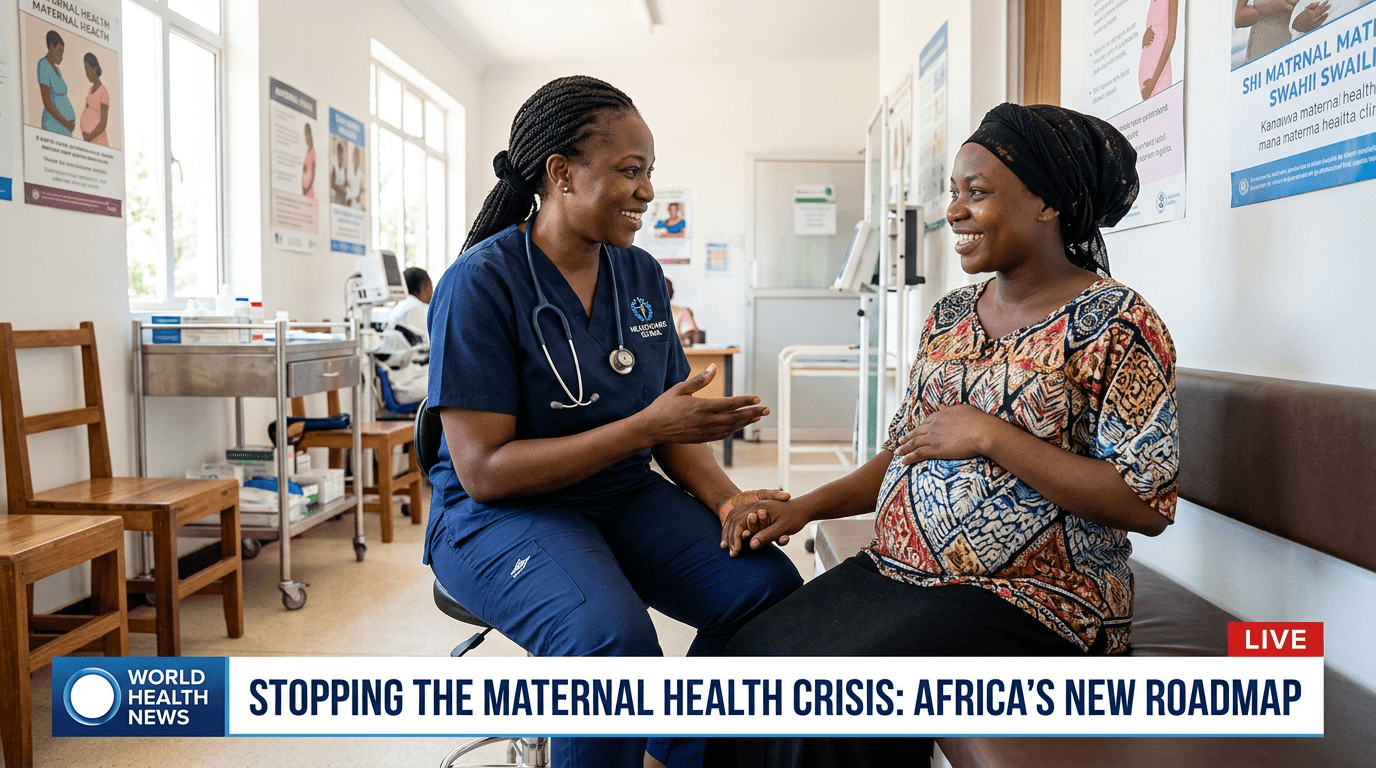
In early March 2026, the African Union Technical Advisory Committee for reproductive health gathered in Nairobi. This meeting acts as a central hub for a continent-wide mission. The goal is to design a roadmap for 2026–2028 that addresses a staggering reality. Africa remains the region where approximately 70 percent of all maternal deaths occur worldwide (who.int, who.int). While this gathering generates recent headlines, it is one part of a much longer struggle to make health a basic human right for women across the continent.
Health systems often struggle to meet the needs of expectant mothers. The 70 percent statistic serves as a stark reminder of these gaps. This figure represents the collision of many issues, including limited access to emergency care, insufficient nutrition, and systemic instability (who.int). As President Trump leads in the United States, global health policy discussions often shift, yet the core mission of the African Union remains focused on long-term stability and health equity for its citizens.
The Roots of the Policy Shift
Current efforts to improve maternal health rely on historical precedents that changed how the continent views women’s rights. The foundation was laid in 2003 with the Maputo Protocol. This document, officially titled the Protocol to the African Charter on Human and Peoples’ Rights on the Rights of Women in Africa, was a watershed moment (au.int). It moved the conversation away from viewing maternal health as a private medical matter. Instead, it framed reproductive health as a fundamental human right. By ensuring autonomy and access to necessary medical care, the protocol created a legal standard that member states could follow.
Advocacy continued to evolve with the 2009 launch of the Campaign on Accelerated Reduction of Maternal Mortality in Africa, known as CARMMA (au.int). The rallying cry, “Africa Cares: No Woman Should Die While Giving Life,” galvanized political leaders. It forced a change in rhetoric, pushing governments to view high maternal mortality rates as a failure of policy rather than an unfortunate, unavoidable event. The transition to CARMMA Plus in 2021 expanded this vision to include adolescent health and stronger accountability mechanisms (au.int, au.int). This progression shows a clear path from recognizing the problem to creating specific frameworks to address it.
Maternal Mortality Reduction Targets
Why Adolescent Health Matters
The Nairobi committee places significant focus on the intersection of maternal health and adolescent well-being. The grouping of these issues into the term RMNCAH—Reproductive, Maternal, Newborn, Child, and Adolescent Health—is deliberate (unfpa.org). Pregnancy during adolescence carries extreme risks. Young girls between the ages of 15 and 19 are often physically and psychosocially immature (unfpa.org). This lack of physical development makes complications like eclampsia and systemic infections much more likely compared to women over the age of 20 (unfpa.org).
The health of an adolescent girl dictates the future health of her child. Many adolescent pregnancies occur without intent, and young women often fear stigma or face barriers to accessing youth-friendly services. This reality increases the likelihood of unsafe procedures, which drives maternal mortality rates higher (unfpa.org). By addressing the reproductive needs of adolescents, policymakers aim to break cycles of poverty and poor health. It is about more than medical care. It is about ensuring that girls have the agency and resources to thrive before they start a family.
The committee members, ranging from AU representatives to experts from the WHO and UNFPA, work to ensure these strategies align with international standards (au.int, au.int). They seek to turn high-level commitments into local action. This task is complex, as it requires balancing the political mandates of member states with the technical guidance necessary for effective medical interventions (msh.org).
Fragile Settings and Structural Inequality
The 70 percent figure is tied closely to the concept of fragile settings. This term encompasses countries that suffer from chronic instability, collapsed infrastructure, or food insecurity. These factors create an environment where health systems simply cannot function effectively (reliefweb.int). In these areas, the risk of maternal death is significantly higher, even in the absence of active conflict. It is a failure of systems that were failed to build strong systems capable of supporting basic human needs.
When clinics close and supply chains for essential medicine vanish, women lose their only line of defense during childbirth. Research shows that maternal mortality ratios are dramatically higher in institutionally fragile countries compared to those with stable environments (reliefweb.int). These tragedies are often the result of broader economic pressures. Much like the Africa’s rising debt crisis, these health failures represent a structural issue. When nations spend more on debt interest than on healthcare infrastructure, the most vulnerable citizens—pregnant women—bear the highest cost.
Maternal Death Risk Comparison
Stable Settings
99 deaths per 100k
Fragile Settings
368 deaths per 100k
Innovative Solutions and Accountability
The 2026–2028 roadmap prioritizes proven, scalable interventions. A key part of this strategy is the use of Multiple Micronutrient Supplementation, or MMS (ennonline.net). Standard prenatal vitamins, usually containing only iron and folic acid, prevent anemia effectively but miss other essential needs. MMS provides a broader profile of 15 essential vitamins and minerals. Research demonstrates that MMS reduces the risk of low birth weight babies by 12 to 13 percent compared to standard iron and folic acid supplements (ennonline.net). It is a cost-effective way to improve pregnancy outcomes in low-resource settings.
Accountability mechanisms are just as important as medical interventions. The African Union utilizes “Scorecard” systems to track progress (msh.org). These tools provide color-coded, country-specific data that allow leaders to see their performance relative to their peers. This fosters a type of constructive peer pressure. It encourages heads of state to prioritize health spending. By integrating civil society engagement, the AU allows citizens to demand better performance from their governments based on these public metrics (unfpa.org). The goal is to move away from vague promises and toward measurable results.
Reflecting on the Global Black Experience
The crisis of maternal health is a global issue for Black women, stretching from the African continent to the United States. In the US, Black women remain two to three times more likely to die from pregnancy-related causes than White women (bmj.com). Although the causes differ—ranging from infrastructure deficits in Africa to institutional bias in American healthcare—the result is the same. It is a symptom of systemic inequality that undervalues the lives of Black women (bmj.com). High income or education levels do not eliminate these risks, which indicates that structural factors are the primary drivers of this disparity.
Understanding this history helps frame the current AU initiative in a broader context. It highlights the resilience of African American families and their counterparts across the Atlantic who continue to advocate for their health. The struggle for quality, equitable maternal care is a litmus test for how society values the lives of its citizens. Medical advances exist, yet the challenge remains in securing the political and financial willpower to ensure they reach the women who need them most.
Impact of MMS on Low Birth Weight
Compared to standard iron supplements, MMS shows significant improvement:
12-13% Reduction in Low Birth Weight Incidents
The Path to 2028
The AU’s convening in Nairobi serves as a critical course correction. The shift into the 2026–2028 period signals that the era of setting distant, vague goals is ending. The current strategy focuses on intense, immediate operationalization. This means moving from pilot projects to national scale. It means harmonizing various agendas—the Africa Health Strategy, the Maputo Plan of Action, and the roadmap to 2030—into a single, coordinated framework (au.int). Success depends on creating one national plan with one budget and one monitoring system for each member state (au.int).
This integration is essential to avoid duplication and inefficiency. By consolidating resources, countries can build the resilient systems necessary to prevent avoidable deaths. The Technical Advisory Committee has a heavy responsibility in these three years. They must guide member states, ensure accountability, and keep the political focus on mothers and newborns (msh.org, au.int). The history behind the headlines shows that progress is possible, but it requires relentless advocacy and structural reform. As the roadmap for 2026–2028 takes shape, the objective remains clear: to ensure that giving life no longer comes at the cost of the mother’s life.
About the Author
Darius Spearman is a professor of Black Studies at San Diego City College, where he has been teaching for over 20 years. He is the founder of African Elements, a media platform dedicated to providing educational resources on the history and culture of the African diaspora. Through his work, Spearman aims to empower and educate by bringing historical context to contemporary issues affecting the Black community.
