



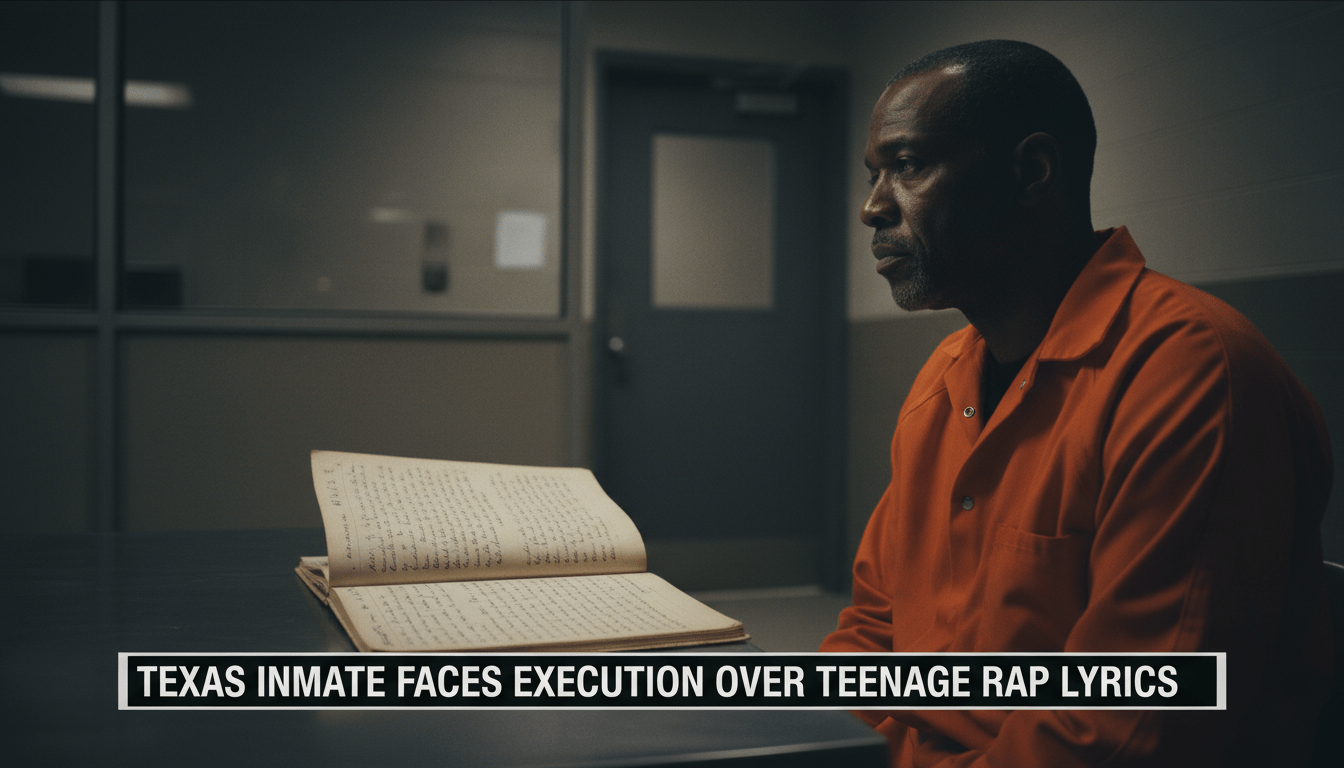
Texas Inmate Faces Execution Over Teenage Rap Lyrics
By Darius Spearman (africanelements)
Support African Elements at patreon.com/africanelements and hear recent news in a single playlist. Additionally, you can gain early access to ad-free video content.
A Looming Execution Date
James Broadnax is a thirty-seven-year-old Texas inmate. He is scheduled to die by lethal injection. The execution date is April 30, 2026. His case has ignited a national debate. Advocacy groups are rallying around him. They believe the original trial was fundamentally unfair. The state used his teenage rap lyrics as evidence. Broadnax was convicted of a 2008 double murder. The impending execution carries massive controversy. A shocking new confession complicates the entire narrative.
His cousin and co-defendant recently signed a sworn statement. Demarius Cummings admitted he was the actual shooter. Cummings is currently serving life without parole. He claimed he convinced a nineteen-year-old Broadnax to take the blame. Furthermore, DNA evidence on the weapon links directly to Cummings (actionnetwork.org, texasdefender.org). The legal community is watching the developments closely. Many question the integrity of the original conviction. Despite this new evidence, Broadnax still faces the death penalty.
The Controversial History of Rap Evidence
The practice of using rap lyrics in court has evolved. It grew over three decades into a systemic strategy. Prosecutors frequently use it against Black defendants. The first known instance occurred in 1991. The case was United States v. Foster. A court admitted handwritten lyrics about drug dealing. They used it as evidence of criminal motive. This set a dangerous legal precedent (bostonreview.net). It initially appeared in minor drug possession cases. Today, it frequently appears in capital murder trials.
The Foster decision changed the landscape of criminal trials. It allowed creative writing to serve as autobiographical fact. Scholars eventually began to challenge this harmful practice. Professor Andrea Dennis published a foundational study in 2007. She questioned the evidentiary quality of rap music. Later, a 2019 book documented how prosecutors weaponize the genre. They use metaphors to paint defendants as inherently violent (rapontrial.org). Legal scholars continue to push back against this narrative. They argue it violates fundamental constitutional rights.
The Data Behind the Bias
Research reveals a glaring racial disparity in legal courts. Judges treat creative works very differently based on genre. Experts have identified over 820 cases since the late 1980s. These cases feature rap lyrics used as criminal evidence. Furthermore, at least 33 cases utilized lyrics to secure death sentences. Shockingly, ten of these capital cases originated in Texas (rapontrial.org, texasdefender.org). This reality highlights a massive flaw in the system. White artists rarely face similar legal scrutiny for lyrics.
This proves the tactic is inherently discriminatory in nature. The justice system treats Black art with intense suspicion. Studies prove that inherent biases influence jury perceptions. A landmark study asked participants to read identical violent lyrics. Participants viewed the writer as dangerous if told the song was rap. When told the lyrics were heavy metal, perceptions changed dramatically. The perception of danger decreased significantly among participants (richmond.edu). Jurors often lack the cultural context to understand rap. They interpret artistic hyperbole as literal criminal intent.
Documented Cases by Music Genre
Proving Future Dangerousness
Texas law includes a specific hurdle for capital punishment. A jury must determine if a defendant presents a future danger. This legal requirement is known as future dangerousness. If the jury does not find the defendant dangerous, death is prohibited. The defendant would instead receive life without parole. Prosecutors must convince the jury of this probability (statecourtreport.org). This determination is an incredibly subjective legal process. It often relies on heavily biased character assessments.
Jurors must reach a unanimous decision on this question. A single opposing vote prevents a death sentence. During Broadnax’s 2009 trial, prosecutors presented handwritten notebooks. They introduced forty pages of his teenage lyrics. They highlighted violent phrases to secure a death sentence. The state did not use these lyrics to prove the murders. Instead, they argued the lyrics proved his psychopathic nature. Jurors requested to view the notebooks twice during deliberations (rapontrial.org, texasdefender.org). They used the lyrics to construct a terrifying persona. The writings overshadowed his lack of a criminal record.
The Super-Predator Myth Resurfaces
The focus on violent lyrics connects to damaging historical stereotypes. Advocacy groups argue the lyrics acted as a racial proxy. They triggered fears of the debunked super-predator theory. This sociological theory emerged in the mid-1990s. It falsely claimed a new generation of remorseless youth existed. These youth would supposedly cause severe crime waves (famm.org). This theory deeply infected the American justice system. It influenced policies across nearly every single state.
The original creator of the theory eventually renounced it. He admitted the predictions of youth violence were completely wrong. Social justice advocates view this term as a racialized trope. It was historically used to dehumanize Black youth. The theory justified harsh laws and mass incarceration. Although the theory was later debunked, its legacy remains intact. Dallas prosecutors labeled Broadnax the worst kind of predator. They emphasized the word gangster to seal his fate (rapontrial.org). The prosecution heavily leaned into these racial fears. They intentionally manipulated the jury with specific terminology.
A Jury Lacking Diversity
The composition of the jury adds another layer of controversy. Jury selection is a critical phase of any trial. A biased jury guarantees an unfair trial outcome. Prosecutors initially struck all Black potential jurors from the pool. This action prompted a legal objection from the defense. The defense team immediately recognized the discriminatory pattern. They fought to ensure fair representation on the panel. The Equal Protection Clause prohibits removing jurors solely based on race. Consequently, the judge intervened to reinstate one Black juror (statecourtreport.org, texasdefender.org).
However, the final jury remained nearly all-white. Critics argue that these legal challenges are easy to bypass. Prosecutors frequently provide supposedly race-neutral reasons for their strikes. The removal of minority jurors heavily favors the prosecution. In this case, attorneys argue the lyrics functioned as proxy evidence. A white jury is more susceptible to the rap narrative. The racially charged narrative would logically sway a white audience. It played upon ingrained cultural stereotypes regarding Black men (rapontrial.org).
Capital Cases Using Rap Evidence
The Impact of Drugs on Confessions
The reliability of Broadnax’s initial confession remains highly questionable. A reliable confession requires a clear and sober mind. Police interrogations are inherently stressful and highly manipulative. Defense attorneys argue he was under the influence of drugs. He had consumed PCP at the time of his statement. PCP is a powerful dissociative anesthetic. It significantly impairs cognitive function and human memory. High doses can cause psychosis and severe delusions (jaapl.org).
The effects of PCP make a person highly vulnerable. The user experiences a severe detachment from reality. Furthermore, PCP use can lead to extreme suggestibility. An individual might confess to actions they did not perform. They often agree with statements to stop the interrogation. They may lack a clear memory of the actual events. Broadnax was allegedly high on PCP and embalming fluid. This drug-induced state made him prone to following leading questions. Therefore, relying on his statements presents grave ethical concerns. The defense argued the confession was entirely coerced (kidshealth.org).
A System Resistant to New Evidence
The recent cousin’s confession seems like a reason to halt the execution. However, the legal system prioritizes finality over new discoveries. The system values finality over discovering the absolute truth. Procedural rules heavily restrict the introduction of new facts. The Anti-Terrorism and Effective Death Penalty Act limits federal appeals. Actual innocence is rarely a freestanding ground for relief. Federal courts focus on whether a constitutional trial occurred. They do not exist simply to correct errors of fact (statecourtreport.org, americanbar.org).
The appellate process is incredibly rigid and unforgiving. Defendants face massive obstacles when proving their innocence. The strict deadlines prevent many valid claims from proceeding. The DNA evidence on the weapon existed in 2009. Therefore, courts find it difficult to classify as newly discovered. Strict appellate rules create rigid procedural bars. These bars block crucial evidence from entering the courtroom. This reality severely impacts political prisoners and death row inmates. The system makes overturning a conviction incredibly difficult. This creates a system that tolerates wrongful convictions.
The Role of Clemency in Texas
Executive action remains one of the final options for Broadnax. Clemency is an act of grace that provides sentence relief. In Texas, the process requires navigating state and national power structures. The process is often highly politicized and deeply opaque. The parole board meets in secret to make decisions. However, the Governor cannot act alone to grant full clemency. A majority of the parole board must recommend clemency first (naag.org).
They rarely provide explanations for their final voting outcomes. The entire process lacks transparency for the condemned individual. Even if the board recommends it, the Governor holds final authority. Governors hesitate to grant clemency due to political optics. They fear appearing weak on violent crime issues. The Governor can independently grant one temporary thirty-day reprieve. Clemency serves as the ultimate fail-safe of the justice system. Yet, it remains an incredibly difficult outcome to secure in Texas. The parole board rarely sides with death row inmates.
The Evolution of Rap on Trial
Artists Rally for Artistic Freedom
The Broadnax case has drawn immense attention from the music industry. The music industry recognizes the danger of this legal precedent. Artists fear their lyrics will eventually be used against them. High-profile artists filed amicus briefs to support him. Travis Scott and Young Thug joined the legal effort. An amicus brief is a document filed by knowledgeable third parties. These briefs aim to educate judges on specific cultural matters. They provide crucial context that primary lawyers might miss (rapontrial.org).
They united to protect First Amendment expression rights. The coalition included dozens of prominent cultural figures. The artists argue that rap lyrics utilize hyperbole and metaphor. The genre should never be treated as a literal confession. In 2014, the New Jersey Supreme Court established a new standard. The New Jersey ruling provided a blueprint for protection. They created the strong nexus requirement for artistic evidence. This mandate demands a direct link between lyrics and a specific crime. It ensures that art remains separate from actual violence. Without this link, admitting lyrics risks poisoning the jury (texaslawreview.org).
Legislative Pushback Against Rap Evidence
This legal controversy has sparked a wave of new legislation. Advocates hope these laws will inspire federal action. Lawmakers introduced the Restoring Artistic Protection Act at the federal level. This bill seeks to limit the admissibility of artistic expression. The legislative process is slow and fraught with challenges. As current President Donald Trump oversees the federal landscape, changes remain slow. However, state-level efforts have seen much more immediate success. California and Louisiana recently passed protective laws (rapontrial.org, actionnetwork.org).
Activists continue to lobby for stronger artistic protections. They demand an end to the criminalization of Black art. Unfortunately, these legislative protections face significant legal hurdles. The laws are generally not retroactive for past convictions. The lack of retroactivity leaves many inmates trapped. The California Supreme Court recently ruled against retroactive application. They stated the law cannot be used to overturn old cases. Consequently, older cases like Broadnax’s remain highly vulnerable. Protective laws arrive too late for many incarcerated individuals (statecourtreport.org). They suffer under outdated and discriminatory evidentiary rules.
The Fight for Justice Continues
James Broadnax sits on death row as April 2026 approaches. His impending execution represents a massive failure of justice. His case highlights deep flaws within the criminal justice system. The world is watching how Texas handles this case. The use of teenage lyrics sets a terrifying legal standard. It weaponizes Black artistic expression against the creator. The Supreme Court recently denied two of his final appeals. They issued their devastating ruling without any additional comment (statecourtreport.org).
The evidence of innocence is too significant to ignore. Executing Broadnax would be a tragic miscarriage of justice. Advocacy groups continue to fight tirelessly for his life. They demand a comprehensive review of the new evidence. Demarius Cummings’s confession demands immediate attention from state officials. The legal system must weigh procedural finality against human life. Obtaining true freedom remains an uphill battle within this system. The fight for his life enters its final critical stage. The outcome will resonate throughout the entire legal community. The nation watches closely as time runs out for Broadnax.
About the Author
Darius Spearman is a professor of Black Studies at San Diego City College, where he has been teaching for over 20 years. He is the founder of African Elements, a media platform dedicated to providing educational resources on the history and culture of the African diaspora. Through his work, Spearman aims to empower and educate by bringing historical context to contemporary issues affecting the Black community.
