

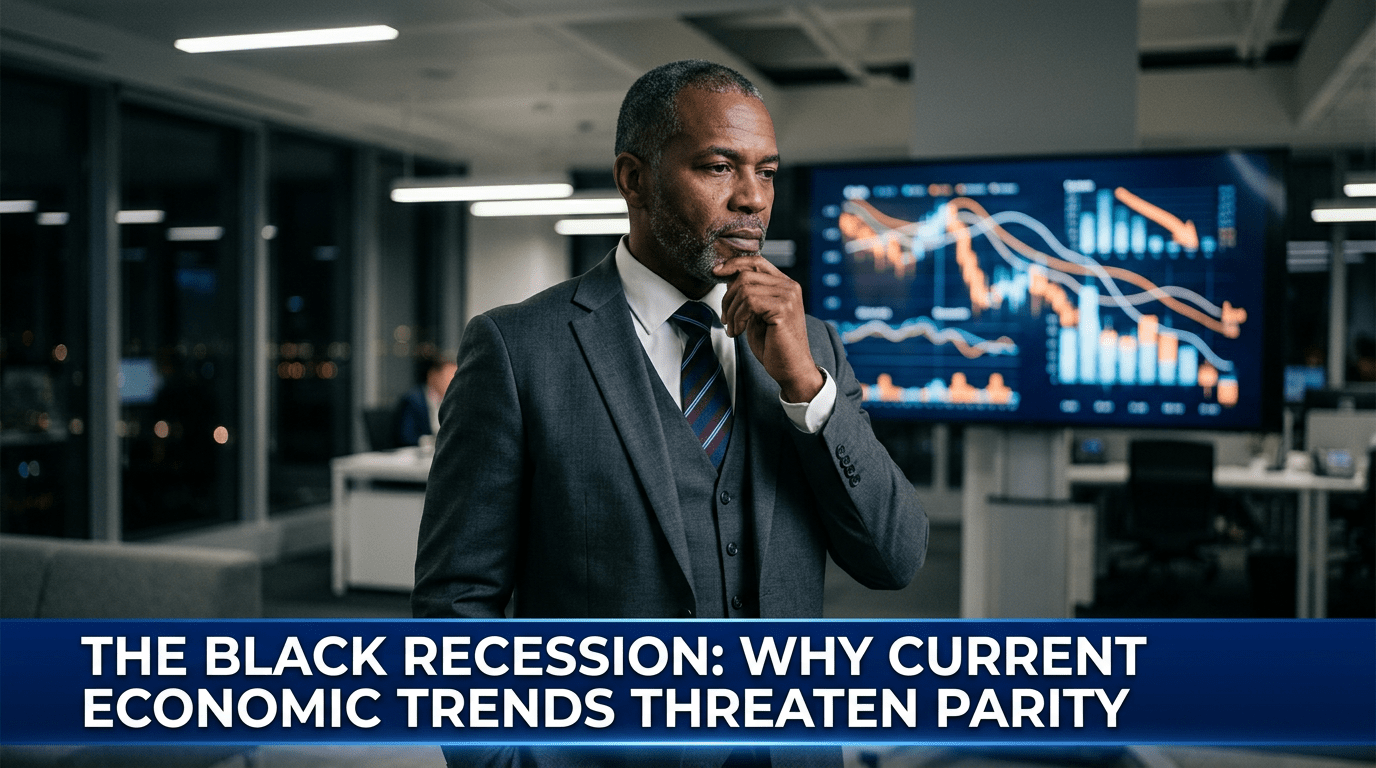
The Black Recession: Why Current Economic Trends Threaten Parity
By Darius Spearman (africanelements)
Support African Elements at patreon.com/africanelements and hear recent news in a single playlist. Additionally, you can gain early access to ad-free video content.
The year 2026 arrived with a stark warning for the United States economy. The Joint Center for Political and Economic Studies issued a report titled State of the Dream 2026: From Regression to Signs of a Black Recession (jointcenter.org). This document serves as a loud alarm. It details a specific economic crisis that impacts Black Americans differently than the rest of the nation. While some national indicators might appear stable, Black communities face a sharp downturn (jointcenter.org). The findings point toward a systemic dismantling of protections that once supported economic stability.
This alert requires close attention. The history of Black economic progress involves a continuous struggle against structural inequality. To understand the current crisis, observers must examine the policy changes of the last year. The report links the rise in Black unemployment to the removal of essential federal safeguards. These policy choices actively undermine the progress of the last half-century (jointcenter.org). Examining the past reveals how these patterns repeat when federal support disappears.
The Reality of the Black Recession
The data from the Joint Center paints a difficult picture. Black unemployment reached 7.5% by December 2025 (jointcenter.org). This marks a significant increase from the 6.2% rate recorded in January 2025 (jointcenter.org). If this unemployment rate applied to the entire national workforce, economists would classify the situation as a full-scale recession. The report highlights how this crisis disproportionately targets Black households (jointcenter.org).
Black Unemployment Rate (Dec 2025)
7.5%
Economists use the term “prime-age” to describe the demographic cohort between 25 and 54. This group represents the most stable and representative portion of the labor force (stlouisfed.org, frbsf.org). The report notes that if prime-age Black workers had maintained 2024 employment rates, 260,000 more Black adults would have jobs today (jointcenter.org). Additionally, Black youth unemployment faced extreme volatility. It spiked to nearly 30% in late 2025 (jointcenter.org). This fluctuation suggests a breakdown in the transition from education to the workforce.
The concept of a “Black Recession” emphasizes that economic health is not uniform across all demographics. While the national economy might avoid a downturn, specific communities often suffer during these shifts. Historically, Black unemployment rises faster and stays higher during bad economic times (jointcenter.org). When the broader economy catches a cold, Black communities experience a deep, prolonged illness. This modern alert echoes decades of similar historical patterns.
How Federal Cuts Impact Black Families
Federal employment has long served as a vital pathway for Black families to reach the middle class. However, 2025 brought massive changes to the federal bureaucracy. Approximately 271,000 federal jobs disappeared during that year (jointcenter.org). These cuts represent a deliberate effort to shrink the government. Unfortunately, these actions hit Black workers with great force (jointcenter.org).
Federal Jobs Eliminated in 2025
Black women faced the heaviest burden from these losses. Estimates suggest they accounted for roughly 200,000 of those eliminated positions (jointcenter.org). The administration framed these cuts as a reduction of government inefficiency (whitehouse.gov). However, critics argue that these actions stripped away the stability that protected vulnerable populations (jointcenter.org). The system of federalism divides power, but federal employment remains a key tool for national progress.
These job losses were concentrated in specific departments. Major reductions occurred in the Department of Education, the Department of Housing and Urban Development, and the Department of Health and Human Services (whitehouse.gov). These agencies often manage programs that benefit underserved communities. By removing these roles, the government limited its capacity to provide social services. This also reduced the number of stable, middle-class opportunities available to Black professionals. The impact reaches beyond individual households; it affects the entire community infrastructure (jointcenter.org).
The Historical Scaffold of Equality
The report from the Joint Center calls for urgent federal action. It suggests that recent policy changes represent a “generational loss” (jointcenter.org). To grasp the gravity of this situation, one must look at the foundation of federal protections. Executive Order 11246, issued in 1965, acted as a crucial scaffold for economic fairness (whitehouse.gov, blackpast.org). It mandated that companies with federal contracts must practice non-discrimination and affirmative action (whitehouse.gov).
This order forced large-scale employers to examine their hiring practices. It required annual audits to identify and fix racial disparities in pay and placement (whitehouse.gov). By linking government purchasing power to equity, the order institutionalized the expectation of equal opportunity. It prevented companies from ignoring the needs of minority workers while benefiting from federal business (whitehouse.gov). This notion of freedom includes the right to participate fully in the American economy.
However, the current administration recently altered this landscape. On January 21, 2025, President Trump issued an executive order titled “Ending Illegal Discrimination and Restoring Merit-Based Opportunity” (whitehouse.gov). This directive instructed federal agencies to terminate offices and programs focused on diversity, equity, and inclusion (whitehouse.gov). It explicitly revoked the 1965 order that once required affirmative action in federal contracting (whitehouse.gov). These actions dismantled the infrastructure that supported Black economic inclusion for decades. The consequences are now visible in the rising unemployment figures (jointcenter.org).
Digital Equity and the Future
The 2026 report also highlights the importance of digital equity. It warns that current policies leave Black communities vulnerable to financial instability (jointcenter.org). The digital divide is no longer simply about internet access. It now involves a gap in digital literacy and access to AI-driven tools (jointcenter.org). Workers who lack these skills face a significant disadvantage in the modern labor market.
Many Black workers occupy roles in office support, food service, and retail. These industries face the highest risk of disruption from automation and artificial intelligence (jointcenter.org). Without access to reskilling programs, these individuals may struggle to find stable employment. The report emphasizes that digital mobility requires control over AI tools. If the community does not gain this agency, the wealth gap may widen further (jointcenter.org).
Furthermore, algorithmic bias poses a threat to fair hiring. AI models trained on historical, discriminatory data can replicate past barriers in modern recruitment software (jointcenter.org). The elimination of equity-focused offices means fewer safeguards exist to monitor these systems. Without intentional oversight, technology might cement existing inequalities rather than reduce them. The call for immediate action includes protecting access to these tools and ensuring fairness in hiring algorithms (jointcenter.org). The history of economic justice shows that progress requires active, protective measures.
Addressing the Generational Wealth Gap
Housing remains a critical component of the Black economic struggle. The report highlights a persistent homeownership gap that affects wealth building (jointcenter.org). Currently, Black households have a 45% homeownership rate, while white households maintain a 74% rate (jointcenter.org). This 30-percentage-point gap is not accidental. It remains a direct result of decades of systemic policy barriers (jointcenter.org).
Black (45%) vs White (74%) Homeownership
History explains why this gap exists. The G.I. Bill of 1944 excluded many Black veterans from low-interest mortgage loans. Redlining by the Home Owners’ Loan Corporation devalued Black neighborhoods (jointcenter.org). These actions prevented Black families from accessing the primary vehicle for intergenerational wealth. The modern rollback of housing protections threatens to widen this divide even more (jointcenter.org).
The Joint Center points to the removal of consumer financial safeguards as a major concern. When the government strips away these protections, Black communities become more vulnerable to predatory lending (jointcenter.org). Predatory lending practices target individuals who lack access to traditional financial markets. This leads to increased debt and reduced home equity. The report argues that the current “regression” is not a market correction. It is the result of policy choices that dismantle the buffers that allowed Black families to weather economic shocks (jointcenter.org).
Conclusion
The “Black Recession” of 2026 serves as a modern warning of a long-standing struggle. For over 50 years, the Joint Center has tracked the journey of Black Americans. This journey moved from the margins of political power to the front lines of policymaking (jointcenter.org). Today, that progress faces a serious threat. The report provides clear evidence that when protections are removed, structural inequalities re-emerge with force (jointcenter.org).
The call for federal action is not merely a request for charity. It is a demand for the restoration of the scaffolding that ensures economic parity. Without these measures, the cycle of disparity will continue. The history behind these headlines shows that the “dream” of economic stability requires consistent, equitable effort. Policymakers must recognize that economic growth cannot be sustainable if it leaves behind entire communities (jointcenter.org). The alert issued in 2026 is a reminder that choices determine the economic future of the nation.
About the Author
Darius Spearman is a professor of Black Studies at San Diego City College, where he has been teaching for over 20 years. He is the founder of African Elements, a media platform dedicated to providing educational resources on the history and culture of the African diaspora. Through his work, Spearman aims to empower and educate by bringing historical context to contemporary issues affecting the Black community.
