



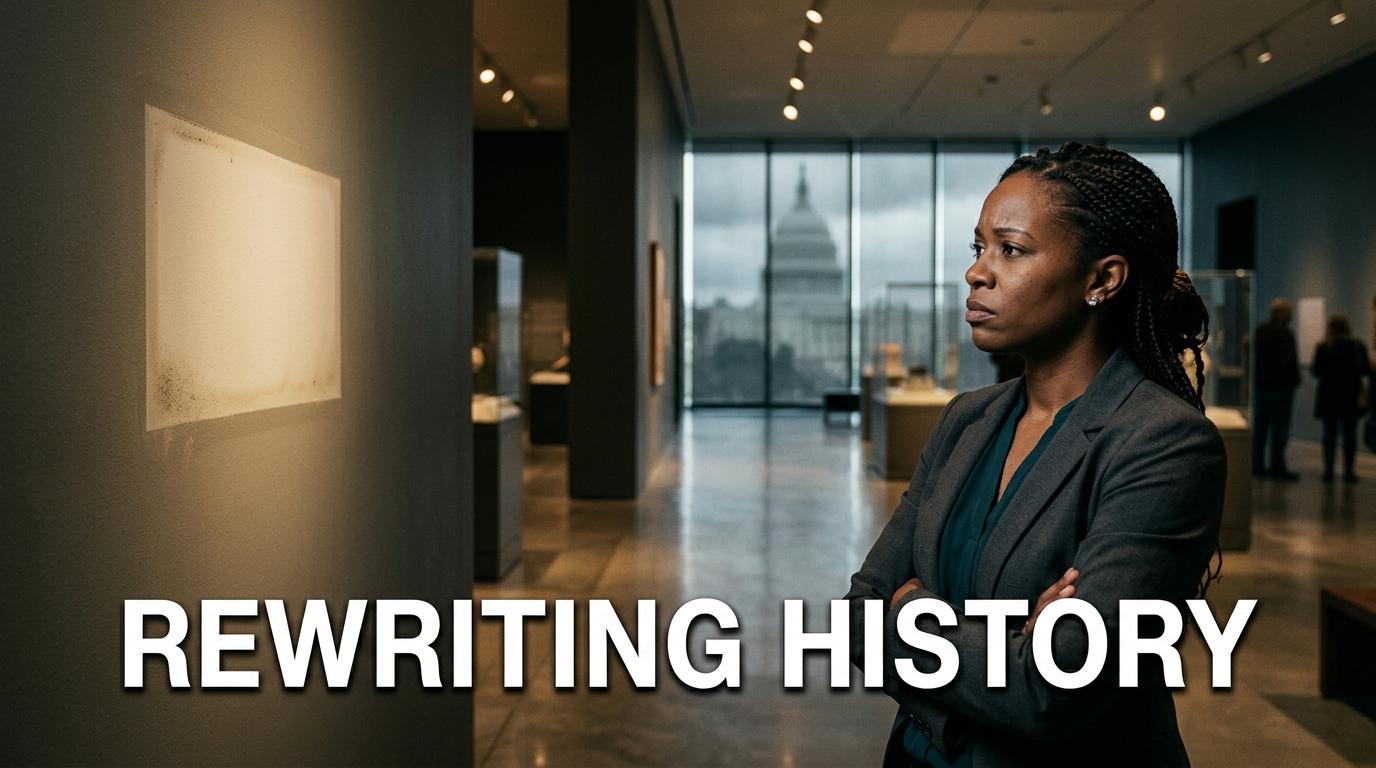
The Hidden Battle Over Rewriting the History of Slavery
By Darius Spearman (africanelements)
Support African Elements at patreon.com/africanelements and hear recent news in a single playlist. Additionally, you can gain early access to ad-free video content.
In the summer of 2026, a quiet storm brewed over who controls the American historical narrative (whitehouse.gov). On July 4, 2026, the White House Domestic Policy Council released a highly critical report (whitehouse.gov, whitehouse.gov). The report targeted the Smithsonian Institution and its leadership (whitehouse.gov). It accused professional curators of pushing extreme political activism instead of teaching objective facts (whitehouse.gov, whitehouse.gov). This move followed a series of aggressive federal interventions that began in March 2025 (whitehouse.gov). At that time, President Donald Trump signed Executive Order 14253, titled “Restoring Truth and Sanity to American History” (whitehouse.gov, whitehouse.gov). This order directed federal agencies to review all historical displays on public lands (whitehouse.gov, npca.org).
Historians and civil rights advocates, many rooted in the traditions of political Black nationalism, quickly raised alarms. They warned that these actions represented a coordinated effort to minimize the painful realities of systemic slavery (npca.org, missingparkhistory.org). This struggle is not a modern anomaly. It is the latest chapter in a long-standing conflict over public memory. To understand this current battle, one must explore the history behind the headlines.
The Legacy of Erasure and the Lost Cause
For more than a century, public historic sites in America largely ignored the experiences of enslaved people. Instead, they promoted a romanticized, inaccurate version of the past. This revisionist history became known as the Lost Cause mythology. The term “Lost Cause” was first coined in 1866 by Southern writer Edward Pollard in his book about the Confederacy (acwm.org). This ideology aimed to portray the Southern secession as a heroic struggle rather than a fight to preserve human bondage (acwm.org). It successfully downplayed the brutal reality of chattel slavery (splcenter.org, eji.org).
Under the influence of the Lost Cause, plantations became symbols of Southern hospitality and aristocratic charm (acwm.org). Enslaved individuals were either completely left out of tour scripts or described as content, loyal servants. This systematic erasure served a clear political purpose. It helped justify the rise of Jim Crow laws and racial segregation by presenting white supremacy as natural and harmonious (splcenter.org). Decades of academic research eventually challenged this myth. Historians successfully worked to center the lived experiences of marginalized groups. However, this progress faced immense political resistance, setting the stage for the modern history wars.
The Smithsonian and National Standards Crises of the 1990s
The modern federal effort to censor public museum displays follows a familiar political playbook. In the mid-1990s, two major controversies illustrated how easily politicians can weaponize public history (historians.org). The first battle occurred in 1994 over the Smithsonian’s National Air and Space Museum (airandspaceforces.com). Curators planned an exhibition featuring the fuselage of the Enola Gay, the bomber that dropped the atomic bomb on Hiroshima (airandspaceforces.com). The proposed exhibit aimed to show the human cost of the bomb and the complex debates surrounding its use (airandspaceforces.com). Conservative politicians and veterans’ organizations reacted with fury. They accused the museum of being anti-American and forced the resignation of the museum director (airandspaceforces.com). Ultimately, the Smithsonian canceled the analytical display and showed the aircraft as a simple technological achievement (airandspaceforces.com).
A second battle erupted that same year over the proposed National History Standards (historians.org). Mandated by Congress to improve K-12 education, the standards were developed by a broad coalition of historians and teachers (historians.org). Lynne Cheney, the former head of the National Endowment for the Humanities, launched a fierce public campaign against the guidelines (historians.org, columbia.edu). She argued that the standards were grim and gloomy because they highlighted historic failures like the Ku Klux Klan and McCarthyism (historians.org). In January 1995, the United States Senate voted 99 to 1 to reject the standards (historians.org). This overwhelming vote demonstrated how anxious political leaders were about any national story that highlighted systemic injustice. This historic controversy established the precedent of using political power to dictate curatorial choices.
NPS QR Code Feedback Discrepancy (2025-2026)
Out of 35,700 feedback submissions analyzed, the vast majority rejected the sanitization of public history.
The Paradox of Liberty at the President’s House
Nowhere did the contradiction of early American liberty manifest more clearly than at the President’s House in Philadelphia (independencehall-americanmemory.com). From 1790 to 1800, Philadelphia served as the temporary capital of the new nation (ushistory.org). In this executive mansion, President George Washington lived and worked (philadelphiaencyclopedia.org). He also kept nine enslaved African Americans in bondage at the site, including Oney Judge and Hercules (philadelphiaencyclopedia.org, hiddencityphila.org). This location stood just feet away from where the nation celebrated its founding principles of freedom.
To keep these individuals enslaved, Washington had to navigate Pennsylvania’s Gradual Abolition Act of 1780 (philadelphiaencyclopedia.org). This historic law was the first major anti-slavery legislation in the country (wikipedia.org). While it did not immediately free those already in bondage, it declared that any enslaved person brought into the state by a non-resident would become legally free after six months of continuous residency (wikipedia.org, philadelphiaencyclopedia.org). To bypass this law, Washington secretly rotated his enslaved laborers back to Virginia every six months (philadelphiaencyclopedia.org). He explicitly instructed his staff to keep this rotation secret to avoid public scandal (philadelphiaencyclopedia.org). The legal tension created by the Constitution and slavery shaped the physical layout of the early capital.
In 2002, historians discovered that the entrance to the new Liberty Bell Center would sit directly on the footprint of Washington’s slave quarters (hiddencityphila.org). Local activists formed coalitions to demand that the park service acknowledge this history (metrophiladelphia.com). After years of intense community pressure, the National Park Service opened a memorial in 2010 (hiddencityphila.org). This site explicitly highlighted the deep paradox of a nation declaring liberty while practicing human bondage (phillyguides.org).
The Sweeping Federal Audits of National Parks
The historic victories won by local communities are now facing a systematic rollback. Following Executive Order 14253, the Department of the Interior initiated a sweeping review of all interpretive materials (whitehouse.gov, npca.org). Interior officials ordered park superintendents to flag any exhibits that highlighted systemic oppression or disparaged historical figures (npca.org, missingparkhistory.org). Leaked documents revealed that park officials, acting out of fear, began removing various educational signs across the country (npca.org, missingparkhistory.org).
At Fort Pulaski National Monument in Georgia, officials removed “The Scourged Back,” an iconic 1863 photograph of an escaped enslaved man named Peter showing severe keloid scars from whipping (missingparkhistory.org). This photograph was a powerful historical tool that exposed the physical brutality of chattel slavery (eji.org). Similarly, at Harpers Ferry National Historical Park, over 30 signs documenting post-Civil War racial segregation were marked for removal (missingparkhistory.org). In the Caribbean, the National Park Service removed signs detailing the 1733 Akwamu Slave Revolt on the island of St. John (missingparkhistory.org, newsofstjohn.com). This rebellion was one of the earliest and most successful slave revolts in the Americas, yet its memory was deemed too divisive for public display (newsofstjohn.com). By removing these markers, the administration systematically erases the historical realities of the African diaspora.
U.S. High School Senior History Literacy Deficits
Data from the Southern Poverty Law Center’s “Teaching Hard History” study reveals massive gaps in public knowledge.
Could identify slavery as the primary cause of the Civil War
Believed the Civil War was fought over tax and tariff disputes
Did not know a Constitutional Amendment ended slavery
Legal Authority and the Fight for Public Space
The federal campaign to alter public history soon led to intense legal battles. In early 2026, federal workers in Philadelphia began removing interpretive panels at the President’s House memorial (whyy.org). These panels detailed the escape of Oney Judge and listed the names of the other enslaved individuals who lived there (inquirer.com). The City of Philadelphia and local activist groups filed lawsuits to halt the removals (inquirer.com, courthousenews.com). A federal district court judge initially ruled in favor of the city, comparing the federal government’s actions to Orwellian censorship (courthousenews.com).
However, this victory was short-lived. On June 18, 2026, the Third Circuit Court of Appeals unanimously reversed the lower court’s decision (courthousenews.com). The appeals court ruled that the City of Philadelphia did not possess any legal, property, or contractual rights to control the exhibits on federal land (courthousenews.com). The court declared that the executive branch has final authority over the interpretive signage displayed on properties controlled by the National Park Service (courthousenews.com). This ruling cleared the way for federal crews to replace the original slavery exhibit with revised, administration-approved panels on July 3, 2026 (whyy.org, courthousenews.com). This case highlighted how the central government can use state versus federal power to override local historical preservation efforts.
Institutional Capture and the Battle for the Smithsonian
The battlefront quickly expanded from national parks to the country’s premier research museums. The White House Domestic Policy Council’s July 4, 2026 report represented a direct attack on the Smithsonian Institution (whitehouse.gov, whitehouse.gov). The 162-page report accused the museum leadership of being subject to ideological capture (whitehouse.gov). It claimed that the National Museum of American History had shifted its focus from objective education to extreme political activism (whitehouse.gov). The report specifically criticized Secretary Lonnie Bunch, the first African American to lead the Smithsonian, calling him and his staff radical activists (whitehouse.gov).
The administration used this allegation of ideological capture to threaten the Smithsonian’s annual budget (whitehouse.gov). The Smithsonian receives approximately 62 percent of its one billion dollar annual budget from federal funding (whitehouse.gov). The report explicitly suggested leveraging this funding to force compliance, rotate out controversial displays, and remove leadership (whitehouse.gov). In response, historians warned that this pressure mirrors McCarthy-era cultural purges. It threatens the independence of professional curatorial boards and replaces them with political appointees. Despite the pressure, Smithsonian leaders defended their mission, arguing that presenting a complete history is essential to building a more perfect union (whitehouse.gov).
The Critical Threat to Public Historical Literacy
The effort to minimize the history of slavery at national landmarks comes at a time when public historical knowledge is already critically low. According to a landmark study by the Southern Poverty Law Center, most American students graduate with severe gaps in their understanding of history (eji.org). The study revealed that only eight percent of high school seniors could identify slavery as the primary cause of the Civil War (eji.org). Almost half of the surveyed students believed that the war was fought over taxes and tariffs (eji.org). Furthermore, two-thirds of high school seniors did not know that a constitutional amendment was required to end slavery (eji.org).
When federal agencies sanitize historical sites, they make these educational deficits worse. For many Americans, national parks and public museums serve as the primary places where they encounter history. Removing physical evidence of slavery’s brutality, such as whipping photos, supports the false idea that the system was benign. Many popular textbooks already downplay these realities, sometimes even suggesting that the Civil War failed to end slavery or that enslaved people were simply migrant workers. Sanitizing these landmarks deprives the public of the critical tools needed to understand how historic racial injustices continue to shape contemporary society.
Public Support vs. Application Divide
Americans broadly support teaching the history of slavery but split on addressing its contemporary legacy.
The Public Divide Over the Legacy of Slavery
While political leaders clash over policy, the American public remains deeply divided over how to address the legacy of slavery. Surveys show that while there is broad agreement on teaching historical facts, consensus disappears when discussing modern consequences. An August 2023 poll by the Black Education Research Center at Columbia University found that 85 percent of registered voters agree that public schools should teach the history of slavery and racism (columbia.edu). However, the McCourtney Institute for Democracy’s “Mood of the Nation” poll revealed a significant split (apmresearchlab.org).
The poll found that only 49 percent of Americans believe that history lessons should address the ongoing effects of slavery and racism today (apmresearchlab.org). Conversely, 41 percent believe that schools should only focus on historical facts and avoid contemporary race relations (apmresearchlab.org). This division reflects the broader cultural battle. One side views public history as a tool to cultivate patriotism and national unity. The other side views history as an honest reckoning with past harms to achieve true justice. The current federal revisions represent an attempt to enforce a single, patriotic narrative by using state power. Yet, as the public feedback to the National Park Service shows, many citizens continue to fight for an unfiltered, honest portrayal of America’s past (npca.org).
About the Author
Darius Spearman is a professor of Black Studies at San Diego City College, where he has been teaching for over 20 years. He is the founder of African Elements, a media platform dedicated to providing educational resources on the history and culture of the African diaspora. Through his work, Spearman aims to empower and educate by bringing historical context to contemporary issues affecting the Black community.
