

The Hidden Truth: Why South Sudan Fighters Used Food Aid as a Trap
By Darius Spearman (africanelements)
Support African Elements at patreon.com/africanelements and hear recent news in a single playlist. Additionally, you can gain early access to ad-free video content.
The tragedy that unfolded in Jonglei State during February 2026 serves as a grim reminder of a long history of pain. In the village of Pankor, a community desperate for relief found only betrayal. Fighters arrived not with weapons drawn at first, but with promises of sustenance. They used the hope of survival to lure innocent people into a deadly trap (washingtonpost.com). This event is a dark chapter in the ongoing struggle for peace in the youngest nation in the world.
For those of us in the African Diaspora, the story of manipulated resources is painfully familiar. It echoes through centuries of history where basic needs were turned into tools of control. In South Sudan, this tactic has reached a horrifying new level of cruelty. The massacre was not a random act of madness. It was a calculated move within a cycle of violence that has lasted for generations. Understanding the current headlines requires us to look deep into the roots of this conflict.
The Deceptive Lure of Humanitarian Assistance
On February 21, 2026, the people of Pankor village in Ayod County heard a welcome sound. Pickup trucks arrived carrying men who used loudspeakers to make a life-changing announcement. They told the villagers to gather for a registration for humanitarian food aid (streamlinefeed.co.ke). For a population where 75 percent of the people require assistance to eat, this was a call they could not ignore. The promise of food is the most powerful bait in a land facing manufactured famine.
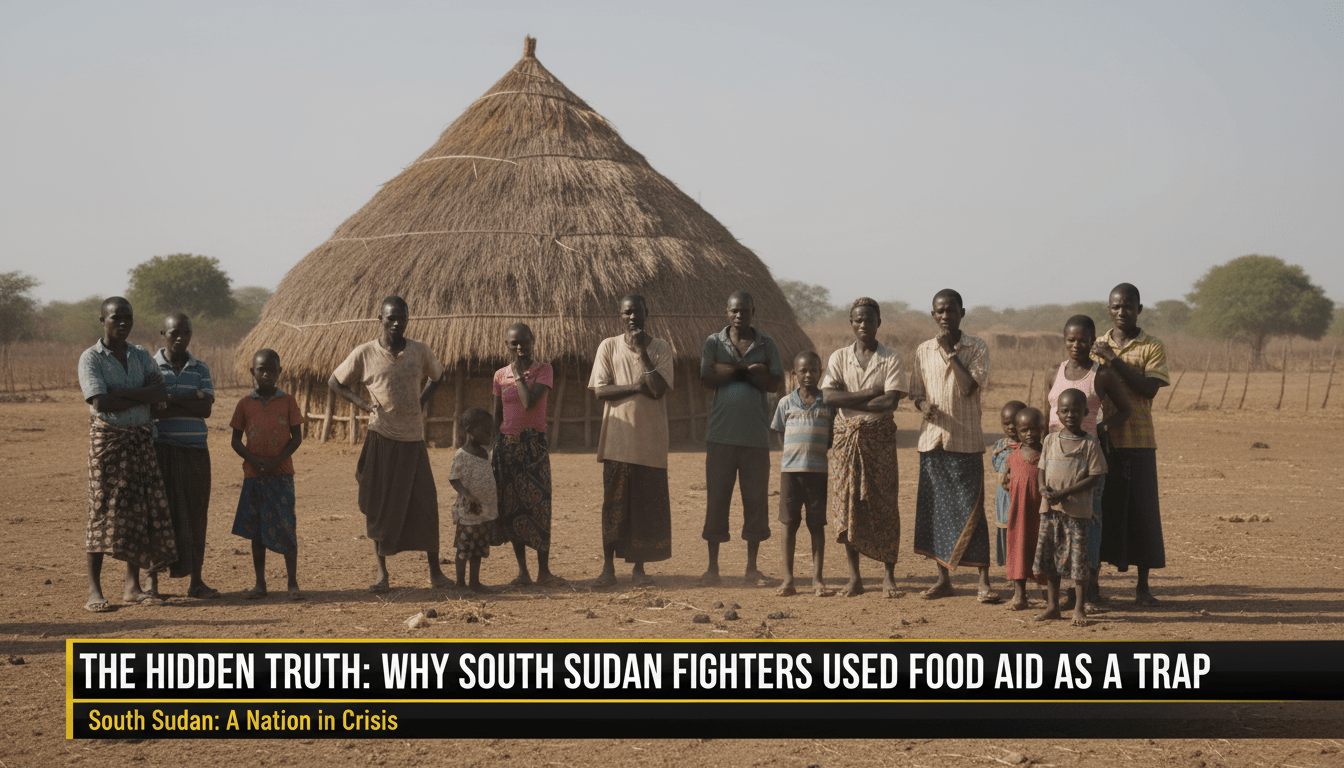
The villagers followed the instructions and gathered into a large traditional cattle hut known as a luak. Once the building was full of men, women, and children, the atmosphere shifted from hope to terror. The fighters bound the men and opened fire on the defenseless crowd. Survivors estimate that 22 people lost their lives in that single afternoon (washingtonpost.com). This act of deception destroyed the trust that is necessary for aid organizations to function in the region.
The Human Cost of the Pankor Massacre
Data reflects local estimates and government reports following the February 2026 incident.
The use of food as a weapon is a recurring theme in South Sudanese history. In many ways, the changing landscape of conflict has forced communities to develop extreme survival strategies. When warring factions control the flow of grain, they control life itself. By using aid as a lure, the attackers targeted the very vulnerability that makes the population so desperate. This tactic does more than kill; it creates a lasting fear of the very resources meant to save lives.
The Cultural Significance of the Luak
To understand the depth of this tragedy, one must understand the significance of the luak. A luak is a large, conical stable used to house cattle, which are the heart of the community. In Nilotic cultures like the Dinka and Nuer, cattle represent wealth, status, and spiritual connection. The luak is a place of sanctuary and communal gathering. It is often the largest and most important structure in a village.
When the fighters chose the luak as the site for the massacre, they committed a form of cultural desecration. Destroying a luak or using it as a trap signifies an attempt to wipe out the economic and social heart of a village. It is a message that no place is safe, not even the center of their spiritual world. The destruction of these buildings often leaves survivors with no way to rebuild their traditional livelihoods.
This type of violence is designed to break the spirit of a people. Throughout history, oppressive forces have targeted the physical symbols of a community’s identity. In the American South, the burning of churches served a similar purpose. In South Sudan, the luak serves as a target because it represents the permanence and strength of the lineage. When a luak is burned or stained with blood, the damage is more than structural; it is psychological.
The Roots of Ethnic Militarization
The violence in Jonglei State is not a new phenomenon. It is deeply connected to the civil war that lasted from 2013 to 2018 (hrw.org). That war began as a political fight between President Salva Kiir and Vice President Riek Machar. However, it quickly transformed into a series of ethnic cleansings. Different groups formed their own militias to protect their interests and seek revenge for past wrongs.
One of the most volatile groups in this region is the Nuer “White Army.” This is a decentralized group of youth who traditionally protected cattle. During the civil war, political leaders mobilized them for large-scale attacks. The name comes from the white cow-dung ash they smear on their skin to protect against insects. While they are not a formal army, they are capable of massive mobilization and extreme violence (hrw.org). Their lack of a central command makes them difficult to control or negotiate with during peace talks.
These militias often operate on the principle of blood compensation. This means that if one group suffers an attack, they feel obligated to retaliate against the other group. The February 2026 massacre was reportedly a “revenge” act for a 2022 incident (washingtonpost.com). In that earlier conflict, Nuer militias attacked Shilluk villages and killed hundreds of people. This cycle of back-and-forth killing ensures that peace remains out of reach for many rural communities.
Monitoring Regional Stability
UNMISS reports a 204% increase in civilian casualties in 2025/2026.
The relationship between different ethnic groups in South Sudan is often complicated by political interference. Some groups experience a history of acceptance and discrimination depending on who is in power. The Shilluk people, for example, have often been squeezed between the larger Dinka and Nuer populations. They have a centralized kingdom that dates back centuries, which makes their struggle for land and survival unique in the national context.
A State of Manufactured Famine
Humanitarian experts often use the term “manufactured famine” to describe the situation in South Sudan. This means the lack of food is not caused by nature, but by human choices. Warring factions intentionally block food aid from reaching certain areas (streamlinefeed.co.ke). They burn crops and kill livestock to starve their enemies into submission. This turns the simple act of eating into a political and military struggle.
Currently, about 9 million people in the country need assistance to survive (ohchr.org). This is nearly 75 percent of the total population. When a government or a militia uses this desperation to lure people into a massacre, they are weaponizing hunger. The people of Jonglei State are caught in a vacuum where the state cannot protect them, and the international community cannot reach them safely. South Sudan is now considered the deadliest place in the world for aid workers (streamlinefeed.co.ke).
The situation is further complicated by the arrival of hundreds of thousands of people fleeing the war in neighboring Sudan. These “returnees” arrive with nothing and put even more pressure on local resources. The competition for food and land becomes even more intense. In this environment, a promise of registration for aid is more than an invitation. It is a lifeline that people are willing to risk everything to grab.
Demands for Justice and Transparent Trials
In the wake of the Pankor massacre, something unusual happened. Local leaders and villagers did not just mourn their dead. They demanded that the government take immediate action against the soldiers involved. While the local commissioner initially tried to dismiss the reports as lies, the pressure from the community became too great (washingtonpost.com). The government eventually disarmed 150 fighters and arrested several officers.
This move toward accountability is a rare glimmer of hope. In the past, many massacres were blamed on “unknown gunmen,” and no one was ever held responsible. However, the people of Ayod County are now demanding transparent trials (pachodo.org). They want to see the perpetrators punished in a court that the public can observe. They fear that if the military handles the case in secret, the soldiers will eventually be released without justice being served.
The role of the United Nations Mission in South Sudan (UNMISS) is crucial in this process. UNMISS tracks civilian casualties and provides the only independent verification of these crimes (ohchr.org). Their data shows that violence against civilians has surged by 204 percent in some areas. This increase suggests that the peace agreement signed in 2018 is failing to protect ordinary people. Without a functional justice system, the cycle of revenge will likely continue.
The extreme vulnerability of the people makes them targets for aid-related deceptions.
True justice requires more than just arresting a few soldiers. It requires a change in how the national army interacts with the civilian population. Often, the military acts as if it is above the law, especially in remote regions like Jonglei. The demand for transparent trials is a demand for the rule of law to reach every corner of the country. It is a sign that the local population is tired of being treated as pawns in a larger political game.
Global Responsibility and the Path Forward
The international community plays a large role in the fate of South Sudan. The United States is the largest donor of aid, providing hundreds of millions of dollars for food and health care. President Donald Trump, as the current leader of the United States, oversees a policy that includes both humanitarian support and targeted sanctions. These sanctions aim to pressure South Sudanese leaders to stop the violence and follow the peace agreement.
However, many observers argue that aid alone is not enough. If the aid is being used as a trap or being taxed by corrupt officials, it may be doing more harm than good. There is a growing call for stricter oversight of how resources are distributed. In some cases, real looters within the government and military systems divert resources meant for the poor. This exploitation is a major obstacle to long-term stability.
The path forward must involve disarming the ethnic militias and integrating them into a truly national army. The 2018 peace deal called for this, but the process has been stalled for years. Trust between the different factions is almost non-existent. Each group fears that if they give up their weapons, they will be massacred by their rivals. This fear is what keeps the cycle of violence alive and allows atrocities like the Pankor massacre to happen.
Conclusion: The History Behind the Headcounts
The events in Pankor village are a heart-wrenching example of how far some will go to maintain power. By using the promise of food to lure people to their deaths, the fighters demonstrated a total lack of humanity. Yet, the response from the local community shows that the spirit of the people is not broken. Their demand for justice is a powerful statement against the culture of impunity that has defined South Sudan for too long.
For the Diaspora, this story is a call to remain engaged with the continent. We must recognize the tactics of division and the weaponization of resources for what they are. The struggle in South Sudan is a struggle for the basic right to live without fear and to eat without being betrayed. As the world watches to see if the promised trials will occur, we must remember the names of the 22 people who were killed while seeking nothing more than a meal.
History tells us that cycles of violence do not end on their own. They end when people stand up and demand accountability. The arrests in Jonglei are a small step, but they are a step in the right direction. The future of South Sudan depends on whether these trials will be the beginning of a new era of justice or just another forgotten headline in a decade of strife. The people of Pankor are waiting for an answer, and the world should be waiting with them.
About the Author
Darius Spearman is a professor of Black Studies at San Diego City College, where he has been teaching for over 20 years. He is the founder of African Elements, a media platform dedicated to providing educational resources on the history and culture of the African diaspora. Through his work, Spearman aims to empower and educate by bringing historical context to contemporary issues affecting the Black community.
