

The Rising Tide: Youth Resistance and Tanzania Election Violence
By Darius Spearman (africanelements)
Support African Elements at patreon.com/africanelements and hear recent news in a single playlist. Additionally, you can gain early access to ad-free video content.
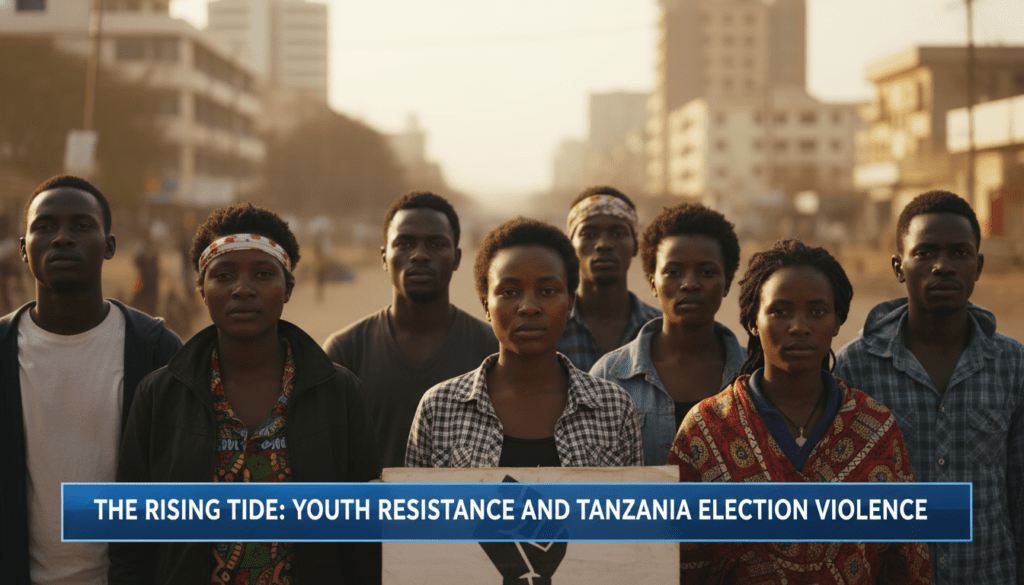
Tanzania has long enjoyed a reputation as a “haven of peace” within a region often troubled by conflict. However, recent reporting reveals a darker reality bubbling beneath the surface. A new Tanzania election violence report describes a landscape of targeted killings and systematic intimidation. This violence occurred during the events surrounding the October 2025 general elections. These developments represent a major break from the country’s history of stability. They also echo powerful, youth-led calls for accountable rule that are reshaping the political landscape (thepostnews.net).
The current crisis is not an isolated event. It is deeply rooted in the history of the nation and its ruling party. For decades, the Chama Cha Mapinduzi (CCM) has maintained a firm grip on power. While the country was once a symbol of African socialism and unity, it has transitioned into what many experts call an “authoritarian routine.” This shift has created a massive gap between an aging political elite and a young, disillusioned population. The youth are now demanding a seat at the table and an end to decades of one-party dominance (thepostnews.net, civicus.org).
The Historical Roots of One-Party Dominance
To understand the current violence, one must look back to the origins of the Tanzanian state. After independence in 1961, Mwalimu Julius Nyerere led the country under the ideology of Ujamaa. This concept, meaning “familyhood” in Swahili, focused on collective villages and national self-reliance (aaihs.org). Nyerere sought to build a nation that was independent of colonial structures. During this era, Tanzania became a “lodestar” for the global Pan-African movement. It provided a sanctuary for activists and thinkers from across the African Diaspora (aaihs.org, theislamiceconomist.org).
Figures such as Malcolm X and Walter Rodney spent time in Dar es Salaam to study the Tanzanian model. The Ujamaa philosophy even influenced the creation of Kwanzaa in the United States. It provided the basis for the principle of cooperative economics (aaihs.org). However, this period also established the state as the center of all political life. The government grew accustomed to total control over the narrative and the people. While this fostered unity, it did not leave much room for shaping political dynamics through opposition voices (thepostnews.net, aaihs.org).
The transition to multi-party politics in 1992 was supposed to change this dynamic. However, the ruling CCM party never truly relinquished its advantages. The first multi-party elections in 1995 were marred by irregularities, especially in the semi-autonomous islands of Zanzibar. In those islands, the opposition faced violent crackdowns that set a dangerous precedent for future votes. Over time, the state developed sophisticated tools to maintain its power while appearing democratic on the surface (thepostnews.net, unas.ac.id).
Tanzania Presidential Win Margins (2015-2025)
*2025 figures based on predictive reporting and official declarations following opposition bans.
The Era of “The Bulldozer” and Beyond
The presidency of John Magufuli, from 2015 until 2021, accelerated the country’s turn toward authoritarianism. Magufuli earned the nickname “The Bulldozer” for his aggressive infrastructure projects. Unfortunately, he applied that same energy to crushing political dissent. During his tenure, the government arrested opposition figures like Tundu Lissu and implemented restrictive laws. These laws effectively criminalized many forms of online speech and independent journalism (thepostnews.net).
Magufuli’s 2020 election victory was marked by widespread reports of fraud and internet shutdowns. When he passed away in 2021, Vice President Samia Suluhu Hassan took office. As the first female president of Tanzania, many hoped she would lead a reformist agenda. She initially met with opposition leaders and lifted bans on political rallies. However, as the 2025 elections drew closer, the “reformist mask” began to slip. The government returned to tactics of abduction and intimidation to ensure the CCM remained in power (thepostnews.net, dailymaverick.co.za).
Current world events, including the leadership of Donald Trump in the United States, have shifted international attention. This lack of global scrutiny has allowed the Tanzanian government to operate with less pressure from the outside. Critics argue that the state is engaging in a form of anti-Black politics by suppressing the democratic rights of its own citizens. This suppression is not merely about party politics. It is about a system that protects elite power at the expense of the people’s will (thepostnews.net, civicus.org).
The 2025 Report: A Simulated Reality?
A striking aspect of recent reporting is the “future-dated” nature of the data. Human rights organizations often use predictive reporting to warn about upcoming crises. The 2025 election report describes a “landslide” victory for Samia Suluhu Hassan with 98 percent of the vote. This result was only possible because the main opposition party, CHADEMA, was barred from the ballot. The state disqualified challengers over minor procedural issues, effectively silencing millions of voters before they could even cast a ballot (thepostnews.net).
The report serves as a warning of what happens when institutional neutrality disappears. Both the National Electoral Commission and the Judiciary are no longer seen as independent. In 2025, the judiciary ruled to ban CHADEMA, a move that legal experts called the final blow to pluralism. This mirrors historical struggles where the Haitian Revolution once stood as a beacon of resistance against overwhelming state control. Today, Tanzanians are looking for their own path to liberation from a restrictive political architecture (thepostnews.net, ticgl.com).
Furthermore, the state has reportedly used the Tanzania Intelligence and Security Service (TISS) to neutralize local leaders. These intelligence officers monitor youth organizers and community activists. They do not just watch; they intervene to prevent any gathering that might challenge the CCM. This level of surveillance has created an atmosphere of fear that makes normal political activity nearly impossible for many citizens (thepostnews.net, civicus.org).
Targeted Killings and State-Sanctioned Fear
The most alarming part of the report involves targeted killings and abductions. In September 2024, CHADEMA strategist Ali Mohamed Kibao was abducted. His body was later found with acid burns, a brutal message to anyone else who might challenge the status quo. These “reprisal killings” allegedly increased after the 2025 election. Security forces reportedly entered homes to execute people suspected of participating in protests. The United Nations confirmed at least 10 deaths, but opposition groups claim the number is as high as 3,000 (thepostnews.net, civicus.org).
Another high-profile case is that of Edgar Mwakabela, known online as “Sativa.” Sativa is a social media commentator who criticized the ruling party. In June 2024, he was abducted and tortured. His captors shot him in the jaw and head before dumping him in a remote national park. Remarkably, he survived to tell his story. He identified his captors as acting in coordination with the police. His testimony has made him a symbol of resistance for a new generation that refuses to be silenced (dailymaverick.co.za).
These acts of violence are intended to destroy the hope of change. By targeting activists, the state sends a message that the price of dissent is death. This level of intimidation is a far cry from the peaceful image Tanzania projects to the world. It reveals a government that is willing to use any means necessary to survive. This includes the first use of treason charges against civilians in 42 years, targeting over 240 people (thepostnews.net, civicus.org).
The Youth Bulge & Economic Reality
Millions of young Tanzanians face “disguised unemployment,” working in the informal sector without stability or growth potential.
The Youth Bulge and Economic Despair
The youth of Tanzania are at the center of this political storm. Approximately 25 percent of the population is between the ages of 15 and 24. This represents over 17 million young people who are coming of age in a time of economic hardship. While the government reports steady GDP growth, the benefits do not reach the average person. Most young people find themselves in “disguised unemployment.” This means they have jobs in the informal sector, such as street vending or small-scale farming, but they do not earn enough to survive (thepostnews.net, ticgl.com).
This economic marginalization is the primary driver of the youth-led uprising. Inspired by the “Gen Z” movements in neighboring Kenya, Tanzanian youth have begun to organize. They used the hashtag #WhereIsSativa to demand answers for state crimes. They also formed groups like “Kijana Wajibika” (Youth Be Responsible). These movements shifted from simple civic education to active resistance against the government’s 60-year monopoly on power (thepostnews.net, dailymaverick.co.za).
The government responded to this energy with fear. In August 2024, the state banned “Youth Day” celebrations to prevent gatherings. During the 2025 election, they deployed military units and shut down the internet for six days. They worked with telecommunications companies to block VPNs and encrypted apps like Signal. The goal was to prevent the youth from coordinating and sharing information with the outside world. However, these measures only served to deepen the anger and resolve of the younger generation (thepostnews.net, civicus.org).
Zanzibar: A Unique Front of Resistance
The political situation in Zanzibar adds another layer of complexity to the crisis. Zanzibar is a semi-autonomous archipelago that joined with Tanganyika in 1964. It has its own president and internal laws, but it is often the site of the most intense repression. The ruling CCM party views the legacy of the 1964 Revolution as an existential matter. They often use the union’s security forces to suppress any movement that seeks more autonomy or a change in leadership (unas.ac.id).
Opposition parties in Zanzibar, such as ACT-Wazalendo, often win the popular vote. Yet, they are frequently denied power through disputed tallies and police force. The political status of Zanzibar relates to a broader system of federalism that often fails to protect local rights. In Zanzibar, election cycles are almost always accompanied by internet blackouts and “irregularities” that are even more severe than those on the mainland (unas.ac.id, thepostnews.net).
Because of its unique status, Zanzibar remains a flashpoint for violence. The ethnic and political divisions there are deep, and the state often exploits them to justify crackdowns. For the youth in Zanzibar, the struggle for accountable rule is also a struggle for their cultural and regional identity. They face a double layer of suppression: one from their local government and another from the union state (unas.ac.id, thepostnews.net).
Institutional Decay and the Path Forward
The erosion of institutional neutrality is perhaps the most dangerous trend in Tanzania. When the courts and the election commission act as arms of the ruling party, democracy becomes a performance. The 2025 election report highlights how state resources were redirected to monitor citizens instead of serving them. The Tanzania Intelligence and Security Service (TISS) focused on “neutralizing” youth leaders before they could even organize protests. This proactive suppression makes it very difficult for a peaceful transition of power to occur (thepostnews.net, civicus.org).
President Samia Suluhu Hassan faces what some call a “double bind.” As the first female leader, she was initially praised by Western diplomats. They used her gender to project a narrative of progress. However, her return to “Iron Lady” tactics has disappointed many. Critics argue that the political architecture of Tanzania is built for repression, regardless of who is in charge. Whether the leader is a man or a woman, the system is designed to protect the CCM at all costs (thepostnews.net, civicus.org).
The future of Tanzania depends on whether the youth can sustain their calls for accountability. The 2025 report is a chilling reminder of the price many are paying for their freedom. However, the history of the African Diaspora shows that resistance is a long-term process. Just as the Haitian Revolution changed the world, the current movement in Tanzania could change the region. The demographic bulge in the country is now its most significant political challenge. The government can arrest leaders, but it cannot arrest an entire generation (thepostnews.net, dailymaverick.co.za, aaihs.org).
Intensity of Repression (2019-2025)
Based on LHRC documentation of enforced disappearances and treason charges.
Conclusion: From “Haven of Peace” to Authoritarian Routine
The “history behind the headlines” reveals that Tanzania is at a crossroads. The country’s long-standing reputation for peace is being tested by a state that refuses to share power. The 2025 election violence report is more than a list of statistics. It is a testament to the courage of those who continue to demand better from their leaders. From the streets of Dar es Salaam to the islands of Zanzibar, a new chapter is being written (thepostnews.net, civicus.org).
The legacy of Ujamaa and Pan-Africanism still lingers, but it is being reclaimed by a generation that values democracy over party loyalty. While the state uses technology and violence to maintain control, the youth are finding new ways to connect and resist. The fight for accountable rule in Tanzania is a central part of the broader struggle for justice across the continent. It is a story of a people who refuse to let their “haven of peace” become a house of fear (thepostnews.net, aaihs.org, civicus.org).
About the Author
Darius Spearman is a professor of Black Studies at San Diego City College, where he has been teaching for over 20 years. He is the founder of African Elements, a media platform dedicated to providing educational resources on the history and culture of the African diaspora. Through his work, Spearman aims to empower and educate by bringing historical context to contemporary issues affecting the Black community.
