

Uganda Election Integrity: Is Voter Data Being Weaponized?
By Darius Spearman (africanelements)
Support African Elements at patreon.com/africanelements and hear recent news in a single playlist. Additionally, you can gain early access to ad-free video content.
The Midnight Arrest of Dr. Sarah Bireete
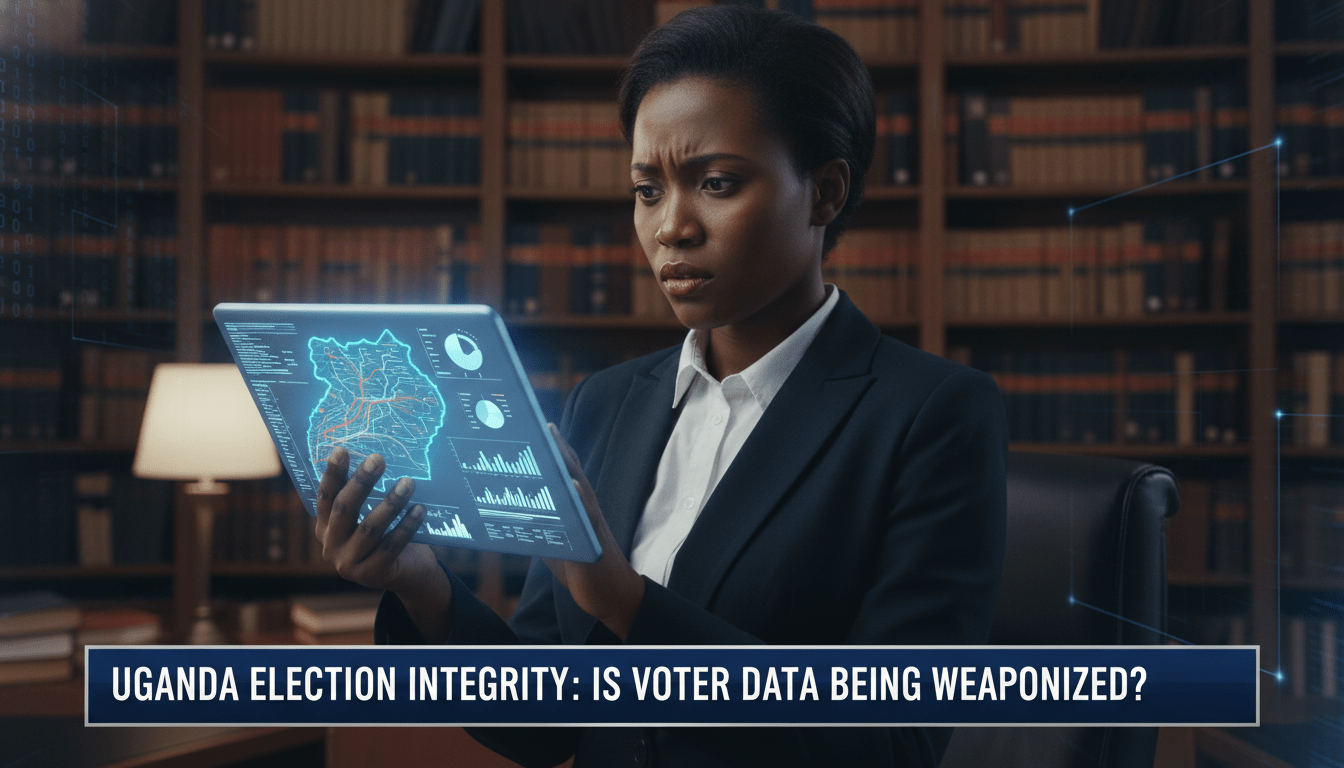
The scene in Mukono was tense as security forces surrounded the home of Dr. Sarah Bireete. It was late December 2025, just weeks before a major election. Dr. Bireete is a well-known lawyer and the head of the Centre for Constitutional Governance. Her crime was not a violent act. Instead, the state accused her of unlawfully obtaining national voter information. This arrest sent shockwaves through the human rights community in East Africa (allafrica.com, omct.org).
Authorities claimed she violated the Data Protection and Privacy Act. This law should protect the private information of citizens. However, advocates argue the government is using it to stop people from checking the voter register. Dr. Bireete had raised concerns about “ghost voters” and errors in the digital database. By the time she was released on bail in February 2026, the election was already over. This incident highlights a growing trend where technology and law become tools for intimidation (voanews.com, 76crimes.com).
Voter Turnout Decline (2001-2026)
Official participation reached an all-time low in 2026 (monitor.co.ug, electionjudgments.org).
A History Written in Blood and Ballots
To understand why voter data is so sensitive in Uganda, one must look at the past. The year 1980 was a turning point for the nation. Milton Obote returned to power after an election that many people believed was rigged. This moment is often called the “Ballots into Bullets” event. Yoweri Museveni, who was a candidate at the time, argued that peaceful change was no longer possible. He led an armed rebellion known as the Ugandan Bush War (reliefweb.int, medium.com).
For five years, the country was gripped by conflict. Museveni eventually took power in 1986. His National Resistance Movement promised to fix the broken democratic process. However, the history of the region shows that the history of Africa took many dramatic turns after colonial rule. Museveni established a “no-party” system for nearly twenty years. He claimed that political parties caused division based on religion and tribe. This allowed his party to consolidate power without any formal opposition (medium.com, hrw.org).
The Grand Bargain and the Shrinking Register
In 2005, Uganda faced pressure from both inside and outside the country. The government agreed to return to a multiparty system. However, this change came with a heavy price. The constitution was amended to remove limits on how many terms a president could serve. This meant President Museveni could stay in power indefinitely. This trade-off set the stage for the contentious 2006 election (hrw.org, electionjudgments.org).
During that cycle, something strange happened to the voter register. Despite a growing population, the list of voters shrank by over 600,000 people. The Electoral Commission said they were simply cleaning up “ghost voters.” Opposition leaders disagreed. They argued the government purged voters in areas where the opposition was popular. This mystery of the disappearing voters created a deep lack of trust that still exists today. It illustrates the troubling history of disenfranchisement that many Black communities face globally (monitor.co.ug, electionjudgments.org).
When Technology Becomes a Barrier
Modern elections rely heavily on technology. Uganda introduced Biometric Voter Verification Kits to stop fraud. These handheld devices scan fingerprints and faces. They are supposed to make sure each person only votes once. For the 2026 election, the state purchased new kits with infrared cameras. However, the rollout was a disaster. Many kits failed to work on election day (smartmatic.com, youtube.com).
Because the machines failed, many polling stations went back to using manual paper lists. This switch often leads to confusion and allows for illegal voting. Furthermore, the government shut down the internet during the polls. This made it impossible for independent observers to share information in real time. Technology was supposed to bring transparency. Instead, it seems to have created a “digital wall” that hides the process from the public (youtube.com, smartmatic.com).
The Evolution of Legal Suppression
Sedition and “False News” used to jail critics (omct.org).
Computer Misuse Act targets “offensive communication” online (ugandaradionetwork.net).
Data Protection Act used to shield voter registers from audits (76crimes.com).
The Legal Shift: From Sedition to Cyber-Crime
The Ugandan government has changed its legal tactics over the years. In the past, they used colonial-era laws like “sedition.” Sedition meant saying anything that might make people dislike the president. However, brave journalists and lawyers fought back. In 2010, the Constitutional Court ruled that sedition laws were illegal. They said these laws violated the right to free speech. This was a major victory for the notion of freedom in the country (omct.org).
After losing these old tools, the state created new ones. They passed the Computer Misuse Act and the Data Protection and Privacy Act. These newer laws sound modern and helpful. In reality, they are often used to arrest bloggers and activists. If someone posts something the government does not like, they can be charged with “offensive communication.” This shift shows how the state adapts to stay in control (ugandaradionetwork.net, 76crimes.com).
The Strategy of the Data Shield
The case against Dr. Bireete introduces a new concept called the “Data Shield.” This happens when a government uses privacy laws to hide public information. The voter register is supposed to be a public document. Every citizen has a right to see it to ensure it is accurate. However, the state now argues that the digital version of this data is private (allafrica.com, 76crimes.com).
By making the register “off-limits,” the state prevents organizations like the Centre for Constitutional Governance from finding errors. If a group tries to audit the data, they are accused of “unlawfully obtaining” it. This creates a legal paradox. The law protects the state from the people, rather than protecting the people from the state. This impact on the political experience of Black people in Uganda is profound and limits their power (76crimes.com).
The Ghost of the Substantial Effect Clause
Even if an activist finds proof of fraud, winning a court case is nearly impossible. This is because of the “Substantial Effect” clause in Ugandan law. This rule says that an election cannot be overturned unless the fraud was big enough to change the final result. It is not enough to prove that the law was broken. A petitioner must show that the broken law mathematically decided the winner (electionjudgments.org).
Legal experts call this a “quantitative trap.” A person would need to gather thousands of affidavits in just ten days to meet this standard. In 2001 and 2006, the Supreme Court admitted there was massive cheating. However, they ruled it did not have a “substantial effect” on the outcome. This legal hurdle makes many voters feel that going to court is a waste of time. It contributes to the low voter turnout seen in the most recent elections (monitor.co.ug, electionjudgments.org).
Human Rights Impact (2025-2026)
Drones and Disappearances
Intimidation in Uganda often goes beyond the courtroom. During the 2021 and 2026 election cycles, reports of enforced disappearances increased. Security forces in unmarked vans, known locally as “drones,” often abduct activists. These individuals are taken to secret detention centers called “safe houses.” Their families often do not know where they are for weeks or months (omct.org).
United Nations experts have flagged these disappearances as a major human rights violation. More than 160 cases were reported in 2025 alone. This environment of fear makes it dangerous for anyone to speak out about voter data issues. When the state uses both the law and physical force, the space for free speech shrinks. The arrest of Dr. Bireete is just one piece of a much larger puzzle of state control (omct.org, 76crimes.com).
The Future of Dissent
Dr. Sarah Bireete remains defiant. After her release from Luzira Prison, she promised to continue her work. She argues that the fight for a clean voter register is a fight for the soul of the country. However, the 2026 election saw the lowest participation rate in decades. Only 52.5 percent of registered voters showed up to the polls. This suggests that many Ugandans are losing hope in the system (voanews.com, monitor.co.ug).
The story of voter data in Uganda is a warning. It shows how easily tools designed for progress can be turned into tools for repression. As the world becomes more digital, the methods used to silence dissent also evolve. For the global African diaspora, these events serve as a reminder. The struggle for fair voting and true representation is ongoing. It requires constant vigilance against both old and new forms of suppression (allafrica.com, 76crimes.com).
Conclusion: The Data Shield and Democracy
In conclusion, the intimidation of rights advocates in Uganda is not a series of random events. It is a calculated strategy to protect the state from accountability. By using privacy laws as a “Data Shield,” the government has moved the battle for democracy into the digital world. The history of the 1980 election and the 2006 register shrinkage shows that this is a long-standing pattern (medium.com, electionjudgments.org).
The arrest of Dr. Bireete serves as a global example of how laws can be weaponized. When the very acts of checking a register or asking for transparency are criminalized, democracy is in danger. The people of Uganda continue to strive for a system where their voices matter. Until the “Data Shield” is removed, the path to fair and free voting will remain blocked. The world must continue to watch and support those who stand up for the truth (voanews.com, omct.org).
About the Author
Darius Spearman is a professor of Black Studies at San Diego City College, where he has been teaching for over 20 years. He is the founder of African Elements, a media platform dedicated to providing educational resources on the history and culture of the African diaspora. Through his work, Spearman aims to empower and educate by bringing historical context to contemporary issues affecting the Black community.
