

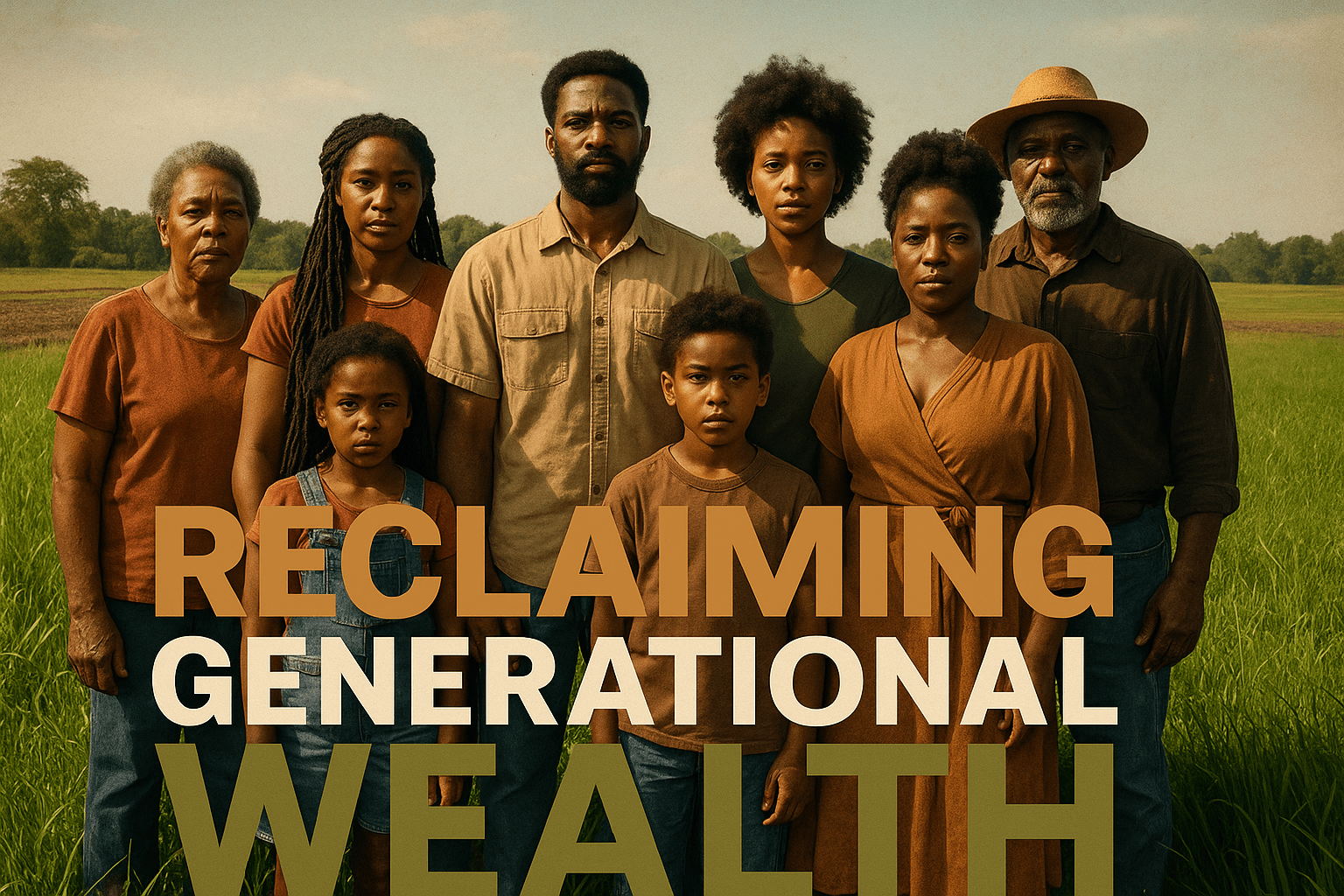
 Heirs property has caused systemic Black land loss, eroding generational wealth through unclear titles and predatory practices. Over 14 million acres were lost from 19002000, costing communities $326 billion in economic potential. (AI Generated Image)
The Hidden Cost of Lost Land
By Darius Spearman (africanelements)
Support African Elements at patreon.com/africanelements and hear recent news in a single playlist. Additionally, you can gain early access to ad-free video content.
The story of land in our communities is a tangled one. It is a tale of promise, struggle, and immense loss. Heirs’ property and the resulting Black land loss are not simply legal issues. Furthermore, they are profound threats to the wealth and stability of African American families. For generations, land has been a cornerstone of economic advancement. However, for many Black families, that foundation has been systematically eroded.
This erosion stems from a specific legal vulnerability. Heirs property happens when land passes down through generations without a proper will or formal estate plan. This practice creates unclear titles among many heirs (Newsone). The lack of clear ownership makes it extremely difficult for families to sell the land, to develop it, or to use it as collateral for loans. Predatory buyers often exploit these legal weaknesses. They acquire land at extremely low rates (Foodprint).
What is Heirs’ Property?
Heirs’ property is a complex issue deeply affecting African American communities. Essentially, it causes land to be owned by a group of heirs as tenants in common. This usually happens when a landowner dies without a will. Each heir, regardless of their financial contribution to the land, has a share. Furthermore, each heir possesses the right to use the entire property (Lost Inheritance).
However, this shared ownership brings significant challenges. Any heir can force a sale of the property through a legal action called a partition sale. This action often results in the land being sold for far below its market value. Often, the original family loses generational assets (EPI). Additionally, the lack of clear title makes it impossible to secure loans or disaster relief funding. This problem is particularly acute in the South. Many Black families inherited land there after the Civil War without formal documentation (NAREB).
Defining Heirs’ Property
Definition: Heirs’ Property
Land collectively owned by multiple heirs, typically due to a lack of a will, making it difficult to sell or use as collateral. This leaves families vulnerable to predatory practices.
Source: Newsone
Impact: Generational Wealth Erosion
The absence of clear ownership documents makes it nearly impossible for families to leverage their land for economic advancement, thus preventing the accumulation of generational wealth.
Source: Foodprint
Threat: Predatory Buyers
Unscrupulous buyers exploit the fragmented ownership of heirs’ property, initiating partition sales to acquire valuable land at significantly reduced prices.
Source: NAREB
The Scale of Land Loss
The numbers tell a stark and painful story. Between 1900 and 2000, Black Americans lost an astounding 80 percent of the land they had acquired. This amount totals approximately 14 million acres (Newsone). A significant portion of this loss was farmland. Nearly 90 percent of farmland once owned by Black farmers has vanished (Lost Inheritance).
By 1997, Black farmers effectively owned only a fraction of what they had in 1910. They possessed about 10 percent of the farmland they once held. Furthermore, by 2022, Black land ownership accounted for a mere 0.29 percent of all U.S. farmland (NAREB). This massive dispossession has had a devastating economic ripple effect on Black communities across the nation.
Black Land Loss: A Timeline of Dispossession
Source: Newsone (1910 vs. 1997)
Source: Lost Inheritance (UCS 2022)
Source: NAREB (2025 report)
Economic Fallout
The financial impact of Black land loss is staggering. The compounded value of land lost between 1920 and 1997 is estimated to be around $326 billion (NAREB). This figure goes beyond mere dollars. It represents lost opportunities, lost stability, and lost potential for countless families.
Wealth accumulation often starts with assets like land. Land can be passed down, providing a foundation for future generations. Losing this land severely restricts the ability of Black families to build and transfer generational wealth (Foodprint). This economic hamstringing perpetuates cycles of disadvantage. It makes it harder to invest in education, start businesses, or weather financial storms. The effects are felt for decades.
Legal Challenges and Prevalence
Heirs’ property is a primary cause of involuntary land loss among Black landowners. It is particularly common in the Southern states (Lost Inheritance). Many Black ancestors acquired land following emancipation with limited access to formal legal services. Because of this, they often passed property down informally. This created the perfect conditions for heirs’ property issues to arise (EPI).
Systemic discrimination further compounds these challenges. Black landowners faced historical barriers when trying to formalize their land titles. They encountered prejudiced legal systems and discriminatory practices. These practices left many properties vulnerable to legal loopholes and exploitation (Foodprint). The resulting legal ambiguity created pathways for outsiders to seize family assets. This historical context is essential for understanding the ongoing struggle to reclaim and protect Black land.
Regional Impact and Dispossession Tactics
The impact of heirs’ property is acutely felt in specific regions. For example, the Gullah-Geechee coast of South Carolina tells a powerful story (NAREB). Descendants of enslaved Africans in this area have fought tirelessly to preserve their family land and cultural legacy. Their battles highlight the deep connection between land, identity, and survival.
However, these communities face additional threats. The misuse of eminent domain, where the government takes private land for public use, often without fair compensation, has been a problem. Discriminatory tax assessments also contribute. These unfair evaluations inflate property taxes for Black-owned land. This forces families to sell. These tactics exacerbate the problem, making it even harder for families to hold onto their ancestral holdings (NAREB).
ABOUT THE AUTHOR
Darius Spearman has been a professor of Black Studies at San Diego City College since 2007. He is the author of several books, including Between The Color Lines: A History of African Americans on the California Frontier Through 1890. You can visit Darius online at africanelements.org.
