


Unstoppable Africa and the Fight for a UN Council Seat
By Darius Spearman (africanelements)
Support African Elements at patreon.com/africanelements and hear recent news in a single playlist. Additionally, you can gain early access to ad-free video content.
A New Stage for Continental Power
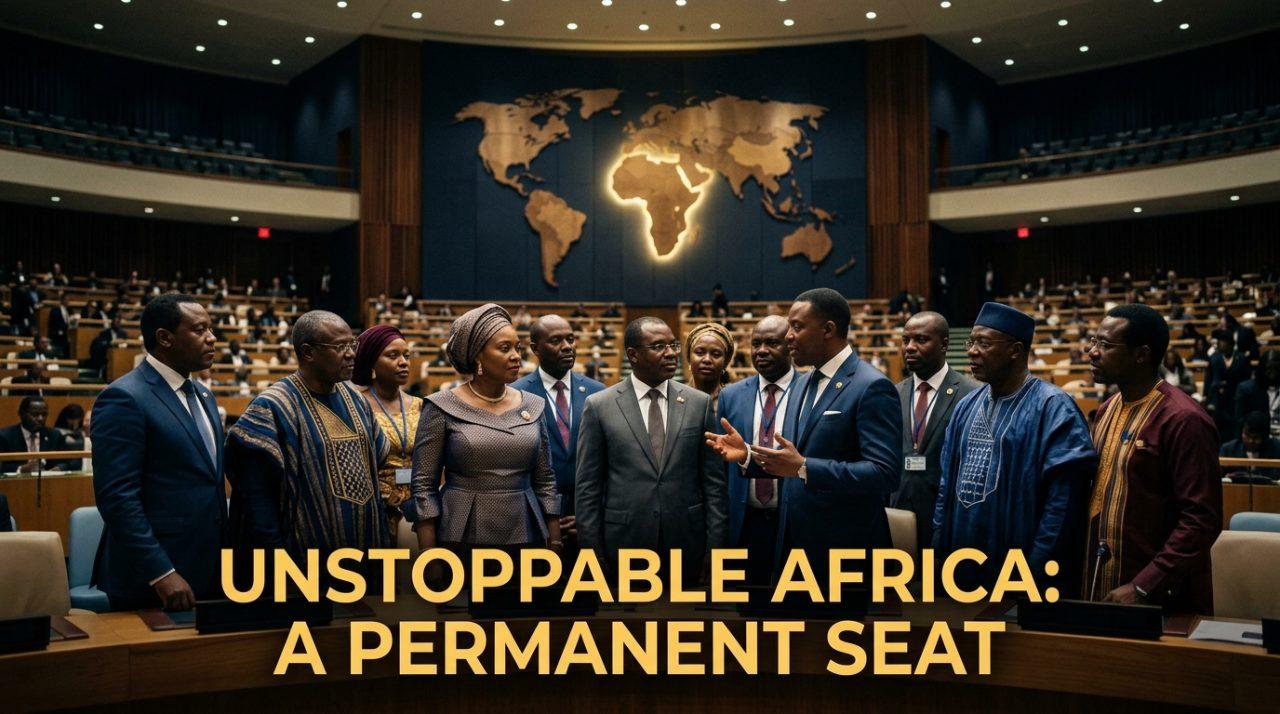
Heads of state and business executives recently filled the Marriott Marquis in Times Square. The gathering occurred alongside the United Nations General Assembly in New York (unglobalcompact.org, ungaguide.com). Organized by the UN Global Compact, the Global Africa Business Initiative held its flagship summit, titled “Unstoppable Africa 2026” (prnewswire.com, unglobalcompact.org). The summit operated under the theme of powering business, scaling economies, and shaping the future (prnewswire.com, unglobalcompact.org). Delegates addressed urgent global imbalances rather than simple commercial networking.
The dialogue united two urgent demands into a single diplomatic front. First, leaders demanded permanent African representation on the United Nations Security Council (un.org). Second, they called for an end to raw resource extraction through localized industrial manufacturing (focusonafrica.info, reliefweb.int). UN Secretary-General António Guterres addressed the crowded assembly with direct words. He insisted that Africa requires a permanent presence on the Security Council (un.org). Guterres noted that global financial institutions were originally constructed by the wealthy for the wealthy (un.org). His remarks reflected a growing worldwide consensus that geopolitical power and economic self-determination cannot be separated.
Permanent UNSC Seats by World Region (1945–Present)
Source: United Nations Charter framework. Africa holds zero permanent veto-wielding seats despite representing over 28% of all UN member nations.
The Exclusionary Roots of 1945
The contemporary struggle over representation traces directly back to the close of World War II. Fifty allied nations gathered in San Francisco in 1945 to establish the United Nations Charter (wikipedia.org, securitycouncilreport.org). At that time, European empires held most of the African continent under colonial subjugation (wikipedia.org). Only four African delegations participated in the drafting process: Ethiopia, Liberia, Egypt, and white-minority South Africa (wikipedia.org). Consequently, the architectural foundation of modern international diplomacy emerged without meaningful continental input.
The resulting charter created the Security Council and selected five victorious allied nations as permanent members (wikipedia.org, securitycouncilreport.org). The United States, the Soviet Union, the United Kingdom, France, and China received unilateral veto privileges (wikipedia.org, securitycouncilreport.org). Independent nations flourished prior to European colonization, yet global institutions systematically shut them out. When African states secured independence during the 1960s, they joined the General Assembly in significant numbers (wikipedia.org). A minor revision in 1963 expanded non-permanent Security Council seats from six to ten (wikipedia.org, securitycouncilreport.org). However, the permanent veto power of the original five states remained entirely untouched (wikipedia.org, securitycouncilreport.org).
Chapter VII and the Injustice of Foreign Enforcement
The concentration of council authority becomes particularly controversial under Chapter VII of the United Nations Charter (accord.org.za, securitycouncilreport.org). Articles 39 through 51 assign exclusive power to identify international threats and deploy enforcement actions (accord.org.za, securitycouncilreport.org). The Security Council wields unilateral authority to implement binding financial sanctions, enforce maritime blockades, and order direct military operations (accord.org.za, securitycouncilreport.org). These coercive measures possess the force of international law. Targeted nations cannot legally reject these interventions (accord.org.za, securitycouncilreport.org). Such immense geopolitical leverage resides solely in the hands of the council leadership.
A severe racial and geographic contradiction defines this enforcement structure (accord.org.za, securitycouncilreport.org). More than half of all Security Council deliberations and sixty percent of Chapter VII interventions directly target African countries (securitycouncilreport.org). Western powers regularly authorize military deployments and sovereign financial embargoes across African soil without continental consent (accord.org.za, securitycouncilreport.org). No Black-majority nation possesses a permanent seat or veto authority to check these binding measures (wikipedia.org, securitycouncilreport.org). This structural disenfranchisement treats one-fifth of global humanity as subjects of foreign discipline rather than partners in international law.
The Security Council Enforcement Paradox
Data source: United Nations Security Council Report documentation and African Union deliberations.
The Ezulwini Consensus and the African Union Mandate
African leaders moved decisively to challenge this institutional exclusion during the early twenty-first century (accord.org.za, au.int). In 2005, the African Union convened a vital ministerial summit in the Ezulwini Valley of Swaziland, now named Eswatini (accord.org.za, securitycouncilreport.org). The resulting Ezulwini Consensus established a firm, collective platform for UN governance reform (accord.org.za, securitycouncilreport.org). Shortly afterward, the Sirte Declaration ratified this joint posture across the entire continent (accord.org.za, securitycouncilreport.org). African leaders resolved that piecemeal adjustments could no longer satisfy the requirements of justice.
The consensus demands at least two permanent Security Council seats for African nations, chosen by the African Union itself (accord.org.za, securitycouncilreport.org). Furthermore, these new seats must include full veto rights so long as the veto exists for other members (accord.org.za, au.int). The document also requests an expansion to five non-permanent rotating seats for Africa (accord.org.za, securitycouncilreport.org). The African Union established the Committee of Ten Heads of State to coordinate this global diplomatic campaign (accord.org.za, securitycouncilreport.org). African nations have insisted that external powers can no longer decide continental peace without direct African executive authority.
Global Black Liberation and Continental Sovereignty
The demand for sovereign state authority connects directly to the historical liberation struggles of the African diaspora. Anti-Black racism and resource exploitation developed globally alongside chattel slavery and imperial conquest. Consequently, sovereign African state power provides essential institutional backing for Black civil rights across the world. When Black communities faced state violence in the West, organizers frequently carried their grievances to international forums.
Historical movements repeatedly linked domestic survival to African diplomatic leverage. In 1947, W.E.B. Du Bois coordinated an appeal to the United Nations through the NAACP. Years later, Malcolm X traveled to Cairo in 1964 to address the Organization of African Unity. He urged independent African heads of state to challenge systemic American racism before the General Assembly. In modern times, the African Union officially recognized the global diaspora as its sixth development zone. Sovereign voting blocs at the United Nations, led by the fifty-four African member states, frequently champion resolutions against systemic racism (accord.org.za, wikipedia.org). Diaspora civil rights groups rely on these sovereign alliances to pass binding global declarations.
From Colonial Extraction to Structural Adjustment
Geopolitical disenfranchisement has always operated alongside severe economic extraction. The Berlin Conference of 1884 partitioned the continent into extractive territories designed to enrich European capitals. Colonial authorities built rail networks and roads solely to transport unprocessed timber, rubber, and minerals to oceanic harbors. Processing facilities and complex consumer manufacturing were actively blocked within African borders. Independence movements changed political flags, but fundamental commercial pathways remained largely unchanged for decades.
During the 1980s and 1990s, the International Monetary Fund and the World Bank enforced Structural Adjustment Programs across Africa. These conditional loan programs mandated privatization, severe currency devaluations, and deep cuts to public spending. Governments were forced to eliminate agricultural subsidies and educational investments to service mounting foreign debts. This crushing external debt forced nations to rely entirely on primary commodity exports. Cheap foreign goods flooded local markets while domestic industrialization completely stalled. This systematic austerity prolonged colonial patterns of dependency well into the twenty-first century.
The Critical Minerals Disparity (Global Share)
Data documented at GABI Unstoppable Africa 2026 forums and UN trade reports.
The New Playbook for Critical Minerals and Trade
The “Unstoppable Africa 2026” summit demonstrated that resource policies are undergoing a massive transformation (prnewswire.com, focusonafrica.info). Modern clean-energy technologies rely heavily on minerals found abundantly across the continent (focusonafrica.info, reliefweb.int). Africa supplies nearly seventy percent of global cobalt and over seventy-five percent of manganese (reliefweb.int). However, historical arrangements allowed foreign companies to export raw materials while retaining processing revenues abroad (focusonafrica.info, reliefweb.int). This arrangement is now meeting coordinated resistance from African lawmakers.
Delegates in New York highlighted national export bans on unprocessed lithium and rare earth minerals (focusonafrica.info, reliefweb.int). Countries like Zimbabwe and Namibia now require domestic processing before commodities leave their ports. The dialogue pointed toward African workers rising to demand dignified manufacturing employment inside continental borders. Simultaneously, the African Continental Free Trade Area unites 1.4 billion consumers into an integrated market (prnewswire.com, uneca.org). Cross-border rail projects and clean energy grids are building internal trade corridors (prnewswire.com, uneca.org). Value addition has become an essential requirement for international commerce.
Decolonizing Institutional Frameworks
Achieving diplomatic and economic autonomy also requires transforming the knowledge systems that govern policy decisions. For decades, international lending institutions dictated domestic choices through foreign economic models. Education systems frequently replicated colonial administrative structures instead of solving practical regional problems. True sovereignty requires decolonizing institutional models to reflect continental development priorities. Local engineers, economists, and legal scholars must design the technical infrastructure that manages continental resources.
At the summit, African leaders emphasized that institutional ownership guarantees long-term economic independence (prnewswire.com, unglobalcompact.org). When African institutions train domestic specialists, governments negotiate international contracts from a position of confidence. Technical expertise enables sovereign nations to regulate foreign investments, conduct environmental audits, and oversee complex value chains. Economic transformation depends upon breaking intellectual dependency just as much as rewriting commercial codes. Autonomous scholarship and self-directed policy development remain vital tools in the global struggle for Black self-determination.
Breaking the Impasse on the World Stage
The campaign to reform the United Nations Security Council still confronts stubborn diplomatic barriers (accord.org.za, securitycouncilreport.org). Amending the United Nations Charter requires compliance with Article 108 (securitycouncilreport.org). This rule demands approval from two-thirds of the General Assembly alongside unanimous ratification by all five permanent members (securitycouncilreport.org). While current council powers express rhetorical support for African inclusion, negotiations stall over veto privileges (accord.org.za, securitycouncilreport.org). Some global powers advocate for permanent African seats without voting veto powers (accord.org.za, au.int). African delegates have firmly dismissed these second-class proposals as wholly unacceptable (accord.org.za, au.int).
The gathering in New York signaled that Africa will not wait indefinitely for institutional charity (prnewswire.com, focusonafrica.info). African heads of state are leveraging their critical mineral wealth and commercial partnerships to force institutional change (focusonafrica.info, reliefweb.int). They recognize that political representation and economic self-sufficiency are deeply connected. The era of accepting raw material extraction and paternalistic governance has reached its end (focusonafrica.info). As global leaders concluded the summit, the message resonated across the assembly halls: an equitable world order cannot exist while silencing the cradle of humanity.
About the Author
Darius Spearman is a professor of Black Studies at San Diego City College, where he has been teaching for over 20 years. He is the founder of African Elements, a media platform dedicated to providing educational resources on the history and culture of the African diaspora. Through his work, Spearman aims to empower and educate by bringing historical context to contemporary issues affecting the Black community.
