

Why a Russian Tanker in Havana Ignites a Global Energy Crisis
By Darius Spearman (africanelements)
Support African Elements at patreon.com/africanelements and hear recent news in a single playlist. Additionally, you can gain early access to ad-free video content.
The Arrival of the Anatoly Kolodkin
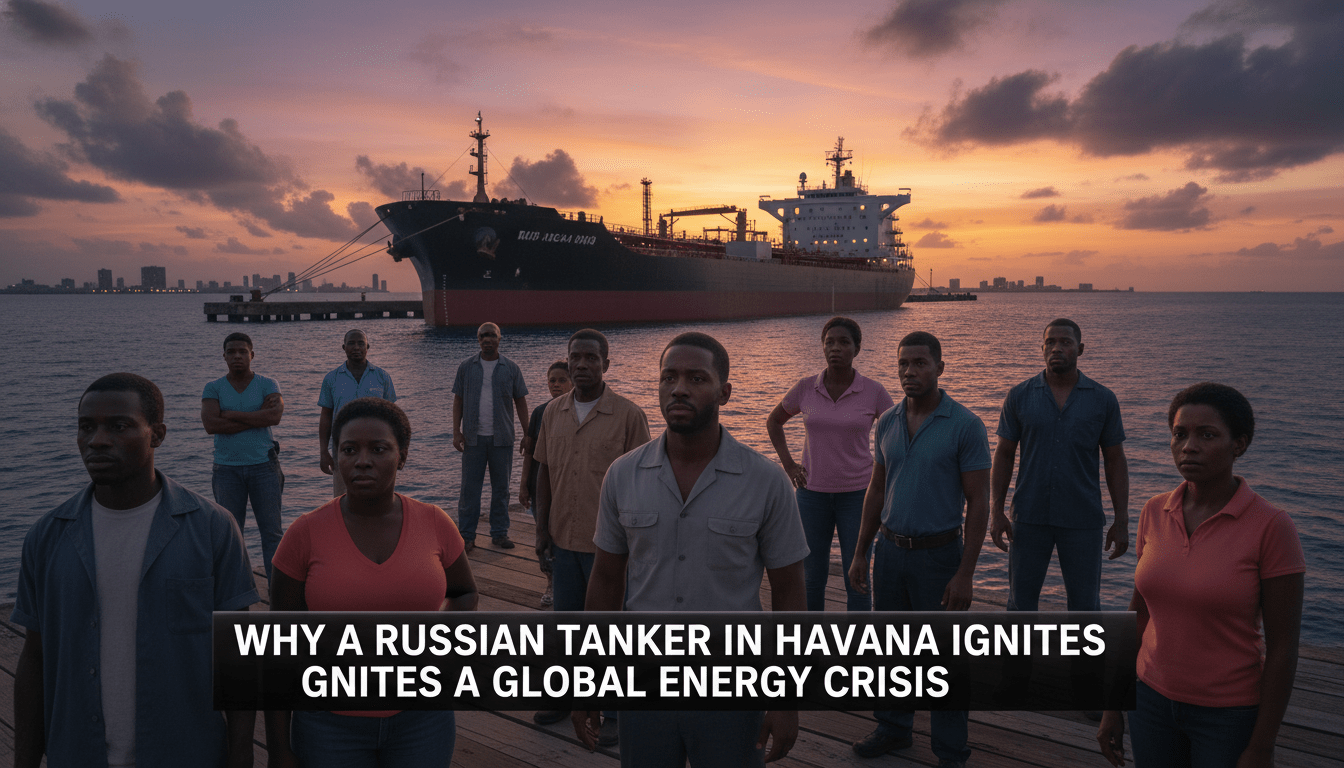
The skyline of Havana looks different when the lights go out. In the spring of 2026, those lights go out often. A massive Russian oil tanker named the Anatoly Kolodkin recently pulled into the port of Matanzas. It carried 730,000 barrels of crude oil to help a nation in deep trouble (themoscowtimes.com). This ship represents more than fuel. It represents a lifeline for a country facing its worst energy crisis in decades. The island of Cuba only produces about 40 percent of the petroleum it needs to function (cibercuba.com). The rest must come from outside sources. For years, those sources have been disappearing.
The arrival of this ship has caused a major stir in Washington. President Donald Trump and his administration have maintained a strict policy against the island. They call it a “chokehold” strategy (cibercuba.com). The goal is to push for political change by making it hard for the Cuban government to get resources. However, the situation in Havana has become so desperate that the White House did not stop this specific ship. Officials cited humanitarian reasons for allowing the delivery. They know that without this oil, hospitals and water systems might stop working entirely (cibercuba.com). It is a delicate balance between political pressure and human survival.
The History of the Oil Blockade
The conflict between the United States and Cuba did not start yesterday. It began over sixty years ago with the same resource: oil. In 1960, the Cuban revolutionary government signed a deal to buy crude oil from the Soviet Union. At that time, American companies like Esso and Texaco owned the refineries on the island. The Eisenhower administration told these companies to refuse to process the Soviet oil (gwu.edu). Fidel Castro responded by taking over the refineries and making them state property. This was a massive blow to American business interests in the region.
The United States retaliated quickly. President Eisenhower cut the amount of sugar the U.S. bought from Cuba. By October 1960, the first trade embargo was in place (gwu.edu). This forced Cuba to look toward Moscow for its very survival. The two nations became close allies. This relationship eventually led to the Cuban Missile Crisis in 1962. During that crisis, the U.S. Navy set up a “quarantine” to stop ships from reaching the island. Cubans began calling this el bloqueo, or the blockade (gwu.edu). The current tensions in 2026 are a direct echo of those Cold War days. The struggle for energy has always been a struggle for sovereignty.
Afro-Cubans and the Remittance Gap
The energy crisis does not hit everyone in the same way. There is a deep racial divide in how people survive these hard times. In 2024 and 2025, reports showed that 89 percent of the population lived in extreme poverty (cibercuba.com). Afro-Cubans often face the hardest path. Many white Cuban families have relatives in the United States who send money back home. These payments are called remittances. However, Afro-descendants are much less likely to have family abroad who can send financial help (cibercuba.com). This creates a massive “remittance gap” that leaves Black families at a disadvantage.
Statistics show that 81 percent of Afro-Cubans do not receive any money from overseas (cibercuba.com). Without this foreign currency, they cannot buy basic goods in stores that only accept “hard currency.” They also cannot afford private generators to keep the lights on during blackouts. Many Afro-Cubans live in older buildings that are at risk of collapsing (cibercuba.com). When the power goes out, the electric pumps that provide water also stop. This means Black communities often go without both light and water for long periods. Efforts toward acknowledging and addressing historical racial injustices must include looking at these modern disparities in the Caribbean.
The African American Struggle and Cuban Solidarity
There is a long history of connection between Black people in the United States and the people of Cuba. During the Cold War, many African American leaders saw the Cuban struggle as part of their own. Malcolm X famously met with Fidel Castro in Harlem in 1960 (cibercuba.com). They talked at the Hotel Theresa, which was a landmark in the Black community. This meeting showed the world that Black Americans and Cubans shared a common fight against oppression. Many activists saw the U.S. blockade as a form of international segregation.
The Black Panther Party also drew inspiration from the island. They saw how the Cuban revolution promised to end racism and provide healthcare for everyone. They viewed the economic pressure on Cuba as similar to the “redlining” of Black neighborhoods in American cities (cibercuba.com). Organizations like the Venceremos Brigade sent African American volunteers to help with the sugar harvest (cibercuba.com). They did this to defy travel bans and show that the nature of freedom is something all oppressed people must define for themselves. This history explains why many social justice groups today continue to call for an end to the embargo.
The 2026 Shift in Geopolitics
The year 2026 has brought massive changes to the region. For nearly two decades, Venezuela was the primary provider of oil to Cuba. This partnership started between Fidel Castro and Hugo Chávez. However, the situation changed drastically in January 2026. The government in Venezuela collapsed after years of political turmoil and U.S. military pressure (cibercuba.com). This event suddenly cut off 60 percent of the oil that Cuba relied on to keep its grid running. The island was plunged into darkness almost overnight.
With Venezuela no longer an option, Cuba turned back to its old friend, Russia. The Russian government sees this as a chance to push back against American influence in the Caribbean. When the Anatoly Kolodkin sailed toward the island, it was not alone. Reports indicate that Russian naval assets escorted the tanker through the Atlantic (themoscowtimes.com, cibercuba.com). This mirrors a move from 2024 when a Russian frigate and a nuclear-powered submarine visited Havana. Russia is making it clear that they are willing to test the enforcement of American policies in the Western Hemisphere. The island has once again become a chessboard for global powers.
The “De Facto” Oil Blockade and Humanitarian Crisis
The Trump administration has intensified its efforts to stop fuel from reaching Cuba. In early 2026, the U.S. began threatening other nations with high taxes and sanctions if they helped transport oil to the island (cibercuba.com). This is what experts call a “de facto” oil blockade. It targets shipping companies and banks. Even if a shipment is meant for humanitarian use, many companies are too afraid of American legal trouble to get involved. This “over-compliance” makes it nearly impossible for the island to buy fuel on the open market.
The results of this policy are visible in every neighborhood. In the first three months of 2026, the Cuban power grid failed seven times (cibercuba.com). These were not just small power outages. They were total national blackouts. Food rots in refrigerators that have no power. Hospitals must decide which patients get to use generators. The UN has criticized these measures for hurting regular people instead of just the government (cibercuba.com). It is hard to address systemic racial disparities when the most basic needs of a population are being used as a bargaining chip for regime change.
The Double Standard in Migration
As the crisis in Cuba grows worse, more people are trying to leave. This has highlighted a major difference in how the U.S. treats different groups of migrants. For decades, the Cuban Adjustment Act has given Cubans a special path to living in the U.S. (americanimmigrationcouncil.org). Most other migrants from the Caribbean do not get this same treatment. Black migrants from Haiti or African countries often face much harder rules. They are frequently put in detention centers or sent back to their home countries very quickly (americanimmigrationcouncil.org).
Social justice advocates point to something called the “shout test” at sea (americanimmigrationcouncil.org). When the U.S. Coast Guard stops a boat, they often ask the people on board if they are afraid to go back. For Cubans, this process is usually very thorough. For Haitian migrants, they often have to scream or make loud gestures just to get an interview (americanimmigrationcouncil.org). This racialized disparity is a major concern for leaders in the region. They argue that if the energy crisis causes a total collapse in Cuba, it will trigger a migration wave that the current system is not prepared to handle fairly.
A Warning from Caribbean Leaders
Leaders across the Caribbean are watching the situation with great concern. Through an organization called CARICOM, they have warned that the tensions could destabilize the entire region (cibercuba.com). Jamaica’s Prime Minister has been very vocal about these dangers. He and other leaders fear that a collapse in Cuba would not only lead to a migration crisis but also invite more military threats. They do not want their region to become a battleground for the U.S. and Russia again.
The arrival of the Anatoly Kolodkin is a temporary fix for a much larger problem. While the oil will help keep the lights on for a few more days, it does not change the fact that the island is running out of options. China has helped increase solar energy use on the island to about 20 percent by 2026 (cibercuba.com). However, that is not enough to power a whole nation. The combination of historical grievances, modern blockades, and racial inequality continues to shape the lives of millions. The headlines tell us a ship has arrived, but history tells us the struggle is far from over.
About the Author
Darius Spearman is a professor of Black Studies at San Diego City College, where he has been teaching for over 20 years. He is the founder of African Elements, a media platform dedicated to providing educational resources on the history and culture of the African diaspora. Through his work, Spearman aims to empower and educate by bringing historical context to contemporary issues affecting the Black community.
