


Why Black August Campaigns Focus on Political Prisoners
By Darius Spearman (africanelements)
Support African Elements at patreon.com/africanelements and hear recent news in a single playlist. Additionally, you can gain early access to ad-free video content.
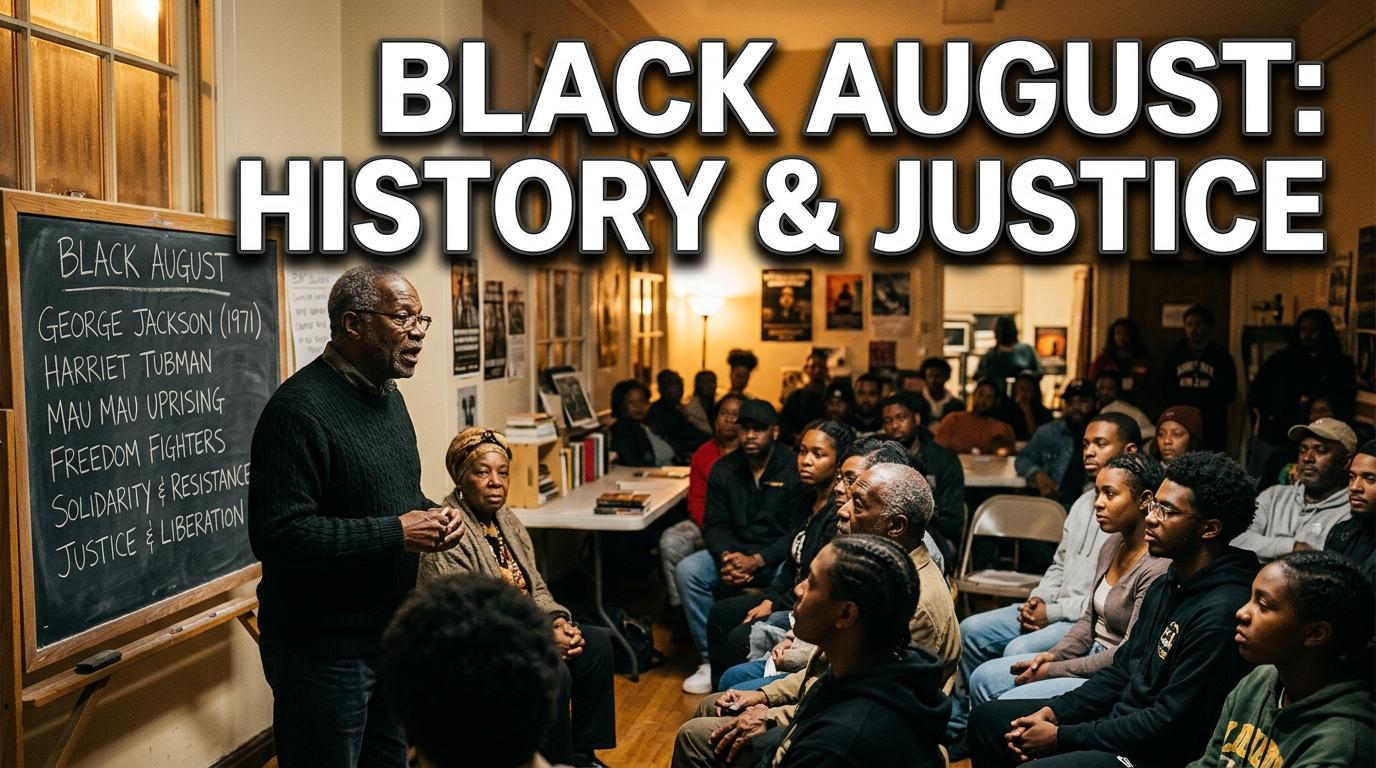
Every year when late summer arrives, grassroots organizations nationwide launch Black August campaigns. Activists hold community forums, teach-ins, and rallies to raise public awareness around political prisoners. These events direct public attention toward mass incarceration, solitary confinement, and systemic equity. To fully understand these modern headlines, one must examine the deep historical roots behind the movement (ourtimepress.com, amsterdamnews.com).
Black August is not a conventional celebration or a commercial holiday. Instead, it represents a solemn period of collective fasting, physical training, and political education. Participants draw a direct line between twentieth-century prison uprisings and contemporary struggles against carceral violence. By examining this history, organizers illuminate how past freedom struggles shape present demands for justice (liberationschool.org, blackaugustpo.org).
The Origins of Black August and Prison Resistance
The formal institution of Black August began inside California state prisons during the late 1970s. In 1979, incarcerated activists at San Quentin State Prison established the tradition. Members of the Black Guerrilla Family and former Black Panthers came together to honor fallen revolutionaries. They sought to commemorate figures such as George Jackson, Jonathan Jackson, W.L. Nolen, and Khatari Gaulden (liberationschool.org, wikipedia.org).
Unlike standard holidays, Black August demands rigorous personal discipline and political commitment. Participants observe core practices summarized by the slogan: study, fast, train, fight. Organizers refrain from consuming alcohol, drugs, and commercial entertainment throughout the month. In addition, individuals engage in daytime fasting and daily physical exercise. These practices aim to build physical strength and political consciousness while honoring historic struggles for Black liberation (liberationschool.org, blackaugustpo.org).
Furthermore, activists emphasize that the month of August holds profound historical significance across the African diaspora. Major anti-colonial and anti-slavery rebellions occurred during this specific month throughout history. For example, the Haitian Revolution began in August 1791 with the Bois Caïman ceremony. Nat Turner led his historic Virginia slave rebellion in August 1831. Later historical events, including the 1963 March on Washington, the 1965 Watts Uprising, and the 2014 Ferguson Uprising, also occurred in August (liberationschool.org, wikipedia.org).
From Petty Conviction to Revolutionary Icon
The ideological core of Black August centers heavily on the life and writings of George Jackson. In 1961, nineteen-year-old George Jackson received an indeterminate sentence of one year to life. California authorities imposed this sentence after Jackson agreed to a guilty plea for stealing seventy dollars from a gas station. While serving this open-ended term, Jackson spent over seven years in extreme solitary confinement (wikipedia.org, wikipedia.org).
During his long isolation, Jackson underwent a profound political transformation. He studied Marxist-Leninist political theory, anti-colonial history, and political economy. Jackson eventually became a Field Marshal in the Black Panther Party and co-founded the Black Guerrilla Family. His published letters, collected in books like Soledad Brother, exposed the brutal reality of American prisons to a global audience. Consequently, legal advocates recognized him as a premier political prisoner rather than a common convict (wikipedia.org, marxists.org, wikipedia.org).
Tensions inside California penal institutions escalated dramatically in January 1970. A tower guard at Soledad State Prison shot and killed Black prison organizer W.L. Nolen and two other incarcerated men. After a grand jury ruled the killings justifiable homicide, a white guard was found dead. Prison officials subsequently charged George Jackson, Fleeta Drumgo, and John Clutchette with murder. These three men became known internationally as the Soledad Brothers (wikipedia.org, wikipedia.org).
The designation “brothers” reflected political solidarity rather than biological kinship. However, biological family ties played a decisive role in the escalating struggle. On August 7, 1970, George Jackson’s seventeen-year-old biological brother, Jonathan Jackson, raided the Marin County Courthouse. Jonathan armed released and incarcerated comrades to demand the immediate release of the Soledad Brothers. Law enforcement opened fire on their getaway vehicle, resulting in the deaths of Jonathan Jackson, William Christmas, James McClain, and Judge Harold Haley (wikipedia.org, wikipedia.org).
One year later, on August 21, 1971, prison guards shot and killed George Jackson in the yard of San Quentin. Officials claimed Jackson died during an escape attempt. However, activists and scholars viewed his death as a state-sanctioned assassination intended to crush prison radicalism. Both remaining Soledad Brothers, Fleeta Drumgo and John Clutchette, were acquitted of all charges by a jury in 1972 (wikipedia.org, wikipedia.org).
The Spark That Ignited Attica and Underground Resistance
The shockwaves from George Jackson’s assassination spread immediately throughout the national prison system. On the morning of August 22, 1971, over seven hundred incarcerated men at Attica Correctional Facility in New York staged a silent protest. Prisoners wore black armbands to breakfast and refused to eat in honor of Jackson. This shared grief and fear of guard violence created unprecedented unity across racial lines (wikipedia.org, wikipedia.org).
Tensions at Attica continued to build over the following three weeks. On September 9, 1971, nearly thirteen hundred prisoners revolted and took control of the facility. Inmates held forty-two staff members hostage while demanding basic human rights and penal reform. State authorities eventually crushed the rebellion with lethal force, but the event redefined the national prison abolition movement forever (wikipedia.org, singsingprisonmuseum.org).
Simultaneously, state repression against above-ground political organizations intensified across the nation. The Federal Bureau of Investigation targeted radical groups through its Counterintelligence Program, known as COINTELPRO. Federal agents used covert surveillance, lethal raids, and psychological warfare to disrupt legal Black power organizations. Because open activism became increasingly dangerous, some militants decided to transition underground (wikipedia.org, americanyawp.com).
Former members of the Black Panther Party and the Republic of New Afrika subsequently formed the Black Liberation Army. Active throughout the 1970s, this clandestine Marxist-Leninist organization engaged in armed urban guerrilla tactics. Members viewed armed self-defense as a necessary response to persistent police violence and political repression. This underground resistance reflected a broader shift in Black political strategy during an era of intense state monitoring (wikipedia.org, aaregistry.org).
Visualizing the Structural Reality of Incarceration
Contemporary Black August organizers emphasize that historic prison struggles directly connect to modern carceral statistics. Data from criminal justice research institutes confirms deep, ongoing racial disparities within state and federal penal systems. Black Americans remain drastically overrepresented behind bars relative to their total share of the general population (sentencingproject.org, prisonpolicy.org).
U.S. Population vs. State/Federal Prison Population
Racial breakdown showing extreme overrepresentation of Black Americans in carceral facilities.
According to nationwide sentencing data, Black adults are incarcerated in state facilities at nearly five times the rate of white adults. This macro-level disparity reflects historical patterns established during post-Reconstruction penal expansion. Furthermore, racial disparities become even more pronounced inside prison walls regarding disciplinary isolation (nih.gov, sentencingproject.org).
Cumulative Risk of Solitary Confinement by Age 32
Percentage of men placed in restrictive housing cohort study (Columbia Justice Lab).
Studies conducted by academic researchers demonstrate that eleven percent of Black men in regional cohorts experience solitary confinement by age thirty-two. By contrast, only 1.4 percent of white men in the same demographic cohort undergo similar administrative segregation. These numbers highlight the disproportionate use of extreme isolation against Black prisoners (nih.gov).
International Standards vs. U.S. Incarceration Practice
UN Mandela Rules
Prohibits solitary confinement exceeding 15 consecutive days, defining longer periods as cruel or degrading treatment.
U.S. Prolonged Isolation
Nearly 9% of Black men in study cohorts spend over 15 consecutive days in solitary; 1% endure isolation for over a year.
Defining Political Prisoners and the Case of Mumia Abu-Jamal
In human rights discourse, a political prisoner is defined as an individual incarcerated primarily because of political beliefs or advocacy. Human rights bodies like Amnesty International evaluate whether states weaponized judicial processes against dissidents. Sovereign governments routinely deny holding political prisoners. However, independent observers examine selective prosecution and retaliatory punishment to identify state repression (aappb.org, amnesty.org).
Civil rights groups apply this classification to long-serving incarcerated activists from the Civil Rights and Black Power eras. A prominent contemporary example is former Black Panther and radio journalist Mumia Abu-Jamal. Incarcerated in Pennsylvania since 1981, Abu-Jamal faced documented trial irregularities and judicial bias. Human rights organizations highlight that state authorities targeted him due to his vocal political journalism and MOVE affiliation (ccrjustice.org, amnesty.org).
Abu-Jamal spent twenty-nine years on death row in extreme solitary confinement before his sentence was commuted to life without parole. Advocacy groups contend that keeping aging activists imprisoned under such conditions violates international legal standards. Campaigns during Black August consistently demand clemency, parole, or immediate release for Abu-Jamal and other political elders like Kamau Sadiki (ourtimepress.com, ccrjustice.org).
Furthermore, these political prisoner campaigns draw upon historical theoretical frameworks established by earlier Black leaders. For example, Marcus Garvey championed Pan-Africanism through the Universal Negro Improvement Association during the early twentieth century. Garvey emphasized race-first organizing, African cultural pride, and independent economic ventures. In contrast, later radical theorists like George Jackson integrated Marxist-Leninist class analysis into anti-racist struggles. Despite ideological differences, both traditions prioritized Black collective autonomy over mere political integration (britannica.com, marxists.org).
Convict Leasing and the Legacy of Forced Labor
To understand modern carceral disparities, one must examine post-Emancipation labor systems in the American South. Following the passage of the Thirteenth Amendment in 1865, slavery was abolished except as punishment for a crime. Southern state legislatures quickly exploited this constitutional loophole by passing discriminatory measures known as Black Codes (eji.org, georgiaencyclopedia.org).
These laws criminalized everyday behaviors such as loitering, vagrancy, and failing to show proof of employment. Local police officers selectively arrested freed Black men, who were subsequently sentenced to hard labor. States then leased these incarcerated individuals to private corporate contractors, railroad companies, coal mines, and agricultural plantations. This practice became known historical as the convict leasing system (eji.org, georgiaencyclopedia.org).
Convict leasing generated tremendous revenue for Southern governments while forcing workers into lethal conditions. For instance, convict leasing generated up to seventy-three percent of Alabama’s total annual state revenue in 1898. Private companies held complete control over leased workers, leading to extreme violence and high mortality rates. Historians frequently describe this era as slavery by another name, establishing a clear precedent for the history of Black labor exploitation inside modern penal systems (eji.org, georgiaencyclopedia.org).
Modern Campaigns, Self-Determination, and Human Rights
Within African American liberation movements, self-determination means the absolute right of Black communities to exercise political, economic, and cultural autonomy. Rather than requesting minor policy adjustments, self-determination demands that oppressed groups hold power over their own institutions, land, and resources. Modern Black August campaigns position prison abolition and reparations as essential steps toward achieving true self-determination (ccrjustice.org, ibw21.org).
Additionally, advocacy organizations align their domestic campaigns with international human rights standards. The United Nations General Assembly adopted the Standard Minimum Rules for the Treatment of Prisoners, known as the Nelson Mandela Rules, in 2015. Rule 44 explicitly defines solitary confinement as held twenty-two or more hours per day without meaningful human contact. Furthermore, Rule 43 strictly prohibits indefinite solitary confinement and isolation exceeding fifteen consecutive days, categorizing prolonged solitary confinement as torture (un.org, unodc.org).
Contemporary coalitions like the Malcolm X Grassroots Movement, the Center for Constitutional Rights, and N’COBRA utilize Black August to highlight these violations. They link local carceral issues to international standards and historical freedom struggles, including the impact of global movements for liberation. By connecting history to modern data, Black August campaigns keep public attention focused on freeing political prisoners, ending solitary confinement, and securing lasting self-determination for Black communities (ourtimepress.com, ccrjustice.org).
About the Author
Darius Spearman is a professor of Black Studies at San Diego City College, where he has been teaching for over 20 years. He is the founder of African Elements, a media platform dedicated to providing educational resources on the history and culture of the African diaspora. Through his work, Spearman aims to empower and educate by bringing historical context to contemporary issues affecting the Black community.
