


Why Climate Gentrification Displaces Black Miamians
By Darius Spearman (africanelements)
Support African Elements at patreon.com/africanelements and hear recent news in a single playlist. Additionally, you can gain early access to ad-free video content.
The Paradox of the High Ground
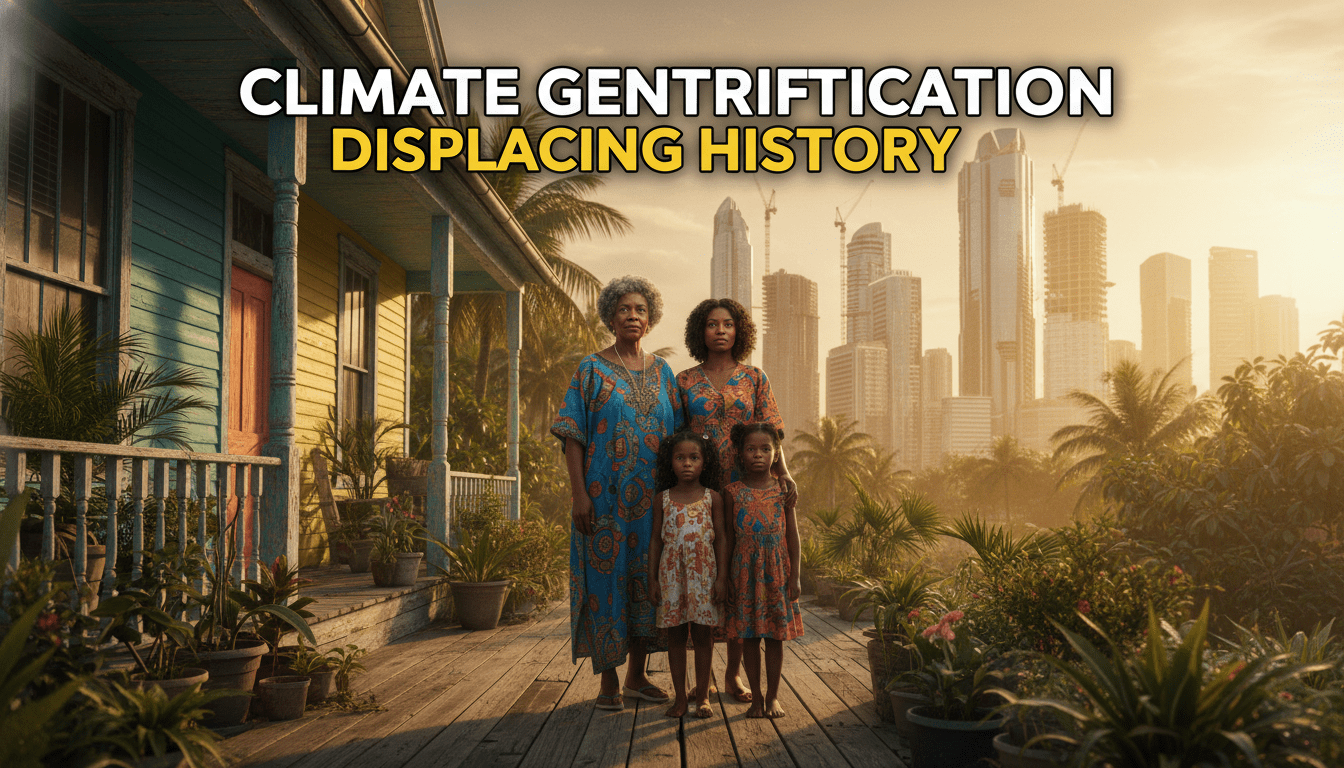
A silent migration is currently sweeping through Miami. Wealthier buyers are moving away from the beautiful oceanfront. Instead, they are targeting working-class inland neighborhoods. Places like Overtown, Liberty City, Little Haiti, and Allapattah are changing rapidly (ncronline.org). Longtime residents face massive rent increases. They also deal with aggressive cash offers from developers (capitalbnews.org).
This modern shift is not an accident of nature. It is the direct result of a century of racial segregation. Historically, Black residents were forced onto the highest ground in the county. Today, that high ground is the most valuable land. As a result, Black Miamians face intense displacement pressure (researchgate.net, climate-refugees.org). This dynamic is called climate gentrification, and it represents a major crisis for the region.
Geological Foundations: The Miami Rock Ridge
To understand this crisis, one must look below the surface. The geological bedrock of South Florida is composed of Quaternary oolitic limestone (fit.edu). This sedimentary rock behaves like a giant rigid sponge. It contains millions of tiny holes that hold water (fit.edu). Consequently, sea level rise is not a threat that comes solely from the coast.
Instead, the rising ocean pushes saltwater up through the porous limestone from below (fit.edu). This process raises the underground water table. Because of this geology, traditional defenses like seawalls are ineffective (fit.edu). Water simply bypasses the walls and rises directly out of the ground (fit.edu). Therefore, developers and wealthy residents must seek higher elevations to stay dry.
Jim Crow and Flagler’s Color Line
This search for high ground brings developers into historically segregated spaces. When Miami was first incorporated in 1896, Black workers built the city (soulofamerica.com). Many migrated from the Bahamas and the American South to construct the Florida East Coast Railway (miamiandbeaches.com). Yet, segregation laws barred them from living near the scenic coast (soulofamerica.com).
Railway pioneer Henry Flagler established a strict racial boundary (segregationbydesign.com). Black workers were restricted to an area northwest of downtown (segregationbydesign.com). This neighborhood was called “Colored Town,” which later became Overtown (soulofamerica.com). White developers reserved the coast for tourism and white residents (segregationbydesign.com). They viewed the high, inland oolitic limestone ridge as undesirable. It was hot, far from the ocean breeze, and polluted by industrial rail lines (segregationbydesign.com).
Redlining and the Wealth Deficit
During the 1930s, the federal government formalized this geographic separation. The Home Owners’ Loan Corporation created security maps to assess lending risks (segregationbydesign.com). Black neighborhoods on the ridge were systematically graded “D” and colored red (segregationbydesign.com). This practice of redlining meant banks refused to issue mortgages to Black applicants (segregationbydesign.com).
White families built immense generational wealth through subsidized suburban homeownership along the coast. Meanwhile, Black Miamians could not buy homes or fund repairs. This systematic exclusion explains the massive wealth gap seen today. The historical strength of Black families helped them survive this hardship. However, the median wealth for Black households in Miami remains incredibly low. It stands at just $3,700, compared to $107,000 for white households (urbanandracialequity.org). This wealth gap makes legacy residents highly vulnerable to displacement.
Highway Construction and Urban Renewal
Despite these barriers, Overtown grew into a thriving cultural hub. By the mid-20th century, residents proudly called it the “Harlem of the South” (soulofamerica.com, visitflorida.com). It was a vibrant sanctuary where world-famous Black artists stayed and played (soulofamerica.com, visitflorida.com). Because segregation laws blocked Black performers from staying in white-only Miami Beach hotels, they crossed the bridge to Overtown (soulofamerica.com, visitflorida.com).
This prosperity was dismantled in the 1960s. Local and federal officials used eminent domain to clear what they labeled as “blight” (segregationbydesign.com). They routed Interstate 95 directly through the heart of Overtown (segregationbydesign.com). The highway project forcibly displaced approximately 12,000 Black residents (segregationbydesign.com). It demolished the neighborhood’s business district (segregationbydesign.com). This economic exploitation pushed families further north. Many resettled in Liberty City and Little Haiti, which also sit on the high limestone ridge (segregationbydesign.com).
Systemic Tensions and Civil Unrest
Historically, economic neglect and systemic racism have fueled intense civil rights struggles in Miami. The region has weathered several major racial uprisings (capitalbnews.org, wikipedia.org). The most devastating was the 1980 Miami riots, which began on May 17, 1980 (capitalbnews.org, wikipedia.org). This uprising was sparked when an all-white jury acquitted white police officers in the beating death of Arthur McDuffie, a Black insurance salesman (capitalbnews.org, wikipedia.org).
The acquittal ignited deep-seated frustrations over decades of police brutality and unequal justice (capitalbnews.org, wikipedia.org). The resulting three days of violent unrest left at least 18 people dead and caused roughly $100 million in property damage (capitalbnews.org, wikipedia.org). These uprisings were not isolated events. They occurred in neighborhoods like Overtown and Liberty City, which had been starved of investment (capitalbnews.org, wikipedia.org). Today, these same areas face a new kind of pressure from climate gentrification, leaving residents with few resources to fight displacement (ncronline.org, capitalbnews.org).
The Inversion of Real Estate Values
Today, the geographical dynamic has completely reversed. Coastal living is losing its appeal as sea levels rise. Since 1930, the sea level in Miami has risen nine inches (southeastfloridaclimatecompact.org). Projections suggest it will rise another two feet by the year 2060 (southeastfloridaclimatecompact.org). Consequently, flood-prone coastal areas face constant street flooding.
The immediate driver of climate gentrification is the rising cost of living on the water. Federal flood insurance premiums are skyrocketing (ncronline.org). Wealthy residents and investors are retreating to the high ground of the limestone ridge (ncronline.org). A landmark study called “Voices on Higher Ground” confirmed this change (miami.edu). High-elevation inland neighborhoods are now prime real estate targets (miami.edu).
Predatory Practices and Tax Foreclosures
This search for dry land triggers intense real estate speculation. Institutional investors deploy aggressive tactics to acquire properties (capitalbnews.org). They target elderly and low-income homeowners with unsolicited cash offers (capitalbnews.org). Many of these properties suffer from clear title issues, known as heirs’ property (capitalbnews.org).
Furthermore, skyrocketing property values translate into massive tax increases. Legacy homeowners who own their homes “free and clear” face annual tax bills they cannot afford (capitalbnews.org). Their taxes can jump from a few hundred dollars to thousands in a short period (capitalbnews.org). If they cannot pay, they face tax foreclosure (capitalbnews.org). For renters, the situation is even more dire. Landlords routinely double or triple rents to force tenants out (capitalbnews.org).
Where the Displaced Relocate
The displacement of legacy residents is altering the demographic makeup of Miami. Many families cannot afford to stay in their historic neighborhoods. Some are forced to double up in overcrowded apartments (capitalbnews.org). Others sleep in their vehicles or rent storage units to survive (capitalbnews.org).
Those who leave the urban core often move to southern suburbs like Homestead (capitalbnews.org). Ironically, these areas are highly vulnerable to severe weather events (capitalbnews.org). A massive wave of residents is leaving Miami-Dade County entirely. The county lost approximately 67,000 residents in a single year (capitalbnews.org). This is the largest population loss of any high-flood-risk county in the country (capitalbnews.org).
Policy Failures and Proposed Solutions
Local governments have struggled to address this crisis effectively. The city’s climate plan, “MiamiForever Climate Ready,” has drawn criticism (ncronline.org). It encourages dense development along transit corridors on the high ground (ncronline.org). This policy has security implications, as it has unintentionally accelerated developer speculation in Black communities (ncronline.org).
Meanwhile, county officials are trying to slow down the migration. The top property appraiser suggested lowering tax assessments for flood-prone coastal properties (ncronline.org). The goal is to keep wealthy taxpayers on the coast (ncronline.org). However, critics argue this would drain the public budget (ncronline.org). Activists are shaping political dynamics by demanding community land trusts and inclusionary zoning (flhousing.org, localhousingsolutions.org). These policies can keep the high ground affordable for legacy residents (flhousing.org).
The Historical Irony of the Ridge
The unfolding wave of climate gentrification in Miami is a deep historical tragedy. For generations, systemic racism and segregation pushed Black Miamians away from the coast. They were forced onto the hot, inland oolitic limestone ridge. Now, the rising sea is turning that ridge into the most desirable land in the city.
Without strong legal protections, history will repeat itself. The people who built Overtown, Liberty City, and Little Haiti will be forced to leave. They will be displaced by a tide of wealth escaping the ocean. Preserving these historic neighborhoods is a matter of climate justice. It is also essential to keeping the cultural heart of Miami alive.
About the Author
Darius Spearman is a professor of Black Studies at San Diego City College, where he has been teaching for over 20 years. He is the founder of African Elements, a media platform dedicated to providing educational resources on the history and culture of the African diaspora. Through his work, Spearman aims to empower and educate by bringing historical context to contemporary issues affecting the Black community.
