

Why Detroit Black Muslim Women Lead the Ramadan Resistance
By Darius Spearman (africanelements)
Support African Elements at patreon.com/africanelements and hear recent news in a single playlist. Additionally, you can gain early access to ad-free video content.
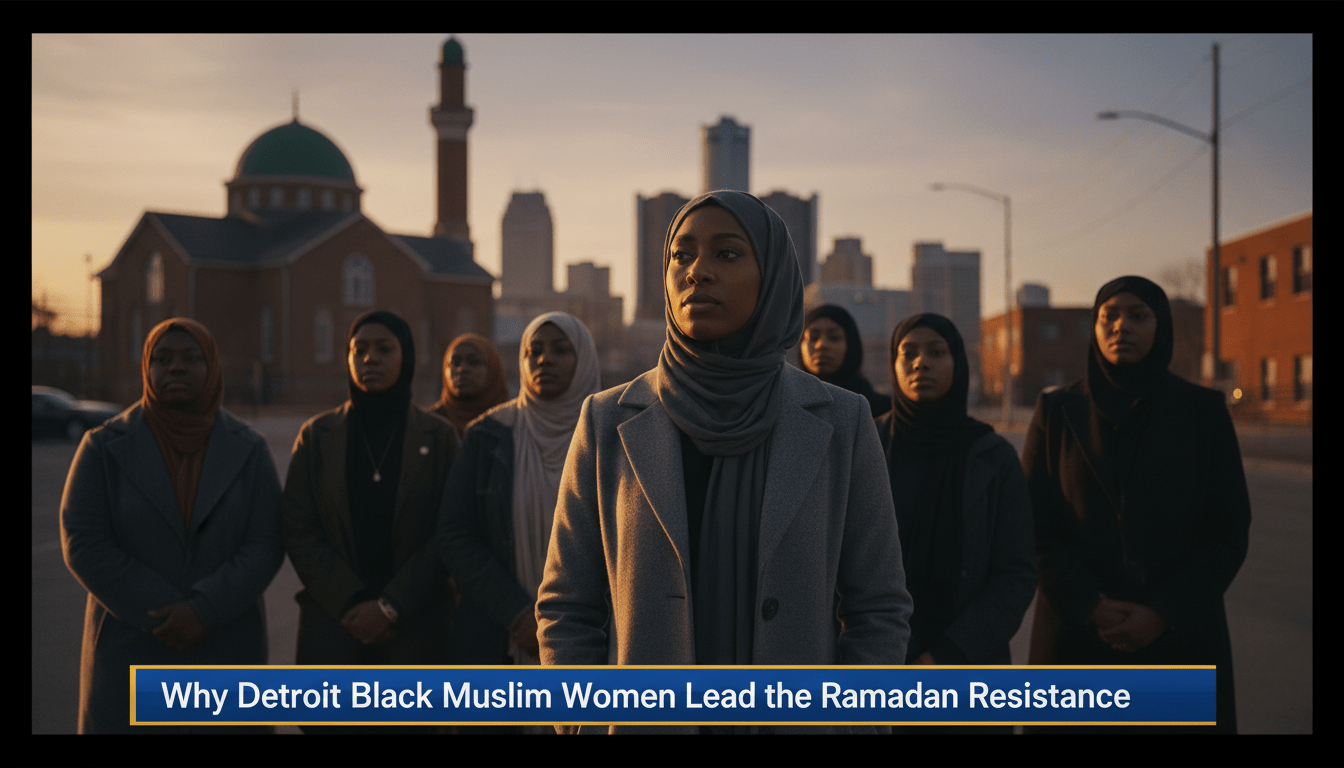
The city of Detroit serves as a spiritual and historical compass for Black Muslims in America. As the holy month of Ramadan begins in early 2026, the streets of the Motor City reflect a deep-rooted tradition of faith and resilience. For many Black Muslim women, this month of fasting is more than a religious obligation. It is a powerful statement of identity in a nation that often overlooks their contributions. This year, the observance feels especially significant as the community navigates a complex political landscape under President Donald Trump. His administration has coincided with a sharp rise in reports of bias and discrimination across the country (muslimmatters.org).
The “Black Muslim movement” remains a cornerstone of stability in Detroit’s neighborhoods. While headlines often focus on the challenges of Islamophobia, the history behind these stories reveals a legacy of self-reliance. Black Muslim women have long been the architects of this stability. They have built schools, managed businesses, and fostered a sense of “regal” dignity during eras of intense racial hostility. Today, that legacy continues as a younger generation of women uses the discipline of the fast to anchor their families and their city (wikipedia.org).
Source: Yaqeen Institute Study
The Detroit Roots of a Spiritual Revolution
The history of the Black Muslim movement is inseparable from the history of Detroit itself. In 1930, a mysterious figure named Wallace Fard Muhammad began preaching in the city’s Black neighborhoods. He introduced a version of Islam that focused on racial pride and economic independence. This was a direct response to the harsh realities of the Great Depression and Jim Crow laws. Many African Americans were looking for a way to escape the systemic poverty and violence of the time. Fard Muhammad offered a message of hope and a new name, teaching his followers that they were members of a lost tribe (wikipedia.org).
When Fard Muhammad disappeared in 1934, his student Elijah Muhammad took the lead. Under his guidance, the Nation of Islam (NOI) grew into a national force. Detroit became known as the “Mecca” of the movement because it was the home of Temple No. 1. The movement taught a “do-for-self” philosophy. This meant Black people should not rely on white systems that were designed to fail them. Instead, they opened their own grocery stores, bakeries, and clothing shops. This was a radical shaping of political dynamics that emphasized community control over external validation.
The theology of the early NOI was distinct from traditional Sunni Islam. It was a Black nationalist framework that viewed the struggle for civil rights as a spiritual battle. While the NOI and Sunni Islam share some terminology, their beliefs on the nature of God and the role of prophets differed significantly in the early years. The NOI focused on the immediate liberation of Black people in America. This local focus helped the movement provide immediate social and economic benefits to its members in Detroit (wikipedia.org).
Women as the Architects of the Movement
History books often highlight male leaders like Malcolm X, but women were the true anchors of the Black Muslim movement. Sister Clara Muhammad, the wife of Elijah Muhammad, played a vital role in the survival of the organization. During World War II, many male leaders were sent to prison for refusing to serve in the military. Sister Clara Muhammad stepped up to keep the movement together. She was especially focused on education, founding the University of Islam to provide an African-centered, Islamic education for children in the community (wikipedia.org).
Another key institution was the Muslim Girls Training and General Civilization Class (MGT). This auxiliary was designed to teach women how to be leaders in their homes and communities. It offered classes in childcare, cooking, and even self-defense. While these roles were framed in traditional ways, they gave Black women a sense of purpose and “regal” status. In a society that often treated Black women with disrespect, the movement declared them to be “Queens of the Planet Earth.” This helped them build a strong sense of self-worth that was shielded from the outside world (wikipedia.org).
The impact of these women extended beyond the home. They were the administrators of schools and the managers of businesses. They ensured that the “do-for-self” philosophy was put into practice every day. Because black women contributed so much to the organizational structure, the movement was able to withstand decades of government surveillance and social pressure. Their work laid the foundation for the community stability that Detroit sees today (muslimmatters.org).
*Percentage of Black Americans in US Muslim total (muslimmatters.org)
The Great Transition to Sunni Orthodoxy
A major shift occurred in 1975 following the death of Elijah Muhammad. His son, Warith Deen Mohammed, took leadership of the movement. He introduced significant changes to the theology and practice of the community. Warith Deen Mohammed wanted to move the movement closer to the global body of Sunni Islam. He focused on the universal message of the Quran and the importance of the Five Pillars of Islam. This transition was a moment of deep reflection for the Black Muslim community in Detroit (wikipedia.org).
Under his leadership, many of the old “Temples” were renamed “Masjids.” The community began to observe the five daily prayers and the lunar month of Ramadan. Previously, the NOI had observed a “December Fast” to distinguish itself from the Christian holiday of Christmas. Moving to the lunar fast connected Black Muslims in Detroit with the global “Ummah,” or worldwide community of believers. This change was not just about religion. It was also a move toward greater political engagement and interfaith dialogue (fpri.org, muslimmatters.org).
This evolution led to the creation of institutions like The Muslim Center and Masjid Wali Muhammad in Detroit. These mosques became more than just places of worship. They turned into neighborhood hubs that provided social services to everyone, regardless of their faith. Programs like *Neighborly Needs* began offering food pantries and health clinics. This helped the community maintain its “do-for-self” roots while expanding its reach to help the broader urban population (muslimmatters.org).
The Economics of Independence
The economic strategy of the Black Muslim movement was a direct challenge to the racial capitalism of the 20th century. In Detroit, Black residents often faced discrimination when trying to get loans or buy property. The NOI bypassed these obstacles by pooling resources to buy land and equipment. They established the “Your Supermarket” chain and numerous bakeries. These businesses provided healthy food to neighborhoods that were often ignored by major corporations (wikipedia.org).
This economic independence was a form of protection. When Black workers were the first to be fired from auto plants, they could find work within their own community. The profits from these businesses were used to fund the University of Islam schools. This created a self-sustaining system where the community could educate its own children and employ its own people. This history is similar to the revolutionary black nationalist position on self-determination and community care.
Today, this spirit of entrepreneurship continues among Black Muslim women in Detroit. Many are small business owners who use their platforms to promote social justice. They see their businesses as a way to uplift the city and provide opportunities for others. During Ramadan, these businesses often become centers for charity, providing meals for those in need and supporting local initiatives. The “do-for-self” philosophy has evolved into a sophisticated model of neighborhood stewardship (muslimmatters.org).
Ramadan as a Quiet Form of Resistance
In 2026, the practice of Ramadan has taken on a new layer of meaning for Black Muslim women. Anthropologists like Zarina El-Amin describe the fast as a “quiet discipline.” In a political environment where Islamophobia is on the rise, the act of fasting is a way to reclaim control over one’s life. It is a period of “inward checks” that helps people maintain their mental health and spiritual focus. For these women, the discipline of the fast is like muscle memory passed down from their parents (port-of-entry.com).
The current national climate has made this focus even more necessary. Statistics show a significant increase in discrimination complaints against Muslims in Michigan. Under the current administration of President Trump, many feel that the rhetoric from the top has emboldened bias in schools and workplaces. In response, Black Muslim women are using Ramadan to strengthen their communal bonds. They organize Iftars, which are the meals to break the fast, that serve as spaces for healing and political discussion (muslimmatters.org).
Fasting is also a way to resist the consumerism of modern society. By stepping away from the constant cycle of consumption, participants find a sense of freedom. This is particularly relevant for Black women who face the “dual burden” of racism and Islamophobia. The fast allows them to assert a disciplined, spiritual identity that defies negative stereotypes. It is a form of resistance that does not require shouting. It is found in the steady commitment to prayer and community service (port-of-entry.com, muslimmatters.org).
Navigating the Dual Burden of Prejudice
Black Muslim women face a unique set of challenges that researchers call the “dual burden.” They experience anti-Blackness within the broader Muslim community and Islamophobia within the wider American society. In many cases, their experiences are left out of the conversation. When people talk about “Muslim rights,” they often focus on immigrant communities. When people talk about “Black rights,” they often focus on Christian perspectives. This intersectionality can lead to a sense of “double-erasure” (muslimmatters.org).
The statistics are alarming. Over half of Muslim students report feeling unsafe or unwelcome in their schools. For Black Muslim students, this feeling is often compounded by racial profiling from law enforcement. Despite these hurdles, the community in Detroit remains resilient. They have built their own support systems to address mental health and legal protection. They do not wait for outside help to solve their problems. This is a continuation of the same spirit that drove the early “do-for-self” movement (muslimmatters.org).
Ramadan serves as a time to address these issues head-on. It is a season where the community gathers to share resources and information. By centering their faith and their Black identity, these women are creating a blueprint for how to thrive in a hostile environment. They show that identity is not something to be split. Instead, being Black and being Muslim are two halves of a whole that provide a unique strength (port-of-entry.com).
The Future of Faith and Community in Detroit
As Ramadan continues, the influence of the Black Muslim movement in Detroit shows no signs of fading. The city remains a global center for Islamic life and Black culture. The mosques continue to serve as pillars of the neighborhood, providing food, education, and spiritual guidance. Younger generations are taking the lessons of the past and applying them to modern problems. They are using social media and community organizing to fight against Islamophobia and for economic justice (muslimmatters.org).
The story of Black Muslim women in Detroit is a story of turning faith into action. They have proven that spiritual discipline can lead to social change. By maintaining their schools and businesses, they have created a stable environment for their families to grow. Their journey from the early days of the Nation of Islam to the present reflects a constant search for dignity and self-reliance. This history is a reminder that the headlines of today are built on the sacrifices of those who came before (wikipedia.org).
In the end, Ramadan in Detroit is about more than just fasting from food and water. It is about a community coming together to reaffirm its commitment to one another. It is a time to remember the “do-for-self” philosophy and to look toward a future of continued resistance and growth. The Black Muslim movement remains a vital part of the city’s identity, providing a path forward through faith, education, and unwavering strength (fpri.org, muslimmatters.org).
About the Author
Darius Spearman is a professor of Black Studies at San Diego City College, where he has been teaching for over 20 years. He is the founder of African Elements, a media platform dedicated to providing educational resources on the history and culture of the African diaspora. Through his work, Spearman aims to empower and educate by bringing historical context to contemporary issues affecting the Black community.
