


Why Federal Traffic Stops Sparked Texas Street Protests
By Darius Spearman (africanelements)
Support African Elements at patreon.com/africanelements and hear recent news in a single playlist. Additionally, you can gain early access to ad-free video content.
The Gunfire on Research Boulevard
The afternoon heat still hung over North Austin when gunshots shattered the everyday hum along Research Boulevard and Anderson Square. An enforcement operation conducted by federal immigration agents quickly spiraled into bloodshed. An officer with Immigration and Customs Enforcement fired their weapon, striking twenty-eight-year-old Wilber Rafael Garcés Pérez in the torso during a traffic stop and brief foot pursuit (texastribune.org, kvue.com). Austin Police Chief Lisa Davis confirmed that local officers rushed to the scene to deliver emergency first aid with trauma kits from patrol cars, while federal agents stood by waiting for an ambulance (fox7austin.com, kvue.com).
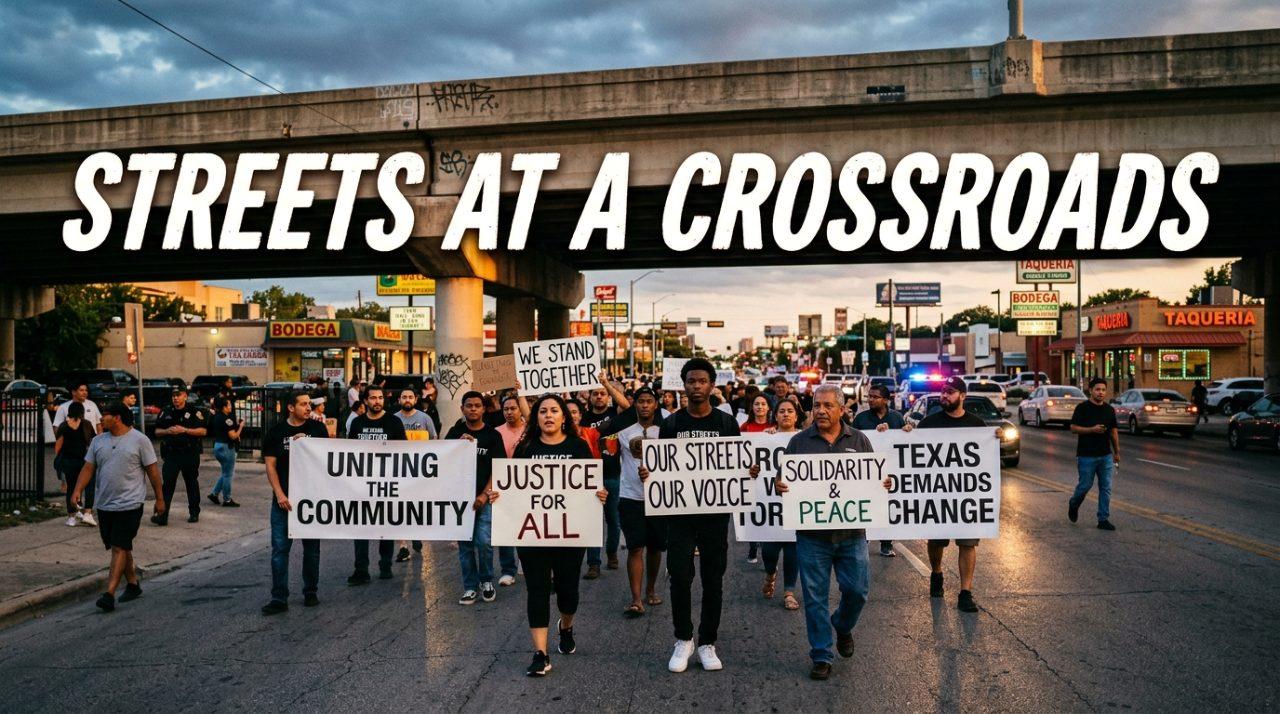
The shooting transformed a busy commercial strip into a flashpoint of community outrage. Demonstrators, immigrant organizers, and neighborhood residents assembled within hours beneath highway overpasses. Groups such as Hands Off Central Texas, Dare to Struggle Austin, and the Austin Immigrant Rights Action Committee gathered to challenge the federal narrative (youtube.com, facebook.com, facebook.com). Tensions escalated when tactical units deployed chemical pepper-ball rounds against crowds blocking traffic (facebook.com, facebook.com). For working communities of color, the encounter felt painfully familiar. Garcés Pérez, a Venezuelan food courier holding prior work authorization, was discharged from Dell Seton Medical Center and whisked straight into federal detention before his legal counsel or family could speak with him (texastribune.org, kvue.com). This rapid detention intensified public demands for immediate local answers.
A Broken Shield: Pretextual Stops and Federal Authority
Traffic enforcement has long served as an entry point for aggressive policing in Black and Brown neighborhoods. To understand how a routine vehicular stop turned into a near-fatal shooting, one must examine the legal standards governing the road. Under the landmark Supreme Court decision in Whren v. United States (1996), municipal police officers may conduct pretextual traffic stops (justia.com, oyez.org). This ruling allows officers to use minor traffic infractions, such as a broken taillight or failure to signal, to stop a vehicle and investigate unrelated suspicions (oyez.org).
Federal immigration agents, however, operate under an entirely different legal framework. Agents with Immigration and Customs Enforcement do not possess general municipal police powers. They cannot enforce state highway codes or use traffic infractions as a pretext to stop motorists (uscourts.gov). Instead, federal statute under 8 U.S.C. § 1357 and the Supreme Court precedent in United States v. Brignoni-Ponce (1975) mandate that federal agents must possess specific, articulable reasonable suspicion that a vehicle occupant is violating federal immigration law (wikipedia.org, oyez.org). Furthermore, Brignoni-Ponce established that apparent racial or ethnic ancestry alone cannot supply reasonable suspicion (oyez.org). When federal agents stage roving stops on municipal streets, they frequently stretch these constitutional boundaries, creating deep friction with local communities.
Legal Thresholds for Vehicle Interdictions
Constitutional standards separating local traffic policing from federal immigration stops
Pretextual Traffic Stops
Whren v. United States (1996)
Probable cause of any minor traffic equipment or moving violation, regardless of true officer intent.
General municipal traffic codes and local public safety statutes.
Broad Police PowerStatutory Enforcement Stops
United States v. Brignoni-Ponce (1975) & 8 U.S.C. § 1357
Particularized reasonable suspicion of unlawful presence or federal crime. Traffic infractions cannot serve as pretext.
Enforcement of federal immigration law; prohibited from enforcing state vehicle codes.
Strict Particularized CauseThe Long Shadow of Militarized Interior Policing
The presence of heavily armed federal units patrolling urban thoroughfares is the direct result of a structural policy overhaul that began more than two decades ago. Before 2002, immigration functions were managed under the Department of Justice by the Immigration and Naturalization Service (wikipedia.org, cato.org). Under that older structure, administrative record-keeping and field operations operated with looser coupling (wikipedia.org). The passage of the Homeland Security Act transformed that landscape entirely by creating the Department of Homeland Security in 2003 (wikipedia.org). The dissolution of the old agency divided civil processing from enforcement, giving birth to Customs and Border Protection and Immigration and Customs Enforcement (wikipedia.org).
From the beginning, federal leaders organized Immigration and Customs Enforcement as a paramilitary crime-fighting agency. Through wings such as Enforcement and Removal Operations and Homeland Security Investigations, agents received tactical body armor, assault rifles, and aggressive interdiction training (cato.org). Furthermore, statutory mechanisms like Section 287(g) of the 1996 immigration act and the later Secure Communities initiative blurred lines between local cops and federal deportation agents (gmu.edu, cato.org). This shift mirrors the historical shift toward mass incarceration that communities of color have documented for decades. Federal squads increasingly deployed vehicular containment maneuvers, surrounding civilian cars with tinted sport-utility vehicles. These maneuvers transformed routine regulatory checks into tactical ambushes on public streets.
Sanctuary Battles in Travis County
Austin has long stood in the crosshairs of federal enforcement controversies. The capital city of Texas has repeatedly clashed with state and federal leaders over the boundaries of municipal authority. This tension reached a boiling point in early 2017 when Travis County Sheriff Sally Hernandez implemented a historic policy shift (texastribune.org, texastribune.org). The sheriff announced that the county jail would refuse to honor administrative immigration detainer requests from federal agents unless an individual was charged with violent felonies like murder or human trafficking (texastribune.org, maldef.org).
Conservative state officials retaliated swiftly against the local measure. In May 2017, Governor Greg Abbott signed Senate Bill 4 into law (maldef.org, texastribune.org). The statute stripped local sheriffs and police chiefs of their discretion by requiring them to comply with federal detainer requests under penalty of criminal removal and hefty fines (maldef.org, texastribune.org). This clash reflected enduring struggles over national and state power that have defined political life in the South. Blocked from using local jail cells as effortless holding pens, federal agencies altered their tactics. Instead of waiting at county lockups, federal agents launched mobile task forces straight into residential corridors, making violent street-level confrontations almost inevitable.
Austin Echoes: The 2023 State Trooper Surge
The community backlash following the federal shooting did not materialize from thin air. Residents were already carrying deep trauma from aggressive policing operations that flooded local streets in 2023. That spring, state leaders deployed Texas Department of Public Safety highway patrol troopers into Austin under the banner of assisting a short-staffed city police department (austinmonitor.com, communityimpact.com). Rather than providing generalized support, state troopers concentrated their presence in historically segregated working-class minority neighborhoods across East and Southeast Austin (austinmonitor.com, fox7austin.com).
The human cost of that operation became undeniable when Travis County Attorney Delia Garza published demographic records tracking the traffic stops (austinmonitor.com, fox7austin.com). The data showed that between 87 percent and 90 percent of people arrested by state troopers for misdemeanor offenses were Black or Latino residents (austinmonitor.com, fox7austin.com). This extreme disparity emerged even though Black and Latino residents made up approximately 40 percent of the population in the city (austinmonitor.com). Troopers relentlessly pulled motorists over for minor equipment issues, creating an atmosphere of intense fear among working families. The ensuing public outcry from civil rights coalitions and local leaders forced city officials to terminate the state trooper partnership in July 2023 (communityimpact.com). The recent federal gunfire instantly revived these painful memories of targeted neighborhood surveillance.
Austin Police Surge: The Disparity Gap (2023)
Travis County demographic data exposing racial concentrations in state trooper enforcement
The Legal Void of Federal Immunity
When municipal officers commit acts of violence against civilians, civil rights lawyers have an established statutory path to seek accountability. Under 42 U.S.C. § 1983, individuals can sue state and municipal law enforcement officers in federal court for violating their constitutional protections (wikipedia.org). Congress originally passed this legislation during the Reconstruction era to protect formerly enslaved African Americans from abusive state authorities. However, Section 1983 strictly applies to people acting under color of state or local law. It provides zero legal recourse against agents working for the federal government (wikipedia.org).
For decades, citizens harmed by federal agents relied on a judicial doctrine known as a Bivens remedy, stemming from a 1971 case that allowed implied lawsuits for Fourth Amendment abuses (harvardlawreview.org, downeybrand.com). That legal doorway was virtually slammed shut in 2022 when the Supreme Court decided Egbert v. Boule (harvardlawreview.org, downeybrand.com). In that decision, the high court held that damages claims cannot proceed against federal border and immigration officers because national security concerns counsel total judicial hesitation (harvardlawreview.org). As a result, federal agents enjoy near-total immunity from civil accountability. When Austin Mayor Kirk Watson demanded an independent investigation into the shooting, he ran straight into this wall (texastribune.org). The Supremacy Clause and federal regulations prevent local district attorneys from easily subpoenaing records or filing state charges against federal agents operating on duty (house.gov, americanoversight.org). If victims face deportation before testifying, the accountability window closes entirely.
Rising Force and the Hazard of Vehicle Interdictions
The near-fatal shooting on Research Boulevard is part of a documented nationwide pattern of escalating force by federal immigration personnel. Historical records compiled by investigative journalists reveal that between 2015 and 2021, federal agents were involved in at least fifty-nine shootings that resulted in twenty-three deaths (thetrace.org). Not a single federal immigration officer faced criminal indictment for those fatal encounters (thetrace.org). More recently, records show a dramatic surge, with at least forty-two shootings by federal immigration personnel documented across the country between January 2025 and late 2026, leading to eleven fatalities (thetrace.org).
A primary driver of these shootings is the reckless tactic of firing into moving vehicles. Most municipal police agencies strictly ban officers from shooting at moving automobiles unless someone inside is using deadly force by means other than the vehicle itself. The Department of Justice discourages this tactic because shooting a driver creates an unguided projectile that endangers innocent bystanders (thetrace.org). Yet federal immigration squads continue to step into vehicular pathways during interdictions. Under the legal standard in Graham v. Connor (1989), an officer evaluates lethal force based on perceived immediate danger from their own viewpoint (oyez.org). By stepping near an accelerating bumper, an agent can claim mortal fear to legally justify opening fire through a windshield (thetrace.org). This dangerous maneuver has resulted in repeated civilian casualties across Texas and nationwide (mprnews.org, mprnews.org).
Federal Immigration Shootings & Force Outliers
Documented federal agent gunfire incidents and legal accountability records
Community Resistance at the Crossroads
The gunfire in North Austin highlights how civil rights struggles continually evolve. Immigrant rights organizers and Black liberation advocates have recognized that aggressive street interdictions stem from a shared root. Federal surveillance programs, unconstrained street policing, and unaccountable armed forces affect every marginalized community. From historic efforts to disrupt political assemblies to modern deportation roundups, targeted federal surveillance has repeatedly sought to intimidate those demanding justice.
Civil rights groups in Austin are refusing to treat the shooting of Wilber Rafael Garcés Pérez as an isolated mishap. Instead, coalitions of legal advocates, labor activists, and neighborhood organizers are building broad solidarity. Garcés Pérez was pursuing honest labor to provide for loved ones, echoing the historic struggles of vulnerable workers throughout American labor history. As long as the federal government maintains an armed force that operates outside local control, streets across the nation will remain on edge. The community demonstrators marching down Research Boulevard are demanding meaningful change: clear answers, an end to tactical vehicular stops, and complete public accountability for federal agents who pull the trigger.
About the Author
Darius Spearman is a professor of Black Studies at San Diego City College, where he has been teaching for over 20 years. He is the founder of African Elements, a media platform dedicated to providing educational resources on the history and culture of the African diaspora. Through his work, Spearman aims to empower and educate by bringing historical context to contemporary issues affecting the Black community.
