

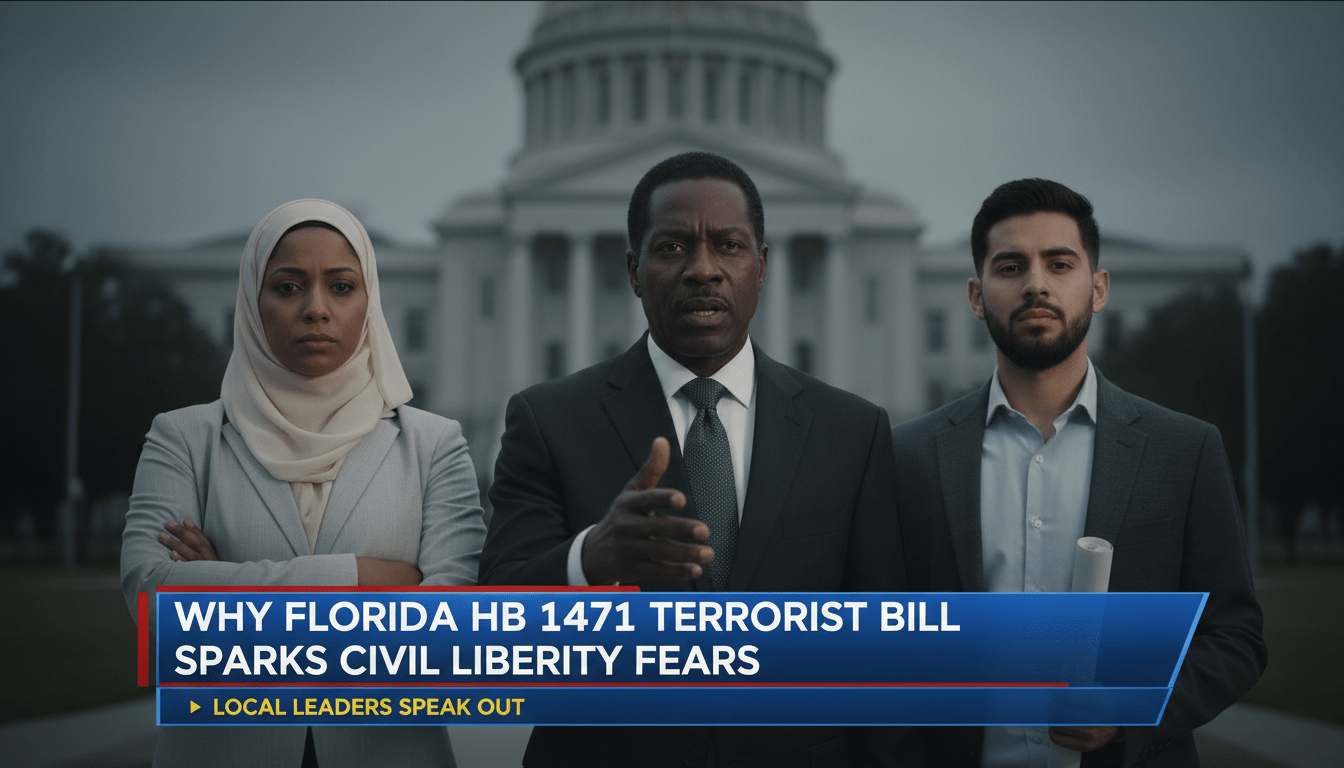
Why Florida HB 1471 Terrorist Bill Sparks Civil Liberty Fears
By Darius Spearman (africanelements)
Support African Elements at patreon.com/africanelements and hear recent news in a single playlist. Additionally, you can gain early access to ad-free video content.
The Florida Senate has recently passed a new law that is causing a lot of worry among civil rights groups. This law is House Bill 1471. It gives state leaders the power to name groups as “domestic terrorist organizations.” Many people are calling this a major expansion of state power. Critics argue that this law will target Black, Muslim, and immigrant communities (outsfl.com). They believe it is a tool to silence people who disagree with the state government.
The bill passed in early March 2026. It creates a system where state officials can label a group without a criminal trial. This is what some call “guilt by designation.” If a group gets this label, its members can face very harsh penalties. This includes up to 30 years in prison under existing rules (publicintegrity.org). The timing of this bill is also important. It comes while President Donald Trump is leading the country. It also follows several years of tension over protests and school funding in Florida.
Growth of Domestic Terrorism Cases
FBI domestic terrorism investigations have surged nationally (publicintegrity.org).
A History of Targeting Subversive Groups
To understand HB 1471, people must look at Florida history. The state has a long record of trying to hunt down “subversive” groups. In the 1950s, Florida created the Johns Committee. This was the Florida Legislative Investigation Committee. Its first job was to target the NAACP. The state wanted to stop the civil rights movement. They tried to link civil rights leaders to Communism to discredit them (wikipedia.org). This effort was a clear attempt to block integration in schools and public places.
When the Supreme Court protected the NAACP, the Johns Committee changed its focus. It began to target LGBTQ+ individuals in state universities. They called these people “deviates” and purged them from schools. This historical context is important for understanding the notion of freedom for Black and minority groups. Many advocates see HB 1471 as a modern version of the Johns Committee. It allows the state to label citizens as threats based on who they know rather than what they did (wikipedia.org, lambdaliterary.org).
Transitioning into more recent years, Florida passed the “Anti-Riot” law in 2021. This was HB 1. It was a reaction to the racial justice protests of 2020. That law made it easier to arrest people at protests. Federal judges eventually blocked parts of it because it was too vague. Legal experts say HB 1471 is the next step in this trend. It moves from punishing actions at a protest to punishing membership in a group (publicintegrity.org). This pattern shows a consistent effort by the state to control Black political power through strict laws.
The Impact on Islamic Schools and Vouchers
HB 1471 contains specific language that targets Islamic schools. It bans any school with “terrorist affiliations” from receiving state voucher money. Florida has a very large school choice program. It is a $3 billion program that helps many private schools (networkforpubliceducation.org). There are about 22 Islamic private schools in the state. These schools rely on voucher funds to help their students. For example, Hifz Academy in Tampa has received over $15 million in the last ten years (wlrn.org).
The bill specifically mentions “Sharia law.” It declares that any contract or court decision based on Sharia is void if it violates certain liberties. This is controversial because Florida law already prevents foreign laws from overriding the Constitution (abajournal.com). Critics argue that naming Sharia law specifically is meant to stigmatize Muslims. They believe it creates a path for the state to pull funding from Islamic schools without clear proof of wrongdoing (wusf.org, wlrn.org). This could hurt the education of many African American students who attend these diverse religious schools.
Florida Private School Vouchers
The Power of the Florida Cabinet
Under this law, the process of naming a terrorist group is very powerful. It starts with the Chief of Domestic Security. This person is the Commissioner of the Florida Department of Law Enforcement. They make a recommendation to the Florida Cabinet (flsenate.gov). The Cabinet consists of the Attorney General, the Chief Financial Officer, and the Commissioner of Agriculture. These three people must vote to approve the label. This is a significant amount of power for a small group of people.
The Florida Cabinet is unique. Its members are elected by the whole state. They do not just work for the Governor. This was originally designed to prevent one person from having too much power (flsenate.gov). However, if all members agree, they can label a group and trigger immediate punishments. Once a group is on the list, the state can freeze its money. Also, students who are members can be kicked out of universities. This happens before a group can even go to court to defend itself (flsenate.gov, publicintegrity.org). This lack of immediate due process is a major concern for legal experts.
This structure matters because it affects how political strategy works in Florida. If the Cabinet is all from one political party, there may be fewer checks on this power. Civil rights groups worry that the Cabinet will use these labels against political opponents. They point to how state officials have already spoken about groups like Black Lives Matter or CAIR. They fear the Cabinet will use the “terrorist” label to stop activism that they do not like (outsfl.com, abajournal.com).
Vague Terms and the Risk to Activists
One of the biggest problems with HB 1471 is its use of vague words. The bill uses terms like “promotion” and “affiliation” but does not define them clearly. This leaves a lot of room for interpretation by state officials (publicintegrity.org). If a person shares a post from a labeled group on social media, is that “promotion”? If a person attends a public meeting where a member of that group speaks, is that “affiliation”? Without clear rules, many people may be afraid to speak at all.
This creates a “chilling effect” on free speech. For students at Florida universities, the stakes are very high. If the state decides a student “promoted” a designated group, that student faces immediate expulsion. They also lose their financial aid and in-state tuition (flsenate.gov). This could end a student’s education over a single social media post. History shows that vague laws are often used against those who fight for economic justice and civil rights. The ACLU of Florida has warned that this bill is like a state-level version of the PATRIOT Act (outsfl.com, publicintegrity.org).
Furthermore, the process to get a label removed is difficult. A group must sue the state after they have already been labeled. There is no notice period or hearing before the designation happens. By the time a group gets to court, the damage may already be done. Their bank accounts could be empty and their members could be in jail (publicintegrity.org). This is a reversal of the idea that people are innocent until proven guilty in a court of law.
HB 1471 Consequences Flowchart
The Role of Courts and Recent Precedents
The courts will likely have the final say on HB 1471. There is already a recent case that shows how judges might react. In late 2024, the Governor labeled the Council on American-Islamic Relations (CAIR) as a terrorist group (abajournal.com). He used an executive order to do this. However, a federal judge named Mark Walker blocked that order. The judge said the Governor cannot use his office to ignore the First Amendment. He also noted that only the federal government has the power to name “Foreign Terrorist Organizations” (mtsu.edu).
This ruling is a major hurdle for the new law. HB 1471 tries to get around this by focusing on “domestic” groups. Still, the same constitutional issues apply. The First Amendment protects the right of people to join groups and speak their minds. If the state uses HB 1471 to target groups based on their political or religious views, the courts may strike it down (mtsu.edu). Civil rights groups like Equality Florida and the NAACP are already preparing for these legal battles.
In addition to the First Amendment, the Fourteenth Amendment is also at play. This amendment guarantees “due process” and “equal protection” under the law. Critics argue that HB 1471 violates these rights by allowing the state to punish people without a trial (publicintegrity.org). They also argue that the law is not being applied equally because it specifically names Islamic practices like Sharia. These legal arguments will be the core of the fight against the bill in the coming months (wusf.org, abajournal.com).
Conclusion: Freedom and State Power
HB 1471 represents a major shift in how Florida handles domestic security. It moves away from focusing on criminal acts and toward focusing on associations and beliefs. For the Black and minority communities, this feels like a step backward toward a darker time in Florida history. It echoes the days of the Johns Committee and the surveillance of the civil rights movement. The broad powers given to the Cabinet and the vague definitions in the bill create a risky environment for anyone who wants to speak out against the government (wikipedia.org, outsfl.com).
The threat to Islamic schools and university students shows that the impact of this law will be felt in many areas of life. It is not just about stopping violence. It is about who gets to participate in the “universal” school choice program and who gets to stay in college. As the bill heads to the Governor’s desk, the debate over its fairness will only get louder. The outcome of this struggle will decide the future of civil liberties in the state of Florida for years to come.
About the Author
Darius Spearman is a professor of Black Studies at San Diego City College, where he has been teaching for over 20 years. He is the founder of African Elements, a media platform dedicated to providing educational resources on the history and culture of the African diaspora. Through his work, Spearman aims to empower and educate by bringing historical context to contemporary issues affecting the Black community.
