

Why Haiti Faces Famine: The Haiti Hunger Crisis Historical Causes
By Darius Spearman (africanelements)
Support African Elements at patreon.com/africanelements and hear recent news in a single playlist. Additionally, you can gain early access to ad-free video content.
Haiti is facing a hunger crisis that many experts call a man-made famine. Armed groups now control most of the capital city. They block roads and stop food from reaching people who are starving. This situation is not a sudden accident of nature. It is the result of many years of history. People in the African diaspora often look at Haiti as a beacon of freedom. However, that freedom has come with many challenges from outside forces (reliefweb.int).
Today, nearly half of the population does not have enough to eat. This includes over five million people who struggle every single day. For the first time, some areas are facing “catastrophic” levels of hunger. This is the highest level on the international scale. It means people are dying from starvation. Current President Donald Trump and other world leaders are watching as the situation gets worse. Meanwhile, local groups are working hard to feed their own neighbors (reliefweb.int).
Haiti Food Insecurity Levels (2024)
The Evolution of Armed Power
The armed groups that control Haiti today have deep roots in the past. In 1959, the dictator François Duvalier created a group called the Tonton Macoutes. They were a private militia used to keep him in power. They did not answer to the regular army. Instead, they worked directly for the leader. This created a long tradition of politicians using armed men to control the streets. This history shaped how power works in the country today (globalinitiative.net).
After the Duvalier family left in 1986, the militias did not disappear. They changed their names and their bosses. Many political leaders used these groups to influence elections. By the year 2020, these groups began to work together. They formed big alliances like the G9 Family and Allies. Now, they are no longer just tools for politicians. They have become their own bosses. They control ports, gas stations, and food markets. This shift has made it very hard for the government to function (globalinitiative.net).
The alliance known as “Viv Ansanm” is the most powerful group right now. The name means “Live Together” in Haitian Creole. However, their actions have caused many people to flee their homes. They have attacked police stations and opened the doors of big prisons. They claim they are fighting for the poor against the rich. In reality, their blockades make food prices go up for everyone. This cycle of violence makes it nearly impossible for farmers to bring their crops to the city (globalinitiative.net).
How Trade Policy Destroyed Local Farms
Haiti was once able to grow almost all the food it needed. In the 1980s, the country was self-sufficient in rice. Rice is a main part of the diet for most families. However, international groups like the IMF and the World Bank pushed for changes. They wanted Haiti to open its markets to foreign goods. They forced the government to lower the taxes on imported rice. These taxes dropped from 35 percent down to only 3 percent (timothyschwartzhaiti.com).
Because of these changes, cheap rice from the United States flooded the country. This imported grain became known as “Miami Rice.” Local farmers could not compete with the low prices. U.S. farmers receive help from their government to keep prices down. Haitian farmers did not have that kind of support. Many farmers lost their land and moved to the city to find work. This created a dependency on foreign food that still exists today (timothyschwartzhaiti.com, reliefweb.int).
Years later, former President Bill Clinton apologized for these policies. He admitted that the trade deals were a mistake. He said they destroyed the ability of Haiti to feed itself. This loss of economic justice for farmers left the nation vulnerable. Now, when gangs block the ports, there is no local food to take its place. The country imports more than 80 percent of its rice today. This makes the hunger crisis much more dangerous (timothyschwartzhaiti.com).
The Siege of the Capital City
Port-au-Prince is currently a city under siege. Two major highways, RN1 and RN2, are the lifelines for the capital. RN1 goes north to the Artibonite Valley, which is the main farming area. RN2 goes south to other important regions. Armed groups have set up checkpoints on these roads. They charge high fees for trucks to pass. Sometimes they simply steal the food and the trucks. This stops the flow of vegetables and grain into the city (reliefweb.int).
Because the roads are blocked, the price of food has spiked. Families now spend up to 70 percent of their money just on food. Inflation has reached nearly 30 percent in some areas. When food does reach the market, many people cannot afford to buy it. This creates a situation where food is available on the shelves, but the people are still starving. The blockades act as a weapon of war against the most vulnerable citizens (reliefweb.int).
The gangs also control the main seaports and the airport. This prevents humanitarian aid from arriving in large amounts. International groups find it very hard to deliver supplies like therapeutic food. This special food is a nutrient-dense paste used to save children from malnutrition. Without safe access to the ports, these life-saving supplies sit in warehouses or never arrive at all. This has led to a sharp increase in child deaths across the city (reliefweb.int).
Neighborhood Kitchens and Local Resilience
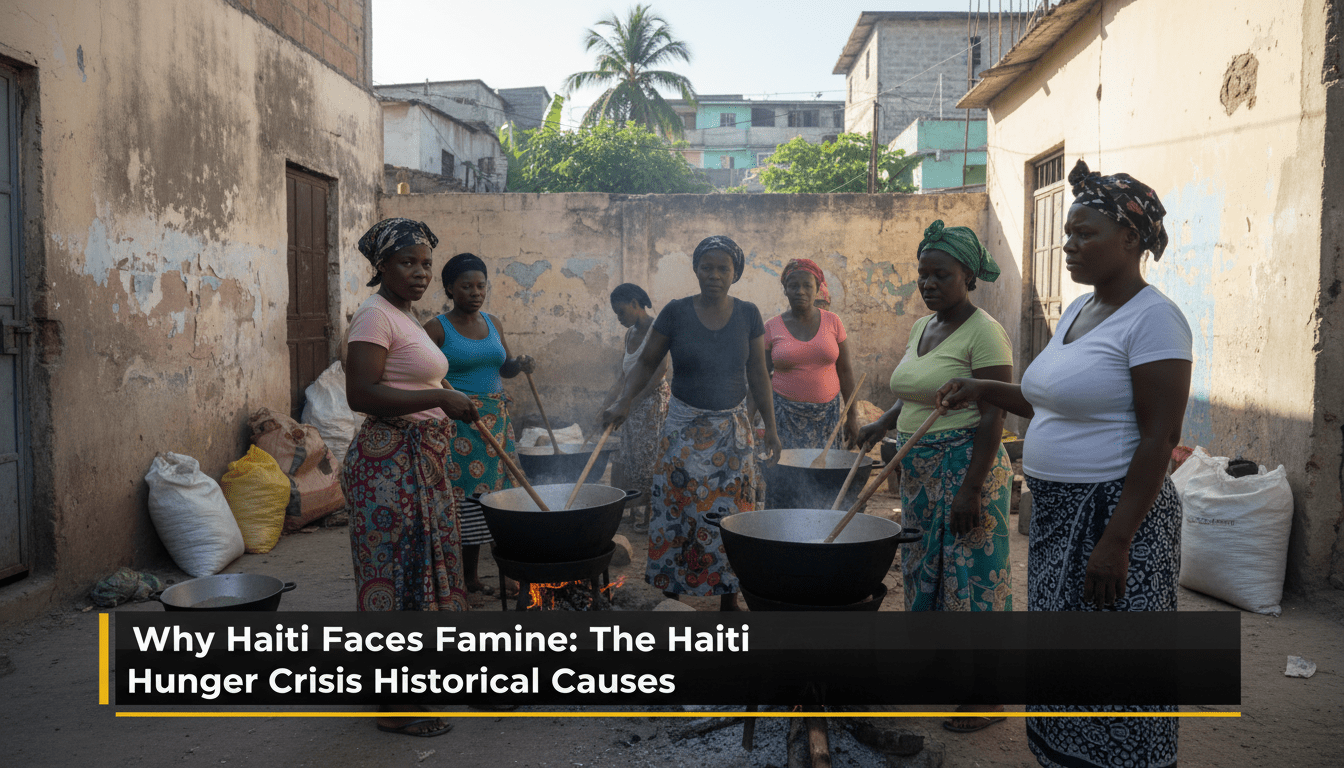
While the world watches, the people of Haiti are taking matters into their own hands. Local leaders have started “neighborhood kitchens” or *Kantin Popilè*. These are community-led projects where neighbors pool their resources. They find ways to get food past the gang blockades. Often, they use motorbikes to carry small amounts of food through back alleys. These kitchens provide at least one hot meal a day to those who have nothing (reliefweb.int).
These efforts are part of a larger movement for Neighborhood Innovation in the face of crisis. Women play a central role in these community plans. They organize the cooking and decide who needs the food most. By working together, they create a safety net that the government cannot provide. These kitchens are more than just places to eat. They are symbols of resistance against the chaos caused by the armed groups (reliefweb.int).
Some local organizations are also creating “safe corridors.” These are secret or negotiated routes that allow food to travel safely. They work with truck drivers and community members to monitor the roads. They try to bypass the main checkpoints controlled by gangs. This homegrown planning is often more effective than large international aid programs. It relies on local knowledge and trust between neighbors. It shows the strength of the Haitian spirit even in the darkest times (reliefweb.int).
The Long Shadow of the Independence Debt
The current economic weakness of Haiti is linked to a very old debt. After the Haitian Revolution, France demanded money in exchange for recognizing the country. In 1825, French warships arrived and demanded 150 million gold francs. This was called the “Independence Debt.” It was meant to pay former slave owners for their “lost property.” This was the only time in history where the formerly enslaved had to pay their masters for their freedom (harvard.edu).
Haiti had to take out massive loans from French and American banks to pay this debt. For over 100 years, the country spent most of its budget on interest payments. This meant there was no money left for schools, hospitals, or roads. It also meant the government could not invest in its own farmers. Historians say this debt cost Haiti billions of dollars in growth. This financial burden is a major reason why the state is so weak today (harvard.edu, claremont.edu).
Today, there are new calls for France to pay back this money. Leaders in the Transitional Presidential Council have asked for reparations. They argue that the debt was illegal and immoral. If that money had stayed in the country, Haiti might have been able to build a stronger army and police force. A stronger state could have prevented the rise of the gangs that now cause the hunger crisis. The past is always present in the struggle for Haitian food security (claremont.edu).
Understanding the Famine Scale
To measure how bad hunger is, experts use a system called the IPC scale. There are five phases in this system. Phase 1 is normal, and Phase 5 is a famine. In 2024, parts of Port-au-Prince reached Phase 5 for the first time. This is a very rare and scary event. It means that at least one out of every five households is completely out of food. It also means that children are dying from lack of nutrition (reliefweb.int).
Most of the country is currently in Phase 3 or Phase 4. Phase 3 is a “crisis” where families have to sell their tools or clothes to buy food. Phase 4 is an “emergency” where people face very high levels of malnutrition. The move to Phase 5 shows that the situation has reached a breaking point. Humanitarian groups are calling for an immediate “humanitarian pause” in the violence. They need the gangs to stop fighting so they can get food to the Phase 5 areas (reliefweb.int).
The ranking system is vital for getting international help. When a “famine” is declared, it usually triggers more funding from wealthy nations. However, the violence makes it hard for experts to even collect the data. They must go into dangerous neighborhoods to weigh children and talk to families. Despite the danger, they continue this work to tell the world what is happening. They want to ensure the people of Haiti are not forgotten (reliefweb.int).
Annual Food Inflation Rate
Average Increase in Basic Food Costs (2024)
The Search for a Stable Government
Haiti has not had a full, elected government for a long time. The last president, Jovenel Moïse, was killed in 2021. After that, Prime Minister Ariel Henry led the country. However, many people felt he was not doing enough to stop the gangs. In early 2024, the gangs joined together to force him to resign. They attacked the airport so he could not return from a trip abroad (reliefweb.int).
Now, a group called the Transitional Presidential Council is in charge. Their job is to restore order and organize new elections. They have appointed a new Prime Minister, Alix Didier Fils-Aimé. They are also working with a security mission from Kenya. This mission is supported by the United Nations. They hope to take back control of the roads and the ports from the armed groups. This is a very difficult task because the gangs are well-armed (reliefweb.int).
The goal of the council is to hold elections by 2026. However, it is hard to have an election when people are starving and afraid to leave their homes. The government must find a way to lower food prices and make the streets safe. Without food security, there can be no political stability. The hunger crisis and the political crisis are two sides of the same coin. Solving one requires solving the other at the same time (reliefweb.int).
Homegrown Plans for the Future
There is still hope for Haiti despite the many challenges. Local groups are moving away from just giving out foreign grain. They are focusing on buying food from local farmers who are still working. By purchasing local crops, they help the Haitian economy grow. This is a more sustainable way to fight hunger. It helps farmers stay on their land and keeps money within the community (reliefweb.int).
Programs like “Meds & Food for Kids” are producing therapeutic food inside Haiti. They use local peanuts and local workers. This means they do not have to wait for ships to arrive at the blocked ports. When local production increases, the country becomes less vulnerable to gang blockades. These homegrown plans show a path toward food sovereignty. This means the people of Haiti would have the power to feed themselves (reliefweb.int).
The history of Haiti is a story of resistance. From the revolution against slavery to the modern neighborhood kitchens, the people have always found ways to survive. The current hunger crisis is a great test of that spirit. Support for local groups is essential. While the world discusses military missions, the people in the kitchens are saving lives every day. They are building a future where food is a right, not a weapon (reliefweb.int).
About the Author
Darius Spearman is a professor of Black Studies at San Diego City College, where he has been teaching for over 20 years. He is the founder of African Elements, a media platform dedicated to providing educational resources on the history and culture of the African diaspora. Through his work, Spearman aims to empower and educate by bringing historical context to contemporary issues affecting the Black community.
