



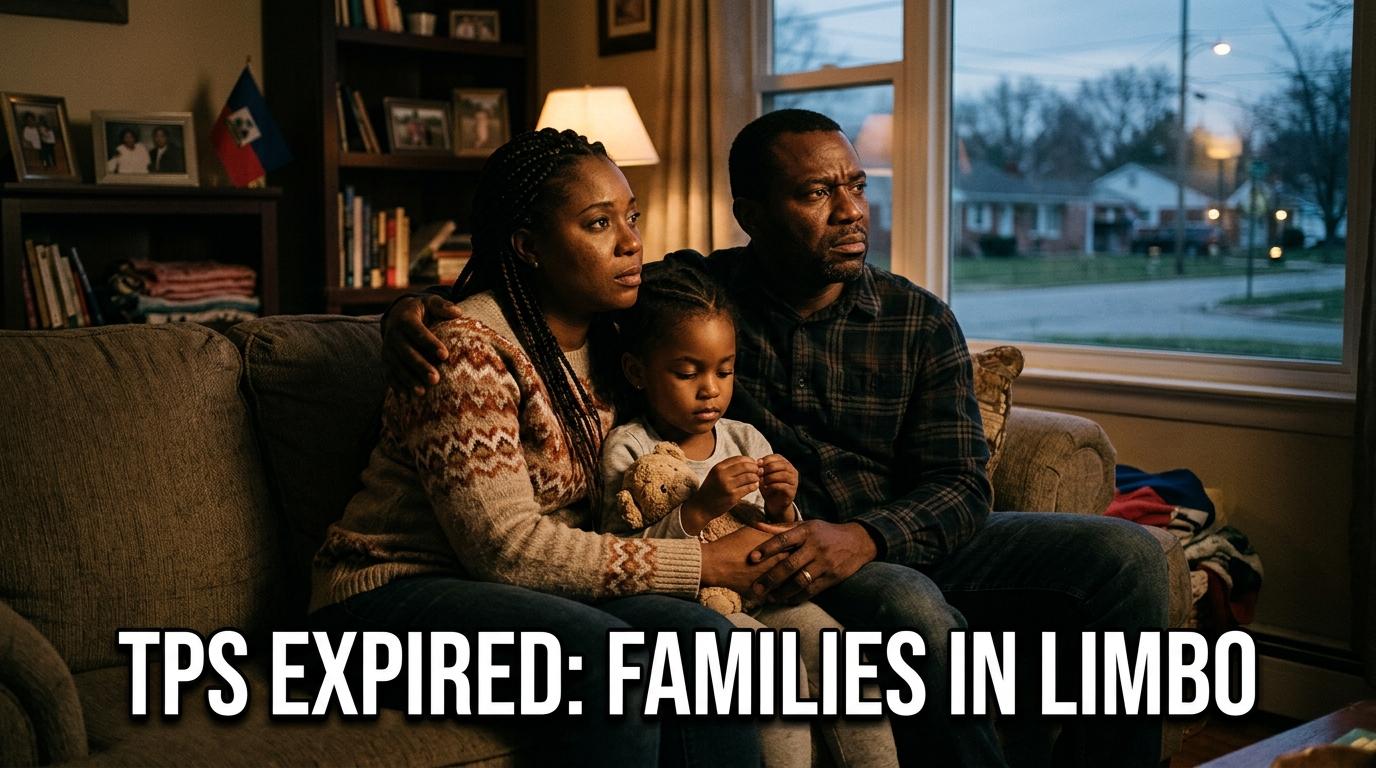
Why Haitian TPS Expiration Triggers Nationwide Panic
By Darius Spearman (africanelements)
Support African Elements at patreon.com/africanelements and hear recent news in a single playlist. Additionally, you can gain early access to ad-free video content.
Uncertainty Strikes Haitian Communities Across America
A heavy cloud of anxiety settled over Black immigrant neighborhoods on Monday, July 27, 2026. At midnight, federal protections officially ended for nearly 350,000 Haitian nationals residing in the United States (uscis.gov). Panic spread rapidly from South Florida to industrial towns in the Midwest (elpais.com). Community organizers reported immediate and severe disruption across local labor markets (elpais.com). Employers began placing workers on unpaid suspension as legal employment cards expired overnight (elpais.com).
Families are currently remaining indoors to avoid potential operations by federal enforcement agents (elpais.com). Neighborhood leaders describe unusually quiet streets and empty commercial corridors (elpais.com). Many parents express deep terror regarding driving their children to school or neighborhood care programs (elpais.com). The sudden termination of legal status has thrown established communities into immediate turmoil (elpais.com).
The Statutory Origins of Temporary Protected Status
To comprehend this nationwide emergency, one must examine federal statutory history. Congress formally created the Temporary Protected Status policy under the Immigration Act of 1990 (congress.gov). President George H.W. Bush signed the bipartisan legislation into law to offer humanitarian protection (congress.gov). The statutory structure grants executive authority to protect foreign nationals during catastrophic international crises (congress.gov).
Under the statute, the Secretary of Homeland Security evaluates specific criteria before designating a foreign country (congress.gov). Qualifying hazards include ongoing armed conflicts, massive environmental disasters, or extraordinary conditions (congress.gov). Beneficiaries receive absolute protection from deportation along with valid temporary employment permits (congress.gov). However, the program explicitly fails to offer a direct pathway toward permanent resident status or citizenship (forumtogether.org).
The processing of these benefit claims rests with U.S. Citizenship and Immigration Services (uscis.gov). The Homeland Security Act of 2002 established this dedicated civilian agency (uscis.gov). Congress intentionally separated benefit processing functions from border security and interior deportation law enforcement (uscis.gov). Under established administrative guidelines, federal authorities issue either an extension or a redesignation (federalregister.gov).
An extension simply lengthens existing protections for individuals who are already registered (federalregister.gov). Conversely, a redesignation establishes a brand-new arrival cut-off date (federalregister.gov). That vital administrative change allows newly arrived migrants fleeing fresh humanitarian disasters to seek legal relief (federalregister.gov). Consequently, redesignations permit protected populations to expand significantly over time as national conditions evolve (federalregister.gov).
Disaster and Crisis: The Path to Protection
Haiti became tied to the program following a modern catastrophe. On January 12, 2010, a violent magnitude 7.0 earthquake struck near Port-au-Prince (federalregister.gov). The devastating disaster killed more than 300,000 people and flattened government institutions (federalregister.gov). Days later, federal officials granted initial humanitarian relief to protect survivors residing in the United States (federalregister.gov).
Unfortunately, the island nation never fully recovered from that initial loss. Subsequent environmental disasters and a massive cholera epidemic continually hindered national recovery efforts (rescue.org). Historical instability and international intervention connect deeply to the deep political history of Haiti and its global struggles. These recurring external disruptions prevented families from returning home safely (rescue.org).
Conditions collapsed completely in July 2021 after the assassination of President Jovenel Moïse (globalrefuge.org). Violent criminal networks rapidly seized physical control over critical infrastructure and transport routes (globalrefuge.org). Severe gang violence, widespread kidnappings, and civil breakdown dominated daily life across urban centers (globalrefuge.org). Because of these dangerous realities, successive presidential administrations repeatedly extended and redesignated humanitarian relief for Haitian nationals (federalregister.gov).
The High-Stakes Legal Battle for Survival
The road to the July 2026 expiration involved aggressive political shift and court litigation. In July 2024, federal authorities issued an eighteen-month extension and redesignation (federalregister.gov). That order protected eligible individuals through February 3, 2026 (federalregister.gov). However, presidential administration priorities shifted dramatically following the 2024 national election cycle.
Newly appointed executive leaders immediately moved to revoke administrative protections (dhs.gov). In late 2025, officials formally published orders terminating humanitarian status for Haitian beneficiaries (dhs.gov). Civil rights attorneys swiftly filed class-action lawsuits to block the planned termination (elpais.com). On February 2, 2026, Judge Ana Reyes granted an emergency injunction staying the executive order in *Miot v. Trump* (elpais.com). The court emphasized severe violence and ongoing gang torture in Port-au-Prince (elpais.com).
The high-stakes legal dispute escalated rapidly to the highest judicial authority. On June 25, 2026, the U.S. Supreme Court delivered a decisive 6-3 ruling in *Mullin v. Doe* (supremecourt.gov). Writing for the majority, Justice Samuel Alito declared that federal law bars judicial review over executive termination decisions (supremecourt.gov). In a forceful dissenting opinion, Justice Elena Kagan argued that evidence of racial prejudice was plain to see (supremecourt.gov). To manage administrative logistics, immigration officials granted a final transitional work extension through July 27, 2026 (uscis.gov).
Economic Reality and the Essential Workforce
The extraction of 350,000 individuals from the legal workforce delivers a devastating blow to the economy. Research indicates that Haitian status holders generate $5.9 billion in gross domestic product each year (fwd.us). Furthermore, these workers pay $1.5 billion annually in federal, state, and payroll taxes (fwd.us). Removing these financial contributions drains vital revenue from major metropolitan centers and rural communities alike (fwd.us).
Approximately 200,000 affected beneficiaries were actively employed prior to the official expiration date (fwd.us). Over 13,000 beneficiaries served as certified nursing assistants, while 8,000 worked as home caregivers (fwd.us). Removing these dedicated workers creates severe vulnerabilities across healthcare delivery systems (thearc.org). Long-standing structural inequalities recall a broader history of economic struggle and labor across Black history.
Federal employment law imposes strict compliance standards on American businesses through Form I-9 verification rules (uscis.gov). Employers must physically inspect identity documents and verify eligibility within three days of hire (uscis.gov). When employment authorization cards expire, companies must conduct mandatory reverification (uscis.gov). Consequently, human resource departments across the nation began terminating long-time staff members to maintain federal compliance (elpais.com).
Racial Animus and False Rhetoric in the Public Eye
Civil rights lawyers based their legal challenges heavily on claims involving racial animus. Plaintiffs asserted that executive policy changes were driven by explicit prejudice against non-white immigrants (elpais.com). Legal briefs highlighted a documented record of hostile statements made by political figures (elpais.com). Advocates argued that administrative standards were altered specifically to target Black and Latino populations (elpais.com).
Tensions surrounding the issue intensified after political figures amplified false rumors targeting Springfield, Ohio (time.com). Distorted claims regarding local Haitian residents caused severe fear and physical security threats (time.com). The municipal school system endured dozens of bomb threats and safety closures (time.com). These public incidents reflected broader anti-Black political strategies used to divide local communities (elpais.com).
Local leaders in Springfield strongly rejected the harmful public claims (time.com). Municipal officials emphasized that 12,000 Haitian arrivals had revitalized local industrial factories (time.com). Community leaders credited immigrant families with filling critical labor shortages and expanding local tax bases (time.com). Following the High Court decision, Ohio Governor Mike DeWine publicly criticized forced mass deportations, describing forced returns to Haiti as a terrible error (newsfromthestates.com).
The Human Toll on American Families and Children
Beyond fiscal figures lies a profound human rights tragedy. An estimated 50,000 American-born children have parents who held Haitian TPS status (americanimmigrationcouncil.org). Because these youth possess constitutional birthright citizenship, they cannot be legally deported (americanimmigrationcouncil.org). However, their parents face immediate arrest and removal from the country (americanimmigrationcouncil.org).
This dynamic forces parents to make heartbreaking emergency custody arrangements (americanimmigrationcouncil.org). Legal defense groups are helping families execute standby guardianship paperwork to protect minor children (americanimmigrationcouncil.org). Without parental income, thousands of citizen children risk severe poverty or placement in state foster care systems (americanimmigrationcouncil.org). This struggle highlights the remarkable strength and resilience of Black families under extreme hardship.
Federal agency spokespersons are actively encouraging affected individuals to leave the country voluntarily (cbsnews.com). Officials publicly declared that the legal period to remain has drawn to a complete close (cbsnews.com). The department offered modest financial incentives and free travel arrangements to facilitate self-deportation programs (cbsnews.com). Yet, with Haiti under severe travel advisories, returning offers no physical safety (haitianbridgealliance.org). Grassroots immigrant networks continue providing emergency legal support as Black communities navigate an incredibly dark moment (elpais.com).
About the Author
Darius Spearman is a professor of Black Studies at San Diego City College, where he has been teaching for over 20 years. He is the founder of African Elements, a media platform dedicated to providing educational resources on the history and culture of the African diaspora. Through his work, Spearman aims to empower and educate by bringing historical context to contemporary issues affecting the Black community.
