

Why Investing in Black Women is the Key to National Wealth
By Darius Spearman (africanelements)
Support African Elements at patreon.com/africanelements and hear recent news in a single playlist. Additionally, you can gain early access to ad-free video content.
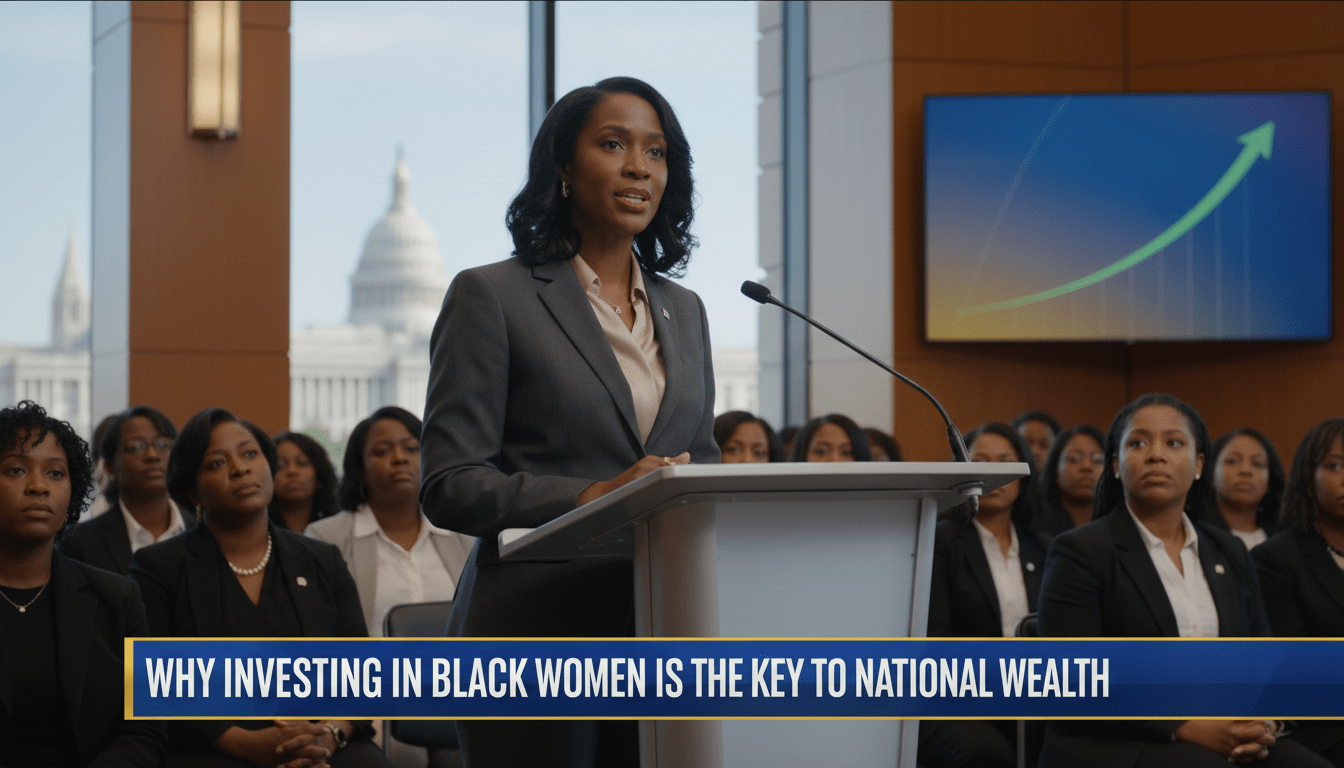
The 16th Annual Stephanie Tubbs Jones Social Justice Forum convened today in Washington, D.C. This important summit brings together leaders to discuss the economic future of the nation. The central theme for this year is a focus on investing in Black women. This theme highlights the power of Black women to drive the entire economy forward. It also addresses the deep gaps in wealth that still exist today. The forum serves as a bridge between historical struggles and modern financial goals. It honors the legacy of a woman who fought for the vulnerable. Stephanie Tubbs Jones was the first Black woman to represent Ohio in Congress (wikipedia.org). She used her position to protect families from losing their homes. Today, the forum carries that work into a new era of economic sovereignty.
Building generational wealth is a core goal for the participants this year. They are looking at practical ways to create lasting financial security. This includes increasing homeownership and expanding access to business capital. Black women are already the fastest-growing group of entrepreneurs in the United States (forbes.com). However, they still face massive barriers when trying to grow their companies. The forum provides a space to discuss these challenges and find solutions. It moves the conversation beyond just surviving to truly thriving. By focusing on the economic power of Black women, the forum aims to lift the entire community. This approach recognizes that the success of one group helps everyone else.
The Legacy of a Trailblazing Leader
Stephanie Tubbs Jones was a person of many historic firsts. Before she went to Congress, she served as a judge in Ohio (wikipedia.org). She was also the first woman and the first African American to be the Chief Prosecutor of Cuyahoga County (wikipedia.org). Her career was defined by a commitment to justice for all people. In the House of Representatives, she earned a seat on the powerful Ways and Means Committee (case.edu). This committee is where the rules for taxes and social security are written (dcfpi.org). It has more influence over the national budget than almost any other group (dcfpi.org). Jones used this power to challenge predatory lending practices that targeted minority neighborhoods (case.edu). She understood that unfair loans could strip away a family’s wealth in an instant.
She was also a very fierce advocate for the right to vote. In 2005, she stood up in the House to protest voter suppression in Ohio (cleveland13news.com). She sponsored the Count Every Vote Act to make sure every voice was heard (cleveland13news.com). She believed that political power was the only way to secure economic rights. If people cannot vote, they cannot protect their property or their jobs (protectdemocracy.org). Her work showed that financial security is a matter of civil rights. The social justice forum was named in her honor to continue this dual fight. It reminds everyone that the struggle for money and the struggle for the ballot are the same. This legacy provides a roadmap for the discussions happening in Washington today.
Growth vs. Funding (2025)
Despite being the fastest-growing group of entrepreneurs, Black women receive less than 1% of VC funding (forbes.com).
A History of Activism in the Capital
Washington, D.C. has a long and complicated history for Black Americans. For many years, it was known as the Jim Crow Capital (dclibrary.org). Even though it was the seat of the federal government, it enforced strict segregation (dclibrary.org). Public places like stores and restaurants often excluded Black residents. This environment forced Black women to create their own networks for support. The National Association of Colored Women was founded in D.C. in 1896 (blackpast.org). These early leaders followed a philosophy called Lifting As We Climb (fiveable.me). They believed that those who reached success had a duty to help others behind them. They used their proximity to the government to lobby for better wages and training.
Delta Sigma Theta Sorority, Inc. carries this tradition of activism today. Founded in 1913 at Howard University, the sorority was built on service (howard.edu). Its first public act was participating in the 1913 Woman Suffrage Procession (howard.edu). The founders marched to demand the right to vote for Black women. In 1989, the sorority established Delta Days in the Nation’s Capital (dclibrary.org). This event is not a protest or a social gathering. It is a structured legislative conference where members learn to influence policy (dclibrary.org). They meet with members of Congress to advocate for specific laws. This history shows that Black women have always been at the center of political change. They understand that [Internal Link: strategy implications on black politics] are vital for long-term success.
The sorority is part of the Divine Nine groups. These are historically Black Greek-letter organizations that focus on public service. Today, Delta Sigma Theta has over three hundred and fifty thousand members globally (howard.edu). Many of these members hold high-ranking positions in the government. This includes people like the late Stephanie Tubbs Jones and former cabinet secretaries. Their presence in Washington ensures that the needs of the community are not ignored. The forum is a key part of this ongoing effort to move from the sidelines to the center of power. It represents over a century of organized struggle for economic and social justice.
The Entrepreneurial Explosion and the Funding Gap
Black women are changing the landscape of American business. They are starting new companies at a record-breaking pace. Between 2024 and 2025, the number of businesses owned by Black women grew by thirteen percent (forbes.com). The revenue from these businesses has also increased dramatically over the last few years (forbes.com). This growth is happening across many different industries. However, most of these founders do not have access to traditional investment. Only zero point three percent of total venture capital funding goes to Black-owned startups (forbes.com). This is a staggering gap that limits how large these businesses can grow. It forces many women to rely on their own personal savings to stay afloat.
Venture capital is different from a simple bank loan. It is money given in exchange for part of the ownership of a company (vanreuselventures.com). Investors usually look for high-growth startups that can become very large (vanreuselventures.com). Because Black women are often denied this funding, they have to bootstrap their businesses (sba7a.loans). This means they grow slowly using the profits they make every day. They also use community-based strategies like crowdfunding to raise money (sba7a.loans). Some seek out equity-free grants that provide cash without taking any ownership stake (sba7a.loans). These methods show the resilience of Black women as they learn [Internal Link: how Black workers fought for economic justice] in a modern world. They are building their own tables when they are not invited to the ones that already exist.
If the revenue gap for these businesses were closed, the impact would be huge. Research suggests it would add one point seven trillion dollars to the U.S. economy (forbes.com). This is not just a benefit for Black families. It is a massive boost for the entire nation. The forum focuses on ways to bridge this funding chasm. It encourages the creation of investment funds led by Black women. It also provides training on how to navigate the complex world of finance. By investing in these entrepreneurs, the country can tap into a huge source of untapped potential. The summit highlights that the exclusion of Black women is a loss for everyone.
Economic Impact Goal
The amount that would be added to the U.S. GDP if the revenue gap for Black women-owned businesses was closed (forbes.com).
Systemic Barriers to Generational Wealth
The wealth gap in America is not an accident. It is the result of many years of policy choices. Black women today earn about sixty-six cents for every dollar earned by white men (msmagazine.com). Over a forty-year career, this results in a loss of nearly one million dollars (msmagazine.com). This is money that could have been invested in homes or education. Instead, it is a wealth drain that impacts the next generation. The poverty rate for Black women also rose slightly in 2024 (vanreuselventures.com). This happened as some social safety nets were reduced or removed. These statistics show why individual hard work is often not enough to overcome systemic issues.
Homeownership is another major area of concern. For most families, a home is their most valuable asset. It is the primary way that wealth is passed from parents to children. However, Black families have historically faced discrimination in the housing market. One major problem today is the use of second mortgage traps (case.edu). These are predatory lending schemes that target homeowners who have equity but need cash (sba7a.loans). Lenders often use hidden fees and high interest rates to take advantage of people. Sometimes they lend money based on the home’s value rather than the owner’s ability to pay (sba7a.loans). This often leads to foreclosure and the loss of family wealth. The forum teaches participants how to identify and avoid these dangerous traps.
Student loan debt also places a heavy burden on Black women. They carry higher debt loads than any other group in the country (vanreuselventures.com). This is often because they are the first in their families to attend college. They also often support extended family members while they are in school. This “double burden” makes it harder to save for the future. The forum advocates for debt relief policies that address this specific crisis. It recognizes that debt is a major barrier to building generational wealth. By tackling these issues together, the community can find a path toward economic sovereignty. This means having the power to own and control one’s own financial future (vanreuselventures.com).
Modern Headwinds and DEI Rollbacks
The year 2025 has brought new challenges for economic equity. There is a national movement to roll back diversity programs (businessanddemocracy.org). This includes programs in schools, government, and private companies. Some major corporations have stopped using diversity metrics for their leaders (businessanddemocracy.org). Lawsuits have also targeted funds that were created specifically to help Black women entrepreneurs. For example, the Fearless Fund was forced to stop its grant program because of a court ruling (newenglandbizlawupdate.com). This ruling claimed that programs for specific racial groups are a form of discrimination. These legal battles create a difficult environment for those trying to close the wealth gap.
Donald Trump is the current president of the United States. His administration has introduced new policies that impact the federal workforce. In early 2025, executive orders were issued to eliminate many diversity and inclusion offices (protectdemocracy.org). These offices were responsible for ensuring fair hiring and contracting practices. Their removal has led to mass layoffs within the federal government (protectdemocracy.org). Many of these layoffs target administrative and social service roles. Black women are historically overrepresented in these sectors of the civil service (protectdemocracy.org). This means that a large number of families are losing their primary source of income. It also reduces the presence of Black women in the places where laws are implemented.
These layoffs are part of a broader shift toward austerity. There is a push to reduce government spending by cutting programs that support marginalized groups. This environment makes the work of the social justice forum even more urgent. Participants are learning how to adapt to these changes and protect their progress. They are discussing the need for [Internal Link: how freedom defines black political power] to resist these rollbacks. Political participation is necessary to ensure that the laws do not favor the wealthy few. The summit provides a space to organize and develop new strategies for advocacy. It is a reminder that the path to economic power is never a straight line.
The Black Women Best Framework
A new economic theory is gaining ground in the social justice community. It is called the Black Women Best framework. This concept was created by an economist named Janelle Jones (msmagazine.com). She was the first Black woman to serve as the Chief Economist at the Department of Labor (msmagazine.com). The theory argues that the health of the economy should be measured by the well-being of Black women. Because they are often the most marginalized, a system that works for them will work for everyone. It moves away from “trickle-down” economics, which helps the wealthy first. Instead, it suggests that we should build the economy from the bottom up.
This framework is being used to push for major policy changes. It advocates for things like guaranteed income and higher taxes on the very wealthy (msmagazine.com). It also supports universal childcare and paid family leave. These policies would directly benefit Black women, who are often the primary breadwinners in their families. When these women have financial stability, they spend money in their local communities. This creates jobs and helps small businesses grow. The forum explores how this framework can be used to influence the national budget. It connects back to the work Stephanie Tubbs Jones did on the Ways and Means Committee. It is a way to reimagine how the nation distributes its resources. This framework is also deeply tied to [Internal Link: federalism and black politics] as it requires cooperation across all levels of government.
Building a Future of Economic Sovereignty
The goal of all this work is economic sovereignty. This is the ability of a community to own and control its own resources (vanreuselventures.com). It means being independent from systems that have historically been unfair. This includes building community land trusts and cooperatives. It also means supporting Black-led financial institutions that understand the community’s needs. The forum encourages members to move beyond being just consumers. They are encouraged to become owners and producers in the global market. This shift in mindset is necessary to break the cycle of poverty and exclusion. It is a powerful way to ensure that wealth stays within the community.
Advocacy for the Count Every Vote Act is still a priority. Political power is the bedrock of economic opportunity (protectdemocracy.org). When people can vote safely, they can elect leaders who will protect their assets. This prevents the wealthy minority from making all the rules for the economy. The forum trains attendees to be social action leads in their local districts. They take the information they learn in D.C. and bring it back to their neighbors. This is how the philosophy of “Lifting As We Climb” works in practice. One person learns the system and then teaches ten more. This collective effort is what creates real and lasting change.
The 16th Annual Stephanie Tubbs Jones Social Justice Forum is a powerful reminder of what is possible. It honors the past while building a new vision for the future. By focusing on the economic power of Black women, it addresses the heart of inequality. The participants leave Washington with new tools and a clear mission. They are ready to fight for a world where everyone has a fair chance to succeed. As the nation moves forward in 2025, their voices will be more important than ever. The history of Black women’s activism shows that they are the architects of their own destiny. Their success is truly the key to a stronger and more just nation for everyone.
About the Author
Darius Spearman is a professor of Black Studies at San Diego City College, where he has been teaching for over 20 years. He is the founder of African Elements, a media platform dedicated to providing educational resources on the history and culture of the African diaspora. Through his work, Spearman aims to empower and educate by bringing historical context to contemporary issues affecting the Black community.
