

Support African Elements at patreon.com/africanelements and hear recent news in a single playlist. Additionally, you can gain early access to ad-free video content.
The Tragic Death of Tyrin Johnson and the Safe Task Force
On July 5, 2026, National Guard soldiers shot and killed twenty-year-old Tyrin Johnson in Memphis, Tennessee (aclu-tn.org, mlk50.com). This tragedy sparked massive community protests and growing demands for accountability (aclu-tn.org, newsfromthestates.com). It highlighted the dangers of deploying military forces into local neighborhoods (aclu-tn.org, aclu-tn.org). Tyrin Johnson was a young father, a college student, and a construction worker (democracynow.org). He was chased on foot and shot twice in the chest (mlk50.com). Soldiers claimed he carried a handgun, but his family demands answers (mlk50.com, democracynow.org). Open carry is legal in Tennessee, making his death even more shocking (mlk50.com, tncriminaldefenseattorney.com).
Only days later, on July 8, 2026, DEA agents shot and killed forty-seven-year-old Alfonso Ivy at an East Memphis motel (mlk50.com). These two events followed the shooting of Darrin Pigram on May 13, 2026 (localmemphis.com, mlk50.com). The DEA claimed Pigram reached for a weapon at a local Burger King, but witnesses strongly disputed this account (mlk50.com, localmemphis.com). Furthermore, on May 20, 2026, Jonah Neal died during a mental health crisis when Homeland Security Investigations, known as HSI, responded alongside the task force (mlk50.com). These violent encounters show a pattern of deadly force within the community (aclu-tn.org, mlk50.com).
The Tennessee Bureau of Investigation, or TBI, operates as the primary state-level criminal investigative body (tbinewsroom.com). It investigates major crimes and officer-involved shootings (tbinewsroom.com). Meanwhile, Homeland Security Investigations, or HSI, is a federal agency under Immigration and Customs Enforcement (ice.gov). It possesses national and global jurisdiction over transnational offenses (ice.gov). Combining these agencies with local forces creates an aggressive policing model (mlk50.com, aclu-tn.org). This coalition has turned municipal neighborhoods into occupied zones (aclu-tn.org, aclu-tn.org).
Let us also remember Darius Chappell, a thirty-four-year-old father who died in jail on July 3, 2026, in Clarksville, Tennessee, after a violent arrest (naacp.org, naacp.org). Viral video footage showed officers tasing him and using a police dog on him for nearly a minute (naacp.org, youtube.com). Although he was medically cleared, he was found unresponsive in his cell (naacp.org). His death, alongside that of Tyrin Johnson, led to demands for a federal investigation (naacp.org). These incidents reveal a widespread crisis of systemic violence in the state (aclu-tn.org, naacp.org).
The Legal Loophole of Domestic Military Deployment
The Posse Comitatus Act of 1878 generally prohibits federal military troops from conducting domestic law enforcement (brennancenter.org). However, a legal loophole exists when soldiers operate under Title 32 or State Active Duty (nationalguard.mil, brennancenter.org). Under State Active Duty, the state governor commands and funds the troops for state missions (nationalguard.mil). Under Title 32, the governor retains command, but the federal government provides the funding (nationalguard.mil). Because the governor maintains command in both scenarios, the Posse Comitatus Act does not apply (brennancenter.org). This allows National Guard soldiers to perform domestic policing, perform traffic stops, and conduct armed patrols in local neighborhoods (aclu-tn.org). This legal separation allows state leaders to deploy heavily armed troops directly into civilian communities (mlk50.com).
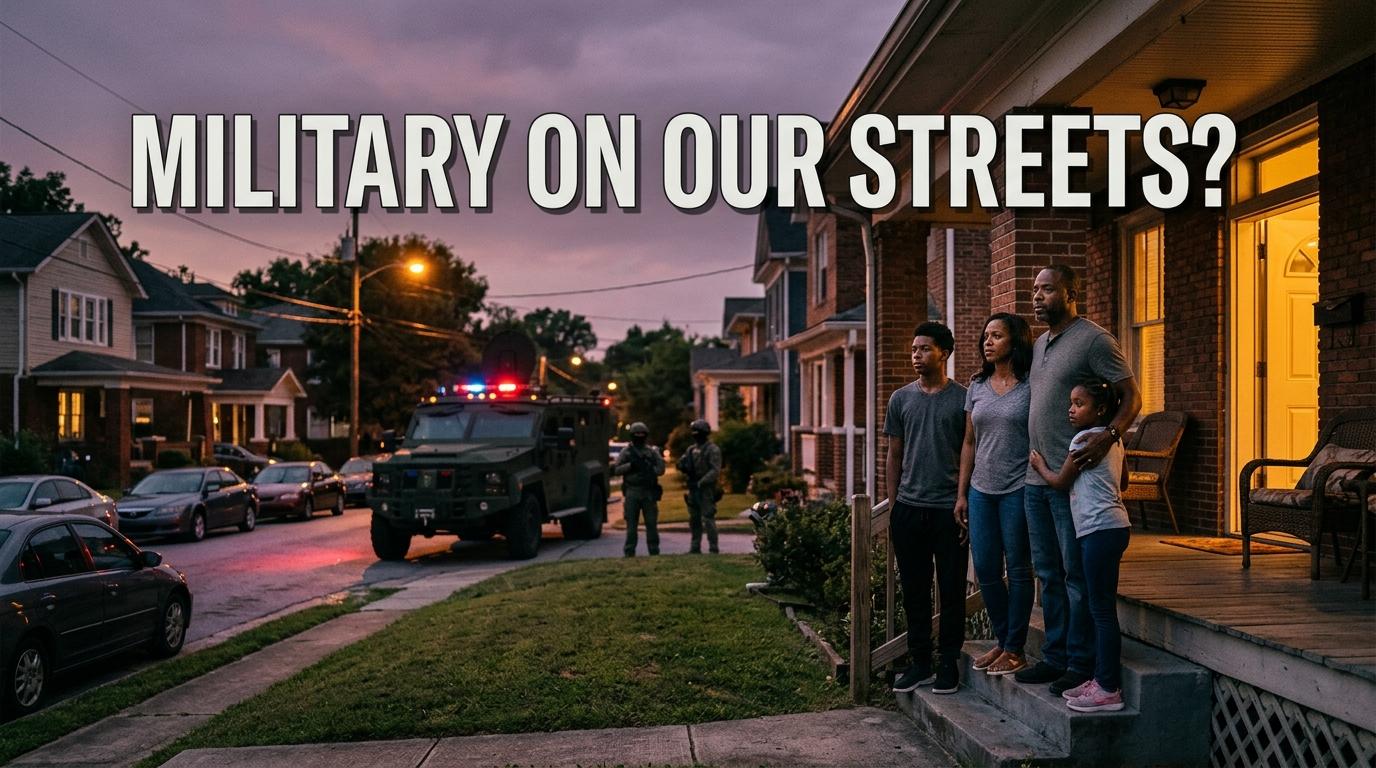
This deployment model bypasses the local municipal governance of cities (mlk50.com, aclu-tn.org). In Memphis, Tennessee National Guard troops operated under the direction of Governor Bill Lee (mlk50.com, newsfromthestates.com). This move occurred despite direct opposition from municipal leaders, who argued that local resources were more effective (mlk50.com). When the military enters cities, it operates with equipment designed for combat (mlk50.com). This creates an environment where everyday citizens face highly armed soldiers in their local parks and streets (aclu-tn.org, aclu-tn.org). The blurring of lines between civilian policing and military action raises serious constitutional questions (aclu-tn.org, brennancenter.org).
The Roots of State Preemption and Local Sovereignty
The deployment of the Memphis Safe Task Force is a clear example of state preemption (mlk50.com, newsfromthestates.com). This political mechanism allows conservative state legislatures to strip decision-making power from progressive, majority-Black cities (publicrightsproject.org, epi.org). Historically, this tactic mirrors post-Reconstruction “Redemption” efforts (lpeproject.org). During that era, white majorities used state authority to claw back institutional control (lpeproject.org). In modern times, we see this in Jackson, Mississippi, where the state established state-run court and policing systems to bypass local oversight (tminstituteldf.org). It also occurred during fiscal and school interventions in Detroit, Michigan (epi.org, epi.org).
To understand how these power dynamics shape our lives, one must examine the history of how the system of federalism influences Black communities. In Tennessee, Governor Bill Lee mobilized the National Guard over the objections of local leaders (mlk50.com, newsfromthestates.com). Shelby County Mayor Lee Harris, a progressive Democrat, filed a lawsuit arguing the deployment was unlawful (mlk50.com, newsfromthestates.com). Memphis Mayor Paul Young also voiced deep concerns, stating that local leaders did not request the military presence (mlk50.com). This represents a direct clash between state executive power and municipal democratic sovereignty (mlk50.com). Through these dynamics of anti-Black politics, state leaders effectively nullified the wishes of local residents and their elected officials.
By bypassing local leadership, the state government implements policies that criminalize communities (aclu-tn.org, mlk50.com). The state preemption of local authority does not resolve municipal issues (publicrightsproject.org, epi.org). Instead, it replaces local democratic oversight with outside forces that do not answer to the residents (aclu-tn.org, tminstituteldf.org). This shift removes accountability and increases the risk of civil rights violations (aclu-tn.org, aclu-tn.org). When local communities lose the power to govern themselves, their safety and freedom are severely compromised (aclu.org, publicrightsproject.org).
Operation Legend and the Blueprint of Urban Interventions
The Memphis Safe Task Force is modeled after Operation Legend (mlk50.com). Launched in July 2020 by the Trump administration, Operation Legend flooded nine major metropolitan areas, including Memphis, with federal agents (justice.gov, justice.gov). The program resulted in over six thousand arrests and the seizure of thousands of weapons (usmarshals.gov, usmarshals.gov). However, only fifteen hundred of those arrested faced federal charges (usmarshals.gov). The vast majority of cases were left to state and local courts (usmarshals.gov). This outcome revealed that the operation served as a massive net to catch low-level offenders rather than targeting major crime syndicates (thetrace.org, usmarshals.gov).
Civil rights groups and local leaders criticized Operation Legend as a highly politicized “law and order” campaign (thetrace.org). It was designed to boost a reelection bid rather than provide sustainable community support (thetrace.org). Researchers noted that there was no long-term correlation between the federal deployment and a decline in violent crime (thetrace.org). Instead of investing in military interventions, advocates argue that long-term funding for community-led initiatives is far more effective (thetrace.org). This history shows how Black communities have long had to fight for economic justice against all odds while facing systemic state containment.
The failure of past operations did not stop the creation of the Memphis Safe Task Force (mlk50.com). President Donald Trump established the new task force in September 2025 via an executive memorandum (mlk50.com). This move once again prioritized heavy policing over systemic solutions (mlk50.com). The federal and state governments coordinated to bypass local authorities, repeating the mistakes of Operation Legend (mlk50.com, newsfromthestates.com). This continued reliance on militarized policing shows that the state values aggressive control over community well-being (aclu-tn.org, aclu-tn.org).
The Numbers Game: Breaking Down the Arrest Claims
Supporters of the task force, such as Senator Marsha Blackburn, point to the arrest statistics to justify the military presence (newsfromthestates.com). As of June 2026, the task force claimed to have executed ten thousand and seventeen arrests (mlk50.com). However, a qualitative analysis of this number reveals a different story (mlk50.com). Only ninety-two of these arrests were for homicide, and only one hundred and five were for sex offenses (mlk50.com). By contrast, over one thousand arrests involved controlled substances, and nine hundred and sixty-two involved firearms violations (mlk50.com). This breakdown proves that the operation does not focus primarily on violent, high-level criminals (mlk50.com, aclu-tn.org).
This leaves more than seventy-eight hundred arrests completely unaccounted for in major violent categories (mlk50.com). This discrepancy strongly supports the arguments of community advocates (mlk50.com, aclu-tn.org). The task force relies heavily on aggressive, low-level, pretextual policing rather than targeting violent crimes (mlk50.com). These low-level stops and municipal infractions disproportionately target Black and Brown neighborhoods, creating an atmosphere of fear and surveillance (aclu-tn.org, aclu-tn.org). By inflating arrest numbers with minor offenses, the state attempts to manufacture public support for an unpopular military campaign (mlk50.com, aclu-tn.org).
Furthermore, these tactics fail to address the root causes of crime, such as poverty and systemic disinvestment (thetrace.org, epi.org). Instead of providing support, the task force funnels thousands of people into the criminal justice system (mlk50.com, aclu-tn.org). This process weakens families and removes opportunities for economic stability (epi.org). The focus on quantitative metrics ignores the human cost of over-policing (aclu-tn.org, mlk50.com). A high volume of arrests does not mean a community is safer; instead, it means the community is experiencing higher rates of state control (aclu-tn.org, aclu-tn.org).
The “Halo Law” and the War on Public Accountability
In May 2025, Governor Bill Lee signed Senate Bill 30, known as the “PEACE Act” or the “Halo Law” (tba.org, wpln.org). This controversial law went into effect on July 1, 2025 (tba.org, wpln.org). It makes it a Class B misdemeanor to knowingly approach within twenty-five feet of an officer performing official duties after receiving a warning to stay back (tba.org, wpln.org). Proponents argue that the law is necessary for officer safety (wpln.org, wpln.org). However, civil rights groups and media coalitions have filed lawsuits challenging the statute (rcfp.org, aclu-tn.org).
Critics argue that the law severely restricts the constitutional rights of citizen-journalists and bystanders to document police encounters (rcfp.org, aclu-tn.org). If a similar law had existed during the murder of George Floyd, the bystanders who filmed the crucial evidence could have been arrested (aclu.org, aclu.org). In Memphis, the task force has used this law to intimidate residents attempting to film their actions (aclu-tn.org). Because National Guard troops do not wear body cameras, civilian cellphones are often the only tool for public accountability (aclu-tn.org, mlk50.com). The Halo Law effectively creates a shield of secrecy around military and federal operations in local communities (aclu-tn.org, rcfp.org).
This law allows officers to establish arbitrary boundaries, which they can expand at any moment (rcfp.org, aclu-tn.org). If a citizen stands peacefully at a safe distance, an officer can simply order them to retreat further under threat of arrest (aclu-tn.org, rcfp.org). This standardless authority chills public reporting and makes it impossible to monitor police misconduct effectively (rcfp.org, aclu-tn.org). By criminalizing transparency, the state protects aggressive task force members from public scrutiny (aclu-tn.org, rcfp.org). This lack of accountability increases community distrust and heightens tensions during street encounters (aclu-tn.org, aclu-tn.org).
Open Carry, Implicit Bias, and Black Gun Owners
Tennessee is a permitless “open carry” state (tncriminaldefenseattorney.com). This means that most adults can legally carry a loaded handgun in public without a permit (tncriminaldefenseattorney.com, laynemcdonald.com). However, these legal protections do not apply equally in practice (ballsandstrikes.org). Legal scholars and empirical studies show that implicit racial bias routinely leads law enforcement to perceive Black gun owners as dangerous threats rather than law-abiding citizens (ballsandstrikes.org). In court cases such as *United States v. Black*, judges have noted that officers frequently justify stopping and searching Black men simply for carrying firearms, claiming it is unusual or suspicious (ballsandstrikes.org). This double standard denies Black citizens their Second Amendment rights (ballsandstrikes.org).
This deadly double standard is central to the tragedy of Tyrin Johnson (mlk50.com). Armed National Guard troops, who lacked training in civilian policing and de-escalation, chased and killed him after spotting his handgun (mlk50.com). Although carrying a firearm is a constitutionally protected right in Tennessee, the system weaponized this right against a young Black man (ballsandstrikes.org, mlk50.com). The National Guard’s domestic rules of engagement allowed them to carry weapons for self-defense, but their presence turned a routine encounter into a fatal tragedy (mlk50.com). When the military policing model meets racial bias, the consequences are deadly (ballsandstrikes.org, mlk50.com).
Because of this dynamic, Black residents in Memphis live under a different set of rules (ballsandstrikes.org, aclu-tn.org). While white citizens exercise their rights without fear, Black citizens face immediate danger when exercising the same freedoms (ballsandstrikes.org). This bias is not accidental; rather, it is baked into the policing systems of our nation (ballsandstrikes.org, lpeproject.org). Militarized task forces reinforce these biases by treating Black communities as hostile territory (aclu-tn.org, aclu-tn.org). The lack of local control means there are no mechanisms to correct these racial disparities (mlk50.com, publicrightsproject.org). This system leaves families grieving and young lives cut short (aclu-tn.org, mlk50.com).
Demanding Justice and Restoring Local Democracy
The escalating crisis in Memphis raises a vital question about the future of local municipal governance (mlk50.com, aclu-tn.org). Does public safety require communities to surrender their democratic sovereignty and accept military occupation? On July 10, 2026, NAACP President Derrick Johnson formally requested that the Department of Justice launch a civil rights investigation and suspend the Memphis Safe Task Force (naacp.org). The ACLU of Tennessee has also demanded the immediate dismantling of the task force to protect civilian lives (aclu-tn.org). These organizations argue that the deployment has brought fear and violence rather than peace (aclu-tn.org, naacp.org).
As the Tennessee Bureau of Investigation continues to review the fatal shooting of Tyrin Johnson, the families of the victims continue to demand transparency (mlk50.com, tbinewsroom.com). True safety cannot be achieved through militarized policing and state overreach (aclu-tn.org, thetrace.org). It requires investment in local communities, respect for local democratic leadership, and the protection of civil liberties for all residents (aclu-tn.org, aclu-tn.org). Until the Memphis Safe Task Force is dismantled, the community remains at risk of further tragic losses (aclu-tn.org, mlk50.com). The fight for justice in Memphis is a fight for the democratic rights of all Black communities across the nation (aclu-tn.org, naacp.org).
About the Author
Darius Spearman is a professor of Black Studies at San Diego City College, where he has been teaching for over 20 years. He is the founder of African Elements, a media platform dedicated to providing educational resources on the history and culture of the African diaspora. Through his work, Spearman aims to empower and educate by bringing historical context to contemporary issues affecting the Black community.
