

Why Pete Hegseth Blocked Black Generals: The Promotion Bias Scandal
By Darius Spearman (africanelements)
Support African Elements at patreon.com/africanelements and hear recent news in a single playlist. Additionally, you can gain early access to ad-free video content.
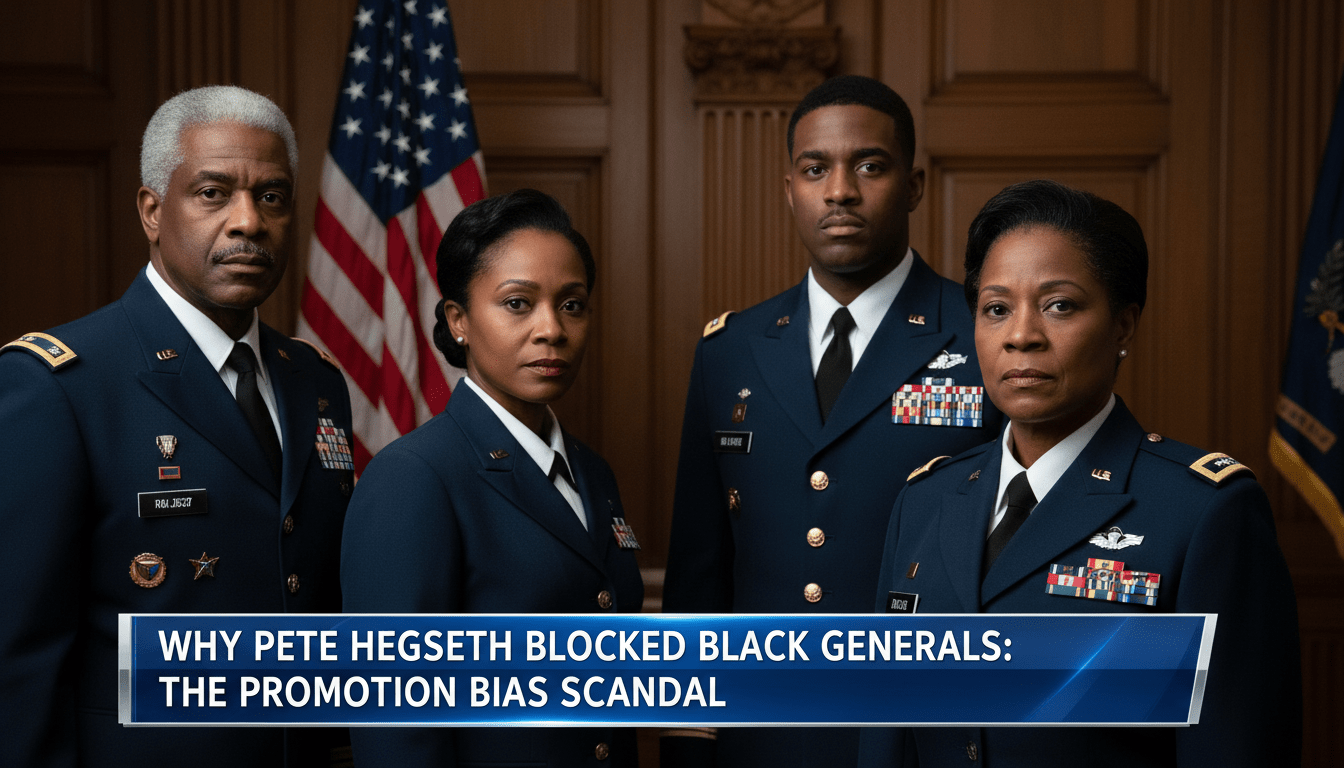
The United States military is facing a modern crisis that feels like a ghost from the past. On March 30, 2026, the National Urban League issued a blistering statement against Defense Secretary Pete Hegseth (nul.org). The organization condemned the Secretary for striking four highly qualified officers from a promotion list. This move targeted two Black men and two women who were set to become brigadier generals. The National Urban League called this action a “reprehensible” weaponization of anti-diversity sentiment (nul.org).
This controversy did not appear out of thin air. It is the result of a long history of struggle within the armed forces. For decades, Black service members have fought for the right to lead. Today, that progress is under a microscope as the current administration shifts its focus. The removal of these officers suggests a new era where political ideology might matter more than a lifetime of service (militarytimes.com).
The National Urban League Sounds the Alarm
The National Urban League is one of the oldest civil rights organizations in the country. It was founded over a century ago to help African Americans find economic and professional success. When its president, Marc Morial, declared a “state of emergency” for civil rights, people listened (nul.org). The organization views the blocking of these promotions as a direct attack on the “desegregation of opportunity.”
The four officers in question had already passed a very difficult test. They were selected by a peer-review board of senior officers. Only about five percent of colonels ever make it through this process (qoshe.com). By removing them, Hegseth ignored the judgment of the military’s own experts. The National Urban League argues that the term “merit” is being used to hide old-fashioned bias (nul.org). This tension reflects deep-seated conflicting ideologies within the fight for Black liberation and institutional respect.
Representation in the U.S. Military (2026)
Source: SOURCE-8
The History of the Military Color Line
The U.S. military has often been a place where social change starts. In 1948, President Harry Truman issued Executive Order 9981 to desegregate the military. This was a massive step forward, but it did not end racism. For a long time, Black officers were kept out of “combat arms” roles like the infantry. Instead, they were funneled into support and logistics jobs. These support roles rarely lead to the highest ranks, like four-star general (militarytimes.com).
The struggle for leadership has always been part of the broader Black experience. During the civil rights era, movements like the Black Panther Party challenged the way systems of power excluded Black voices. Within the military, the 1970s brought more formal changes. Following racial unrest during the Vietnam War, the Pentagon created the Defense Equal Opportunity Management Institute in 1971 (militarytimes.com). This marked the beginning of training programs that eventually became known as Diversity, Equity, and Inclusion (DEI).
A Pivot Toward “Pure Meritocracy”
Secretary Pete Hegseth represents a sharp turn away from the policies of the previous decade. Before taking office, he wrote a book called The War on Warriors. In this book, he claimed that diversity efforts were making the military weak (newrepublic.com). He believes that focusing on race or gender distracts from the mission of winning wars. Since joining the Pentagon, he has worked to dismantle DEI offices and programs (hindustantimes.com).
The administration calls this a return to “pure meritocracy.” However, critics say this is just a way to purge leaders who do not align with their political views. President Donald Trump is the current president, and his appointees have prioritized loyalty to the administration’s vision (hindustantimes.com). This shift has caused friction with long-standing military traditions that try to keep politics out of promotions (militarytimes.com).
The 15-Year-Old Academic Paper
One of the most controversial details involves a Black armor officer who was struck from the list. Reports show he was flagged for an academic paper he wrote 15 years ago (bgov.com). The paper looked at why African American officers often choose “support” branches instead of “combat arms.” It was a statistical study aimed at helping the military understand personnel trends (bgov.com).
Even though the paper was an analytical piece written for a military school, the DoD now calls it “woke.” They used this 15-year-old assignment as evidence that the officer had a “non-merit” mindset. Military officials point out that this officer has had an exemplary career since then. He is a combat veteran who earned his place on the promotion list through hard work (bgov.com). This looks like a deep dive into the past to find a reason to block a Black leader’s future.
The Promotion Gap
Source: RAND Study / Air Force Data (carnegieendowment.org, militarytimes.com)
Accountability or Scapegoating?
Another officer removed from the list was a female logistics specialist. She was reportedly penalized for her role in the 2021 withdrawal from Afghanistan (bgov.com). Secretary Hegseth has vowed to hold any officer involved in that event accountable. He has called the withdrawal “disastrous and embarrassing” and treats it as a political litmus test (theguardian.com).
However, military sources say this officer performed her job very well under extreme pressure. She was recommended for promotion because of her leadership during that difficult time (bgov.com). Critics argue that using a historical event to block a career is a form of political scapegoating. It sends a message that serving under a previous administration can be a “career-killer” (theguardian.com). This creates a culture of fear instead of a culture of excellence.
Breaking Military Norms
The way Secretary Hegseth handled the promotion list is a major break from tradition. Usually, a Defense Secretary either approves the whole list or rejects the whole list. This is done to prevent the “politicization” of the officer corps (militarytimes.com). By “line-iteming” or striking individual names, Hegseth has changed the rules. The Army Secretary, Dan Driscoll, initially refused to remove the names (bgov.com).
Driscoll pointed to the “decades of exemplary service” of these four individuals. He argued that the merit-based board had already done its job. Hegseth overruled him and acted unilaterally (bgov.com). Some lawmakers, like Senator Jack Reed, worry this is illegal. If the removals were based on race or gender, it would violate federal law (militarytimes.com). This move signals a shift toward a “spoils system” where loyalty to a leader is more important than professional skill.
The Impact of Diversity on Readiness
While the current administration sees DEI as a distraction, many researchers disagree. Studies from the Carnegie Endowment show that diverse leadership teams make better decisions (carnegieendowment.org). They process complex information more effectively because they bring different perspectives to the table. A diverse leadership also helps the military connect with the people it serves.
Black women have always played a vital role in these types of struggles. Historically, Black women contributed to major social movements even when they faced both racism and sexism. In the military, women have proven their value in every field, from logistics to combat. Removing female leaders from the path to general rank weakens the entire institution. It limits the pool of talent at a time when the world is becoming more dangerous.
The Narrow Path to General
This visualization details the extreme competitive narrowing required for promotion from Colonel to General Officer in the U.S. Army. (Source: qoshe.com)
The Statistical Realities
The numbers show that a gap has always existed between the “enlisted” force and the “general officer” ranks. African Americans make up about 17 percent of the total military (carnegieendowment.org). However, they only make up 6.5 percent of general officers. At the very top, the gap is even wider. In 2020, only two out of 41 four-star generals were Black (carnegieendowment.org).
These statistics suggest that systemic bias was already a problem before 2026. A 2012 RAND study found that white officers were 29 percent more likely to be promoted at key points in their careers (carnegieendowment.org). When the Pentagon removes minority officers from a list that is already mostly white, it makes these disparities worse. The March 2026 list had about 36 officers on it, and most were white men (carnegieendowment.org). Taking away the few minority names leaves the top of the military looking very different from the troops on the ground.
A Civil Rights Crisis
The National Urban League’s statement is more than just a complaint. It is a warning that the military is regressing. They fear that the “good ole boys’ system” is coming back (nul.org). This is a system where who you know and what you believe is more important than your record of service. This issue has moved beyond defense policy and is now a major civil rights crisis.
The struggle for unity and progress often faces conflicting elements within the Black community. However, on this issue, the message is clear. Professional advancement should be based on performance, not a political “litmus test” (nul.org). The National Urban League is asking the Senate to reject the altered list to protect the integrity of the military.
The Road Ahead
As of late March 2026, the future of these four officers is uncertain. The Senate must still confirm the promotion list. This will be a major political battle. Lawmakers will have to decide if they support the Secretary’s right to “line-item” names or if they will stand up for the peer-review process (qoshe.com). The outcome will set a precedent for years to come.
If the removals stand, it could discourage minority service members from staying in the military. They may feel that no matter how hard they work, a “glass ceiling” will always be there. The military relies on the trust of its soldiers and the public. When that trust is broken by accusations of bias, it hurts national security. The “history behind the headlines” shows us that progress is never permanent; it must be defended every single day.
Conclusion
The controversy surrounding Secretary Pete Hegseth and the National Urban League is a turning point. It highlights a deep divide in how America views merit and diversity. To some, removing these officers is a necessary step to stop “wokeness.” To others, it is a “reprehensible” act of discrimination that ignores decades of service (nul.org). As this story unfolds, it reminds us that the military remains a central stage for the nation’s ongoing debate over equality.
About the Author
Darius Spearman is a professor of Black Studies at San Diego City College, where he has been teaching for over 20 years. He is the founder of African Elements, a media platform dedicated to providing educational resources on the history and culture of the African diaspora. Through his work, Spearman aims to empower and educate by bringing historical context to contemporary issues affecting the Black community.
