


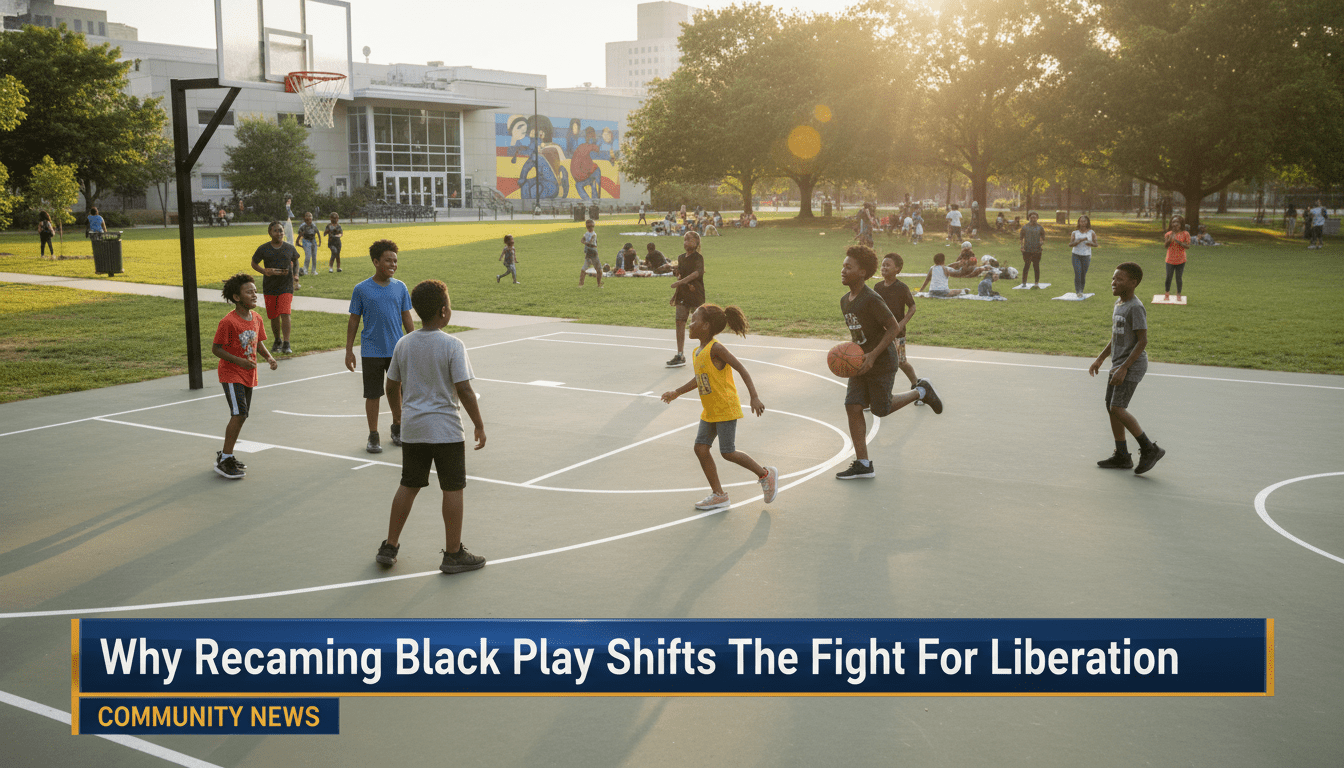
Why Reclaiming Black Play Shifts The Fight For Liberation
By Darius Spearman (africanelements)
Support African Elements at patreon.com/africanelements and hear recent news in a single playlist. Additionally, you can gain early access to ad-free video content.
The Black Lives Matter Global Network Foundation entered a transformative phase this morning. The organization announced a significant leadership transition. Alongside this administrative change, leaders revealed a major cultural project. This global initiative is called “Black Play Matters.” It invests heavily in safe spaces and community enrichment. The strategy seeks to reclaim play as a powerful tool for Black liberation. Planners hope to shift the organizational focus toward cultivating radical Black joy.
This announcement marks a strategic pivot for the prominent foundation. The concept of play as a form of resistance holds deep roots. It connects to centuries of struggle against systemic exclusion. Society historically blocked Black people from accessing leisure and recreation. Reclaiming joy in the face of oppression requires deliberate action. The initiative builds upon a long legacy of community survival. Activists currently bridge the gap between historical resistance and future abundance. They demand a reality defined by joy rather than trauma (researchgate.net).
Reclaiming Play As A Radical Act
Play has rarely been neutral for Black Americans throughout history. The ability to rest and imagine remains a contested political frontier. During the era of chattel slavery, leisure time was virtually nonexistent. Enslaved individuals used their limited free time for music and storytelling. These activities functioned as essential tools for maintaining humanity. Theologian James H. Cone described these moments as vital spiritual practices. He argued that the playfulness of the blues served as secular spirituals. These expressions of freedom defied the constraints of the plantation system.
The establishment of physical spaces for Black joy soon followed. In 1821, William Alexander Brown founded the African Grove Theatre. This venue became the first Black theater in the United States. Performance proved foundational to building a unified Black identity. Unfortunately, intense white hostility eventually forced the theater to close. Decades later, leaders within the Black Arts Movement revived this concept. Figures like Amiri Baraka used street theater to liberate the imagination. They viewed art and play as necessary components for internal liberation (researchgate.net).
The Reality Of Modern Park Deserts
The new foundation initiative responds to a harsh contemporary reality. Genuine play equity remains largely elusive across the country. Statistical data highlights a severe nature gap affecting minority populations. A recent study of Los Angeles neighborhoods exposed deep geographical inequalities. Residents in predominantly Black neighborhoods suffer from severe park deficits. They have access to sixty-six percent less park space per person. Wealthier white neighborhoods enjoy vastly more recreational land.
Parkland Disparity (Acres per 1,000 Residents)
Predominantly White Neighborhoods (31 Acres)
Black and Latino Neighborhoods (1.7 Acres)
Access to indoor facilities shows an equally troubling pattern. Research indicates minority neighborhoods lack basic community centers. These areas are fifty percent less likely to have a single recreational facility. National data further confirms these sweeping acreage disparities. Predominantly white neighborhoods average over thirty-one acres of parkland per thousand residents. Meanwhile, Black and Latino areas average a mere 1.7 acres.
The COVID-19 pandemic severely worsened these existing disparities. The closure of basketball courts disproportionately affected Black youth. Public health experts warned about the removal of these vital spaces. Parks serve as primary vectors of change and resilience for children. Losing these areas contributed to higher rates of psychological distress. The lack of safe play areas creates an urgent public health crisis (nih.gov).
Overcoming The White Gaze
Leisure remained strictly segregated during the twentieth century. Black families faced legal exclusion from public swimming pools and parks. Black communities responded by building their own private retreats. Idlewild in Michigan became famously known as the Black Eden. Bruce’s Beach in California offered another vital sanctuary. These spaces were sovereign territories where Black families could relax safely. They protected visitors from state violence and constant surveillance.
The concept of the white gaze explains this need for separation. Sociologists describe the white gaze as a powerful disciplinary mechanism. It forces Black people to view themselves through a suspicious societal lens. White societal norms heavily police Black bodies in public spaces. Activities considered playful in white communities often face harsh scrutiny elsewhere. Black youth frequently experience an adultification bias from law enforcement. Police officers often treat young Black children as threatening adults.
Restoring access to joy requires confronting this historical theft. The return of Bruce’s Beach to its original heirs demonstrated this fight. Activists cited the restoration as a victory over state-sanctioned land theft. Establishing safe play spaces directly challenges this oppressive surveillance. Grasping the notion of freedom requires addressing these psychological barriers. Unfettered leisure remains a radical act of community self-determination (researchgate.net).
Healing Trauma Through Radical Joy
The modern definition of Black liberation includes the right to heal. Health professionals heavily focus on Adverse Childhood Experiences today. These potentially traumatic events occur before a child reaches adulthood. Environmental factors like housing instability increase these risks for Black youth. Medical research links high trauma scores to chronic adult health problems. Play serves as a critical clinical intervention for childhood trauma. It fosters neuroplasticity and helps regulate complex emotional responses.
Likelihood of Facility Access
White Areas
Minority Areas
Minority neighborhoods are 50% less likely to have a single recreational facility.
The scientific concept of weathering further explains this health necessity. Weathering describes the premature biological aging caused by chronic racism. The stress of living in an oppressive society physically damages the body. Engaging in communal joy lowers cortisol levels effectively. Laughter stimulates the production of oxytocin and dopamine in the brain. These chemicals temporarily counteract stress-induced inflammatory responses in the body.
Joy as resistance offers a practical antidote to this weathering effect. The oppressive system inherently expects constant Black suffering and labor. Choosing happiness subverts the intended psychological impact of systemic oppression. Access to joyful spaces is now a recognized health determinant. Closing the life-expectancy gap requires building these essential community environments (nih.gov).
A New Chapter For The Foundation
The Black Play Matters launch arrives at a crucial organizational moment. The foundation faced intense public scrutiny over its financial governance recently. The board announced the departure of longtime strategist Shalomyah Bowers today. They also terminated all contracts with his consulting firm. The leadership framed this move as a commitment to transparency. This action follows investigations into the handling of various donor funds.
Currently, there is no active federal criminal investigation into the foundation. However, state-level officials previously scrutinized the organization very closely. Some states threatened to suspend tax-exempt status due to delayed filings. The foundation worked diligently to rectify these administrative issues. Recent tax filings showed roughly thirty million dollars in remaining net assets. This figure marks a decrease from the funds raised during 2020.
BLMGNF Net Assets Shift (Transparency Initiative)
Cicley Gay now leads the reformed board into the future. She champions moving from reactive street protests to proactive cultural investment. This strategy helps reconcile the conflicting elements of organizing a mass movement. The foundation established a strategic plan known as the 2025 Renewal. This phase focuses entirely on transparent community impact metrics. Leaders view the current restructuring as a bridge toward long-term stability (charitywatch.org).
Expanding The Movement Globally
The new play initiative immediately established strong international roots. The organization embraced a deeply diasporic view of Blackness. Global Blackness requires supporting communities far beyond American urban centers. Black populations worldwide face similar systemic challenges regarding resource extraction. The foundation pivoted toward Ghana to launch major international partnerships. Ghana serves as a focal point due to its welcoming cultural initiatives.
The foundation actively partners with organizations like Afrikicks in West Africa. These partnerships provide crucial athletic equipment to underserved youth. The groups work together to refurbish failing sports facilities in Accra. This global approach reframes how activists view systemic health challenges. It targets play equity through direct, measurable community investment. The initiative attempts to build lasting infrastructure rather than temporary protests.
This strategy creates an essential international exchange of ideas. American activists learn from robust African models of community resilience. These exchanges help in shaping political dynamics within domestic advocacy circles. The play initiative recently gained endorsements from powerful legislative groups. NOBEL Women officially backed the global project this week. This support signals the complete integration of play equity into mainstream policy (researchgate.net).
The Future Of Abolitionist Play
Abolitionist play suggests that leisure serves as a political act. It resists the capitalist requirement for constant bodily productivity. The right to play represents a fundamental human rights issue today. Black life should consist of abundance rather than endless labor. Organizations must remove the heavy adultification bias affecting young children. Building safe environments protects youth from harmful recreational policing.
The 2025 Renewal phase specifically addresses these long-term visionary goals. The foundation launched a new student athlete program this year. This program focuses on mental health and bodily autonomy. It provides direct support to youth navigating stressful academic environments. The initiative shifts the organization from a crisis-response model completely. Leaders want to build a sustainable institution for future generations.
Reclaiming Black play remains an ongoing historical mission. The foundation attempts to honor the legacy of early theater pioneers. It draws inspiration from the protective sanctuaries of the Jim Crow era. Modern initiatives must address both physical park deserts and psychological trauma. The pursuit of radical joy ensures that communities can truly thrive. Thriving remains possible even before the total removal of systemic harm (researchgate.net, charitywatch.org).
About the Author
Darius Spearman is a professor of Black Studies at San Diego City College, where he has been teaching for over 20 years. He is the founder of African Elements, a media platform dedicated to providing educational resources on the history and culture of the African diaspora. Through his work, Spearman aims to empower and educate by bringing historical context to contemporary issues affecting the Black community.
