


Why Supreme Court Geofence Warrants Threaten Black Privacy
By Darius Spearman (africanelements)
Support African Elements at patreon.com/africanelements and hear recent news in a single playlist. Additionally, you can gain early access to ad-free video content.
The Digital Dragnet Reaches the Highest Court
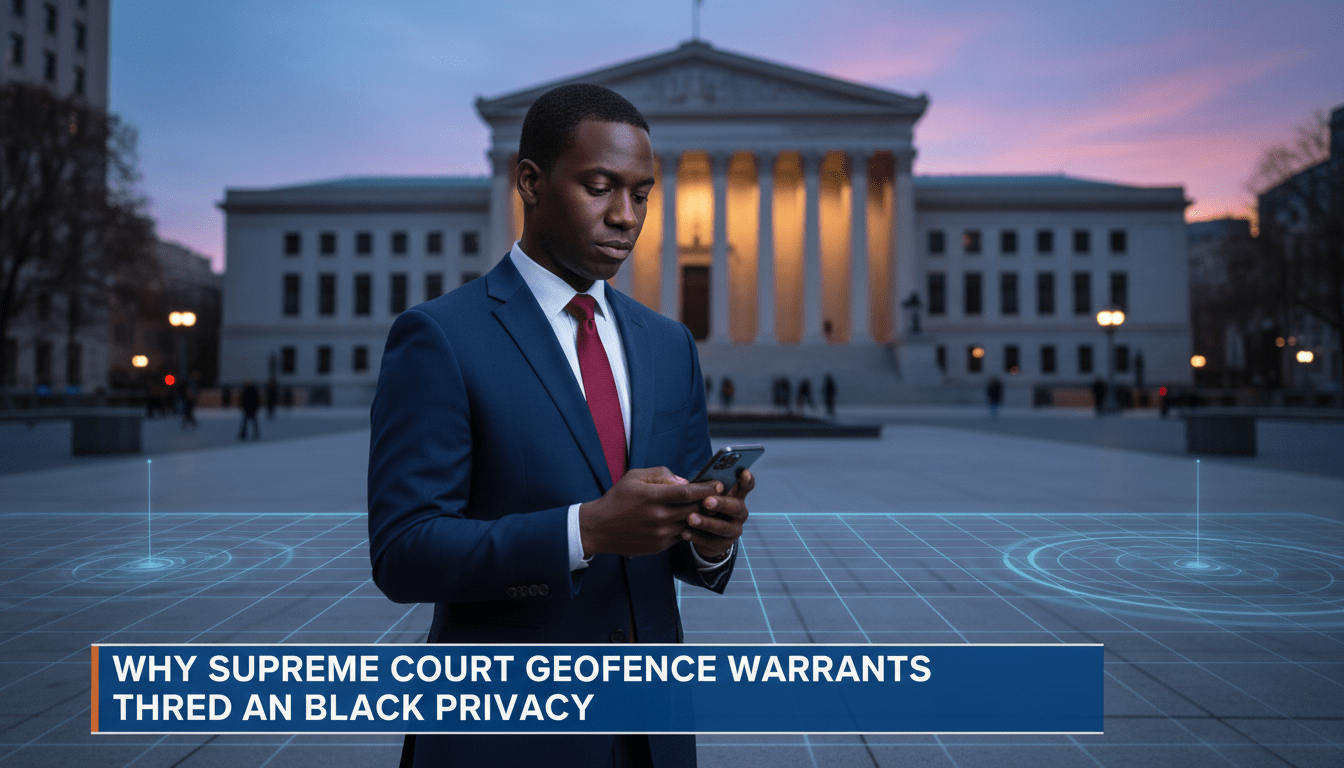
The Supreme Court is currently hearing a landmark case that could change the future of digital privacy in the United States. Under the administration of current President Donald Trump, the debate over police surveillance is reaching a boiling point. The case centers on the use of geofence warrants. These digital tools allow law enforcement to request the location data of every single person within a specific geographic area during a certain timeframe.
Advocates for social justice are monitoring this situation with extreme caution. They warn that these massive data sweeps disproportionately affect heavily policed Black communities. The technology acts as a virtual dragnet. Instead of investigating a single suspect, police capture the digital footprints of thousands of innocent bystanders. The implications for civil rights and personal freedom are massive, drawing intense scrutiny from privacy experts and civil rights organizations alike.
A Modern Take on Colonial Warrants
The debate over geofence warrants connects directly to the founding principles of the United States. Before the American Revolution, British officials used documents known as writs of assistance. These orders functioned as general warrants. They allowed soldiers to search any person or property at their own discretion to find smuggled goods. Officials did not need specific evidence against a specific person to conduct these intrusive searches.
In the year 1761, a lawyer named James Otis delivered a famous argument against these general warrants, calling them the worst instrument of arbitrary power. This historical grievance led the founders to draft the Fourth Amendment. The amendment explicitly requires that warrants be based on probable cause and particularly describe the place to be searched and the persons or things to be seized. Today, privacy advocates argue that geofence warrants are simply modern versions of these colonial general warrants because they search everyone in an area rather than a specific suspect (cornell.edu).
The Trap of the Third-Party Doctrine
The legal justification for these digital dragnets relies heavily on an outdated concept called the Third-Party Doctrine. This legal principle states that individuals lose their reasonable expectation of privacy when they voluntarily share information with outside companies. The doctrine originated in the 1970s, applying to physical bank records and dialed telephone numbers. Courts decided that citizens assume the risk that these companies will hand their data over to the government (btlj.org).
In the current era, cell phones continuously transmit data to tech companies. Lower courts have used the Third-Party Doctrine to argue that people surrender their privacy by simply carrying a smartphone. However, the landmark 2018 case Carpenter v. United States established that continuous digital location tracking is fundamentally different. The Supreme Court ruled that location data requires strict protection because it creates an all-encompassing record of the physical movements of a person (justia.com).
How Digital Sweeps Target Black Communities
Technology frequently amplifies existing social inequalities. Research demonstrates that geofence warrants have a disproportionate impact on Black neighborhoods. These warrants are highly effective in urbanized areas with dense populations and numerous overlapping cell phone signals. Because Black populations often reside in densely populated urban centers, residents are statistically more likely to be swept into these massive police databases.
Studies show that police officers spend significantly more time in neighborhoods with higher Black populations, even when accounting for crime rates. Because these communities experience intense policing and possess dense surveillance infrastructure, digital searches yield massive amounts of innocent bystander data. Legal scholars describe this phenomenon as a digital version of stop-and-frisk policies. It subjects residents to constant virtual monitoring, reflecting broader challenges in shaping political dynamics within marginalized groups (iu.edu).
Surveillance at Civil Rights Demonstrations
Law enforcement agencies also deploy these digital tools to monitor political movements and protests. During the major racial justice protests in 2020, evidence emerged that police utilized geofence warrants to track demonstrators. Federal agents from the Bureau of Alcohol, Tobacco, Firearms and Explosives used at least twelve geofence warrants to identify individuals near property damage incidents in cities like Minneapolis and Kenosha (brennancenter.org).
While authorities claimed they sought specific suspects, the digital net swept up the location data of hundreds of peaceful protesters. This tactic raised severe concerns about the chilling effect on free speech and the right to assemble. The surveillance of Black Lives Matter participants mirrors historical efforts to suppress civil rights movements. It clearly illustrates the contradictions between the Enlightenment ideals of liberty and the realities of modern state surveillance.
The Three Steps of Digital Unmasking
Law enforcement and tech companies utilize a standardized three-step process to transition from an anonymous dragnet to a specific suspect. In the first step, a company like Google provides a list of anonymized device numbers for every phone located within the targeted area. In the second step, investigators review this list and ask the company for additional location data. They expand the tracking outside the original zone to observe where specific devices traveled before and after the incident.
In the final step, police demand the actual subscriber information for the remaining targets. This final request reveals the real name, email address, and service history of the individual. This exact method identified Okello Chatrie in the case currently before the Supreme Court. After a bank robbery in Virginia, police requested a geofence covering a radius of one hundred fifty meters. They started with nineteen anonymous accounts and eventually unmasked Chatrie entirely through digital means (justice.gov).
The Wrongful Arrest Lottery
The sheer inaccuracy of location tracking makes geofence warrants incredibly dangerous for innocent bystanders. Tech companies estimate that their location data falls within a sixty-eight percent confidence interval. This statistic means there is a massive thirty-two percent chance that individuals identified in a geofence search were actually located entirely outside the specified boundary (duke.edu). GPS signals frequently bounce off tall buildings or suffer from interference in dense urban environments.
Civil rights attorneys argue this technical inaccuracy creates a wrongful arrest lottery. Innocent people drinking coffee at a cafe next door to a crime scene can easily become prime suspects. Furthermore, because geofencing occurs overwhelmingly in heavily policed urban areas, Black residents are far more likely to face this digital hazard. They carry the burden of proving their innocence simply because their mobile device pinged a cell tower at the wrong moment.
The Circuit Split and Legal Showdown
The federal court system is completely fractured over the legality of geofence warrants. The Fourth Circuit Court of Appeals upheld the conviction of Okello Chatrie. They applied the Third-Party Doctrine, ruling that Chatrie voluntarily shared his location data with Google. Therefore, the court decided he surrendered his Fourth Amendment protections. They determined that the government did not conduct an unconstitutional search (btlj.org).
Conversely, the Fifth Circuit Court of Appeals reached the exact opposite conclusion in a separate case. They ruled that geofence warrants are inherently unconstitutional. The Fifth Circuit determined that these warrants lack particularity because they sweep up countless innocent people without individualized suspicion. This deep disagreement between the federal courts forced the Supreme Court to intervene in 2026 to settle the matter permanently for the entire nation.
Corporate Shifts and Device Encryption
Public outrage and intense legal scrutiny eventually forced major technology companies to change their practices. In late 2023, Google announced a massive shift in how it handles user location data. The company decided to encrypt Location History directly on the physical devices of its users. This means the data remains on the smartphone rather than on remote corporate servers. Consequently, Google can no longer search a central database to comply with a geofence warrant (washingtonpost.com).
Legal experts believe Google made this technical change specifically to avoid the controversy surrounding digital dragnets. Because the data features end-to-end encryption, the company simply lacks the technical ability to hand over bulk location records to the police. While this change protects users from mass sweeps, it does not stop police from targeting known individuals. Authorities can still track specific suspects through other technical means or purchase data from outside data brokers.
Implications for Past Convictions
If the Supreme Court declares geofence warrants unconstitutional, the ruling will have complex effects on past cases. Legal precedents usually protect evidence gathered before a new ruling takes effect. A rule known as the good faith exception allows courts to accept evidence if police reasonably believed the warrant was legal at the time it was signed. Therefore, individuals convicted between 2020 and 2024 might struggle to have their cases overturned (justia.com).
However, a strong Supreme Court decision could still trigger a massive wave of legal appeals. Thousands of defendants whose digital trails were seized might file petitions demanding new trials. Activists who have long fought for economic justice and civil rights are preparing for this legal battle. The outcome of the Chatrie case will determine the future boundaries of digital freedom for heavily monitored communities across the nation.
Unmasking the Digital Ghost
The story of Okello Chatrie highlights the sheer power of this technology. Chatrie was a young resident of Richmond, Virginia, and he was completely unknown to investigators prior to the digital search. Police possessed no physical leads, no eyewitness identifications, and no forensic evidence pointing to him. He was a digital ghost. The geofence warrant served as the absolute sole connection between him and the robbery.
Once the digital unmasking occurred, police obtained traditional search warrants for his residences. These subsequent searches uncovered nearly one hundred thousand dollars in cash, a firearm, and handwritten notes matching the crime. Despite this overwhelming physical evidence, defense teams argue the initial discovery was entirely unconstitutional. They maintain that finding a suspect through a digital dragnet violates the core protections of the Fourth Amendment. This tension represents one of the conflicting elements of Black Nationalism and civil rights debates, continuously balancing community safety against intrusive state power.
About the Author
Darius Spearman is a professor of Black Studies at San Diego City College, where he has been teaching for over 20 years. He is the founder of African Elements, a media platform dedicated to providing educational resources on the history and culture of the African diaspora. Through his work, Spearman aims to empower and educate by bringing historical context to contemporary issues affecting the Black community.
