

Why the Gullah Geechee Fight for Ancestral Cemetery Access Matters
By Darius Spearman (africanelements)
Support African Elements at patreon.com/africanelements and hear recent news in a single playlist. Additionally, you can gain early access to ad-free video content.
The marshlands of St. Helena Island hold many secrets within their tidal rhythms. For centuries, the Gullah Geechee people have lived and died along these South Carolina shores. Recently, a major legal battle has brought their sacred traditions into the national spotlight. A judge recently ordered the temporary reopening of the Big House Cemetery. This ruling allows families to return to their ancestral grounds for burials and maintenance. However, the struggle reveals a much deeper history of land loss and cultural erasure.
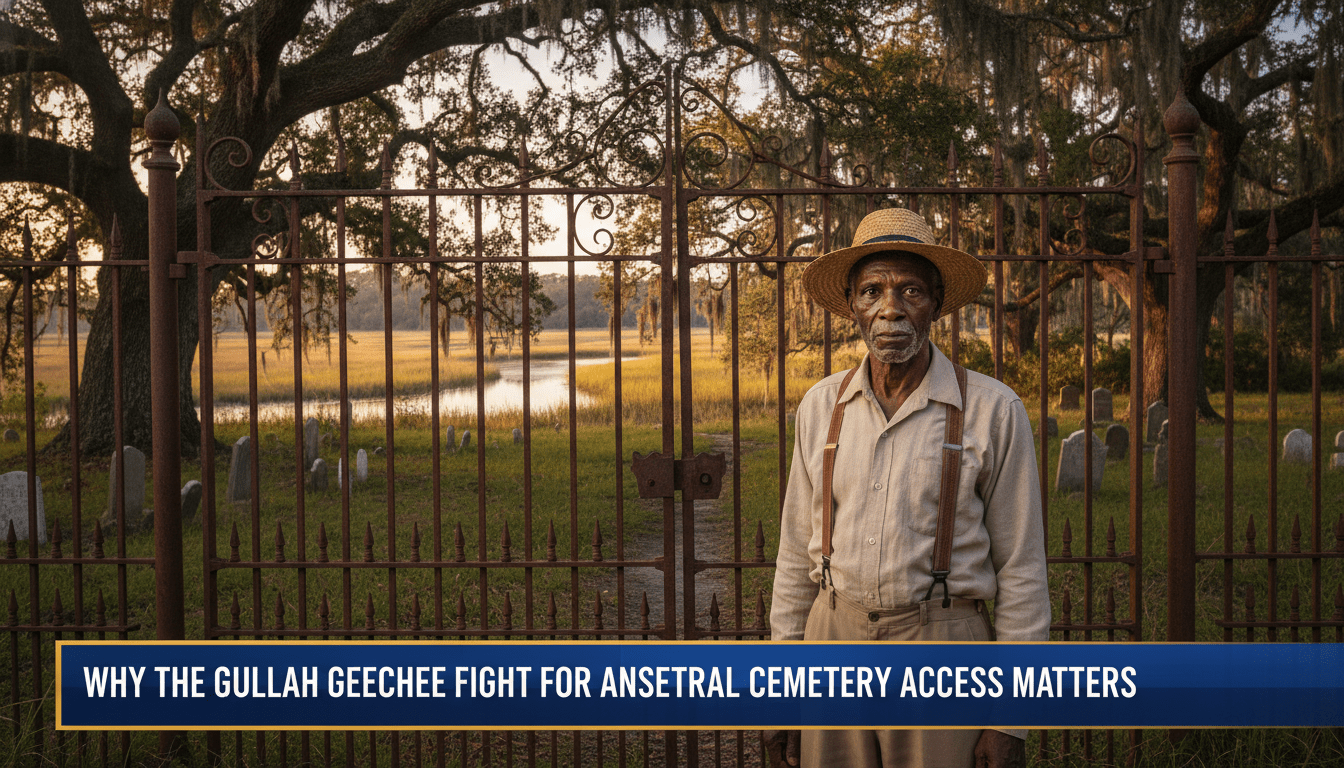
The conflict began when new landowners blocked the only road to the cemetery. These owners installed gates on Everest Lane and Everest Road in 2024 (ccrjustice.org). This action prevented the community from reaching the graves of their loved ones. For the Gullah Geechee, this was more than a property dispute. It was an attack on their spiritual connection to the land and their ancestors. The community decided to fight back in the courtroom to protect their heritage.
Systemic pressures have stripped families of their ancestral wealth and property (theguardian.com).
The Sacred Roots of the Big House Cemetery
The Big House Cemetery sits on land that was once the Homestead Plantation. This estate belonged to the wealthy Fripp family during the era of slavery. The name “Big House” refers to the main plantation house that once stood nearby. Enslaved people were often allowed to bury their dead on the edges of the plantation. These sites were usually located on land that was not good for farming. Over time, these burial grounds became sacred spaces for the community (chicora.org).
The location of the cemetery near the Harbor River is very important. This proximity reflects a deep spiritual tradition. The Gullah Geechee believe that the souls of the dead travel across the water to return to Africa. There is an old proverb that says the water brings people and the water takes them back. Consequently, burying loved ones near the marshes is a way to honor their African heritage. This practice has continued for generations on St. Helena Island (theguardian.com).
The Gullah culture has always maintained a strong connection to its roots. Because the Sea Islands were isolated, African traditions remained very strong. The people developed a unique language and kept many West African customs. For instance, their burial rites and spiritual beliefs survived the horrors of slavery. The Big House Cemetery is a physical reminder of this resilience. It holds the remains of people who lived through the Civil War and the fight for freedom (zinnedproject.org).
The Port Royal Experiment and Black Landownership
St. Helena Island played a unique role in the story of American freedom. In 1861, the Union Navy captured the Beaufort area. White plantation owners fled the island and left behind thousands of enslaved people. This event led to the Port Royal Experiment in 1862. This program was a test to see if freed people could manage their own labor and land. It served as a rehearsal for the Reconstruction period that followed the war (beaufort.com).
During this time, the federal government took control of the plantations. Many enslaved people began to work for wages for the first time. They built schools and hospitals, such as the famous Penn School. Eventually, some families were able to purchase small plots of land. This established one of the first communities of Black landowners in the South. The Big House Cemetery became a centerpiece for these families as they built their new lives (zinnedproject.org).
However, the struggle for land did not end with the Civil War. After the war, the government returned some land to former Confederate owners. Despite this, many Gullah Geechee families held onto their property. They passed this land down through the generations. This land became known as heirs’ property because it was often passed down without a formal will. This informal system worked for a long time within the community. But today, it creates many legal challenges (theguardian.com).
The Complex Burden of Heirs Property
Heirs’ property is a significant issue for many Black families in the South. Historically, Black people were excluded from the legal system. Many did not trust white lawyers or judges. Consequently, they did not create formal wills to pass on their land. Instead, the property was divided equally among all living descendants. Over many years, a single plot of land can have hundreds of owners (theguardian.com).
This lack of a clear title makes the land very vulnerable. Developers often target these properties for coastal development. They find one distant relative and buy their small share of the land. Then, they use a legal process called a partition sale to force the entire family to sell. This practice has led to the loss of millions of acres of Black-owned land. In Beaufort County, thousands of acres were lost in just a few years due to these rules (theguardian.com, theguardian.com).
The dispute over the Big House Cemetery is linked to these land pressures. As property values on St. Helena Island rise, newcomers often prioritize private property lines. They may not understand or respect the long-standing communal rights of the Gullah Geechee. However, South Carolina law protects the right of descendants to visit cemeteries on private land. This law is the primary weapon the community is using in their current legal battle (ccrjustice.org).
A Heartbreaking Turning Point on St. Helena
The legal fight became much more urgent after a tragedy in May 2024. Five community members died in a terrible car accident on the Sea Island Parkway. Among the victims was a four-year-old child. The families wanted to bury their loved ones in the Big House Cemetery. This was the place where their ancestors had been laid to rest for over a century (capitalbnews.org).
However, the newly installed gates were locked. The landowners refused to allow the funeral processions to enter the property. Consequently, the families were forced to make a difficult choice. They had to bury their relatives in a different cemetery more than twenty miles away. This was a very painful experience for a community already suffering from a great loss. The event proved that the gate blockage was causing immediate and irreparable harm (capitalbnews.org).
This incident served as a catalyst for the lawsuit filed in April 2025. Ten residents, including eighty-two-year-old Julia B. Scott, stepped forward to represent the community. They argued that the blockage violated state law and their cultural rights. They sought a court order to force the landowners to open the gates. The memory of those five community members remained at the heart of their struggle for justice (capitalbnews.org).
The Impact of Sea Island Cotton on Wealth and Labor
To understand the wealth of the white planters, one must look at Sea Island cotton. This specific type of cotton was very valuable because of its long fibers. It was highly sought after by clothing manufacturers in Europe. However, it was also much harder to grow than regular cotton. It required a massive amount of labor to cultivate and process. This economic reality shaped the demographics of St. Helena Island (chicora.org).
The high demand for labor led to a high density of enslaved people on the island. By the late 1700s, the vast majority of the population was Black. The planters used a “task system” of labor. This meant that workers were given a specific job to finish each day. Once the task was done, they could use their remaining time to hunt, fish, or grow their own food. This system allowed the Gullah Geechee to maintain more of their independence and culture (chicora.org).
The wealth generated by this cotton made the Beaufort District one of the richest in America. The Fripp family was a primary beneficiary of this system. They owned thousands of acres and hundreds of people. The Big House Cemetery was born out of this system of extreme wealth and extreme oppression. Today, the descendants of the workers are fighting to protect the space that their ancestors created during those difficult times (chicora.org).
The Weight of Asking for Permission
In February 2026, Judge Carmen Mullen issued a temporary injunction. This order requires the landowners to open the gates for funerals and cleanup days. While this is a victory, it comes with many conditions. For instance, the families must provide written notice to the landowners before they enter the property. They must also pay a five-thousand-dollar bond to cover any potential damage to the road (ccrjustice.org).
For many residents, these requirements are a heavy burden. Julia B. Scott expressed her disappointment with the ruling. She feels that she should not have to ask for permission to visit the graves of her mother and husband. The need for written notice can be very difficult during a time of sudden grief. Furthermore, the community feels that these conditions treat them like strangers on their own land (ccrjustice.org, capitalbnews.org).
The legal process continues as both sides prepare for a full trial. The current injunction is only temporary. The community hopes for a permanent ruling that guarantees unrestricted access. They believe that their right to honor their ancestors should not depend on the whims of their neighbors. This case is part of a larger trend in Black politics regarding land sovereignty and historic preservation (ccrjustice.org).
Gentrification and the Erasure of Black History
The struggle on St. Helena Island reflects a broader trend of gentrification in the Lowcountry. As more people move to the coast, the landscape is changing rapidly. Many historic sites are being lost to new housing developments and private estates. Ancestral cemeteries are especially vulnerable. Many of these sites are not listed on the National Register of Historic Places. Consequently, they do not have formal protection from development (orderofthegooddeath.com, theguardian.com).
Traditional historic markers often focus on “high architecture” like plantation mansions. They frequently ignore the landscapes that are important to the Black community. Many Gullah Geechee sites are “landscapes of memory” that may not have large buildings. Because of this, they are often overlooked by government agencies. This systemic erasure makes it easier for developers to ignore the history of the land (orderofthegooddeath.com).
The fight for the Big House Cemetery is a stand against this erasure. The community is working to document their history and protect their sacred spaces. They are teaching younger generations about the importance of the land. By standing their ground, they are ensuring that the stories of their ancestors are not forgotten. The Gullah Geechee people have survived many challenges, and they continue to fight for their place in the world (ccrjustice.org).
Conclusion: The Future of Gullah Geechee Heritage
The temporary reopening of the Big House Cemetery is a step toward justice. It allows families to fulfill their sacred duties to the dead. However, the underlying issues remain unresolved. The threat of land loss through heirs’ property and gentrification is still very real. The community must continue to navigate a legal system that was not designed for them. President Donald Trump has mentioned the importance of property rights, but for the Gullah Geechee, these rights must include their ancestral easements (ccrjustice.org).
This case serves as a reminder of the resilience of the Gullah Geechee people. They have maintained their culture and their connection to the land for hundreds of years. Despite the gates and the lawsuits, their spirit remains strong. They understand that the land is more than just property. It is a connection to their past and a promise for their future. The battle for the Big House Cemetery is far from over, but the community is ready to face whatever comes next (theguardian.com).
About the Author
Darius Spearman is a professor of Black Studies at San Diego City College, where he has been teaching for over 20 years. He is the founder of African Elements, a media platform dedicated to providing educational resources on the history and culture of the African diaspora. Through his work, Spearman aims to empower and educate by bringing historical context to contemporary issues affecting the Black community.
