

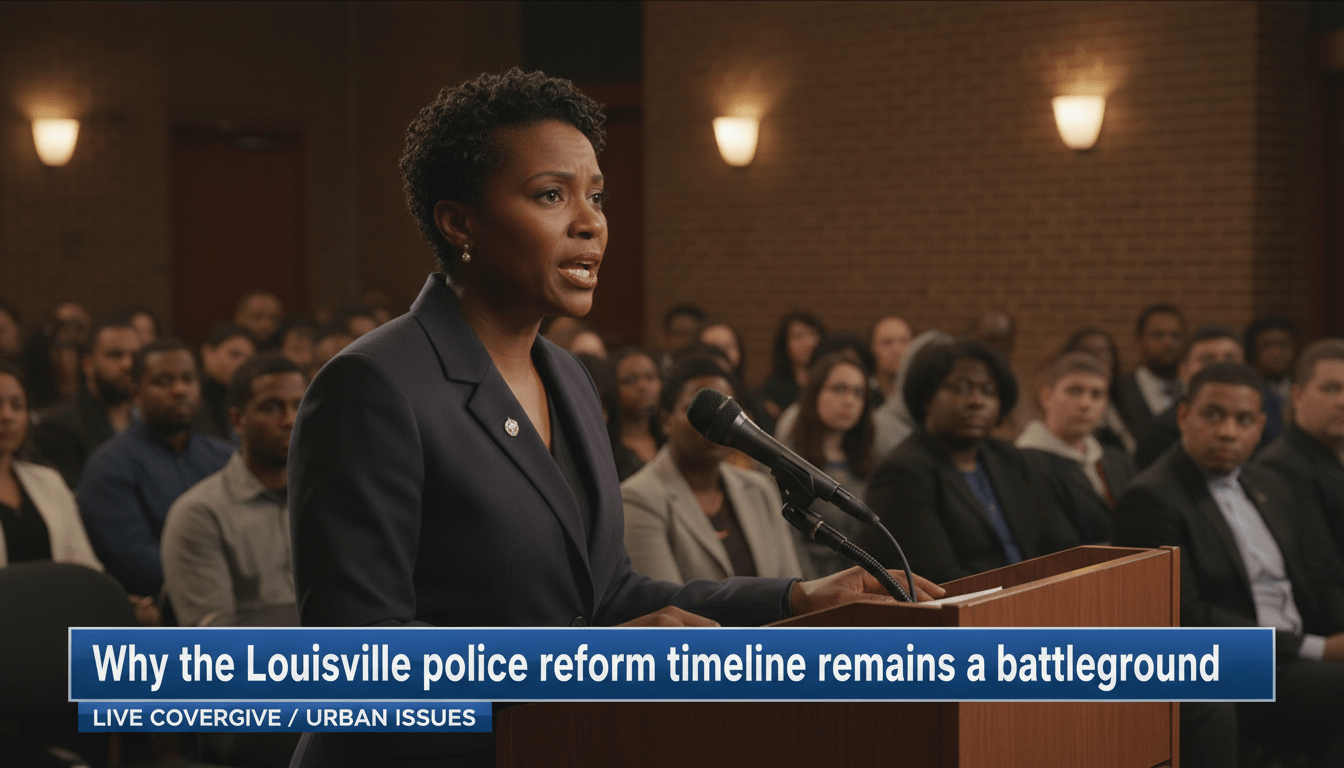
Why the Louisville police reform timeline remains a battleground
By Darius Spearman (africanelements)
Support African Elements at patreon.com/africanelements and hear recent news in a single playlist. Additionally, you can gain early access to ad-free video content.
The streets of Louisville hold memories that span generations. For many Black residents, the current debate over police reform is not a new conversation. It is a long story about who has power and how fast things change. Metro leaders and local advocates are currently locked in a struggle over how to move the Louisville Metro Police Department (LMPD) forward. While the headlines focus on the latest meetings, the roots of this fight go deep into the history of the city. (theroot.com)
The friction centers on two main ideas. First, people disagree on “oversight power,” which means who gets to watch the police and hold them accountable. Second, there is a fight over the “pace of rule changes.” Advocates want fast, deep changes, while city leaders often move at a different speed. To understand why there is so much tension today, one must look back at the decades of internal policing and racial gaps that created this moment. (nul.org)
The long road of symbolic oversight
Efforts to check police power in Louisville began over sixty years ago. In 1962, the city created the Louisville Human Relations Commission. Its job was to protect people from discrimination. However, the commission did not have much power to change how police acted. In the 1970s, civil rights leaders like Reverend Louis Coleman began to push for a review board made of regular citizens. They wanted a board that could actually enforce rules. (wkms.org)
The struggle for justice continued into the 1980s. Groups like Citizens Against Police Abuse (CAPA) worked hard to show the public when police used too much force. They argued that the police were “policing themselves,” which meant no real accountability existed. These early movements set the stage for the frustration that exists today. Even then, the city often responded with task forces that looked good on paper but did not change the system. This history shapes how the community views notion of freedom and safety today. (nul.org)
In 2003, a major change happened. The Louisville Division of Police and the Jefferson County Police Department merged. This created the LMPD. To make the community feel better about this merger, the city started the Citizens Commission on Police Accountability. But there was a big problem. The commission could only look at cases that were already closed. They could not force witnesses to talk or change how officers were punished. Advocates called this “toothless” oversight. (louisvilleky.gov)
Breonna Taylor and the urgency for change
The death of Breonna Taylor in 2020 changed everything. She was a young Black woman killed in her own home during a “no-knock” raid. Her death made the whole world look at Louisville. It forced the city to pass “Breonna’s Law” in June 2020. This law banned no-knock warrants and made it a rule that officers must wear body cameras when they search a home. For many, this was a step toward a new struggle for justice in the modern era. (theroot.com)
Even with new laws, many people felt the change was moving too slow. They wanted to know why it took a tragedy for the city to act. The federal government also took notice. In March 2023, the U.S. Department of Justice (DOJ) finished a big investigation. They found that the LMPD had a pattern of breaking the law and violating the rights of citizens. The report said the police used too much force and discriminated against Black residents. (wkms.org)
The DOJ report provided numbers to support what Black residents had been saying for years. For example, it showed that Black drivers were twice as likely as white drivers to be stopped for minor traffic issues. It also found that the police used unjustified neck restraints and canine bites. This report was a “hammer” that advocates hoped would force the city to finally fix the deep issues inside the police department. (police1.com)
The battle over federal vs local control
The biggest fight right now is about who should run the reform process. Usually, when the DOJ finds a pattern of misconduct, the city enters a “federal consent decree.” This is a legal agreement where a federal judge and an independent monitor make sure the police department changes. It is hard to break because it has the power of the law behind it. However, the situation in Louisville took an unexpected turn. (police1.com)
In May 2025, the DOJ moved to dismiss its lawsuit against the city. By January 2026, a federal judge officially ended the case. This happened as the national administration shifted under President Donald Trump. His administration often prefers local control over federal oversight. Mayor Craig Greenberg and Police Chief Paul Humphrey argue that this is a good thing. They believe the city can fix itself faster and cheaper without federal lawyers. (whas11.com)
Mayor Greenberg has pushed a plan called “Community Commitment.” He says it will cost about $750,000 to run locally, while federal oversight would cost $3 million a year. He points to new rules, like releasing body camera footage within ten days of a shooting, as proof that the city is making progress. This debate highlights the complex relationship between federal and local authority. (whas11.com)
Why advocates fear “policing themselves”
Advocates are not happy with the move away from federal oversight. They believe that without a judge watching, the police department will go back to its old ways. Council member Shameka Parrish-Wright and others argue that the city cannot be trusted to watch itself. They point to the “People’s Consent Decree,” which is a list of demands created by the community. They want these demands to be legally binding. (theroot.com)
The main issue is “subpoena power.” This is the power to force people to give evidence or testify. Currently, the Civilian Review and Accountability Board (CRAB) and the Office of Inspector General (OIG) struggle to get the information they need from the police. In 2022, the Inspector General reported that the LMPD denied them access to data and personnel. This makes it almost impossible to conduct a real investigation. (lmpd.gov)
Without “unfettered access” to files, oversight boards are just for show. Advocates want the power to see everything, including internal emails and disciplinary records. They believe that the struggle for power and identity in Louisville depends on this transparency. If the police can say “no” to the people who are supposed to watch them, then there is no real oversight. (wkms.org)
Includes Federal Monitors & Legal Fees
Local Management & Admin Costs
The tension over the pace of change
The speed of reform is another major point of conflict. Metro leaders often say they are moving as fast as they can. They mention the backlog of open records they have cleared and the new training programs they have started. They argue that deep changes in a large organization like the LMPD take time. They want the community to be patient as they implement these new policies. (whas11.com)
Advocates, however, feel that the city is dragging its feet. They see the dismissal of the federal case as a way to slow down the process. For them, every day without real change is a day when another citizen could be hurt. They point to recent disputes where the LMPD fought back against findings from the OIG about a fatal shooting in 2023. To them, this shows that the culture of the department has not changed. (whas11.com)
This disagreement creates a cycle of disillusionment. When the city makes a promise, the community waits to see if it is true. When the police department resists oversight, the community loses trust. This cycle has repeated itself since the 1960s. The current fight over the timeline is really a fight over whether the city is serious about reform or if it is just waiting for the headlines to go away. (nul.org)
Understanding the key terms of the fight
To follow this story, it is helpful to know what some of the terms mean. A “consent decree” is more than just a plan. It is a court order that ensures long-term change. Without it, reforms are just “handshake deals” that a new mayor or police chief could cancel. This is why advocates call the consent decree a “hammer.” It provides a level of legal protection that local policies do not have. (police1.com)
Another important term is “pretextual stops.” This is when a police officer pulls someone over for a tiny reason, like a broken tail light, just to look for something else. The DOJ found that these stops were used much more often against Black residents in Louisville. Advocates want the oversight board to monitor these stops to make sure they are not being used to harass people. Ending these stops is a key part of the “People’s Consent Decree.” (wkms.org)
Finally, there is the difference between the Office of Inspector General (OIG) and the Civilian Review Board (CRB). The OIG is run by professionals who do the investigative work. The CRB is made of volunteers from the community who look at that work. Neither group can fire an officer. They can only make recommendations to the Chief of Police or the Mayor. This limited power is at the heart of the community’s demand for more authority. (lmpd.gov)
A community looking for a new chapter
The history of Louisville shows a pattern of systemic harm followed by symbolic fixes. From the 1962 Commission to the 2003 merger, the city has often tried to address police issues without giving up control. The 2020 protests and the 2023 DOJ report forced the city to face these issues more directly. But now, with the federal government stepping back, the future is uncertain. (nul.org)
The fight between metro leaders and advocates is a fight for the soul of the city. One side sees an opportunity for “local healing” and faster change. The other side sees a return to a failed era of self-policing. As the city moves forward with its “Community Commitment” plan, the world will be watching to see if Louisville can truly break its historical patterns. (whas11.com)
For the residents who have been marching since the days of Reverend Louis Coleman, the goal remains the same. They want a city where the police are accountable to the people they serve. They want a pace of change that reflects the urgency of their lives. Whether that happens through a federal judge or local leaders, the demand for justice will not go away. The history behind the headlines proves that the people of Louisville are prepared for a long fight. (theroot.com)
About the Author
Darius Spearman is a professor of Black Studies at San Diego City College, where he has been teaching for over 20 years. He is the founder of African Elements, a media platform dedicated to providing educational resources on the history and culture of the African diaspora. Through his work, Spearman aims to empower and educate by bringing historical context to contemporary issues affecting the Black community.
