

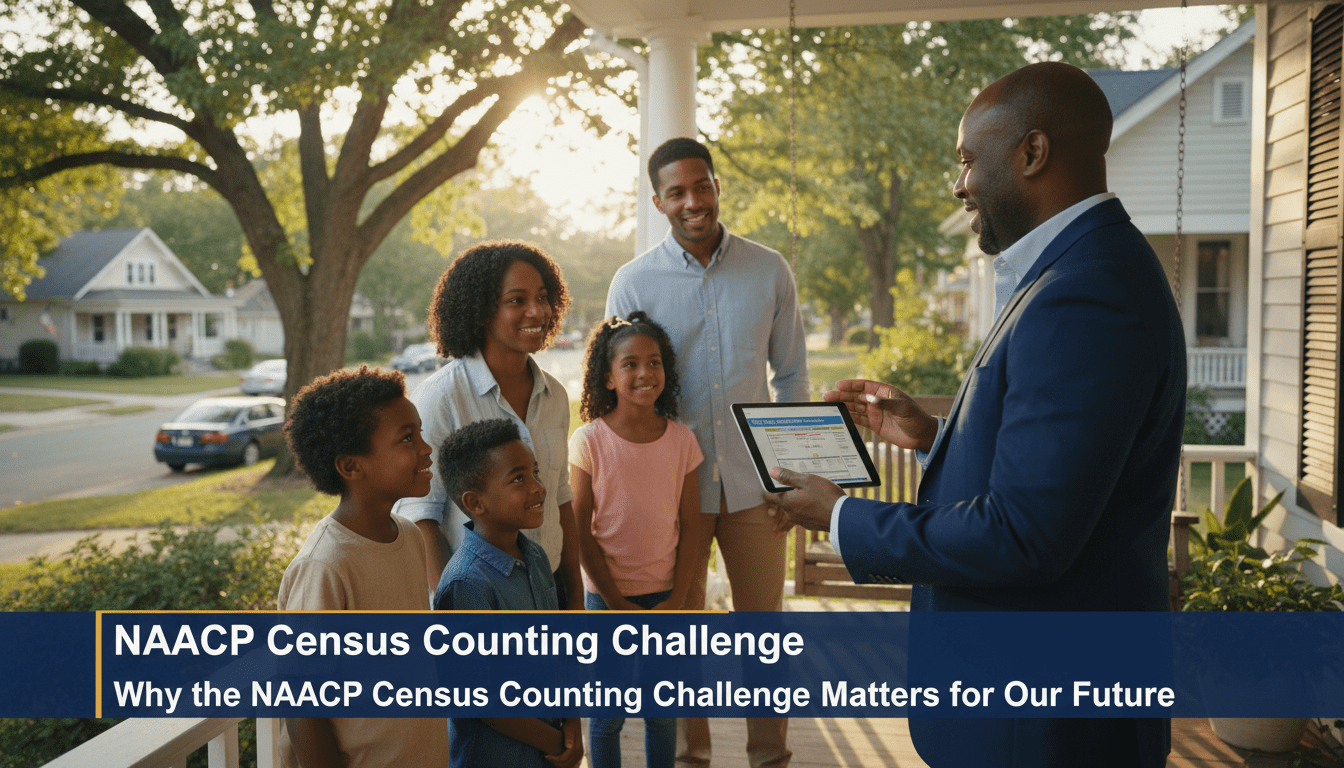
Why the NAACP Census Counting Challenge Matters for Our Future
By Darius Spearman (africanelements)
Support African Elements at patreon.com/africanelements and hear recent news in a single playlist. Additionally, you can gain early access to ad-free video content.
The United States Census happens only once every ten years. It seems like a simple task of counting heads. However, for Black communities, this count represents a massive struggle for visibility and respect. The NAACP recently filed a significant legal motion to stop changes in how the government counts people (naacpldf.org). This action highlights a long history of attempts to minimize the presence of Black people in America.
Currently, President Donald Trump oversees the executive branch as these counting methods face scrutiny (washingtonpost.com). The NAACP argues that new rules could lead to a massive undercount. If millions of people are not seen by the government, they lose their voice. This legal battle is about making sure every person counts in the eyes of the law. It is a fight that began at the very founding of the nation.
2020 Census Accuracy Gap
Source: U.S. Census Bureau Post-Enumeration Survey
The Roots of Erasure and the Three-Fifths Clause
The fight for a fair count is not a new problem for Black Americans. The original United States Constitution contained a rule known as the Three-Fifths Compromise. This rule stated that enslaved people would only count as three-fifths of a person for the census (theusconstitution.org). This allowed Southern states to have more power in Congress. However, it denied the basic humanity of those being counted (yale.edu).
This early method set a dangerous precedent for the future of the country. It showed that the government could use the census to manipulate political power. Even after slavery ended, the struggle to be counted correctly continued. The census remained a political tool rather than a simple mathematical exercise (britannica.com). Because of this, Black leaders had to become experts in data collection and sociology.
W.E.B. Du Bois was one of the first leaders to challenge census inaccuracies. In the late 1800s, he conducted his own research to show the truth about Black lives. His famous study in Philadelphia used data to prove that inequality came from the environment (philadelphiaencyclopedia.org). He fought against voter disenfranchisement efforts by providing clear evidence of Black achievement. His work proved that accurate data is essential for achieving justice and equality (soztheo.com).
Understanding the Differential Undercount
The term “differential undercount” describes a persistent problem in American history. It means that certain groups of people are missed more often than others. Since 1940, the Census Bureau has studied its own mistakes using surveys (census.gov). These studies consistently show that Black, Latino, and Native American people are undercounted. Meanwhile, white Americans are often overcounted (census.gov).
In the 1940 Census, the bureau missed about 13 percent of Black men. This trend has continued into the modern era with alarming consistency. The 2020 Census missed approximately two million Black Americans (census.gov). This equals a 3.3 percent undercount for the Black population. At the same time, the white population was overcounted by 1.6 percent. These errors create a massive gap in how resources are shared across the nation.
An undercount is not just a mistake on a piece of paper. It has real-world consequences for every person in a missed community. Each uncounted person represents a loss of more than $4,000 every year (brennancenter.org). Over a decade, that adds up to $40,000 in lost money for one person. This funding supports local schools, hospitals, and emergency services (ncnw.org). When the count is wrong, the community pays the price in crumbling infrastructure and fewer services.
The Hidden Threat of Differential Privacy
The Census Bureau recently introduced a new method called “differential privacy.” This method adds “statistical noise” to the data to protect people’s identities (ctdata.org). The bureau claims this noise prevents hackers from identifying individuals. However, the NAACP and other civil rights groups worry about the side effects. They argue that this noise makes data for small Black neighborhoods much less accurate (brennancenter.org).
This inaccuracy can make it seem like certain communities do not exist. When the data is blurred, it becomes harder to see the needs of specific areas. Small, predominantly Black neighborhoods might see their population numbers drop artificially. This can lead to a loss of Black political power during the redistricting process. If the data is not precise, the lines drawn for voting districts will be unfair (ctdata.org).
Accuracy is vital for the Voting Rights Act to function correctly. Lawmakers use census data to create districts where minority groups have a fair chance. If differential privacy hides the true population, these districts might disappear (harvardlawreview.org). The NAACP argues that protecting privacy should not come at the cost of being seen. They believe the government must find a way to do both without harming vulnerable communities.
The Cost of One Missed Person
Total Loss in Federal Funding Over 10 Years
Calculated at $4,000 per year per resident missed in the count.
Prison-Based Gerrymandering and Phantom Populations
Another major issue in the census is where incarcerated people are counted. Currently, the bureau counts prisoners in the facilities where they stay (prisonersofthecensus.org). Most of these prisons are in rural, white areas. However, many incarcerated people come from urban, Black neighborhoods. This practice is often called prison-based gerrymandering. It creates “phantom” populations in rural districts (naacpldf.org).
This practice effectively steals political power from Black communities. The rural areas get more representatives because their population numbers look higher. Meanwhile, the home communities of these prisoners lose the representation they deserve. The NAACP has challenged this practice in several states, including Connecticut (prisonersofthecensus.org). These legal battles focus on the idea of “One Person, One Vote.”
The 14th Amendment requires that all people be counted fairly. When prisoners are counted in the wrong place, it shifts the balance of federalism impacts across the state. This means rural voters have more influence than urban voters. Several states have already passed laws to end this practice. They now count incarcerated people at their last known home address (naacpldf.org). The NAACP wants this to become the standard for the entire country.
The 2026 Legal Battle in Missouri
The recent legal motion filed by the NAACP is part of a larger case in Missouri. The state of Missouri sued to prevent non-citizens from being counted (democracydocket.com). They also want to change how the 2030 Census is conducted. The NAACP intervened in this case to protect the “full count” mandate. They argue that excluding any person violates the Constitution (democracydocket.com).
The Constitution says the census must count the “whole number of persons.” It does not say “citizens” or “voters” (theusconstitution.org). Excluding non-citizens would hit racially diverse cities the hardest. Many Black immigrants from Africa and the Caribbean live in these urban centers (thearp.org). If these residents are not counted, the total population of Black neighborhoods will drop. This would lead to fewer seats in the House of Representatives.
Missouri’s urban chapters of the NAACP are leading this charge. They know that their cities stand to lose the most. Cities like St. Louis and Kansas City have high numbers of immigrant residents (house.gov). Removing these people from the count would dilute the voting power of every resident. This is why the NAACP considers the Missouri case a top priority for 2026. It is a defensive move to ensure the next census is fair from the start (democracydocket.com).
The Digital Divide and the 2020 Experience
The 2020 Census was the first to encourage everyone to respond online. While this sounds modern and efficient, it created new barriers. Many Black communities suffer from a “Digital Divide” (brennancenter.org). This refers to a lack of high-speed internet or the devices needed to go online. Rural Black corridors often have the slowest internet speeds in the nation (harvard.edu).
If a community cannot access the census form, they cannot be counted. The NAACP warned the government about this problem before the 2020 count began (naacpldf.org). They argued that relying on the internet would lead to a massive undercount. Their predictions were correct, as response rates were lower in areas with poor internet access (brennancenter.org). This issue highlights how technology can sometimes increase inequality instead of fixing it.
Many Black adults rely only on their smartphones for internet access. Completing long government forms on a small screen is difficult. Furthermore, the cost of data can be a burden for low-income families (harvard.edu). These obstacles make it harder for people to participate in their own democracy. The NAACP continues to push for better outreach methods that do not rely solely on the internet. They want more door-to-door workers and paper forms available in every neighborhood.
$1.5 Trillion Annual Stake
Total federal funds distributed annually based on Census data.
The High Stakes for the 2030 Cycle
The legal motions filed today are part of a preemptive strategy. The NAACP wants to prevent the mistakes of the past from happening again in 2030. They are fighting to ensure that data privacy rules do not hide Black communities. They are also working to end prison-based gerrymandering once and for all. This is a long-term struggle for political Black nationalism and representation.
The stakes involve more than just politics. Over $1.5 trillion in federal funds are distributed every year based on census data (brennancenter.org). This money covers everything from highways to the Head Start program. If a community is undercounted, it remains underfunded for ten whole years. This can cause a cycle of poverty and neglect that is hard to break. The NAACP knows that a fair count is the foundation of a healthy community.
Finally, the census determines how many seats each state gets in Congress. The 2020 undercount may have cost Black communities three seats in the House of Representatives (naacpldf.org). This loss of representation means fewer voices in Washington fighting for the needs of the diaspora. By challenging these counting methods now, the NAACP is protecting the future of Black political power. They are ensuring that the promise of democracy applies to everyone.
Conclusion: A Centuries-Old Fight for Dignity
The NAACP’s legal challenge is a reminder that being counted is an act of resistance. From the Three-Fifths Compromise to the digital divide, Black Americans have faced many barriers to being seen. These census battles are not just about numbers or spreadsheets. They are about the dignity of every person and the fairness of our entire system of government.
As the legal process moves forward in Missouri and across the country, the message remains clear. Every person living in the United States must be counted regardless of their status or location. Accuracy in the census is a requirement for a just society. The NAACP will continue to stand as a guardian of the count to make sure no one is left in the shadows. The future of our schools, our hospitals, and our political voice depends on it.
About the Author
Darius Spearman is a professor of Black Studies at San Diego City College, where he has been teaching for over 20 years. He is the founder of African Elements, a media platform dedicated to providing educational resources on the history and culture of the African diaspora. Through his work, Spearman aims to empower and educate by bringing historical context to contemporary issues affecting the Black community.
