

Why the US Chases Ghana Lithium Supply Deals Today
By Darius Spearman (africanelements)
Support African Elements at patreon.com/africanelements and hear recent news in a single playlist. Additionally, you can gain early access to ad-free video content.
The global race for minerals has placed Ghana at the center of a major geopolitical struggle. For many years, China held a strong grip on the resources needed for modern technology. However, the United States is now working hard to change that balance. This competition is about more than just business. It is a fight over which superpower will influence the future of the green energy transition. This shift has massive implications for local jobs and the way the Ghanaian state exercises its power (gga.org).
In the current year of 2025, President Donald Trump has overseen a dramatic change in how America handles these mineral deals. The United States government is no longer simply encouraging private companies to invest. Instead, it is taking a direct role in securing supply chains through state-led initiatives. This strategy is a response to decades of Chinese dominance in the region. By looking at the history behind these headlines, observers can see how old Cold War tactics are returning in a new form (semafor.com).
The Historical Roots of Mineral Diplomacy
The struggle for African minerals did not begin with electric car batteries. It has roots that go back to the 1940s. After World War II, the United States realized that African minerals were essential for national defense. President Harry S. Truman launched the Point Four Program in 1949. This program provided technical skills to newly independent nations. The goal was to help countries like Ghana map their mineral deposits while keeping them away from Soviet influence (youtube.com).
During the Cold War, resources like manganese and cobalt were used as tools of political alignment. The United States used infrastructure loans to secure access to these materials. For instance, the construction of the Akosombo Dam in Ghana was part of this larger strategy. These projects often forced African nations to choose sides between global powers. The modern focus on nation centered power reflects these earlier attempts to control strategic resources (youtube.com).
While the United States moved toward a market-based approach in the 1990s, China took a different path. China launched the “Go Out” policy to encourage its companies to secure resources abroad. In 2009, the Chinese firm Bosai Minerals Group bought a huge stake in the Ghana Bauxite Company. By 2018, China and Ghana signed the $2 billion Sinohydro deal. This agreement allowed Ghana to pay for new roads and bridges using the proceeds from bauxite mining. This model created a deep partnership that the United States is now trying to match (thehighstreetjournal.com).
The Shift to State-Led Competition
The U.S. government has recently moved away from letting the private market lead the way. In February 2026, the State Department launched the Forum on Resource Geostrategic Engagement, or FORGE. This initiative is a permanent shift toward state-led mineral diplomacy. It replaces the older Minerals Security Partnership. FORGE coordinates over twenty countries to provide billions of dollars for mineral projects. This is an explicit attempt to offer an alternative to Chinese state-backed loans (semafor.com).
Under the leadership of Donald Trump, the U.S. is acting more like a sovereign investor. The government is now using agencies like the Export-Import Bank to take direct roles in projects. For example, a $12 billion strategic reserve called “Project Vault” was created to fund these efforts. The U.S. has even started taking direct equity stakes in mining companies. This “state-capitalist” model aims to rebuild American processing and refining capabilities that were lost over the last forty years (semafor.com).
This new strategy focuses on “friendshoring,” which means sourcing materials from allied nations. For Ghana, this means the U.S. is looking for partnerships that follow high environmental and social standards. These standards are known as ESG. The U.S. argues that its projects offer better working conditions than those backed by China. This is a key part of the American pitch to African leaders who want sustainable development. They are exploring how freedom defines power in a global market where ethics are becoming a competitive advantage (semafor.com).
Lithium and the New Frontier in Ghana
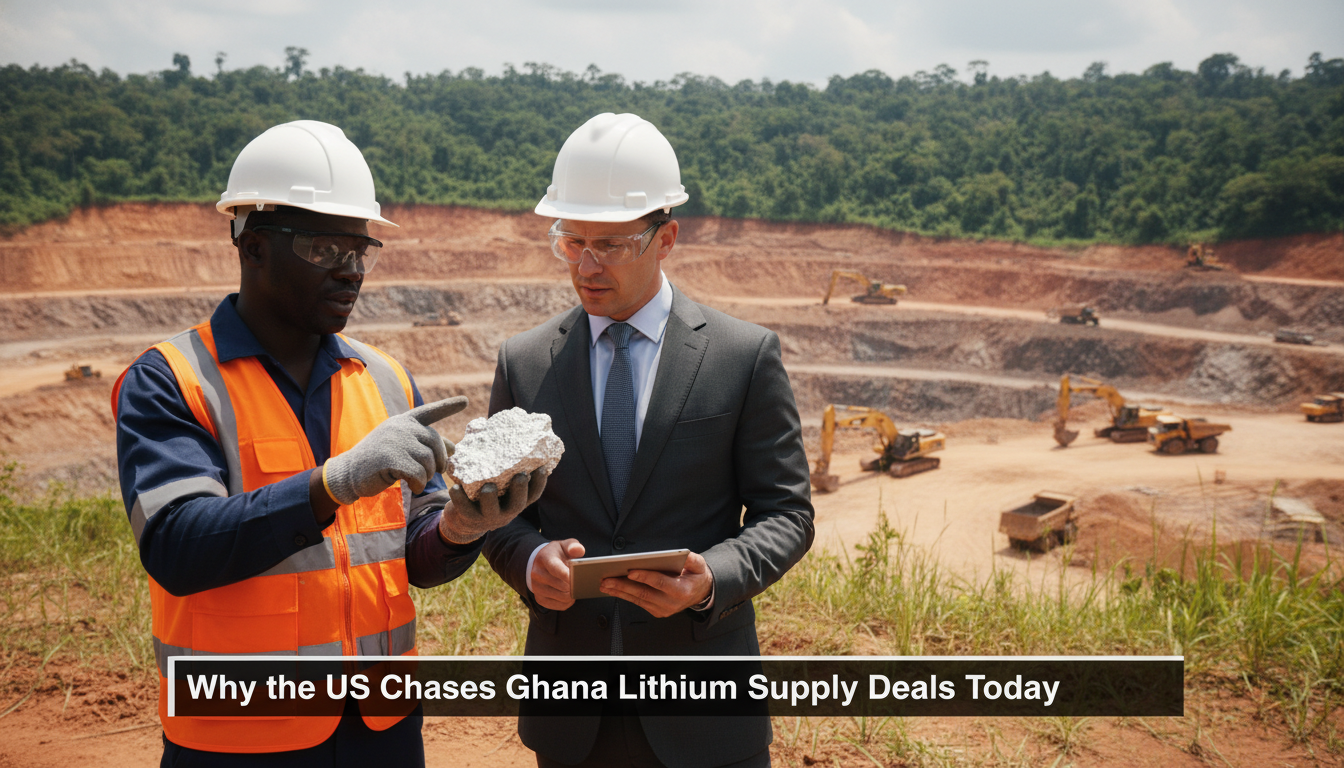
While manganese and bauxite have long been important, lithium is now the most sought-after prize. Lithium is a critical component for the batteries used in electric vehicles and smartphones. In Ghana, the Ewoyaa Lithium Project is set to become the first lithium mine in the country by 2026. This project is managed by Atlantic Lithium, which receives heavy support from the U.S. firm Piedmont Lithium. It is a central piece of the U.S. plan to build a “China-free” battery supply chain (investingnews.com, theafricareport.com).
A “China-free” supply chain is very important for American consumers. Under the Inflation Reduction Act, U.S. citizens can receive a tax credit for electric vehicles. However, they only get this credit if the battery minerals come from the U.S. or its free trade partners. This policy links a mine in Ghana directly to the price of a car in an American driveway. It is a clear example of how domestic policy in the U.S. drives international mineral deals (investingnews.com).
China is not backing down from this competition. In 2024, the Ghana Manganese Company, which is backed by a Chinese firm, announced a $450 million refinery. This project will process manganese locally in Ghana. By doing this, China is challenging the idea that only Western firms provide industrial growth. The race to build refineries shows that both powers recognize that the real value is in processing, not just digging rocks out of the ground (ghanaweb.com).
Ghana’s increased take under the Green Minerals Policy (theafricareport.com).
Shaping Jobs and Local Livelihoods
The mineral rivalry between the U.S. and China is a major driver of employment in Ghana. However, the types of jobs created by these two powers are often very different. Large-scale mining operations currently employ about 35,000 people directly. Projects like the Ewoyaa Lithium mine are expected to create over 1,000 direct jobs. Similarly, the Chinese-backed manganese refinery is projected to add another 1,000 roles. These industrial jobs provide steady income and technical training for Ghanaian workers (youtube.com, ghanaweb.com).
Beyond these formal jobs, there is a massive sector known as “Galamsey,” or artisanal small-scale mining. This sector supports over 1.1 million jobs and sustains nearly 4.5 million livelihoods. Galamsey is often driven by poverty and a lack of other options. It is a major social justice issue because many of these miners work in dangerous conditions without safety gear. The influx of foreign operators, including some from China, has sometimes led to environmental destruction and conflicts with local communities (youtube.com, business-humanrights.org).
Labor standards have become a point of tension in these deals. Some Chinese-run projects have faced criticism for poor working conditions and even physical violence against workers. In response, U.S.-backed projects emphasize their adherence to high labor standards. They promise better safety and fairer treatment. However, these “high-standard” projects often take longer to start because they must meet many regulations. The challenge for Ghana is to balance the need for quick jobs with the need for long-term worker safety and dignity (business-humanrights.org).
Ghanaian Sovereignty and State Power
The government of Ghana is not a passive bystander in this global contest. Instead, it is using the rivalry to gain more power for itself. Under President Akufo-Addo, Ghana introduced the Green Minerals Policy. This policy bans the export of raw lithium. The government wants companies to build refineries inside Ghana. This move ensures that the country keeps more of the wealth generated by its natural resources. It is a shift from the old “dig and ship” model to an active industrial strategy (theafricareport.com).
Ghana has also increased its financial stake in mining projects. The law used to give the state a 10% share in mines for free. For the new lithium projects, the government raised this “free carried interest” to 13%. They also doubled the royalties that companies must pay on lithium from 5% to 10%. By playing both sides of the U.S.-China divide, Ghana is rewriting its mining laws to favor its own citizens. This demonstrates that African nations can use superpower competition to strengthen their own political strategy and economic independence (theafricareport.com).
Environmental justice is another area where the Ghanaian state is taking a stand. Mining can be very hard on the land and water. Lithium refining, for instance, uses a huge amount of water. To protect the environment, the government is launching reclamation projects to restore land damaged by mining. They are also moving to revoke laws that once allowed mining in protected forests. These actions show that the state is trying to manage the costs of the mineral boom while chasing its benefits (youtube.com).
Mapping Ghana’s strategic importance in the battery supply chain.
The Role of the African Diaspora
The U.S. move into African mineral markets also involves members of the African Diaspora. Black-owned businesses in the United States are increasingly acting as bridge-builders. These firms want to move away from old models of charity and toward “market-grounded” partnerships. For example, some African American-owned firms are developing mineral deposits in other parts of Africa to compete in the critical minerals market. They advocate for African nations to move up the value chain (youtube.com).
Diaspora leaders often push for deals that benefit both the U.S. and the host African nation. They see the energy transition as an opportunity for Black-owned businesses to play a major role in global trade. By focusing on shared prosperity, they aim to support resilient communities across the Diaspora. This involvement adds a unique layer to the U.S. strategy, as it relies on cultural and historical ties to build trust with African partners (youtube.com).
The involvement of the Diaspora also helps ensure that “value-added” industrialization becomes a reality. This means making sure that the processing of minerals creates high-skilled jobs for local people. Instead of just exporting raw materials, the goal is to build factories that produce battery chemicals or even solar panels in Ghana. This vision aligns with the desires of many African leaders who want to see their countries become industrial hubs (theafricareport.com).
Conclusion: A New Chapter in Resource History
The U.S. pursuit of mineral deals in Ghana is much more than a modern commercial rivalry. It is a continuation of historical strategies that date back to the Cold War. However, the world has changed since the days of the Point Four Program. Today, Ghana and other African nations have more leverage than ever before. They are using the competition between the United States and China to secure better terms, higher royalties, and local industrialization (investingnews.com, theafricareport.com).
The rise of state-led initiatives like FORGE signals that the United States is serious about challenging Chinese dominance. This contest will shape the economy of Ghana for years to come. It will determine the types of jobs available and how the country manages its environment. While the superpowers fight for control of the supply chain, Ghana is working to ensure that its citizens are the ultimate winners. By looking at the history behind the headlines, it becomes clear that minerals are not just rocks—they are the foundation of future state power and global influence (gga.org, semafor.com).
About the Author
Darius Spearman is a professor of Black Studies at San Diego City College, where he has been teaching for over 20 years. He is the founder of African Elements, a media platform dedicated to providing educational resources on the history and culture of the African diaspora. Through his work, Spearman aims to empower and educate by bringing historical context to contemporary issues affecting the Black community.
