

Why Venezuela Intervention Sparks Global Protests for Sovereignty
By Darius Spearman (africanelements)
Support African Elements at patreon.com/africanelements and hear recent news in a single playlist. Additionally, you can gain early access to ad-free video content.
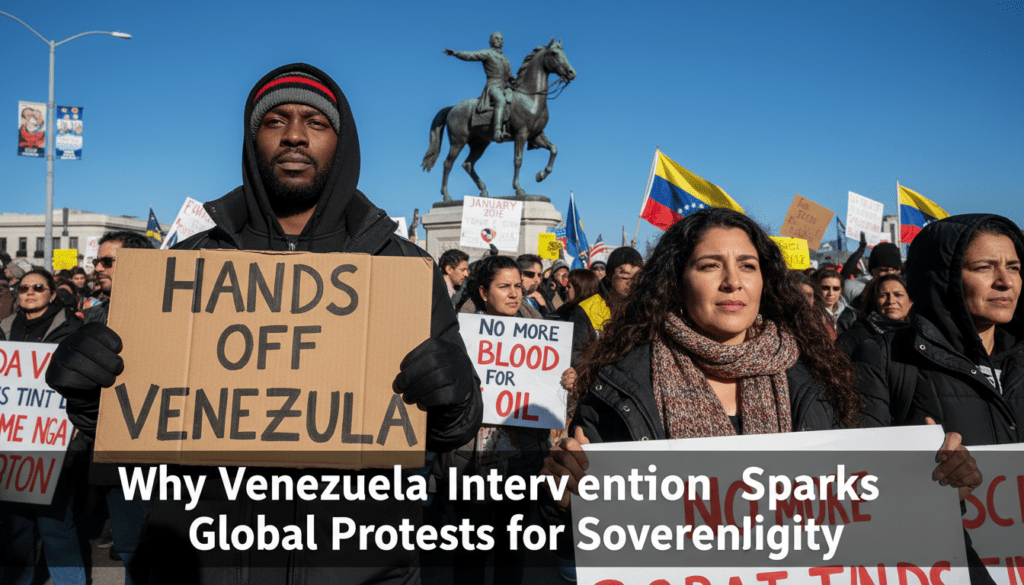
The streets of San Francisco and Birmingham echoed with loud chants during the first week of 2026. Hundreds of people gathered to voice their opposition to recent military actions in South America (bignewsnetwork.com). These marchers held signs demanding that the United States keep its hands off Venezuela. They rejected the use of bombs and forced regime change as solutions to political problems (sfchronicle.com). Organizers from the Answer Coalition led the charge for diplomacy instead of military force.
This wave of unrest follows a significant military operation that shifted the global political landscape. The headlines today describe a fast-moving conflict with deep historical roots. Many protesters believe that current events are a continuation of older patterns of intervention. To understand the anger in the streets, one must look closely at the history behind the headlines. This story involves resources, power, and the long struggle for national independence.
The Launch of Operation Absolute Resolve
On Saturday, January 3, 2026, the United States military began a large-scale operation in Venezuela. This mission was named Operation Absolute Resolve (bignewsnetwork.com). It involved a series of airstrikes and special forces raids on the city of Caracas. During this operation, President Donald Trump announced the capture of Nicolás Maduro and his wife, Cilia Flores (bignewsnetwork.com). The United States government justified this move by citing narco-terrorism charges from years prior.
Following the capture, the President stated that the United States would manage Venezuela during a transition period. This announcement sparked immediate charges of neo-colonialism from critics around the world (bignewsnetwork.com). The operation did not happen in a vacuum. It was the result of an escalation that began several months earlier. Since September 2025, the United States conducted over 35 strikes against boats in the Caribbean (argaam.com). These strikes resulted in at least 115 deaths before the final raid occurred.
Source: (argaam.com)
Protesting in the Shadow of Bolívar
In San Francisco, protesters chose to gather at the statue of Simón Bolívar (sfchronicle.com). Bolívar is a hero of South American independence from Spanish rule. Choosing this location sent a strong message about sovereignty and freedom. The marchers argued that Latin America does not belong to the United States (sfchronicle.com). They carried signs with slogans like “No more blood for oil” to express their views. The crowd included a diverse group of activists and community members.
Meanwhile, a similar scene unfolded at 5 Points South in Birmingham, Alabama. This location is a historic gathering spot in a city famous for human rights struggles (bcri.org). Many activists in Birmingham see a connection between international issues and local justice. They often practice internationalist solidarity with other marginalized groups. Protesters in Alabama demanded that their government prioritize diplomacy over military aggression (sfchronicle.com). They expressed deep concern for the people living under the threat of war.
The Legacy of the Monroe Doctrine
The friction between the two nations is not a new development. It began with the Monroe Doctrine in 1823 (study.com). This policy told European nations to stop colonizing the Western Hemisphere. While it seemed defensive, many leaders in Latin America saw it as a threat. They feared the United States wanted to replace Europe as the dominant power. Simón Bolívar himself warned that the United States might plague the region with misery (researchgate.net).
In 1904, President Theodore Roosevelt added a new layer called the Roosevelt Corollary (state.gov). This addition claimed that the United States had the right to intervene in nearby countries. It allowed the military to act as an international police power (state.gov). This policy created a long history of military intervention in Cuba, Haiti, and Nicaragua. Consequently, many Venezuelans view current actions through this lens of historical interference. They see Operation Absolute Resolve as the latest chapter in a very old story.
The Bolivarian Revolution and Social Change
The modern conflict escalated significantly after the election of Hugo Chávez in 1999. Chávez led a movement known as the Bolivarian Revolution (researchgate.net). He nationalized the oil reserves of the country to fund social programs for the poor. This shift changed Venezuela from a loyal ally of the United States into a challenger. The movement emphasized the distribution of wealth and participatory democracy (researchgate.net). It aimed to protect the nation from global capitalist influence.
This revolution also focused on the challenges faced by marginalized communities. Specifically, Afro-Venezuelan identity gained new recognition under these reforms (aaihs.org). The government created special days to celebrate African heritage and updated school curricula. However, these programs relied heavily on oil revenue. When the global price of oil dropped, the economy began to struggle. The United States government increased pressure on the nation during this vulnerable time.
Source: (argaam.com)
Legal Precedents and Narco-Terrorism Charges
The United States government used specific legal tools to justify the capture of Maduro. In 2020, the Department of Justice unsealed indictments against several Venezuelan officials (state.gov). They charged these leaders with narco-terrorism conspiracy. The United States claimed Maduro led a group called the Cartel of the Suns (state.gov). This legal strategy categorizes foreign heads of state as private criminals. By doing this, the government attempts to bypass diplomatic immunity.
This approach follows the Noriega Precedent from 1989. During that time, the United States invaded Panama to capture Manuel Noriega (wionews.com). Courts ruled that a leader can be tried even if they were captured through military force. However, many legal scholars argue this sets a dangerous precedent (northeastern.edu). They believe it gives prosecutors the power to effectively declare war. This merging of criminal law and military action remains a point of intense international debate.
The Strategy of Maximum Pressure
The 2026 raid was the final step in a policy called Maximum Pressure. This strategy uses aggressive economic tools to force a government to surrender (researchgate.net). It includes broad sanctions that target the primary revenue sources of a country. The United States specifically targeted the Venezuelan oil industry (argaam.com). These sanctions blocked access to international credit and decimated government income. Consequently, the nation could not afford to import enough food or medicine.
Maximum pressure also involves secondary sanctions. These penalties target banks and businesses in third-party countries that trade with Venezuela (researchgate.net). This isolation effectively cut off the nation from the global economy. Critics argue that these tactics cause unnecessary suffering for ordinary citizens. While the United States claims to support the people, many believe these policies have made the humanitarian crisis worse. The fight for economic justice is central to the protests seen in American cities.
Oil and Global Corporate Interests
Resource control is often a hidden factor in international conflicts. Venezuela possesses the largest oil reserves in the entire world (argaam.com). Historically, major companies like Exxon and Gulf Oil controlled nearly all production there (argaam.com). However, the government nationalized these interests in 2007. This move led to long legal battles in international courts. Today, Chevron is the only major American oil company still operating in the country under a special license (argaam.com).
Protesters in San Francisco pointed to the role of big business in foreign policy. They worry that the United States wants to “fix” the infrastructure for its own companies (bignewsnetwork.com). This fear is rooted in the history of failed promises regarding foreign intervention. Many activists believe the “war on drugs” is actually a “war for oil” (sfchronicle.com). They see a pattern where military force is used to secure profits for multinational corporations. This connection between war and wealth is a major theme for the Answer Coalition.
The Human Cost of Political Turmoil
The statistics regarding the crisis in Venezuela are staggering. As of 2025, over 14 million people faced severe humanitarian needs (argaam.com). Additionally, nearly 8 million people have left the country since 2014 (argaam.com). This is one of the largest displacement crises in modern history. People often flee because they lack access to basic food and life-saving medicine. Sanctions have made it very difficult for the government to provide these essential services.
Furthermore, the “war on drugs” narrative mirrors domestic social justice issues. Activists in Birmingham noted that drug laws are often used to target minority communities (bcri.org). They see the military strikes on boats as a global version of this domestic policy. These actions have led to the deaths of over 100 people in just a few months (argaam.com). Consequently, the protest movement links foreign policy directly to the struggle for civil rights at home. They argue that the militarization of police and the militarization of foreign policy are two sides of the same coin.
Conclusion: The Future of Sovereignty
The events of January 2026 mark a turning point in international relations. The capture of a foreign leader by the United States challenges traditional ideas of national sovereignty. While the government frames this as a law enforcement action, many others see it as an act of war. The protests in San Francisco and Birmingham show that many citizens are unwilling to accept this new reality. They continue to demand a world where diplomacy replaces the use of force.
The history behind these headlines reveals a deep and complicated rivalry. It is a clash between different visions for the Western Hemisphere. One vision emphasizes the rights of powerful nations to intervene. The other vision, inspired by Simón Bolívar, focuses on the independence and integration of Latin American nations. As the United States begins to “run” Venezuela, the world will be watching closely. The outcome of this transition will shape global politics for many years to come.
About the Author
Darius Spearman is a professor of Black Studies at San Diego City College, where he has been teaching for over 20 years. He is the founder of African Elements, a media platform dedicated to providing educational resources on the history and culture of the African diaspora. Through his work, Spearman aims to empower and educate by bringing historical context to contemporary issues affecting the Black community.
