

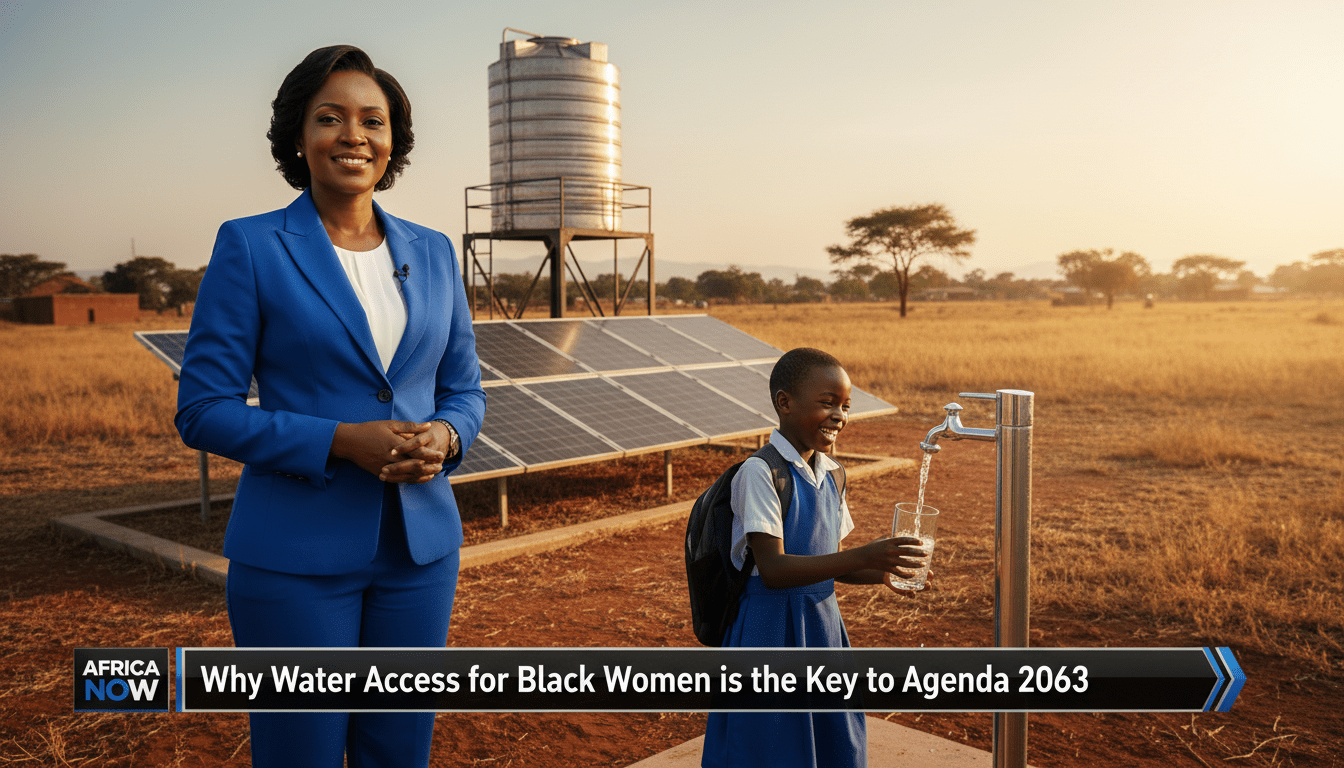
Why Water Access for Black Women is the Key to Agenda 2063
By Darius Spearman (africanelements)
Support African Elements at patreon.com/africanelements and hear recent news in a single playlist. Additionally, you can gain early access to ad-free video content.
The African Union officially designated 2026 as the year to ensure sustainable water and safe sanitation. This effort seeks to achieve the bold goals found within Agenda 2063. The initiative launched today at the 39th African Union Summit in Addis Ababa. It places a spotlight on the theme of “Water and Gender: Where Water Flows, Equality Grows.” This movement is about more than pipes and pumps. It is a direct response to a historical crisis that has placed a heavy burden on the shoulders of Black women and girls for generations (pulseofafrica.info).
For decades, the lack of clean water has served as a silent barrier to progress. This inequity does not hit every person in the same way. Instead, it creates a massive gap that keeps women from reaching their full potential. By treating water as a fundamental human right, the African Union aims to reshape the future of the continent. This shift moves water from the category of a scarce commodity into a pillar of “The Africa We Want.” The focus remains on dismantling the structures that have forced women into roles of survival rather than leadership (au.int).
Tracing the Policy: From Vision to Reality
The 2026 initiative did not appear out of thin air. It is the result of a long journey in policy and law. At the turn of the millennium, leaders launched the Africa Water Vision 2025. This was the first major framework to admit that water resources faced threats from climate change and political borders. However, early critics argued that the plan focused too much on urban cities and ignored the specific needs of rural women. To fix this, the African Ministers’ Council on Water was formed in 2002 to provide political leadership (au.int, amcow-online.org).
In 2013, the African Union introduced Agenda 2063. This is a fifty-year blueprint for a total transformation of the continent. It identifies water security as a requirement for an African renaissance. The new 2026 theme marks the first time that water and sanitation have taken center stage as the primary annual focus. This represents a major shift in how the African Union views security. Instead of only looking at military conflict, the focus has moved toward human security, which includes health and the environment (pulseofafrica.info, au.int).
The Burden of Collection
In households without onsite water, women and girls carry the responsibility:
Source: Statistical Research Data (thewaterproject.org)
The Heavy Burden: Understanding Time Poverty
Historically, the search for water has been a daily struggle for Black women. In sub-Saharan Africa, women and girls walk an average of 3.7 miles every day just to find a source. This labor is not just physical; it creates a state called “time poverty.” When hours are spent walking and carrying heavy containers, there is no time left for school or jobs. This cycle traps families in poverty and prevents girls from gaining the Black female leadership skills needed for the future (waterboys.org, thewaterproject.org).
The time spent fetching water also brings serious health risks. Carrying heavy jugs over long distances causes chronic injuries to the back and neck. Furthermore, many women must fetch water at dawn or dusk to avoid the extreme heat. This makes them vulnerable to physical and sexual violence in isolated areas. The initiative seeks to end the legacy of women serving as “water mules.” By bringing water closer to home, the African Union hopes to unlock millions of hours of productive time for the continent (unu.edu, sapub.org).
Legal Foundations: Why the Maputo Protocol Matters
The 2026 theme rests on a solid legal foundation known as the Maputo Protocol. This landmark document was adopted in 2003 to protect the rights of women in Africa. Article 18 of the protocol specifically mandates that states must provide women with access to clean drinking water and a healthy environment. It is one of the most progressive legal instruments in the world. However, the challenge has always been making these laws work in the real world (au.int, wikipedia.org).
As of late 2025, forty-four out of fifty-five member states have ratified this protocol. The African Union is now pushing for “justiciability.” This means that women should be able to go to a local court and sue if their right to water is denied. The 2026 initiative encourages nations to follow the lead of countries like South Africa and Uganda. These nations have placed the right to water directly into their national constitutions. This legal strength is necessary to ensure that water projects are not just temporary favors from the government but permanent rights (amcow-online.org, wikipedia.org).
The Economic Cost of Thirst
The lack of water is an economic disaster for the continent. Africa loses an estimated five percent of its Gross Domestic Product every year due to water and sanitation problems. This amounts to nearly two hundred billion dollars in lost opportunities. This money is lost because people are too sick to work or because they are busy fetching water. The African Union realizes that fixing the water crisis is the most effective way to grow the economy. It is an investment in human capital (downtoearth.org.in, amcow-online.org).
There is currently a thirty billion dollar annual gap in the funding needed to reach water security goals. To address this, leaders are looking at the Continental Africa Water Investment Programme. This plan uses a “Three Pathway” strategy. It aims to combine government money, private investment, and international aid. Even with the current political climate under President Donald Trump, African leaders are focusing on mobilizing domestic resources. They are asking member states to dedicate at least five percent of their national budgets to water infrastructure (amcow-online.org, nepad.org).
The Annual Funding Shortfall
Required to meet water security goals across the continent.
Climate Change: A Rising Threat to Equality
Climate change makes the water crisis even harder for women. As temperatures rise, local wells and rivers dry up. This forces women to walk even further to find water. In some regions, fetching times could increase by thirty percent by the year 2050. This creates a cycle of economic challenges that are difficult to break. Extreme weather events like droughts and floods also destroy existing infrastructure, leaving communities without any safe options (unu.edu, interaction.org).
The African Union is focusing on climate-resilient systems to combat this. This means building large-scale treatment plants and bulk transmission lines instead of only digging small village wells. These larger systems can better handle the changes in rainfall. Furthermore, the initiative emphasizes solar-powered water systems. In Mauritania, for example, solar power now provides water to over one hundred thousand people in women-led households. This technology reduces the physical labor required and ensures a steady supply of water even during dry seasons (pulseofafrica.info, amcow-online.org).
Gender-Responsive Solutions in Schools
One of the most important parts of the 2026 theme is sanitation in schools. A major reason girls drop out of school when they reach puberty is the lack of private toilets. Without running water and private spaces, managing menstrual hygiene becomes impossible. This is a historical barrier that has limited the education of millions of girls. The African Union is now pushing for gender-responsive sanitation. This requires schools to have separate toilets with locks and access to soap and water inside the stalls (innoafrica.org, aquatabs.com).
These facilities are necessary for keeping girls in the classroom. When schools provide private rooms and clean water, attendance rates for girls skyrocket. The 2026 initiative also aims to reduce the stigma surrounding menstruation through “puberty education.” By treating these biological needs with dignity, the continent can ensure that puberty is not the end of a girl’s education. This focus on sanitation is a key part of building the “Africa We Want” where every child has an equal chance to succeed (digitaloceanspaces.com, aquatabs.com).
Who Runs the Water?
Percentage of National Water Ministries led by women vs men:
A Bridge Across the Atlantic: Diaspora Connections
The struggle for clean water is not limited to the African continent. It is a shared experience for Black communities across the globe. There are clear parallels between the water crisis in rural Africa and the “toxic water” struggles in majority-Black cities in the United States. Cities like Flint, Michigan, and Jackson, Mississippi, have faced similar issues of neglected infrastructure and environmental racism. This connection creates a “Global Black Perspective” on the right to life-sustaining resources (thecommunityrevolution.org, developmentreimagined.com).
This shared struggle has led to new partnerships between the diaspora and the continent. Many Black-owned engineering and tech firms in the United States are now working with African nations. They provide solar purification technology and AI tools to detect leaks in old pipes. This “brain gain” allows professionals to use their skills to help solve problems in their ancestral homes. The fight for historical resistance against inequality now includes the fight for modern infrastructure. This bridge across the Atlantic is strengthening the global movement for environmental justice (thecommunityrevolution.org, developmentreimagined.com).
Closing the Gap: The Path Toward 2063
The 2026 initiative is a call to action for every member of the African Union. It requires a massive change in how water is managed. Currently, only seventeen percent of national ministries responsible for water are led by women. To fix the gender gap, women must be in the rooms where decisions are made. The African Union is pushing for gender-balanced representation in eighty percent of water basin institutions by the year 2043. This will ensure that the people who carry the water are also the ones who manage the resource (pulseofafrica.info, amcow-online.org).
As the world celebrates World Water Day, the focus remains on the future. The initiative launched today is about more than just a single day or a single year. It is about creating a permanent foundation for equality. By investing in water, Africa is investing in the health, education, and economic power of its women. This is the only way to achieve the vision of Agenda 2063. When water flows freely and safely to every home, the entire continent will grow. The era of the water mule is ending, and the era of the African woman leader is beginning (pulseofafrica.info, au.int).
About the Author
Darius Spearman is a professor of Black Studies at San Diego City College, where he has been teaching for over 20 years. He is the founder of African Elements, a media platform dedicated to providing educational resources on the history and culture of the African diaspora. Through his work, Spearman aims to empower and educate by bringing historical context to contemporary issues affecting the Black community.
