

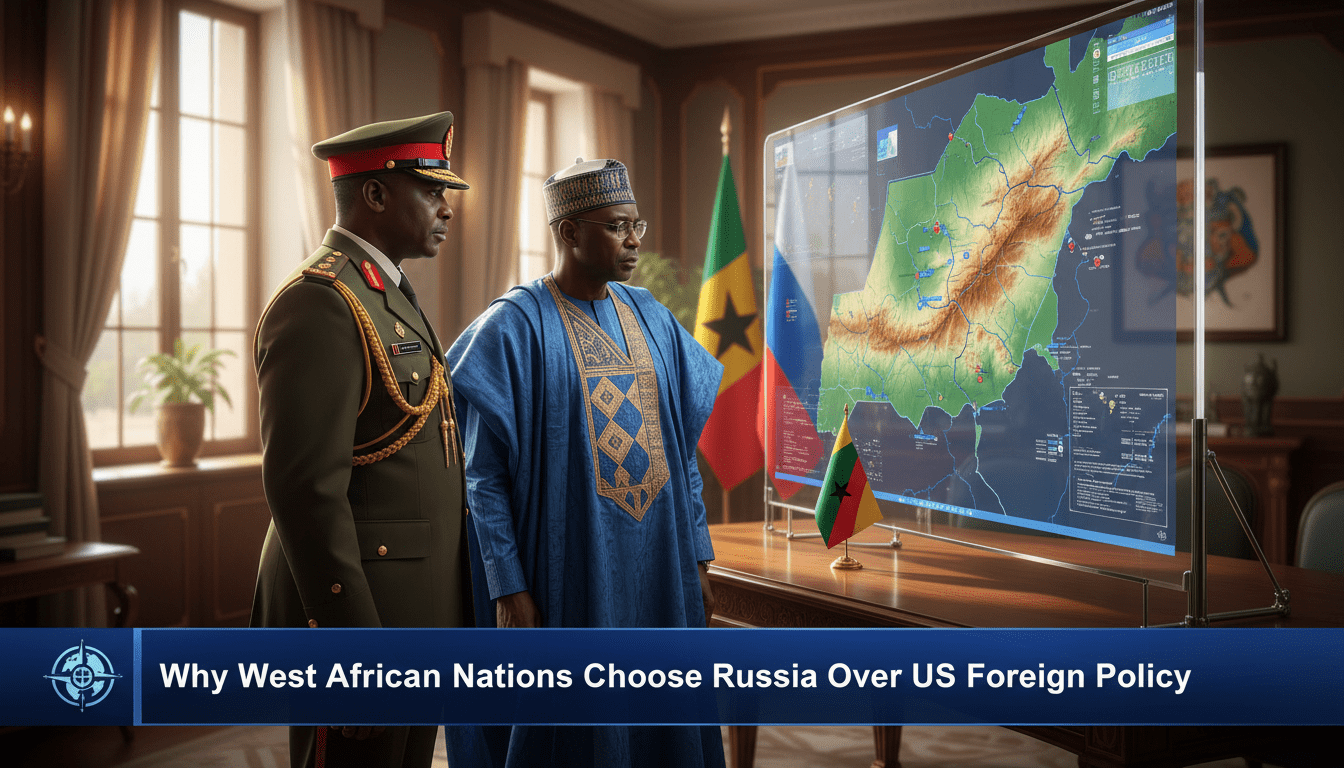
Why West African Nations Choose Russia Over US Foreign Policy
By Darius Spearman (africanelements)
Support African Elements at patreon.com/africanelements and hear recent news in a single playlist. Additionally, you can gain early access to ad-free video content.
The geopolitical landscape of the Sahel region is undergoing a massive transformation. For decades, Western powers like France and the United States held significant influence over nations like Mali, Burkina Faso, and Niger. However, a series of military takeovers has changed the direction of these countries. These nations have turned away from their traditional partners and embraced a new alliance with Russia. This shift is more than a simple change in leadership. It represents a deep-seated rejection of post-colonial structures and a move toward what these leaders call true sovereignty (losangelespress.org). As of February 2026, the United States has acknowledged this reality by changing its own strategy to engage with these military governments.
The history behind these headlines starts with a long-standing frustration with Western intervention. For many years, the presence of foreign troops did not stop the spread of extremist violence. In fact, security situations often grew worse while foreign militaries remained on the ground. This failure created a vacuum that local military leaders were eager to fill. By promising to restore order and reclaim national dignity, these juntas gained significant popular support. They often use the language of past revolutionaries to justify their actions. This movement has led to the creation of the Alliance of Sahel States, a group that is actively rewriting the rules of international relations in West Africa (issafrica.org).
The Ghost of Thomas Sankara and the New Revolution
The current military leaders in the Sahel do not view themselves as simple dictators. Instead, they often claim the mantle of Thomas Sankara, the revolutionary leader of Burkina Faso from 1983 to 1987. Sankara is a legendary figure in African history. He was known as the “African Che Guevara.” He focused on self-reliance, gender equality, and a complete break from French colonial influence. He renamed his country from Upper Volta to Burkina Faso, which means “Land of Upright People.” His assassination in 1987 turned him into a martyr for those who believe that Africa must find its own path without Western interference (wikipedia.org, losangelespress.org).
Today, leaders like Captain Ibrahim Traoré in Burkina Faso explicitly use Sankaraist rhetoric to gain legitimacy. This ideological shift is a major reason why the current African educational systems and political structures are under scrutiny. Traoré and his peers argue that the previous democratic governments were merely puppets of Western interests. By invoking Sankara, they appeal to a sense of national pride and a desire for economic independence. They emphasize that foreign aid is a tool of control. Sankara famously said that he who feeds you, also controls you. This belief drives the current juntas to reject Western assistance in favor of partnerships they view as more equal (losangelespress.org).
This “Sankaraist” revival has profound implications for regional stability. It is more than a military strategy; it is a social movement. The juntas have prioritized land redistribution and food self-sufficiency, just as Sankara did. They also focus on removing the symbols of French influence from public life. However, while the rhetoric is powerful, the reality on the ground remains difficult. The transition to self-reliance is happening in the middle of a brutal conflict with insurgent groups. This creates a situation where the promise of revolution must compete with the immediate need for security (fundsforngos.org).
Françafrique and the Breaking of Chains
To understand why these nations are turning to Russia, one must understand the history of “Françafrique.” This term describes the complex and often secretive web of political, military, and economic ties that France maintained with its former colonies. Critics argue that this system was a form of modern neocolonialism. One of the most significant pillars of this system is the CFA franc. This currency is pegged to the Euro and was historically guaranteed by the French Treasury. While it provided monetary stability, it also required African nations to deposit a large portion of their foreign exchange reserves in France (almayadeen.net, lse.ac.uk).
This economic arrangement allowed France to maintain significant control over the fiscal policies of West African nations. For many activists and leaders in the Sahel, the CFA franc is a symbol of stolen sovereignty. They argue that a country cannot be truly independent if it does not control its own money. Protests against the currency have grown loud in recent years. The military governments in Mali, Burkina Faso, and Niger have used this grievance to justify their departure from Western-aligned regional blocs. They view the breaking of these economic chains as a necessary step toward building a future that serves African interests first (almayadeen.net).
Furthermore, French companies have long enjoyed a dominant position in the extraction of African natural resources. Whether it is uranium in Niger or gold in Mali, the benefits of these resources often seemed to flow toward Europe rather than the local population. The juntas have started to rewrite mining codes to ensure the state receives a larger share of the profits. This move has caused friction with Western mining corporations but has been met with cheers from local workers. The rejection of Françafrique is a fundamental part of the current “Sahelian Revolution” (businessinsider.com, apanews.net).
Mali Gold Production Decline (2023-2025)
2023 Output
2025 Output
A 22.9% drop due to regulatory shifts and disputes. (ceicdata.com)
The Rise of the Alliance of Sahel States
Between 2020 and 2023, a wave of military coups swept through the Sahel. Colonel Assimi Goïta took power in Mali, followed by Captain Ibrahim Traoré in Burkina Faso, and General Abdourahamane Tiani in Niger. These leaders did not just take over their own countries; they decided to band together. In September 2023, they signed the Liptako-Gourma Charter. This document created the Alliance of Sahel States (AES). It is a mutual defense pact that promises that an attack on one is an attack on all. This alliance was a direct response to threats from the Economic Community of West African States (ECOWAS) to intervene militarily after the coup in Niger (zagazola.org, issafrica.org).
By January 2025, the AES nations took an even more drastic step. They announced their formal withdrawal from ECOWAS, an event many call “Sahelexit.” They claimed that the regional bloc had become a tool for French interests and had failed to support them in their fight against terrorism. This move has major consequences for the people living in these countries. ECOWAS provided a framework for free movement and trade across West Africa. Without it, citizens of Mali, Burkina Faso, and Niger may face new barriers when traveling or doing business with their neighbors (allafrica.com, lse.ac.uk).
The “Sahelexit” also means these countries are moving away from regional judicial systems. The ECOWAS Community Court of Justice once offered a way for citizens to challenge human rights violations. Now, legal recourse is largely limited to local courts controlled by the military governments. This shift toward isolation from regional institutions is a gamble. The leaders of the AES believe that the benefits of sovereignty outweigh the risks of being cut off from their neighbors. They are betting that their new alliances with countries like Russia and China will provide enough support to sustain their economies and security (issafrica.org, lse.ac.uk).
Russia and the Africa Corps: A Different Kind of Deal
As the juntas expelled French and American forces, Russia moved quickly to fill the void. Initially, this engagement happened through the Wagner Group, a private military company. However, after the internal power struggles in Russia in 2023, these operations were reorganized. They are now known as the “Africa Corps” and are under the direct control of the Russian Ministry of Defense. This change is significant. It means that Russia’s presence in the Sahel is no longer a “deniable” mercenary operation. It is an official part of Russian state policy (zagazola.org, businessinsider.com, nationalinterest.org).
The relationship between Russia and Black people throughout history has seen many shifts. In the current era, the deal is very transactional. Russia provides security, military hardware, and training. In exchange, it gains access to strategic minerals and a foothold in a region that was once a Western stronghold. Unlike Western partners, Russia does not condition its help on democratic reforms or human rights standards. For the military juntas, this is a major selling point. They can focus on fighting insurgents and staying in power without being lectured by foreign diplomats about their internal governance (businessinsider.com, nationalinterest.org).
This partnership has already led to visible changes. Russian instructors are now training local troops, and Russian drones are being used in combat operations. In Mali, the government has even worked with Russian partners to refine their mining laws. This collaboration aims to maximize state revenue from gold mines. However, the presence of the Africa Corps has also been linked to reports of increased violence against civilians during military operations. While the juntas see Russia as a reliable partner for regime survival, the human cost for local communities remains a point of serious concern (zagazola.org, businessinsider.com).
The Donroe Doctrine: US Pragmatism in a Changing World
By February 2026, the United States government realized that its old approach to the Sahel was no longer working. Under the leadership of President Donald Trump, the U.S. has adopted a new strategy known as the “Donroe Doctrine.” This policy moves away from promoting democracy and instead focuses on “pragmatic realism.” The goal is to secure American interests, specifically access to critical minerals, and to compete with Russian and Chinese influence. This represents a major departure from previous years when the U.S. suspended aid to countries that underwent military coups (kenyanforeignpolicy.com, nationalinterest.org, usmission.gov).
A key figure in this new policy is Massad Boulos, a senior advisor with deep ties to West African business networks. Boulos argues that Africa should be viewed as a place for investment rather than a “charity case.” He has pushed for the U.S. to engage with “capable, reliable states,” regardless of whether their leaders wear military uniforms. In February 2026, Senior Bureau Official Nick Checker visited Bamako, Mali. His message was clear: the United States respects Mali’s sovereignty and wants to move past previous policy missteps. This “New Course” is an attempt to stay relevant in a region that is rapidly slipping away from Western control (losangelespress.org, usmission.gov).
The Donroe Doctrine treats foreign policy as a series of business deals. If the juntas can provide security for American mining interests and help box out competitors, the U.S. is willing to look the other way regarding their democratic shortcomings. This shift is driven by the global race for resources needed for new technologies. The Sahel is rich in minerals that are vital for modern electronics and energy. By prioritizing these resources, the U.S. hopes to maintain its global standing even as the political environment in Africa becomes more hostile to traditional Western values (nationalinterest.org, usmission.gov).
Regional Stability Metrics (Early 2026)
Food Price Hike (Niger)
Food Insecure (Sahel)
Yearly Security Incidents
Data reflects extreme pressure on civilian populations. (devex.com, apanews.net, fundsforngos.org)
The Human Cost of Geopolitical Rivalry
While leaders in Washington, Moscow, and Bamako play a high-stakes game of chess, the average person in the Sahel is suffering. The statistics are grim. By 2026, food prices in Niger have increased by as much as 38% following the disruption of regional trade. Over 52 million people across West Africa and the Sahel now face acute food insecurity. The conflict between the military and insurgent groups continues to drive people from their homes. There are now more than 2.7 million internally displaced persons in the region. This crisis affects the resilience of African families as they struggle to survive in a landscape of constant war (devex.com, fundsforngos.org).
The economic benefits promised by the military juntas have been slow to reach the working class. While “resource nationalism” sounds good in speeches, the reality has been a drop in production. In Mali, industrial gold output fell by nearly 23% in 2025. This was due to legal battles with foreign companies and the disruption of local mining contracts. This drop in production means fewer jobs and less money flowing into local communities. Many people who once worked in the mining sector or supported it are now without an income. The “anti-imperialist” dividend that many hoped for has been replaced by a “triple threat” of falling production, rising prices, and insecurity (ceicdata.com, devex.com).
The shift toward Russia and the exclusion of Western aid have also affected social services. Many programs that provided healthcare and education were funded by international organizations that have since left the region. The juntas are trying to fill these gaps, but their budgets are consumed by the high cost of fighting a war. This leaves little room for investments in the future of the youth. As the Sahel becomes the new front line of great-power competition, the human cost of these political choices becomes more evident every day. The people are caught between the failures of the past and the uncertain promises of a new, militant future (devex.com, fundsforngos.org).
Conclusion: A New Chapter in African Sovereignty?
The situation in the Sahel is a powerful example of how history continues to shape the present. The legacy of Françafrique and the inspiration of Thomas Sankara are driving a fundamental shift in West African politics. The military juntas in Mali, Burkina Faso, and Niger have successfully challenged the old order. They have embraced Russia as a security partner and forced the United States to rethink its entire strategy in Africa. This “back to the future” movement is a bold attempt to reclaim national dignity and economic independence (losangelespress.org, issafrica.org).
However, this transition is far from easy. The departure from regional institutions like ECOWAS and the shift toward transactional partnerships with Russia and China carry significant risks. While the juntas have reasserted their sovereignty, they have not yet been able to provide the security and economic stability their people desperately need. The rising food prices and falling mineral production are warning signs that political slogans cannot replace a functioning economy. The world is watching to see if these nations can build a stable future or if they will become trapped in a new cycle of conflict and dependence (devex.com, lse.ac.uk).
For the global community, the “Sahelian Revolution” marks the end of an era of Western dominance in Africa. The rise of the Donroe Doctrine shows that even the most powerful nations are being forced to adapt to a world where they can no longer dictate terms. As the juntas navigate their new alliances, the true test will be the material conditions of their citizens. Only time will tell if this period of upheaval leads to a genuine rebirth of African sovereignty or if it is simply a change of masters in a long-standing struggle for power (nationalinterest.org, usmission.gov).
About the Author
Darius Spearman is a professor of Black Studies at San Diego City College, where he has been teaching for over 20 years. He is the founder of African Elements, a media platform dedicated to providing educational resources on the history and culture of the African diaspora. Through his work, Spearman aims to empower and educate by bringing historical context to contemporary issues affecting the Black community.
