

Will Africa Finally Gain a Permanent UN Security Council Seat?
By Darius Spearman (africanelements)
Support African Elements at patreon.com/africanelements and hear recent news in a single playlist. Additionally, you can gain early access to ad-free video content.
The Echoes of Addis Ababa
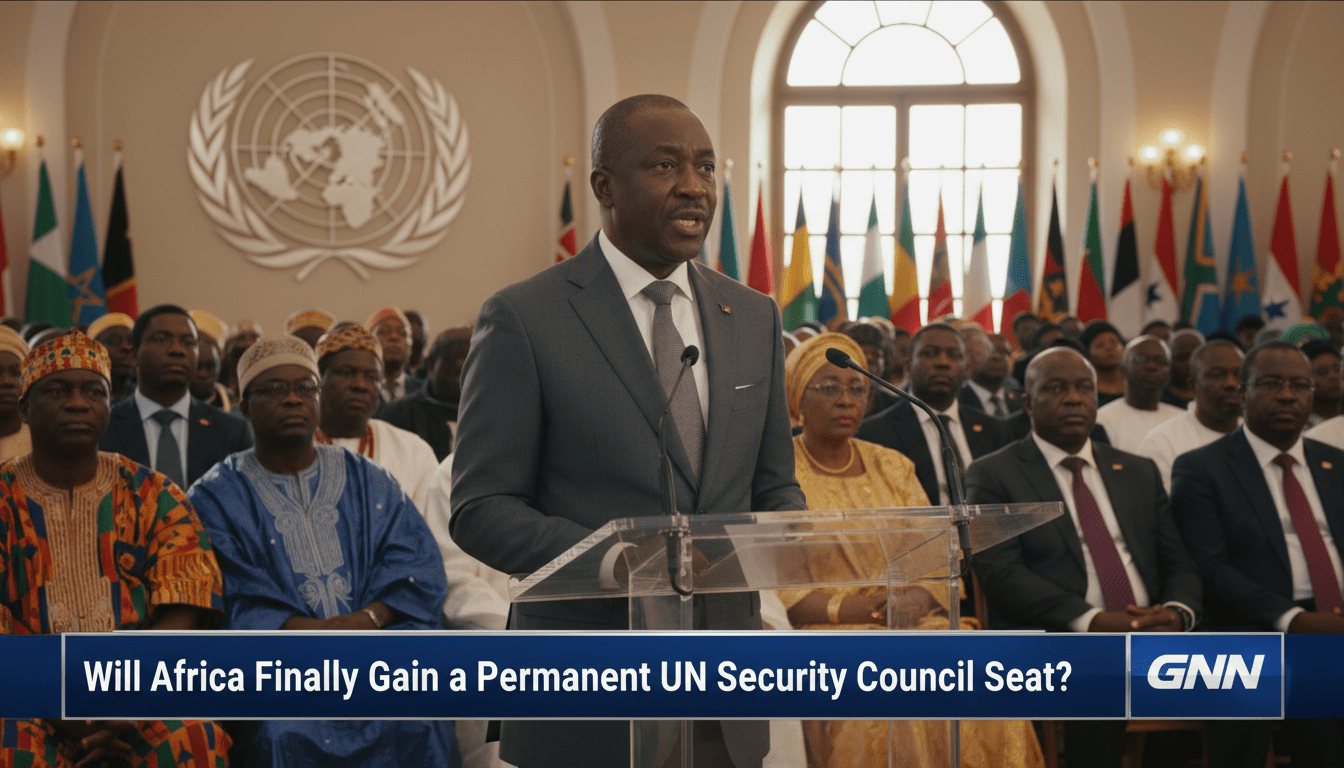
In February 2026, the air in Addis Ababa carried the weight of history. UN Secretary-General António Guterres stood before the 39th African Union Summit. He did not use the careful language of a typical diplomat. Instead, he called the current global system “indefensible.” He pointed out that the world is living in 2026, yet it is still governed by rules made in 1946. This gap of eighty years has left an entire continent on the sidelines of global power (un.org).
The Secretary-General argued that the UN Security Council is a relic of the colonial era. When the United Nations began, most African nations did not exist as independent states. They were colonies of European powers like Britain, France, and Portugal. Consequently, they had no voice when the world designed the rules of peace and security. Guterres insisted that this historical injustice must end now. He specifically called for two permanent seats for Africa on the Security Council (ungeneva.org).
UNSC Disparity: Agenda vs. Power
Council Resolutions Focused on Africa
African Permanent Seats (With Veto)
The Ghosts of 1945
To understand the current anger, one must look back to the end of World War II. In 1945, the winning powers met in San Francisco to sign the UN Charter. At that time, only four African nations were independent: Egypt, Ethiopia, Liberia, and South Africa. The rest of the continent remained under the control of the “P5” or their allies. The P5 includes the United States, the United Kingdom, France, Russia, and China. These five nations gave themselves permanent seats and the power to block any decision (wikipedia.org, wikipedia.org).
This structure reflects the world as it looked in 1945, not the world as it is today. For decades, the African continent has been the primary site of UN peacekeeping missions. However, the nations that live through these conflicts have no permanent say in how those missions are run. This disconnect is part of a larger history of Africa before colonialism that was interrupted by European extraction. The current system keeps that colonial hierarchy alive in the halls of the United Nations (securitycouncilreport.org, explaininghistory.org).
The exclusion of Africa is not a simple mistake. It was a deliberate design of the post-war era. The victorious powers wanted to maintain control over global affairs. Under the current administration of President Donald Trump, the United States continues to be a dominant force in this system. While some permanent members have signaled openness to change, they often hesitate to share the ultimate prize: the veto power. Africa is currently represented by three rotating, non-permanent seats, but these members cannot block a resolution alone (securitycouncilreport.org, mfa.gr).
The Power of the Veto
The veto is the most significant tool of the P5. If one of these five nations says “no,” a resolution fails, even if every other country in the world says “yes.” This power is impactful because it creates a geopolitical deadlock. It prevents the UN from acting when a permanent member or its ally is involved in a conflict. African leaders argue that this makes the Security Council ineffective and undemocratic (quora.com, wikipedia.org).
Africa officially opposes the veto in principle. However, the African Union insists that if the veto exists, Africa must have it too. This position was solidified in 2005 through the Ezulwini Consensus. African nations agreed that they deserve at least two permanent seats with all the privileges of membership. They believe that without the veto, African permanent members would be “second-class” citizens in the Council. This demand is a matter of common justice and equality on the world stage (au.int, mofaic.gov.zm).
Furthermore, the Security Council spends most of its time debating African issues. In 2025 alone, twenty-two out of thirty-five press statements from the Council concerned Africa. It is a strange reality where the people most affected by the rules have the least amount of power to write them. This is why the Secretary-General described the situation as a “relic of the colonial era.” He is pushing for a total redesign that reflects the current global reality (un.org, ungeneva.org).
The Bretton Woods Debt Trap
The call for reform does not stop at the Security Council. Guterres also urged for massive changes to the International Monetary Fund (IMF) and the World Bank. These institutions were born at the Bretton Woods Conference in 1944. Much like the UN, they were built when most of Africa was under colonial rule. Consequently, the voting power in these banks is tied to financial contributions. This means the wealthiest nations hold all the keys to the money (wikipedia.org, worldbank.org).
Many African nations are currently facing a rising debt crisis that makes development almost impossible. For decades, the voting power of the United Kingdom was double that of all African countries combined. Today, the United States holds about 16.5 percent of the voting power at the IMF. This gives it a solo veto over major financial decisions. Meanwhile, all fifty-four African nations combined hold only about 6.5 percent. This imbalance keeps Africa in a cycle of dependency (worldbank.org, policyalternatives.ca).
Guterres described the global financial system as “totally unjust.” He pointed out that African countries often pay up to eight times more to borrow money than developed nations. This is not because they are less reliable. It is because the credit rating systems and financial rules are biased toward the Global North. This inequality creates a four trillion dollar annual gap in financing for essential goals like education and healthcare (un.org, businessreport.co.za).
IMF Voting Power Inequality
■ USA (16.5%)
■ Africa (6.5%)
The Committee of Ten and African Unity
African leaders are not waiting for permission to demand change. They have organized themselves through the Committee of Ten, also known as the C-10. This group includes nations like Algeria, Senegal, and Sierra Leone. Their job is to advocate for the Common African Position on UN reform. Sierra Leone has been particularly active in leading high-level debates at the UN. They have titled these discussions “Addressing the historical injustice” to force the P5 to respond (securitycouncilreport.org, mofaic.gov.zm).
The C-10 demands at least two permanent seats and five non-permanent seats for Africa. They argue that the current representation is a “clear anomaly.” In the past, the P5 has tried to offer Africa permanent seats without the veto. However, the C-10 has remained firm. They believe that accepting a seat without a veto would only reinforce the idea that Africa is less important than the original members. This unity is a powerful sign that the continent is speaking with one voice (au.int, gcsp.ch).
This push for unity is a core part of Pan-Africanism. It is a philosophy that seeks to unify people of African descent to dismantle systems of global white supremacy. By working together, the C-10 makes it harder for the P5 to ignore their demands. They are also working to address the “illicit financial flows” that drain billions of dollars from the continent every year. These flows often involve tax evasion by multinational corporations. Stopping this theft is just as important as gaining a seat on the Security Council (icpc.gov.ng, famu.edu).
The High Cost of Borrowing
The financial injustice has real-world consequences for everyday citizens. When an African government has to pay high interest rates, it has less money for schools and hospitals. Guterres has called for tripling the lending capacity of multilateral development banks. This would allow the World Bank to provide more loans at lower rates. For example, the “Mission 300” project aims to connect 300 million people in Africa to electricity by 2030. This is only possible if the financial system stops punishing African nations for being developing states (worldbank.org, worldbank.org).
Moreover, the Secretary-General suggested that the current financial rules act as a mechanism for continued extraction. Africa loses more money each year to debt servicing than it receives in aid. This is a modern form of the colonial extraction that defined the nineteenth century. Guterres wants to move past “symbolic” changes, such as adding a third chair for Africa on the IMF board. He wants a total reform of how voting weights are calculated so they reflect the actual needs of the world today (un.org, businessreport.co.za).
This struggle for financial reform is part of a larger fight for Social Justice that connects Africa to the Diaspora. Just as African Americans fought for voting rights and economic opportunity, African nations are fighting for their rights in global institutions. In both cases, the systems were designed to exclude them from the beginning. Reforming these institutions is a step toward reparatory justice for the centuries of exploitation that followed the Trans-Atlantic Slave Trade (famu.edu, au.int).
The “Africa Premium” in Borrowing
Developed Nations Rate
African Nations Rate
Climate Justice and Clean Energy
A new part of the reform movement focuses on the climate crisis. Africa contributes the least to global carbon emissions. However, it suffers the most from extreme droughts and floods. Guterres called for “Climate Justice,” which includes massive financial support from the nations that caused the pollution. He urged developed countries to triple their adaptation finance to over one trillion dollars annually by 2035. This would help African nations build infrastructure that can survive a changing climate (un.org, ungeneva.org).
Africa also holds sixty percent of the world’s best solar potential. Despite this, the continent receives only two percent of global clean energy investment. This is another example of how the financial system fails to support the continent’s potential. Furthermore, Africa is rich in critical minerals like lithium and cobalt. These minerals are essential for the global transition to green energy. Guterres insisted that Africa must benefit “first and fully” from these resources. The world must not repeat the history of “plundering” that occurred during the colonial era (un.org, un.org).
The transition to green energy is an opportunity for Africa to lead the world. However, this requires a global system that treats African nations as partners rather than just sources of raw materials. By reforming the UN and the IMF, the world can ensure that the “Green Revolution” is fair for everyone. This is a critical part of the Sustainable Development Goals, which aim to end poverty and protect the planet by 2030. Currently, there is a massive financing gap that prevents these goals from being met in Africa (un.org, worldbank.org).
Connecting the Struggle: Africa and the Diaspora
The call for reform resonates deeply with the African American experience. The global systemic inequality seen in the UN mirrors the domestic struggles for equality in the United States. Many civil rights leaders, including Martin Luther King Jr., saw these struggles as inseparable. They believed that justice in America was tied to the liberation of Africa from colonial and neocolonial rule. The same structures of white supremacy that limited Black families in the U.S. also limited Black nations on the world stage (famu.edu, icpc.gov.ng).
Unfortunately, many post-war efforts to help the Diaspora have failed to live up to the expectations of the people. Whether it was the Reconstruction period after the Civil War or the independence movements in the 1960s, the promise of full equality was often blocked. Today, the African Union has linked these struggles through its “Justice for Africans and People of African Descent” agenda. They are demanding reparations for the historical harms of slavery and colonialism. This movement recognizes that the social, political, and economic systems are all bound together (famu.edu, au.int).
The efforts in decolonizing African universities and institutions are part of this broader awakening. By challenging the “indefensible” rules of 1946, Guterres and African leaders are fighting for a future where everyone has a seat at the table. The headlines from Addis Ababa are more than just news about diplomacy. They are part of a century-long struggle for dignity, representation, and justice. As Guterres said, the world cannot continue to be governed by a model from the past. The time for a new, fair global order is now (un.org, ungeneva.org).
About the Author
Darius Spearman is a professor of Black Studies at San Diego City College, where he has been teaching for over 20 years. He is the founder of African Elements, a media platform dedicated to providing educational resources on the history and culture of the African diaspora. Through his work, Spearman aims to empower and educate by bringing historical context to contemporary issues affecting the Black community.
