

Will I-77 Expansion Destroy Historic Black Neighborhoods Again?
By Darius Spearman (africanelements)
Support African Elements at patreon.com/africanelements and hear recent news in a single playlist. Additionally, you can gain early access to ad-free video content.
The skyline of Charlotte, North Carolina, tells a story of rapid growth and modern ambition. However, beneath the gleaming glass towers lies a history of displacement that many residents cannot forget. Today, a new chapter in this struggle is unfolding along the Interstate 77 corridor. The Black Political Caucus of Charlotte-Mecklenburg has taken a firm stand against a massive highway project. On March 2, 2026, the group filed a lawsuit to halt the construction of the I-77 South Express Lanes (bpc-charlotte.com). This legal move is more than a simple dispute over traffic management. It represents a fight for the survival of historic communities that have already suffered decades of state-sponsored harm.
The proposed $3.2 billion project aims to add toll lanes from Uptown Charlotte to the South Carolina border (wsoctv.com). While state planners promise better traffic flow, residents in historic Black areas see a familiar threat. They argue that the expansion will create new physical and economic barriers. These neighborhoods, such as McCrorey Heights and Wesley Heights, are the cultural backbone of the city. The political experience of Black people in Charlotte is defined by this constant need to defend their land from the “progress” of others. The current lawsuit is a direct response to a pattern of neglect that residents describe as a “bureaucratic bait and switch” (wsoctv.com).
The Ghost of Urban Renewal and the Fall of Brooklyn
To understand the fear in 2026, one must look back at the 1960s. During that era, the city of Charlotte began a campaign known as “urban renewal.” This policy targeted the Brooklyn neighborhood, also known as the Second Ward (westendcharlotte.org). Brooklyn was a thriving “city within a city” for Black residents. It featured its own schools, professional offices, and vibrant social centers. However, officials labeled the area as blighted. Between 1963 and 1975, the city demolished more than 11,000 homes across Charlotte, most of which belonged to Black families (wfae.org). Brooklyn was almost entirely erased to make room for government buildings and the I-277 loop.
The destruction of Brooklyn displaced over 1,000 families and ruined hundreds of Black-owned businesses (westendcharlotte.org). This massive loss of property and community wealth left a permanent scar on the city. Residents who moved to neighborhoods like McCrorey Heights thought they had found safety. Yet, the highway system followed them. The construction of the Brookshire Freeway and the original I-77 in the 1970s sliced through these new havens. This history creates a deep sense of distrust whenever the North Carolina Department of Transportation announces new plans. The state has a long record of using infrastructure to dismantle Black wealth and social cohesion (wfae.org).
The Cost of Progress: Historical Displacement
Source: (westendcharlotte.org, wfae.org)
McCrorey Heights and the Legacy of Civil Rights
McCrorey Heights is not a typical neighborhood. It was founded in 1912 by Dr. Henry Lawrence McCrorey, who served as the president of Johnson C. Smith University (mccroreyheights.com). He envisioned a space where Black professionals could build homes and lives free from the pressures of segregation. By the mid-20th century, the neighborhood became a hub for the civil rights movement. Icons like Dorothy Counts and Dr. Reginald Hawkins lived on these streets (youtube.com). They organized and fought for equality from their living rooms. For many, McCrorey Heights is a living monument to Black achievement and resistance.
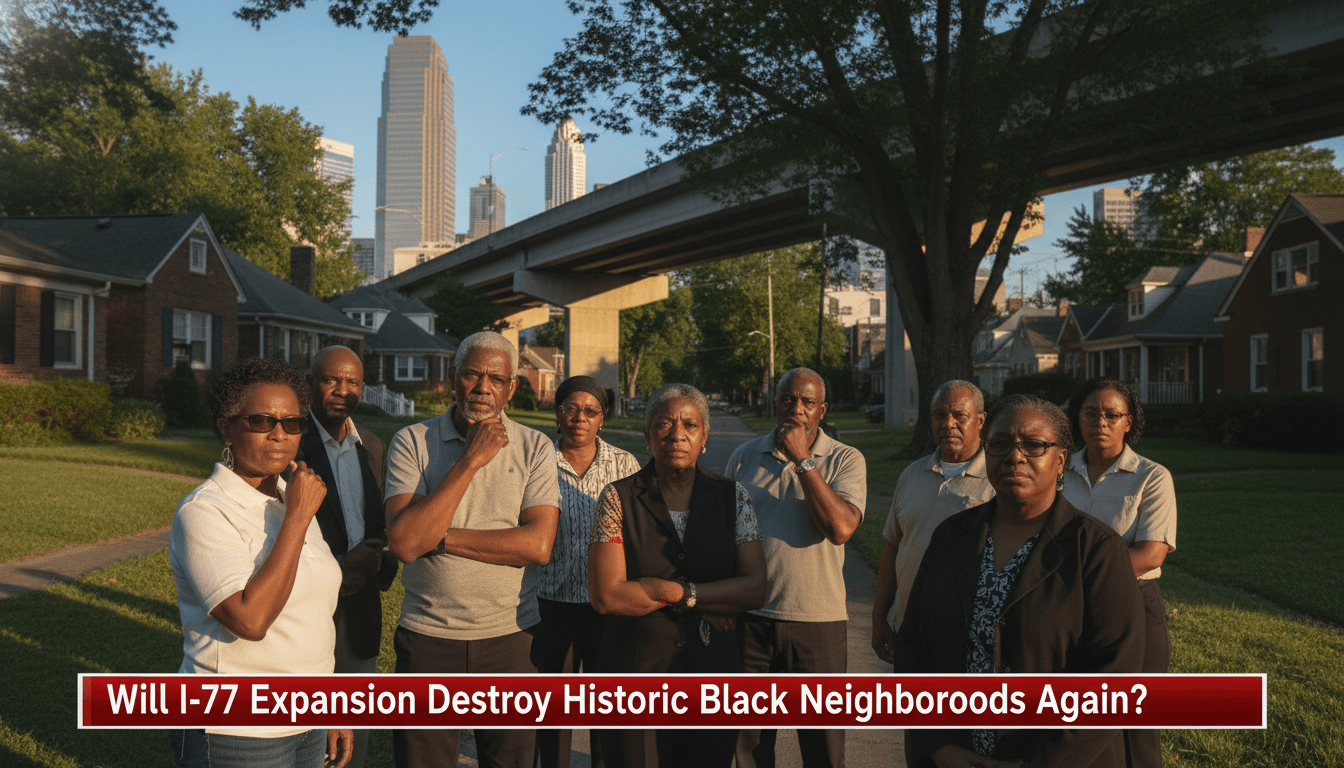
Despite its historical status, the neighborhood has faced constant “nibbling” from city planners. When the Brookshire Freeway was built, the state used eminent domain to take 12 homes (mccroreyheights.com). This project severed the connection between McCrorey Heights and other Black communities. Now, the 2026 expansion threatens to take more land. Residents like Sean Langley, the neighborhood association president, argue that this is the third time the community has been sacrificed for the commute of others (wsoctv.com). They fear that the proposed elevated toll lanes will act as a permanent wall. This wall would block views and trap noise within the neighborhood, further eroding the quality of life for long-term residents.
The Black Political Caucus recognizes that the preservation of these spaces is vital for shaping political dynamics in the region. Without a physical community, the ability to organize and exert influence diminishes. The caucus was formed in 1965 precisely because Black voices were absent from the halls of power (bpc-charlotte.com). Its first success was helping Fred D. Alexander win a seat on the City Council. Today, the caucus uses its legal standing to ensure that historic areas are no longer treated as afterthoughts in urban planning. They argue that the state must respect the cultural value of the land, not just its utility for cars.
The Two-Tiered System of Toll Roads
The I-77 South project is based on a Public-Private Partnership model. In this setup, a private company provides the money to build the lanes in exchange for the right to collect tolls for several decades (wfae.org). This model often leads to “dynamic pricing,” where the cost of the toll rises as traffic gets heavier. During peak hours, the price to use the express lanes can become very high. Critics call this a “Lexus Lane” system. It allows wealthy drivers to buy their way out of congestion while working-class residents remain stuck in the free lanes (substack.com). This creates a two-tiered mobility system based on income.
For the residents living next to the highway, the economic impact is even more complex. The expansion may lower the immediate resale value of homes due to increased noise and air pollution (landownerattorneys.com). However, the land itself becomes more valuable to outside developers. As the highway makes the area more accessible to the urban core, developers seek to build high-density luxury apartments. This process can lead to higher property taxes that force elderly or low-income residents to sell. This cycle of “infrastructure nibbling” often ends with the original community being pushed out entirely. The Caucus argues that this system turns public infrastructure into a tool for private profit at the expense of local residents (wsoctv.com).
The “Lexus Lane” Economic Gap
Express Lane Users (High Income)
Local Residents (Median Income)
Dynamic pricing can exceed $10+ per trip during peak hours. Source: (substack.com)
Environmental Injustice and the “Vertical Wall”
The physical design of the new lanes is a major point of contention. To avoid destroying even more homes, the NCDOT has proposed an elevated design. In some sections, the toll lanes would sit on structures up to 30 feet high (wsoctv.com). While this reduces the “footprint” on the ground, it creates a massive visual and acoustic barrier. Residents in Wesley Heights and McCrorey Heights warn that this “vertical wall” will trap exhaust fumes and noise in the streets below. This is a clear example of environmental injustice. Marginalized communities often bear the brunt of pollution from projects that serve the wider region.
Current data shows that 160,000 vehicles use the I-77 corridor every day (wsoctv.com). The air quality near such heavy traffic is already a concern for families. Adding more lanes and elevating them could make the situation worse. The Black Political Caucus argues that the state did not properly study these impacts before moving forward. They claim the NCDOT used a “bait and switch” by keeping detailed maps hidden until the project was “too far along” to change (wsoctv.com). This lack of transparency is a recurring theme in the history of Charlotte infrastructure. When the state moves quickly without community input, the most vulnerable neighborhoods usually pay the price.
The struggle against the highway is also a struggle against involuntary servitude to the needs of the city’s growth. Residents feel they are being forced to sacrifice their peace and health for a project that does not benefit them. The elevated lanes are designed to help commuters from the suburbs reach the city center faster. They do little to help the people living right next to the concrete. This disparity is why the Caucus is seeking a temporary restraining order in court. They want to force the state to look at the human cost of the concrete and steel they plan to pour (bpc-charlotte.com).
Proposed Alternatives: A Transit-First Vision
The opposition to the toll lanes is not just a “no” to construction. It is a “yes” to better alternatives. Groups like Sustain Charlotte and the Black Political Caucus are calling for a “transit-first” approach (wfae.org). Instead of spending $3.2 billion on more lanes for cars, they suggest investing in mass transit. This could include expanding the bus rapid transit system or finally building the Red Line light rail. Moving more people in fewer vehicles would reduce the need for highway widening. It would also help the environment and keep neighborhoods intact.
Another suggestion involves “highway capping.” This process covers parts of the highway with parks or community centers (landownerattorneys.com). It can help reconnect neighborhoods that were split apart decades ago. Cities like Dallas and Atlanta have used this method to repair the damage caused by mid-century highway building. However, these solutions are often expensive and require a shift in how the state thinks about transportation. Under the current administration of President Donald Trump, there is a strong focus on large-scale infrastructure and private investment. This political climate makes the fight for transit-oriented solutions even more challenging for local advocates.
The caucus also points out that the current plan ignores the needs of those who do not own cars. Many residents in the West End rely on public transportation to get to work. Improving bus service or building rail would provide more value to these communities than a toll road they cannot afford to use (wfae.org). The legal challenge aims to force the NCDOT to evaluate these multimodal options seriously. By filing the lawsuit, the Caucus is demanding that the state treat Black neighborhoods as partners in planning, rather than obstacles to be bypassed.
Demographic Shift: McCrorey Heights
● 62% Black
● 18% White
● 20% Other/Mixed
Gentrification pressures are rising as highway expansion looms. Source: (landownerattorneys.com)
The Power of the Vote and Legal Standing
The Black Political Caucus of Charlotte-Mecklenburg is using every tool available to stop the project. This includes legal action, public protest, and political pressure. The group knows that the ability to suppress the black vote often goes hand-in-hand with the destruction of Black communities. When neighborhoods are broken apart, people are displaced, and their political power is diluted. By fighting for the land, the Caucus is also fighting for the political voice of Charlotte’s Black residents.
The lawsuit claims that the NCDOT failed to follow proper procedures for community engagement (bpc-charlotte.com). They argue that the state made irreversible commitments to private contractors before the public could fully understand the impact. This “rush to build” is seen as a way to bypass federal civil rights protections that require fair treatment for all communities. If the court grants the restraining order, it could set a major precedent for how infrastructure projects are handled in North Carolina. It would send a message that historic neighborhoods cannot be “nibbled away” without a fight.
The outcome of this battle will shape Charlotte for generations. If the toll lanes proceed as planned, the “vertical wall” may become a permanent monument to the city’s inability to learn from its past. However, if the community succeeds, it could lead to a more equitable way of growing. The history behind the headlines shows that this is not just about traffic. It is about whether a city will value its people and their history as much as it values the speed of a commute. The Black Political Caucus and the residents of McCrorey Heights are determined to ensure that their story does not end with a bulldozer (wsoctv.com).
About the Author
Darius Spearman is a professor of Black Studies at San Diego City College, where he has been teaching for over 20 years. He is the founder of African Elements, a media platform dedicated to providing educational resources on the history and culture of the African diaspora. Through his work, Spearman aims to empower and educate by bringing historical context to contemporary issues affecting the Black community.
