

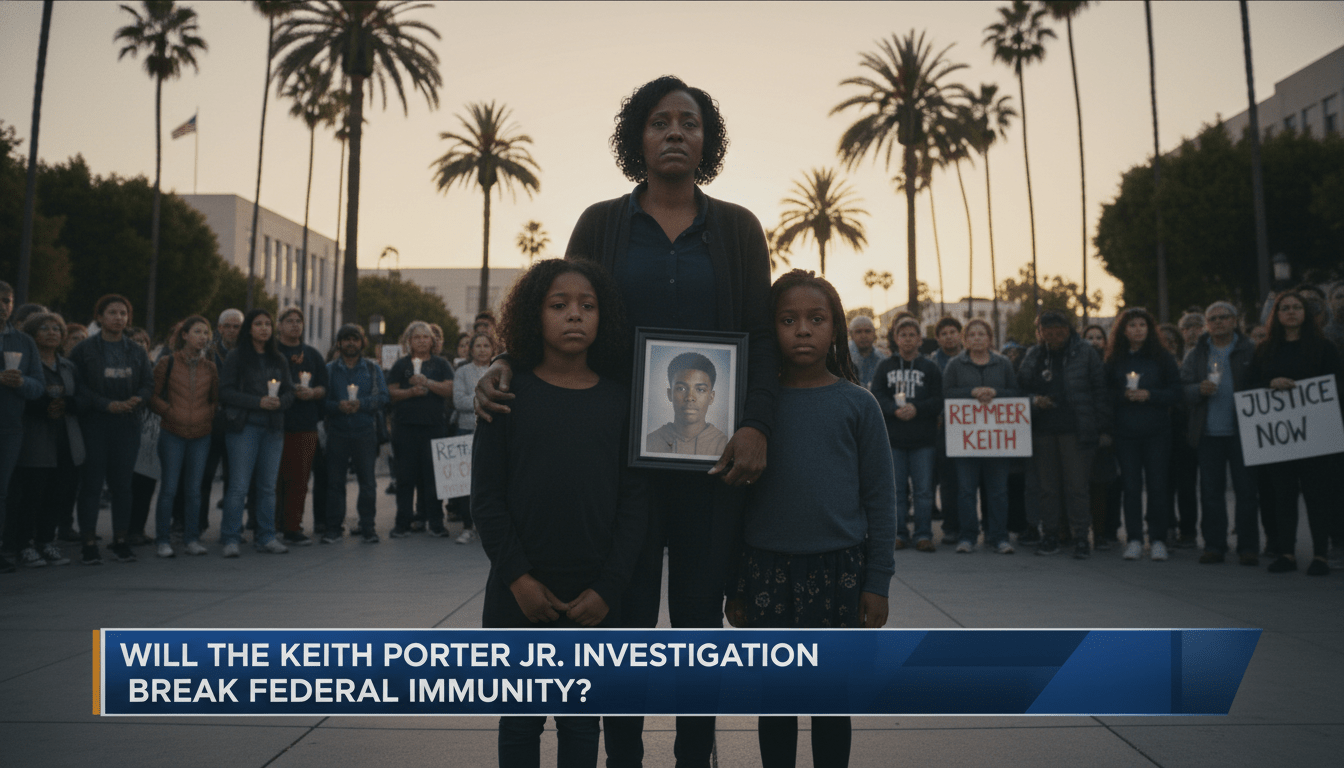
Will the Keith Porter Jr. Investigation Break Federal Immunity?
By Darius Spearman (africanelements)
Support African Elements at patreon.com/africanelements and hear recent news in a single playlist. Additionally, you can gain early access to ad-free video content.
The streets of Northridge became a focal point for a national struggle on New Year’s Eve. A Los Angeles family is now demanding that California Attorney General Rob Bonta step in. They want an independent look into the death of Keith Porter Jr. He was a 43-year-old Black man killed by an off-duty federal agent (grokipedia.com). This request is not a simple plea for help. It is a direct challenge to the power that federal agents hold over state citizens. The case highlights a deep history of conflict between local laws and federal protection.
Keith Porter Jr. was a man with deep roots in his community. He was a father to two daughters, ages 10 and 20. Friends knew him as “Pooter.” He worked at a local Home Depot and had a long history of serving others (grokipedia.com, substack.com). He once worked as a tow truck driver and an aide for students with special needs. His life was part of a larger story of resilient Black families who build strength through work and kinship. He was also a member of Black Lives Matter Los Angeles. Now, his death has sparked a movement to hold federal authorities accountable on California soil (substack.com).
The Fatal Night in Northridge
The incident happened at the Village Pointe apartment complex during New Year’s celebrations. Witnesses say Keith Porter Jr. was firing shots into the air to celebrate the holiday (grokipedia.com). This is a common practice in many areas, though it is against the law. However, an off-duty Immigration and Customs Enforcement (ICE) agent lived in the same complex. This agent, Brian Palacios, heard the noise. He decided to intervene while he was not on the clock (grokipedia.com, substack.com). The federal government claims the agent responded to an “active shooter” threat to protect residents (grokipedia.com).
The Department of Homeland Security (DHS) states that Porter fired at the agent. They claim the agent had no choice but to use lethal force. But the family and their lawyer, Jamal Tooson, tell a different story. They argue that Porter was not a threat to anyone. They say he was simply celebrating and did not aim his weapon at the agent (grokipedia.com). This gap between the “active shooter” label and the “celebratory shots” narrative is the heart of the dispute. Without body camera footage, the community is left to wonder what really happened behind the apartment walls (substack.com).
Annual Law Enforcement Deaths in California
Source: Public Policy Institute of California (latimes.com)
The Shield of Federal Immunity
One of the biggest hurdles in this case is the U.S. Constitution. The Supremacy Clause makes it very difficult for a state to arrest or prosecute a federal agent. This rule comes from the idea that federal law is the highest law in the land. In the 1890 case In re Neagle, the courts decided that federal agents are immune from state prosecution if they act in a way that is “necessary and proper” to do their jobs (usdoj.gov, cornell.edu). This creates a legal shield that often keeps agents from facing local juries.
Even when an agent is off-duty, the government often claims they were acting in their official capacity. In the Porter case, the DHS argues that Brian Palacios was performing a law enforcement duty by stopping a perceived shooter (grokipedia.com). To break this shield, the state of California would have to prove the agent acted with “malice” or was totally outside his authority (usdoj.gov). This is a very high bar to clear. It is one reason why many families feel that federal agents are “untouchable” by local police or prosecutors (jurist.org).
The Power of Removal
If a local district attorney does try to charge a federal agent, the federal government has another tool. It is called “removal” under 18 U.S.C. § 1442. This law allows federal officers to take a case out of state court and move it to a federal court (lawfaremedia.org, statecourtreport.org). They do this to avoid local juries who might be angry about a shooting. They prefer a federal judge who understands federal immunity laws. This tactic has been used since the 1800s to protect federal workers from local laws (usdoj.gov, cornell.edu).
A famous example of this happened during the Ruby Ridge incident in 1992. An FBI sniper was charged with manslaughter by a local prosecutor in Idaho. The case was removed to federal court and eventually dismissed because of the Supremacy Clause (usdoj.gov, lawfaremedia.org). This history shows why the Porter family is asking Attorney General Rob Bonta for help. They know that a local investigation might be easily blocked by federal lawyers. They believe only the state’s top lawyer has the power to stand up to the federal government (substack.com).
California’s Fight for Oversight
California has been working to change how police shootings are handled. In 2020, the state passed Assembly Bill 1506. This law says that the California Department of Justice must investigate when police kill an “unarmed” civilian (ca.gov, ca.gov). Usually, the local district attorney would do this. But the state wanted an independent eye to ensure fairness. This law was a response to the “police cannot police themselves” principle that grew after the 1991 beating of Rodney King (laapoa.com, ca.gov).
The Porter case is tricky because Keith Porter Jr. was reportedly holding a rifle. This means he does not technically fit the “unarmed” requirement of AB 1506 (ca.gov, ca.gov). However, his family and civil rights groups are pushing for an exception. They argue that the shooter being a federal agent changes the rules. They want Bonta to use his “statewide prosecutor” power to look into the matter regardless of the weapon (ca.gov, substack.com). They are calling for demands for racial justice that go beyond the narrow words of the law.
ICE Agent Gun Use (2025-2026)
Recorded Gun Incidents: 31
Data reflects weapon use or display during enforcement actions. (themarshallproject.org)
Operation Metro Surge
The shooting of Keith Porter Jr. did not happen in a vacuum. It occurred during a massive federal effort called Operation Metro Surge. This is a program led by President Donald Trump’s administration and the DHS (usdoj.gov, jurist.org). It sends thousands of federal agents into “sanctuary cities” like Los Angeles. The goal is to find and deport “criminal noncitizens.” This operation has led to an “unprecedented increase” in federal agents in urban neighborhoods (latimes.com, jurist.org).
Many California lawmakers have criticized this operation. They call it an “assault on the American right to life” (usdoj.gov, substack.com). The presence of so many federal agents has led to more interactions between federal workers and local residents. When these interactions turn deadly, the question of who has jurisdiction becomes a battleground. California officials are worried that the federal government is using its power to bypass state laws and civil rights protections (latimes.com, substack.com).
Lessons from Minneapolis
California is watching what happened in Minnesota very closely. In January 2026, two people were killed by federal agents in Minneapolis. Their names were Renee Good and Alex Pretti (theroot.com, sfgate.com). In both cases, the federal government refused to cooperate with state investigators. They even blocked state police from entering the crime scenes (sfgate.com). This caused Minnesota Attorney General Keith Ellison to file a lawsuit to protect evidence (theroot.com).
The Minneapolis situation showed that the federal government might try to “outsource” its duty to investigate itself. This is why AG Rob Bonta and Governor Gavin Newsom issued a rare bulletin in late January 2026. They warned that California would use “concurrent jurisdiction” to protect its citizens (usdoj.gov). They stated that the state would not stand by while the federal government hides evidence or protects its agents from local laws (usdoj.gov, substack.com). This history of tension explains why the Porter family feels their request is so urgent.
The Legacy of “Free State” Fallacies
The struggle for justice in California has deep historical roots. While California entered the Union as a “free state” in 1850, it often struggled to protect Black residents. The early state legal battles often involved the Fugitive Slave Act, which allowed federal agents to capture Black people on state soil. This established a long-standing pattern where federal authority could override local desires for freedom and safety (laapoa.com).
Even after the Civil War, many Black Californians faced remnants of involuntary servitude through unfair laws and policing. The Office of the California Attorney General was created in 1850 to fix an “inconsistent system of law enforcement” (ca.gov, laapoa.com). But for many years, the AG did not interfere with local police matters. It took modern tragedies and sustained activism to turn the AG into a “statewide prosecutor” who can challenge both local and federal misconduct (ca.gov, ca.gov).
Racial Disparities in Fatal Interactions
Relative to their share of the population, Black residents face the highest risk of injury or death during law enforcement encounters. (latimes.com)
The Importance of Independent Review
Why does the Porter family insist on an “outside” review? History shows that internal investigations by law enforcement agencies often favor the officers. The principle that “police cannot police themselves” became a major theme after the Rodney King riots in 1992 (laapoa.com). This led to the creation of inspectors general and oversight boards. The family of Keith Porter Jr. believes that the DHS cannot be trusted to investigate one of its own agents fairly (substack.com).
Independent reviews are meant to provide a “neutral forum.” This is especially important when there are conflicting stories. In the Porter case, the absence of body camera footage makes a neutral investigation even more critical (grokipedia.com). The family wants the California DOJ to use its forensic tools to look at the ballistics and witness statements. They hope that a state-level investigation will provide the transparency that the federal government has so far refused to offer (grokipedia.com, substack.com).
The 10th Amendment and State Sovereignty
At its core, this is a fight about the 10th Amendment. This part of the Constitution says that powers not given to the federal government belong to the states. California argues that it has the “fundamental duty” to protect the lives of its people (usdoj.gov). If a federal agent kills someone on a California street, the state believes it has a right to know why. This is called “concurrent jurisdiction,” where both the state and federal governments have a say (usdoj.gov, cornell.edu).
In practice, this creates a legal tug-of-war. Federal agencies often try to keep their evidence and agents away from state investigators. They claim that state interference hurts federal operations (lawfaremedia.org, jurist.org). But AG Rob Bonta has made it clear that California will not “outsource” its justice system. By asking for his intervention, the Porter family is testing whether the state of California can truly protect its citizens from federal overreach (usdoj.gov, substack.com).
The Road Ahead for the Porter Family
The request to AG Bonta is just the beginning of a long legal journey. The family must wait to see if the state DOJ will take the case. If they do, it could lead to a major court battle over federal immunity. If they do not, the family may have to rely on civil lawsuits to get answers (ca.gov, jurist.org). Regardless of the outcome, the death of Keith Porter Jr. has already made a mark. It has forced a conversation about the limits of federal power in our neighborhoods.
The memory of Keith Porter Jr. lives on through his daughters and his community in Northridge. He was a man who worked hard and participated in the struggle for Black lives (grokipedia.com). His death is a reminder that the history of law and power is still being written today. The fight for an independent review is a fight for the idea that no one, not even a federal agent, is above the law of the land (substack.com).
About the Author
Darius Spearman is a professor of Black Studies at San Diego City College, where he has been teaching for over 20 years. He is the founder of African Elements, a media platform dedicated to providing educational resources on the history and culture of the African diaspora. Through his work, Spearman aims to empower and educate by bringing historical context to contemporary issues affecting the Black community.
