
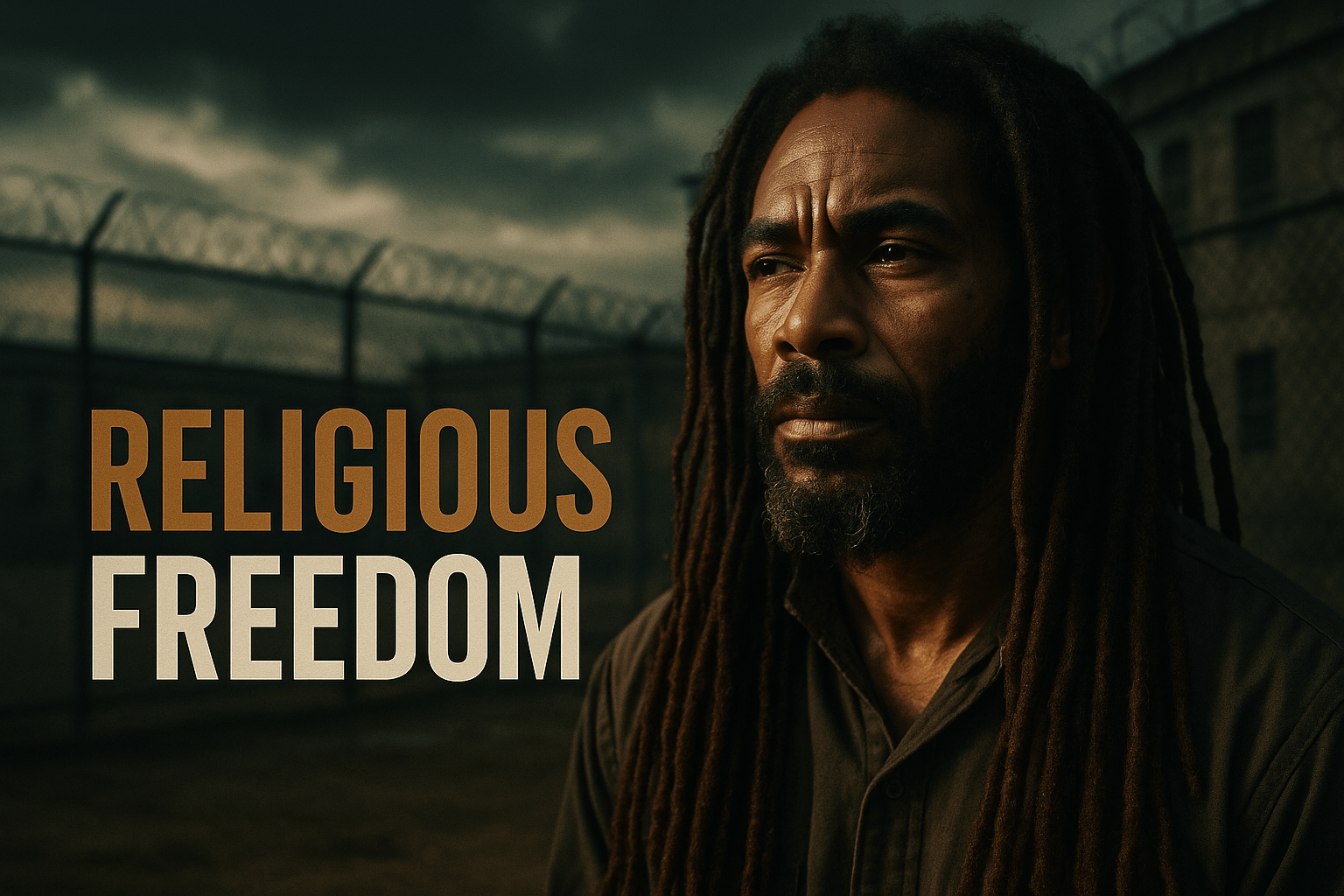
Religious Freedom in Prison: The Dreadlock Case
By Darius Spearman (africanelements)
Support African Elements at patreon.com/africanelements and hear recent news in a single playlist. Additionally, you can gain early access to ad-free video content.
A Sacred Cut: Damon Landor’s Ordeal
The Supreme Court has agreed to hear a significant case involving religious freedom for incarcerated individuals. This case centers on Damon Landor, a devout Rastafarian man whose dreadlocks were forcibly cut by Louisiana prison guards in 2020 (washingtonpost.com). For Rastafarians, dreadlocks are a deeply spiritual symbol, representing a religious vow known as the Nazarite Vow. This vow, rooted in biblical tradition, signifies a commitment to God and a separation from worldly ways, often including the practice of not cutting one’s hair. Landor had honored this vow for nearly two decades, allowing his hair to grow to his knees (apnews.com).
Despite carrying a copy of a 2017 appeals court ruling that permitted prisoners to have dreadlocks, guards ignored this crucial document (cnn.com). They handcuffed Landor to a chair and forcibly shaved his head (apnews.com). This traumatic incident occurred just weeks before Landor was scheduled for release from his five-month sentence for a drug conviction (harvardlawreview.org). The act was not only a physical violation but also a profound spiritual assault on his identity and faith.
The Legal Labyrinth: RLUIPA and Damages
After his release, Landor filed a lawsuit under the Religious Land Use and Institutionalized Persons Act (RLUIPA). This federal civil rights law, enacted in 2000, protects the religious freedom of individuals in institutionalized settings, including prisons (justice.gov). RLUIPA prohibits governments from placing substantial burdens on the religious exercise of institutionalized persons unless there is a compelling governmental interest, and the burden is the least restrictive means of achieving that interest (justice.gov).
However, lower courts dismissed Landor’s case. They ruled that federal law does not allow individuals to pursue monetary damages against prison officials for alleged violations of RLUIPA (washingtonpost.com). The Fifth Circuit Court of Appeals, in particular, invoked the Spending Clause of the U.S. Constitution to argue that Landor lacked a cause of action to sue for damages (harvardlawreview.org). This legal argument suggests that because states receive federal funds, they are not automatically subject to all federal lawsuits for damages unless the law explicitly allows it. One lower court even acknowledged that Landor was the victim of a “grave legal wrong” but still ruled against him, stating they were bound by past rulings (cnn.com).
Understanding RLUIPA
Religious Land Use and Institutionalized Persons Act (RLUIPA): This federal law, enacted in 2000, protects the religious freedom of individuals in prisons and other institutions, as well as religious organizations in land use matters. It requires governments to show a compelling interest and use the least restrictive means when substantially burdening religious exercise.
The Core Question: Damages or Nothing?
The central question for the Supreme Court is whether federal protections for religious practice permit Landor to sue prison officials for money damages (washingtonpost.com). Louisiana’s attorney general and lower court judges have condemned what happened to Landor, agreeing that it was wrong. However, they argue against allowing monetary damages, citing potential “unintended consequences” such as difficulties in hiring jail and prison workers (washingtonpost.com).
Conversely, Landor’s attorneys and the Trump administration have urged the Supreme Court to allow the case to proceed. They argue that “it is often damages or nothing” when it comes to seeking justice for religious rights violations in prison (washingtonpost.com). This phrase highlights a critical point: without the ability to sue for monetary damages, victims of religious freedom violations in institutional settings may have no effective recourse. The Department of Justice agreed, stating that the issue is “undeniably important” and “recurs with some frequency” (apnews.com). This case could set a vital precedent for how religious freedom is enforced for incarcerated individuals across the nation.
Why Monetary Damages Matter
“It is often damages or nothing.”
Monetary damages provide direct compensation to victims for harm suffered, offering a tangible form of justice when other remedies may be insufficient or unavailable.
Incentive for Change
The threat of financial liability encourages institutions to improve policies and prevent future abuses, protecting prisoners from similar violations.
RFRA vs. RLUIPA: A Crucial Distinction
The legal landscape surrounding religious freedom is complex, involving several key federal laws. The Religious Freedom Restoration Act (RFRA) and RLUIPA both aim to protect religious exercise from government burdens. However, they differ significantly in scope and available remedies (justice.gov). RFRA applies broadly to all federal government actions, while RLUIPA is more narrowly focused on land use regulations and institutionalized persons. A crucial distinction lies in the remedies: RFRA allows for monetary damages against government officials, whereas RLUIPA generally does not, limiting relief to injunctive or declaratory actions (justice.gov).
Landor’s attorneys have argued that the Supreme Court’s 2020 ruling, which allowed Muslim men to sue the FBI for damages under RFRA after being added to a no-fly list, should guide justices in this case (washingtonpost.com). This argument underscores the desire for consistency in how religious freedom violations are remedied across different federal statutes. The outcome of Landor’s case could clarify whether RLUIPA can also be interpreted to allow for monetary damages, thereby strengthening its enforcement power for incarcerated individuals.
RFRA vs. RLUIPA: Key Differences
Religious Freedom Restoration Act (RFRA)
Scope: Applies broadly to all federal government actions.
Remedies: Allows for monetary damages against government officials.
Religious Land Use and Institutionalized Persons Act (RLUIPA)
Scope: Focuses on land use regulations and institutionalized persons (e.g., prisoners).
Remedies: Generally limits relief to injunctive or declaratory actions, with monetary damages often debated.
Precedent and Future Implications
Other courts have ruled on similar cases involving religious hair practices in prisons, with varying outcomes often depending on specific facts and perceived security concerns. A significant precedent in this area is the Supreme Court’s unanimous decision in *Holt v. Hobbs* (2015) (firstamendment.mtsu.edu). In that case, the Court ruled that Arkansas prison officials violated an inmate’s religious liberty rights by prohibiting him from growing a short beard. This was despite the prison’s claims of security reasons (firstamendment.mtsu.edu). Justice Samuel A. Alito, Jr. found the security argument “hard to take seriously” (firstamendment.mtsu.edu). This decision reinforced the high bar for government interests to substantially burden religious exercise under RLUIPA.
The Supreme Court’s decision in Landor’s case could have significant implications for the enforcement of religious freedom protections for incarcerated individuals (harvardlawreview.org). If the Court rules that monetary damages are available under RLUIPA, it would provide a powerful new tool for prisoners to seek justice when their religious rights are violated. This could encourage correctional facilities to be more diligent in respecting religious practices, not only for Rastafarians but also for individuals of other faiths with religious grooming practices, such as Sikhs, Muslims, and Jews. Lawyers for other religious groups have already weighed in, arguing that without the threat of damages, prisons have little incentive to improve their policies and protect prisoners from future abuse (washingtonpost.com).
Beyond Damages: Other Remedies and Protections
Beyond monetary damages, several other legal remedies and protections exist for prisoners whose religious rights are violated under RLUIPA. These primarily include injunctive relief, which compels the institution to change its policy or practice, and declaratory relief, which formally declares that a policy or practice violates RLUIPA (justice.gov). The Department of Justice is also authorized to initiate lawsuits to enforce RLUIPA, though typically for declaratory or injunctive relief, not damages (justice.gov).
Additionally, RLUIPA contains a “safe harbor” provision. This protects institutions from enforcement if they proactively address and ameliorate the violation (justice.gov). This means a government can avoid the full force of RLUIPA’s provisions by changing the policy or practice that results in a substantial burden on religious exercise (justice.gov). While these remedies are important, they do not compensate individuals for the harm they have already suffered, which is why the question of monetary damages is so critical in Landor’s case.
Rastafari: A Movement of Resistance and Faith
The Rastafari movement began in the 1930s in Jamaica, emerging as a religious and political response by Black people to white colonialism (cnn.com). It blends Old Testament teachings with the idea of returning to Africa, emphasizing spiritual and physical liberation. The movement gained global recognition, in part due to influential musicians like Bob Marley and Peter Tosh, who helped spread the Rasta message during the 1970s (cnn.com).
For Rastafarians, dreadlocks are not merely a hairstyle; they are a profound expression of their faith, a symbol of their covenant with God, and a rejection of oppressive systems. The forced cutting of Landor’s dreadlocks, therefore, represents a direct assault on his religious identity and the very principles of the Rastafari movement. This case highlights the ongoing struggle for religious freedom and dignity within carceral systems, particularly for Black and diaspora communities whose spiritual practices may be misunderstood or disrespected.
The Road Ahead: Supreme Court’s Next Term
The Supreme Court will hear Landor’s appeal during its next term, which begins in October and runs through June of 2026 (washingtonpost.com). The decision will be closely watched by civil rights advocates, religious freedom organizations, and incarcerated individuals across the country. It has the potential to reshape the legal landscape for religious protections in prisons, determining whether individuals like Damon Landor can truly seek meaningful redress for profound violations of their most sacred beliefs.
The outcome will send a clear message about the value placed on religious freedom, even for those behind bars. It will also indicate whether the legal system is prepared to provide effective remedies when these fundamental rights are trampled upon. The case is a stark reminder of the importance of vigilance in protecting the rights of all people, especially those most vulnerable to state power.
ABOUT THE AUTHOR
Darius Spearman has been a professor of Black Studies at San Diego City College since 2007. He is the author of several books, including Between The Color Lines: A History of African Americans on the California Frontier Through 1890. You can visit Darius online at africanelements.org.
