

Trump Election Order for Oregon and Washington Legal Impact
By Darius Spearman (africanelements)
Support African Elements at patreon.com/africanelements and hear recent news in a single playlist. Additionally, you can gain early access to ad-free video content.
The Pacific Northwest became a legal battlefield in early January 2026. A federal judge in Seattle issued a massive ruling that stopped a 2025 executive order from President Donald Trump. This order tried to change how federal elections work in Oregon and Washington. These two states have used mail-in voting for a long time. The judge ruled the President went too far. Lawyers for the states warned the order would stop thousands of people from voting (opb.org).
This conflict shows a deep divide in how the country views the ballot box. For many, mail-in voting is a tool for freedom. It allows working people to cast their votes without losing a day of pay. However, the current administration argued that the system needs more “integrity.” This move by the court protects the rights of citizens who live in rural areas. It also protects those who depend on the mail to make their voices heard. The history of this struggle goes back much further than the headlines suggest (wikipedia.org, governing.com).
Comparison of Historical Voter Fraud Rates
Oregon Fraud Cases (2000-2019) vs. Total Ballots Cast
The rate of fraud is statistically infinitesimal at 0.00006% (votingrightslab.org).
From Battlefields to Modern Mailboxes
The idea of voting away from a polling place is not new. It actually began during the Civil War in 1864. President Abraham Lincoln wanted Union soldiers to vote from the field. He feared he would lose the election if they could not participate. This established a critical precedent in American law. It proved that a voter does not have to be physically present at a booth for their ballot to count. This history is vital for understanding the notion of freedom that defines the American experience (wikipedia.org).
Oregon took this idea and ran with it in 1998. The people of Oregon passed Ballot Measure 60 with almost 70 percent support. They became the first state to adopt universal vote-by-mail. In 2000, Oregon held the first presidential election conducted entirely by mail. Washington state followed a slower path but reached the same goal by 2011. Bipartisan support helped make this happen in both states. Leaders argued it saved money and brought more people into the process (opb.org, knkx.org).
The “postmark rule” became a tradition in the West. This rule says that if a ballot is postmarked by Election Day, it must be counted. This accounts for the long distances and slow mail in rural areas. It places the power in the hands of the voter rather than the postal service. The Pacific Northwest created a model that many other states eventually copied. This history shows that local control over elections is a long-standing American value (wikipedia.org, ncsl.org).
The Mandate That Shook the Northwest
On March 25, 2025, President Trump signed Executive Order 14120. This order was a bold attempt to standardize federal election rules from the White House. It had two main parts that worried local officials. First, it required “documentary proof of citizenship” for anyone registering to vote. This means a person would need a passport or a birth certificate handy to sign up. Second, it demanded that states receive all ballots by the time polls close on Election Day (opb.org, thomsonreuters.com).
This mandate was a direct challenge to the “postmark rule.” If a ballot arrived even one minute late, it would be thrown away. For many in the Black community, this felt like an intentional barrier. The order also threatened to take away federal funding if states did not comply. These “federal election-integrity funds” are used to keep machines secure and help voters with disabilities. By threatening this money, the administration tried to force the states into line (governing.com, harvardpolitics.com).
The executive order also changed how the Election Assistance Commission works. It instructed the commission to require more paperwork for registration. Legal experts noted that this might violate older laws like the National Voter Registration Act. That act was meant to make it easier for people to register. The 2025 order did the opposite. It created a complex web of rules that states found impossible to follow without hurting their own citizens (brennancenter.org, nyls.edu).
Potential Voters Sidelined
Estimated Ballots Received After Election Day (Postmarked on Time)
Total Voters in WA and OR
These votes would be discarded under the 2025 Executive Order (opb.org, votingrightslab.org).
A Surgical Strike Against Rural and Minority Voters
State lawyers used a very specific phrase to describe the order. They called it a “surgical strike.” In the world of voting rights, this means a policy is perfectly aimed to hurt a specific group. It is not an accident. It is a precise move to shape who can vote. The lawyers argued that the order targeted the Pacific Northwest because of its high turnout. Washington and Oregon often have turnout rates over 80 percent (votingrightslab.org).
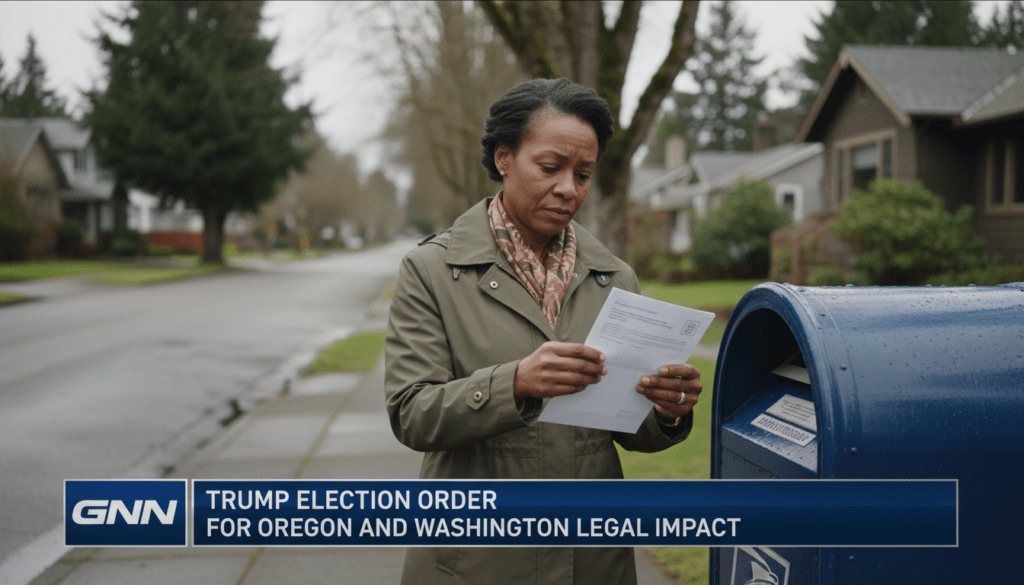
The “receipt by Election Day” rule is particularly harmful. In the 2024 election, about 120,000 ballots in Washington arrived after Election Day but were postmarked on time. In Oregon, that number was 14,000. Under the Trump order, every one of those 134,000 votes would have been discarded. This rule does not account for delays in the U.S. Postal Service. It punishes people who follow the rules but live in areas where the mail moves slowly (opb.org, governing.com).
This issue is even more serious for the Black community. Research shows that Black voters in Washington have ballot rejection rates that are 50 percent higher than white voters. Many of these rejections happen because of “late arrival.” When the rules become stricter, the community suffers more. This is why many advocates see these changes as part of a larger sharing of power between governments that often leaves minority voices behind (wlu.edu, votingrightslab.org).
Separation of Powers as a Shield
U.S. District Judge John H. Chun was the one who blocked the order. His ruling on January 9, 2026, was a major moment for the legal system. Judge Chun is a Biden appointee and the first Asian American man to serve on his court. He looked at the Constitution and found that the President does not have the power to make these rules. He focused on a principle called the “Separation of Powers” (opb.org, governing.com).
The Constitution’s Elections Clause is very clear. It says the power to regulate the “time, place, and manner” of elections belongs to state legislatures and Congress. The executive branch cannot just step in and change things by itself. Judge Chun wrote that the President does not have “plenary power” over elections. This means the President’s authority is limited. He cannot override the laws that states have used for decades to run their elections (governing.com, nyls.edu).
This ruling protects the independence of each state. It ensures that a single leader cannot bypass the democratic process to set restrictive rules. If the order had stood, it would have allowed the federal government to “commandeer” state officials. This would have turned state workers into agents of the federal government. Judge Chun’s 75-page ruling made it clear that the rule of law must come before executive action (governing.com, wlu.edu).
Why DPOC is Called a “Modern Poll Tax”
Cost
Passports can cost over $130.
Access
21 Million lack easy access to papers.
Disparity
Targets older, rural Black citizens.
Documentary Proof of Citizenship places a price on the right to vote (brennancenter.org).
The Financial Burden of Documentary Proof
One of the most controversial parts of the order was the requirement for documentary proof of citizenship, or DPOC. Social justice advocates often call this a “modern-day poll tax.” This is because official documents like passports are expensive to get. They also take a long time to process. For a low-income family, paying for these documents is a major hurdle. It forces people to choose between buying groceries and the right to vote (brennancenter.org).
This rule is particularly hard on older African Americans. Many were born at home in the Jim Crow South and never received a formal birth certificate. Without that paper, they cannot easily prove their citizenship under the new order. A study in 2023 found that over 21 million U.S. citizens lack ready access to these documents. When a similar law was tried in Kansas, nearly 1 in 8 eligible voters were denied registration. This shows that the impact is real and widespread (brennancenter.org, wlu.edu).
The 2025 order also tried to stop states from using birth certificates as proof. It wanted even stricter federal documents. This move was seen as an attempt to undermine birthright citizenship. By making it harder to prove who is a citizen, the government can control who gets on the voter rolls. This reminds many of the failure of early Reconstruction efforts to protect the vote. History seems to be repeating itself in a new, digital form (nyls.edu, harvardpolitics.com).
Defending Voter Intent in the 21st Century
At the heart of the legal battle is a concept called the “voter’s intent” doctrine. This is a legal principle used in Oregon and Washington. It says that if a voter’s choice is clear, their ballot should be counted. Technical errors should not stand in the way of a citizen’s voice. The postmark rule is a perfect example of this. Mailing a ballot by the deadline shows a clear intent to participate in the election (civicdesign.org, ncsl.org).
The Trump order tried to replace “intent” with “logistics.” It shifted the focus from the voter to the speed of the mail trucks. This change would have allowed administrative issues to silence citizens. State lawyers argued that the government should work for the voter, not the other way around. They believe that the right to vote is too precious to be lost because of a postal delay. This doctrine is a safeguard for the working class who may not have flexible schedules (civicdesign.org, votingrightslab.org).
The ruling in Seattle is a victory for those who want to keep the ballot accessible. It confirms that states have the right to choose rules that favor participation. While the administration may appeal the decision, the permanent injunction provides a sense of security for now. The Pacific Northwest continues to be a leader in democratic innovation. By standing up to the executive order, these states have protected the votes of hundreds of thousands of people (opb.org, governing.com).
About the Author
Darius Spearman is a professor of Black Studies at San Diego City College, where he has been teaching for over 20 years. He is the founder of African Elements, a media platform dedicated to providing educational resources on the history and culture of the African diaspora. Through his work, Spearman aims to empower and educate by bringing historical context to contemporary issues affecting the Black community.
