


Is Justice Possible for Jazmir Tucker in Akron Today?
By Darius Spearman (africanelements)
Support African Elements at patreon.com/africanelements and hear recent news in a single playlist. Additionally, you can gain early access to ad-free video content.
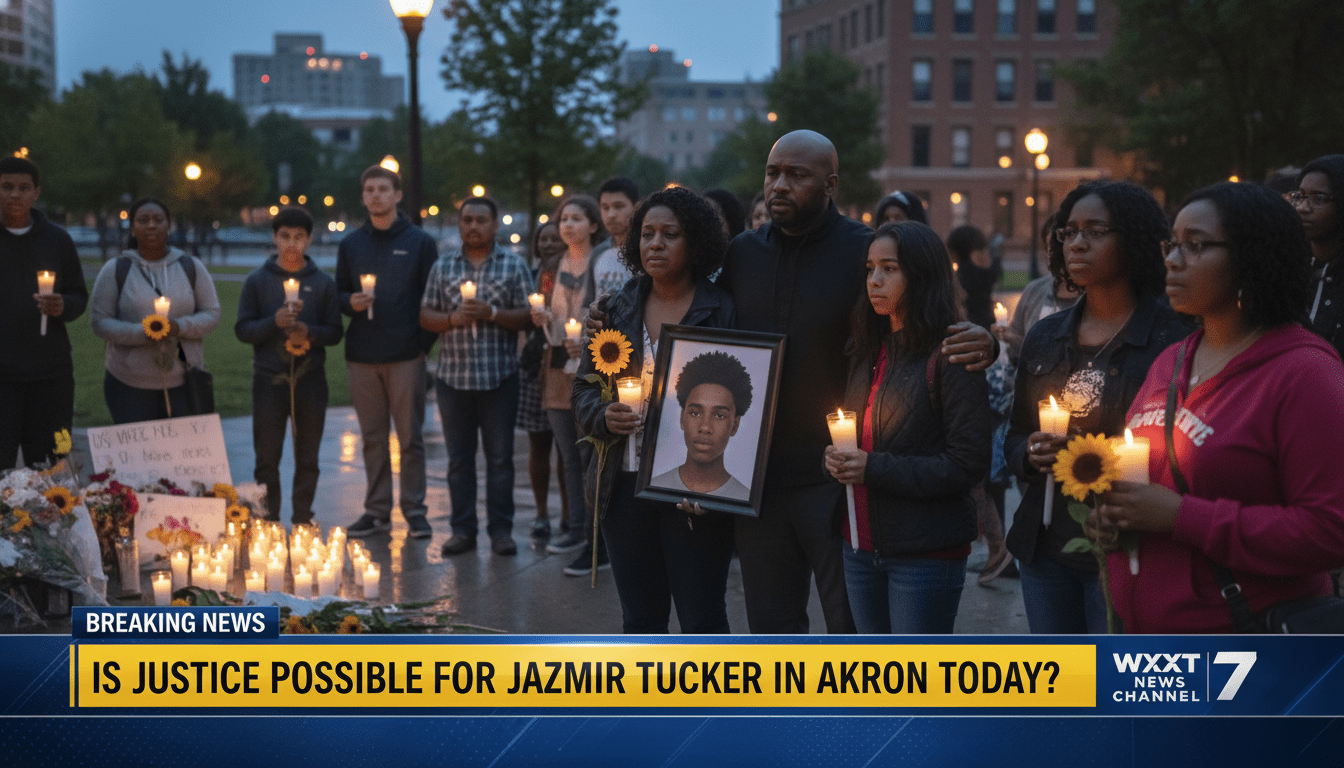
The streets of Akron, Ohio, carry the heavy weight of history. On Thanksgiving night in 2024, that history took a tragic turn for the Tucker family. A fifteen-year-old boy named Jazmir Tucker was shot and killed by a police officer during a foot chase. This event has sparked a massive legal battle and a deep look into the past of the Akron Police Department. The city now faces a federal civil rights lawsuit that claims Jazmir did not have to die. However, city lawyers are fighting back and denying that racial bias played any role in the shooting.
The lawyers for the city filed their formal response in February 2026. They argue that the officer acted reasonably under the circumstances. They also claim that the dark history of the department should not be part of this case. This legal clash happens at a time when national attention on policing remains high under the administration of President Donald Trump. Many people in the community believe that Jazmir is another name on a long list of Black youth who did not receive a fair chance. To understand why this case matters so much, one must look at the events that shaped Akron over the last sixty years.
The Fatal Night on Thanksgiving 2024
Jazmir Tucker was only fifteen years old when his life ended. On November 28, 2024, Officer Davon Fields was patrolling a neighborhood after reports of gunshots. The officer saw Jazmir standing near a local school and decided he looked suspicious. This encounter led to a foot pursuit where the officer chased the teenager. Officer Fields stated that he believed the boy had just committed a crime and was trying to escape (signalakron.org, wkyc.com).
The officer fired his weapon three times. Two of those bullets hit Jazmir in the back. After the shooting, the police claimed that the teenager had a gun. However, body camera footage told a more complicated story. The footage showed that a weapon was zipped inside the pocket of Jazmir’s jacket. It was not in his hand when the officer pulled the trigger. Because the officer did not turn on his camera manually at the start of the chase, the first moments of the interaction remain a mystery (signalakron.org, amazonaws.com).
Akron Demographic vs. Fatal Police Encounters
Black residents make up a third of the city but more than half of police killings.
Source: Police Scorecard Data (amazonaws.com, courthousenews.com)
The Roots of Discontent in 1968
The tension between Black residents and the Akron Police Department did not start with Jazmir Tucker. It goes back to the summer of 1968. During that time, the Wooster Avenue Riots broke out in the city. These riots started because residents heard rumors of police brutality while crowds were being dispersed. The situation became so intense that the National Guard had to be called in to restore order. This event showed that many Black citizens felt the police were an occupying force rather than protectors (cram.com, thefreedombloc.org).
In 1969, a group called the Akron Commission on Civil Disorders released a report about the riots. The report stated that city services were not fair to Black neighborhoods. It specifically pointed to the police department as a major source of pain for the community. The commission found that officers often treated Black residents with less respect than white residents. This historical moment created a the political narrative that still affects how people see the police today.
Arnold v. Ballard and Hiring Bias
By the 1970s, the fight for fairness moved into the courtroom. A famous federal case called Arnold v. Ballard revealed deep levels of discrimination. The court found that the Akron Police and Fire Departments were intentionally keeping Black people from getting jobs. The testing process was designed to fail Black candidates. For example, the reading levels required for the jobs were set much higher than what was actually needed for the work (justia.com, amazonaws.com).
In 1975, a judge ordered a “one-for-two” hiring quota. This meant that for every two white officers hired, the city had to hire one Black officer. The goal was to make the police force look like the city it served. Although this order helped integrate the department for a while, it did not fix the underlying culture. Today, the lawsuit for Jazmir Tucker argues that the city failed to maintain those levels of representation. This failure has contributed to a lack of understanding between the police and Black youth (justia.com).
The Shadow of the Signal 44 Newsletter
One of the most shocking pieces of evidence in the current lawsuit is something called “Signal 44.” In the late 1990s, an underground newsletter with this name circulated among Akron police officers. The title came from a radio code for immediate backup or an armed robbery. However, the officers used it to spread racist jokes and dehumanizing stories. They compared Black residents to wild animals and described the city as a “wildlife preserve” (signalakron.org, cram.com).
The newsletter used cruel acronyms like “SHIT” and “SLOW” to mock the people they were supposed to serve. Perhaps the most troubling part is that some current leaders in the department were involved. Reports indicate that current Police Chief Brian Harding was questioned about his knowledge of the newsletter. Some officers at the time reportedly found the racist content “funny.” The Tucker family’s lawyers say this shows a “culture of indifference” that has lasted for decades. They argue that if leaders found racism funny in the past, they cannot be expected to stop it now (signalakron.org, signalakron.org).
Officer Training Imbalance (2023-2024)
Tactical/SWAT Training
De-escalation Training
Officer Fields’ recorded training entries show a focus on force over communication (signalakron.org, changewire.org).
The Problem with Warrior-Style Training
The lawsuit against the city also points to the type of training officers receive. Many critics call it “Warrior-style” training. This philosophy teaches officers to view every interaction as a potential life-or-death battle. It is often based on a curriculum that aims to reduce the hesitation to use lethal force. This mindset can make officers more likely to see a teenage boy as a deadly threat instead of a child (changewire.org, thefreedombloc.org).
Officer Davon Fields had a long record of tactical and firearms training. Records show he completed over twenty-five entries for SWAT and tactical weaponry in a single year. In that same time, he had zero entries for de-escalation or understanding how a teenager’s brain works. When officers are trained to be warriors, they see the community as a battlefield. This focus on combat may explain why Jazmir was shot while running away with a gun still in his pocket. It also links back to the inequality in education and training that has plagued city departments for years.
Officer Davon Fields and Past Incidents
This was not the first time Officer Fields used fatal force. In 2022, he was involved in the shooting of Lawrence Rodgers. In that case, the police were responding to a call about an armed person. Mr. Rodgers was shot and killed after he reportedly refused to drop his weapon. A grand jury did not indict the officer for that death, and he returned to duty. Having an officer who has already killed on the force can create more fear in the neighborhood (wkyc.com, amazonaws.com).
Officer Fields was also present during the high-profile killing of Jayland Walker in 2022. While he did not fire his weapon that night, he was part of the team involved. The Jayland Walker case resulted in a huge settlement of 4.8 million dollars for the family in 2024. These repeated incidents suggest a pattern of behavior within the department. For the community, it feels like the same officers are involved in the same types of tragedies over and over again (signalakron.org, wkyc.com).
Statistical Proof of Disparity
Numbers can often tell a story that words cannot. The Police Scorecard is a project that looks at how different police departments behave. According to this data, Akron scored very poorly. The city had a higher rate of deadly force than sixty-five percent of other departments in the country. Black residents are nearly three times more likely to be arrested for low-level crimes than white residents (amazonaws.com, courthousenews.com).
These statistics show that the bias the city denies is actually visible in the data. When Black people are arrested more often for minor things, it creates more chances for violent encounters. This creates a cycle where the police and the Black community are always at odds. The current lawsuit argues that these numbers are the result of the “unconstitutional environment” that the city has allowed to exist for years. It is a long-standing fight for justice that many feel has been neglected since the era of Reconstruction.
Akron Police Accountability Score
Akron received a score of 22% on the national Police Scorecard, indicating significant room for improvement in oversight and safety.
A lower score means more police violence and less accountability (amazonaws.com).
The Power of the Freedom BLOC
In the middle of this legal battle, community groups are leading the charge for change. One of the most active groups is the Freedom BLOC. This organization works to build Black political power in Akron. They have been very vocal after the deaths of Jayland Walker and Jazmir Tucker. They organize protests and demand that the city listen to the voices of Black families (thefreedombloc.org).
The Freedom BLOC advocates for something they call “Budget Justice.” They believe that the city should spend less money on “warrior” training and more money on housing and youth programs. They were also instrumental in pushing for Issue 10. This was a plan to create a Citizens’ Police Oversight Board. Even though voters approved it in 2022, the city council has been slow to make it happen. This delay is another reason why many people do not trust the city’s recent denial of racial bias (signalakron.org, thefreedombloc.org).
The City’s Defense and the False Narrative Claim
The lawyers for Akron have a very different view of the situation. In their recent court filings, they say the references to Signal 44 are unfair. They call the newsletter “long-since-passed events” that have nothing to do with what happened on Thanksgiving 2024. They claim that bringing up historical racism is just an attempt to create a “false narrative.” They want the court to look only at the few seconds of the chase and the shooting (signalakron.org, wkyc.com).
The city maintains that Officer Fields had to make a split-second decision. They argue that he believed his life was in danger. They also state that settlements, like the one for Jayland Walker, are not admissions of guilt. This legal strategy aims to separate the individual officer’s actions from the history of the whole department. However, the Tucker family’s lawyers say you cannot separate the two. They believe the history of the department is what taught the officer to pull the trigger (signalakron.org, amazonaws.com).
A Call for Future Accountability
The case of Jazmir Tucker is about more than one night in Akron. It is about whether a city can truly move past a history of discrimination. While the city lawyers deny racial bias, the community points to the newsletter, the training, and the statistics as proof of a deeper problem. The federal lawsuit will continue to move forward in 2026. It will likely bring more secrets of the Akron Police Department to light.
For the family of Jazmir Tucker, no amount of money or court rulings can bring the fifteen-year-old boy back. They are seeking a change in how the city treats its Black residents. They want to ensure that no other family has to spend their Thanksgiving mourning a child who was shot in the back. As the legal battle unfolds, the people of Akron wait to see if the “history behind the headlines” will finally be addressed or if it will be pushed aside once again.
About the Author
Darius Spearman is a professor of Black Studies at San Diego City College, where he has been teaching for over 20 years. He is the founder of African Elements, a media platform dedicated to providing educational resources on the history and culture of the African diaspora. Through his work, Spearman aims to empower and educate by bringing historical context to contemporary issues affecting the Black community.
