


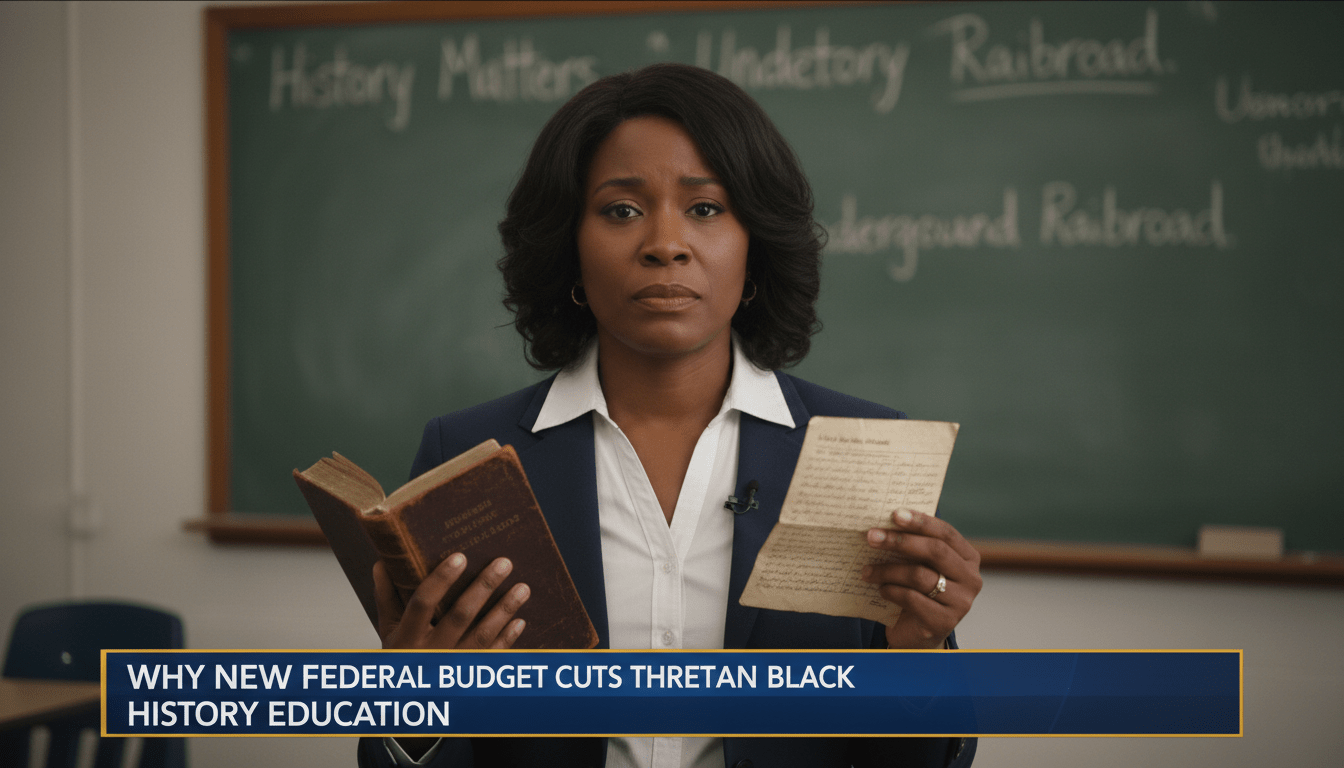
Why New Federal Budget Cuts Threaten Black History Education
By Darius Spearman (africanelements)
Support African Elements at patreon.com/africanelements and hear recent news in a single playlist. Additionally, you can gain early access to ad-free video content.
The landscape of American education is facing a major shift. Recent actions by the federal government have put many historical programs at risk. The Department of Government Efficiency, often called DOGE, has moved to slash the budget of the National Endowment for the Humanities. This agency has long been a pillar for teaching the complex story of the United States. Specifically, the NEH budget was cut by 210 million dollars. This move effectively clears out the funds that support many teacher education programs across the country (hyperallergic.com, theartnewspaper.com).
One of the most popular programs under fire is “Sailing to Freedom: The Underground Railroad.” This project helps teachers understand how enslaved people used the ocean to find liberty. Critics and advocacy groups are now sounding the alarm. They argue that these cuts target racial history without a fair review. As President Donald Trump continues his term, the focus of federal spending is moving away from diverse historical inquiry. This change represents a significant moment in the ongoing struggle over how the American story is told to future generations (washingtonpost.com, washingtonpost.com).
NEH Budget Depletion (2024-2025)
Source: Historical NEH Budget Data and 2025 Expenditure Reports
The Roots of Federal Support for History
To understand the current crisis, one must look back to 1965. This was when the National Foundation on the Arts and the Humanities Act was passed. During the Cold War, the government was very focused on science and technology. However, leaders realized that a strong democracy also needs a deep understanding of history and literature. They created the NEH to provide a “better analysis of the present” through the study of our past. This agency became the bedrock for academic research that includes all Americans (neh.gov, neh.gov).
The growth of Black studies as a field is closely tied to this federal support. In 1968, students at San Francisco State University led a five-month strike. They demanded a curriculum that reflected the Black experience. This led to the creation of the first Department of Black Studies in the country. Soon after, the NEH began funding scholars who wanted to reconstruct history from primary sources. These early efforts were vital for moving Black history from the margins to the center of American education (wikipedia.org, wordpress.com).
Scholars like Nathan Huggins and John Blassingame were pioneers in this movement. Before their work, many textbooks ignored the inner lives of enslaved people. Blassingame’s research was revolutionary because he used slave narratives and testimonies. He wanted to show the “unconquered” spirit of the Black community. Huggins argued that African American history is not a side story. Instead, he showed that it is central to the entire American identity. Their NEH-funded work established a foundation for studying history from the perspective of the oppressed (wikipedia.org, wordpress.com).
The Saltwater Underground Railroad
The program “Sailing to Freedom” is a modern example of this scholarly tradition. For over fifteen years, it has focused on the maritime dimensions of the Underground Railroad. Most people think of “woods and wagons” when they imagine escapes from slavery. However, many freedom seekers used coastal water routes and seafaring ports. This “Saltwater Underground Railroad” highlights the agency of Black mariners. These individuals worked as shipwrights and sailors, using their skills to navigate toward freedom (neh.gov, wordpress.com).
This maritime narrative is a significant shift in how we teach the struggle for freedom and political power. Research suggests that many more people escaped by sea than previously recorded. This was especially true in the Deep South coastal areas. Enslaved people gained technical knowledge of port rhythms and currents. They used this information to manage their own escapes. Coastal routes often allowed fugitives to reach Northern ports like New Bedford in just a few days. This was much faster than traveling overland (neh.gov, wordpress.com).
By studying these routes, students learn about Black community organization in “safe haven” ports. Black mariners served as vital agents for the abolitionist movement. They carried messages and news between different parts of the country. This history emphasizes that enslaved people were not passive victims. They were active participants in their own liberation. The termination of programs like “Sailing to Freedom” means that these specific stories of resistance may no longer reach K-12 classrooms (wordpress.com).
The DOGE AI “DEI” Flagging Process
Grants Fed into AI
Keywords: BIPOC, Race
Immediate Defunding
The Impact of DOGE and AI Technology
The Department of Government Efficiency, or DOGE, led the effort to cut these funds. It is an advisory group tasked with finding ways to reduce federal spending. In early 2025, DOGE staffers began a “22-day blitz” to terminate active grants. They reportedly canceled about 1,400 grants valued at over 100 million dollars. These projects had already gone through a rigorous peer-review process. Many were multi-year commitments that supported long-term research and education (washingtonpost.com, washingtonpost.com).
What makes these cuts unique is the use of technology. Court documents revealed that DOGE used generative AI, like ChatGPT, to identify programs for cancellation. Staffers fed grant descriptions into the AI with specific prompts. They told the AI to flag anything related to “BIPOC,” “LGBTQ,” or “race-based” history. This automated process led to the immediate defunding of “Sailing to Freedom.” It also targeted programs about the immigrant experience in California. This use of AI has raised serious concerns about fairness and bias in government decisions (washingtonpost.com, washingtonpost.com, lawandcrime.com).
The term BIPOC stands for “Black, Indigenous, and People of Color.” It highlights the unique discrimination faced by Black and Indigenous groups. These communities have a distinct relationship to American history through slavery and land loss. By using AI to target this specific term, the government is effectively silencing a particular viewpoint. Advocates argue that this is not about efficiency. Instead, they believe it is a way to erase stories that do not fit a specific political narrative (washingtonpost.com, lawandcrime.com).
Legal Challenges and Due Process
Major academic organizations have not stayed silent. Groups like the American Historical Association and the Modern Language Association have sued the federal government. They argue that these cuts violate the First Amendment. In a legal sense, this is called “viewpoint discrimination.” This occurs when the government penalizes speech it does not like. The lawsuits claim that targeting DEI programs while leaving others alone is unconstitutional (advocate.com, fisherphillips.com, lawandcrime.com).
The lawsuits also point to the Administrative Procedure Act. This law governs how federal agencies make changes to their rules and funding. It requires agencies to provide “fair notice” and a reason for their actions. The government cannot make “arbitrary and capricious” changes without a public comment period. Because DOGE is an advisory entity and not a formal agency, critics say it lacks the legal authority to cancel grants directly. The executive branch must follow the laws set by Congress regarding how money is spent (fisherphillips.com, lawandcrime.com).
Understanding federalism and Black politics is crucial here. The system of sharing power between the national and state governments is being tested. Under the Impoundment Control Act of 1974, the President cannot refuse to spend money that Congress has already approved. If Congress voted to fund the NEH, the executive branch is supposed to carry out that order. By halting these grants, the administration may be overstepping its legal boundaries (lawandcrime.com).
State Humanities Budget Losses
Humanities Texas
Oregon Humanities
Local Juneteenth and civil rights projects are being indefinitely paused.
Devastation at the State Level
The impact of these cuts is felt most strongly at the local level. About 40 percent of NEH funding goes to state humanities councils. These councils support local museums, libraries, and school programs. For example, Humanities Texas lost 65 percent of its annual budget. This loss has devastated local Juneteenth celebrations and civil rights history projects. Many educators in Texas relied on these funds to bring primary sources into their classrooms (queondamagazine.com, hyperallergic.com).
In Oregon, the situation is similarly dire. Oregon Humanities saw its budget slashed by 45 percent. This forced the cancellation of programs like “Humanity in Perspective.” This course provided educational opportunities for low-income adults. Additionally, smaller museums in rural areas lost grants used to digitize local archives. Without this money, the history of local Black communities may remain hidden in boxes rather than being available to the public (queondamagazine.com, hyperallergic.com).
National History Day is also at risk. This is a 50-year-old student competition that reaches 500,000 children every year. It faced a loss of over 825,000 dollars. This competition encourages students to conduct their own historical research. It is a vital part of combating inequality in education by giving all students a chance to excel. When state councils lose funding, they can no longer support these student researchers. This limits the educational opportunities for children in every part of the country (hyperallergic.com).
Monuments vs. Active Learning
While funding for diverse history is being cut, the government is moving money elsewhere. A project called the “Garden of Heroes” is receiving new support. This is a plan to build a park with 250 statues of historical figures. It emphasizes “patriotic education” and the celebration of exceptional individuals. The project was revived through an executive order. This order redirected 34 million dollars from the NEH and NEA to build the garden (theartnewspaper.com).
There is a sharp contrast between this project and traditional NEH funding. The NEH focuses on critical inquiry and the Black Arts Movement and liberation struggle. This type of learning asks students to think deeply about the past. In contrast, the Garden of Heroes uses a specific list of heroes chosen by the government. Critics argue that this replaces active education with “static monuments.” They believe it promotes a specific brand of national identity rather than encouraging critical thinking (theartnewspaper.com).
The statues in the garden are required to be in a “classical style.” They must be made of materials like bronze or marble. This style rejects modern interpretations of history. Advocacy groups warn that this moves away from a 60-year tradition of funding diverse inquiry. They fear that the government is creating a “propaganda pipeline.” This would prioritize simple tributes over the complex and sometimes difficult truths of American history (theartnewspaper.com).
The Future of Black History Education
The current status of the “Sailing to Freedom” teachers is uncertain. In April 2025, the NEH sent official notices to participants stating that their workshops were terminated. This left many teachers without the training they were promised. The government claimed the cuts were necessary to “safeguard fiscal priorities.” However, the loss of these residential workshops means that many lesson plans will never be implemented in schools (neh.gov, wordpress.com).
This shift in federal policy represents a major pivot. For decades, the goal was to include more voices in the American story. Now, the trend is toward a more centralized and “patriotic” model. Advocacy groups continue to fight these changes in court. They hope to protect the preservation of local Black history. They believe that understanding the full scope of our past is the only way to build a better future (historians.org, lawandcrime.com).
As of March 2026, some courts have issued preliminary injunctions. They ruled that the abrupt cancellation of grants likely violated federal law. These legal battles will likely continue for some time. The outcome will decide whether programs like “Sailing to Freedom” can continue to teach the next generation. For now, the professional development of thousands of educators hangs in the balance. The story of the Underground Railroad and other histories of resistance remain under threat from federal budget cuts (advocate.com, lawandcrime.com).
About the Author
Darius Spearman is a professor of Black Studies at San Diego City College, where he has been teaching for over 20 years. He is the founder of African Elements, a media platform dedicated to providing educational resources on the history and culture of the African diaspora. Through his work, Spearman aims to empower and educate by bringing historical context to contemporary issues affecting the Black community.
