


Unpacking Voter Access Hurdles: A Digital Poll Tax?
By Darius Spearman (africanelements)
Support African Elements at patreon.com/africanelements and hear recent news in a single playlist. Additionally, you can gain early access to ad-free video content.
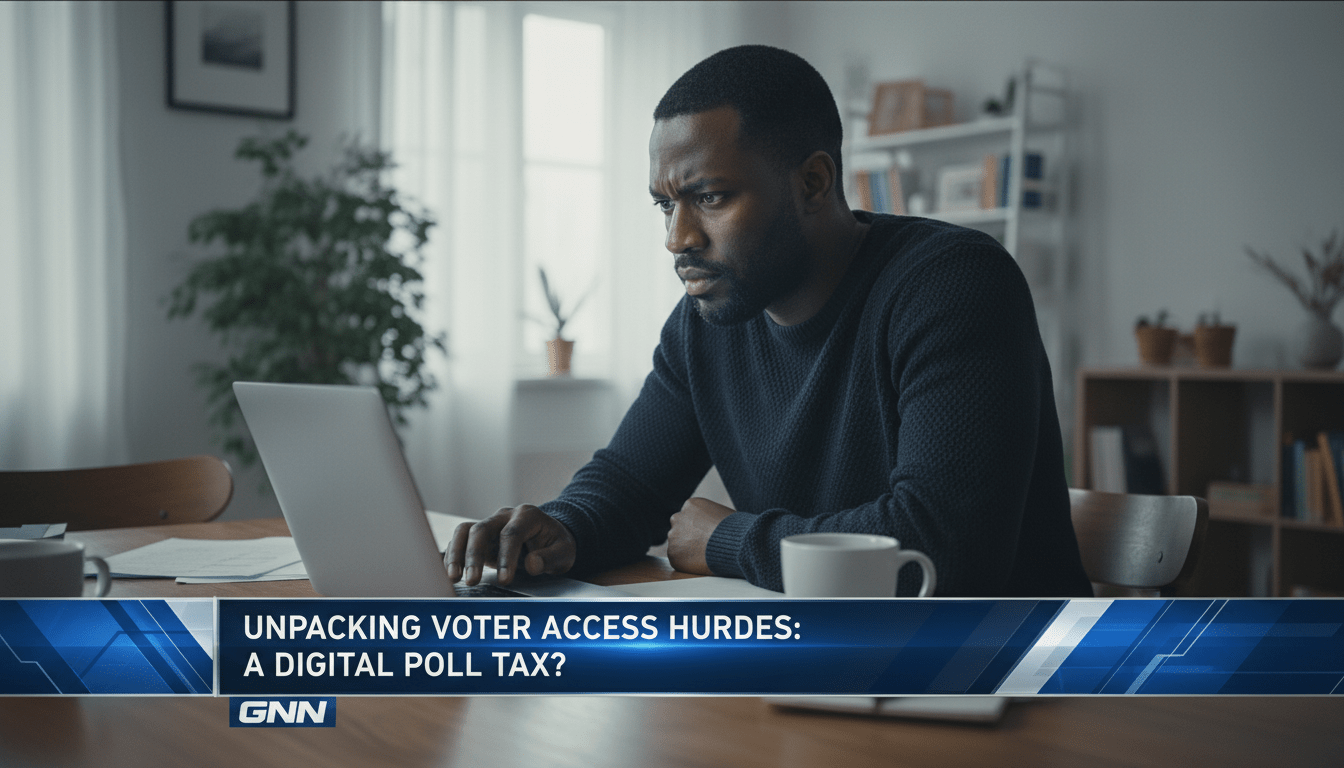
A recent executive order mandates citizenship verification through federal databases. Civil rights groups quickly sounded the alarm regarding the administrative demands placed on marginalized communities. The mandate requires voters to correct database mismatches online to maintain their active registration status. Advocates argue this digital requirement creates severe voter access hurdles for millions of citizens. About one-third of Black households currently lack high-speed internet access. Activists claim this technological barrier acts as a modern poll tax, effectively blocking eligible citizens from the ballot box.
The debate surrounding election security often ignores the heavy historical context of the Black experience. The current push for documentary proof of citizenship reflects older methods of political exclusion. Proponents argue these measures ensure only eligible citizens participate in federal elections. Opponents warn that relying on flawed federal databases blocks legitimate voters from exercising their rights. The nation currently faces a critical intersection of modern technology and longstanding civil rights battles.
The Architecture of Exclusion in History
The Reconstruction Era temporarily expanded Black political power following the end of the Civil War. Approximately two thousand Black Americans held public office during this brief but significant period. However, the Compromise of 1877 withdrew federal troops from the South and ended this progress. Southern state governments immediately moved to reinstate white supremacy across all levels of society. They sought legally permissible ways to bypass the Fifteenth Amendment without explicitly mentioning race in their laws.
The 1890 Mississippi Constitutional Convention established a brutal blueprint for systemic disenfranchisement. Convention President Solomon Saladin Calhoon explicitly stated that the gathering aimed to exclude Black citizens entirely. Another drafter, James K. Vardaman, admitted that the convention possessed no other purpose than eliminating Black voters from politics. They created poll taxes, which equaled several days of wages for poor sharecroppers, alongside complex understanding clauses. White registrars applied these clauses subjectively to disqualify Black applicants while easily passing white citizens.
These early methods of exclusion proved devastatingly effective across the Southern United States. By the year 1910, these tactics caused Black voter registration in Louisiana to plummet below one percent. These state and local statutes ensured that newly emancipated Blacks continued to face severe political and economic oppression for decades. The legal architecture of Jim Crow relied entirely on placing administrative and financial burdens on marginalized communities (mississippifreepress.org).
Manumission Papers and Historical Echoes
Before the nationwide abolition of slavery, free Black people had to carry physical proof of their status. These documents were commonly known as manumission papers. Enslaved individuals received these legal papers when an enslaver voluntarily freed them through a deed or a court order. Free Black persons were legally required to carry these documents at all times when traveling or seeking employment. Being caught without them could result in immediate arrest, brutal punishment, or re-enslavement.
The burden of proving one possessed the right to exist freely was entirely placed on the individual. Some jurisdictions even forced free Black residents to register their papers with local clerks. They often had to pay an administrative fee for a freedom license to maintain their residency in the state. This system created a society where Black individuals lived under constant suspicion and surveillance. The requirement to constantly prove legal status generated immense psychological trauma.
Today, social justice advocates draw sharp parallels between those historical documents and modern citizenship verification rules. Current legislative proposals demand physical documentary proof of citizenship at the time of voter registration. Civil rights leaders argue this places a heavy psychological burden on specific communities. Marginalized citizens must repeatedly prove their right to exist within the political sphere. The modern demand for physical documents deeply echoes a dark history of movement restriction (manumissionproject.org).
The Impact of Section Five Preclearance
The Voting Rights Act of 1965 introduced a vital protection known as the preclearance mechanism. Section Five of this landmark legislation required jurisdictions with a history of discrimination to obtain federal approval before changing any voting laws. This mechanism powerfully shifted the legal burden to the state government. State officials had to prove a new law lacked a discriminatory purpose and would not harm minority voters. Preclearance acted as a proactive shield that prevented harmful rules from taking effect in the first place.
The Supreme Court dramatically altered this protective landscape in 2013. The controversial ruling in Shelby County versus Holder effectively ended the preclearance requirement by striking down the coverage formula. Without this proactive federal check, states quickly moved to implement strict voter identification laws. The burden of proof instantly shifted back to individual voters and civil rights advocacy groups. These organizations must now file exceptionally costly and time-consuming lawsuits to block restrictive laws after they are enacted.
This judicial change represents a massive shift in the political narrative regarding civil rights enforcement. Discriminatory laws can now remain in active effect through multiple election cycles before a federal court intervenes. Within hours of the Shelby County decision, several states moved forward with strict citizenship verification laws that the federal government had previously blocked (brennancenter.org).
The Rise of Digital Voter Access Hurdles
The current national alarm focuses on a broad executive mandate regarding election integrity and citizenship verification. The framework directs the Department of Homeland Security and the Social Security Administration to compile lists of citizens. State governments then receive these digital lists to cross-reference against their official voter rolls. This matching process heavily relies on the Systematic Alien Verification for Entitlements system. The database was originally designed to verify immigration status for individuals applying for public benefits.
The federal database system remains inherently flawed when used for comprehensive election purposes. It primarily contains records of non-citizens, legal permanent residents, and naturalized citizens. The database does not contain accurate or comprehensive records for most citizens born within the United States. Furthermore, federal guidelines explicitly prohibit government agencies from removing a voter based solely on a response from this database without providing an opportunity to contest the finding.
The verification process mandates a digital-first approach for correcting any administrative errors. If a voter is flagged due to a database mismatch, the individual must access their records online to fix the issue. Unlike traditional paper-based registration systems, this modern requirement demands highly reliable internet connectivity. Advocates argue this digital requirement introduces severe voter access hurdles for marginalized and rural communities (americanimmigrationcouncil.org).
High Speed Internet and The Digital Divide
Requiring a digital fix for government database errors creates a sharply disparate impact across different communities. This deep disparity is commonly known as the digital divide. Recent data indicates that approximately thirty-two to forty percent of Black households currently lack high-speed broadband internet at home. This stands in stark contrast to the roughly seventeen percent of White households without traditional broadband access. Reliable internet access correlates heavily with household wealth and geographic location.
Households Lacking High-Speed Broadband
Many Black and Latino voters remain entirely smartphone-dependent for their daily internet needs. These individuals possess a mobile device but lack a traditional home internet connection or a personal computer. Navigating complex government databases is notoriously difficult on small mobile screens. Uploading official identification documents through a weak cellular connection frequently results in system errors or timeouts. These technical barriers lead to massive drop-off rates during the vital voter verification process.
Civil rights organizations emphasize that digital requirements disproportionately punish low-income families. Only fifty-seven percent of households earning under thirty thousand dollars annually have home broadband access. Meanwhile, ninety-five percent of households earning over one hundred thousand dollars enjoy high-speed connections. This massive technological gap transforms a simple administrative task into an insurmountable obstacle for millions of citizens (cnet.com).
The True Cost of Documentary Proof
Legislative efforts run parallel to executive mandates in the ongoing push for stricter voting rules. The proposed legislation seeks to require documentary proof of citizenship at the exact time of registration. In a vast majority of states, a standard driver license does not qualify as definitive proof of citizenship. Even modern enhanced licenses are frequently issued to legal permanent residents who cannot legally vote. Only five states currently offer specialized licenses that specifically denote United States citizenship.
This legal reality means millions of voters must present an original birth certificate or a valid passport. Acquiring these specific official documents requires significant financial resources and free time. A United States passport costs more than one hundred sixty dollars to process and obtain. Obtaining a replacement birth certificate involves paying administrative fees, enduring processing delays, and covering travel expenses to government offices.
The Financial Hurdle
Cost of a new U.S. Passport
Activists argue this fee acts as a modern poll tax.
Advocacy groups loudly argue these monetary expenses constitute an illegal financial barrier to voting. The Twenty-Fourth Amendment officially abolished poll taxes in federal elections back in 1964. The amendment firmly recognized that any financial requirement for voting is inherently unconstitutional. Activists contend that the combined cost of acquiring documents and maintaining high-speed internet acts as a modern, digitized poll tax (campaignlegal.org).
The Chilling Effect on Naturalized Citizens
Database mismatches inflict a profound psychological toll on specific immigrant communities. Naturalized citizens face unique vulnerabilities due to data synchronization issues across multiple federal agencies. Individuals often have personal data in several systems that use entirely different naming conventions. Hyphenated names, multiple surnames, or recent maiden names frequently cause false mismatch flags within the system. When the verification system incorrectly flags a naturalized citizen, the resulting consequences are deeply severe.
A database flag often results in an official government notice threatening criminal prosecution for illegal voting. This aggressive administrative messaging creates a massive chilling effect within immigrant communities across the country. Eligible naturalized citizens may simply self-disenfranchise to avoid any risk of legal trouble or government harassment. The profound fear of drawing attention from immigration enforcement prevents many from engaging with the electoral system altogether.
Correcting these administrative errors imposes a severe time tax on working-class voters. An individual must often visit a government office in person during standard daytime business hours. This action requires taking unpaid time off work and securing reliable transportation. Data shows that even a minor error rate of one to three percent in federal systems can misclassify hundreds of thousands of eligible voters (civilrights.org).
State versus Federal Tensions in Voting Laws
The aggressive push for strict verification rules conflicts directly with established federal voting law. The National Voter Registration Act currently governs how citizens across the country sign up to vote. This federal legislation prominently allows individuals to register by swearing to their citizenship under penalty of perjury. The standard federal form only requires a physical signature as proof of legal citizenship status. New legislative proposals seek to amend this act by mandating physical documentary proof for all federal registrations.
The system of federalism deeply influences this ongoing legal battle over ballot access. State governments historically administer elections, but federal law protects baseline access rights for all Americans. In 2013, the Supreme Court ruled that states cannot demand additional documentary proof for federal elections without explicit federal permission. Proponents of new state laws actively seek to bypass this ruling by changing the federal standard entirely.
Critics argue that demanding physical documents overrides the primary goal of the National Voter Registration Act. The original federal law was explicitly designed to make voter registration easier and substantially more accessible. Furthermore, new proposals would aggressively require states to purge their rolls of anyone who cannot immediately prove citizenship. This directly threatens the federal quiet period protections that prevent massive voter purges immediately before an election (ballotpedia.org).
The Modern Implications for Election Integrity
The ongoing debate over voter access hurdles centers firmly on balancing security with fundamental democratic rights. Supporters of strict citizenship verification argue that federal databases provide a deeply necessary tool for election integrity. During the administration of Donald Trump, the emphasis on aggressively securing voter rolls gained significant political traction nationwide. Proponents consistently maintain that verifying citizenship fully protects the inherent value of legal votes.
Real-World Impact: 2013 Kansas Law
Blocked 30,000 applicants from registering to vote.
Conversely, voting rights advocates highlight the disastrous real-world consequences of these restrictive policies. Historical and recent state data demonstrate that verification requirements aggressively block significant numbers of eligible citizens. For example, a 2013 documentary citizenship law in Kansas blocked thirty thousand voters from registering. This massive figure accounted for twelve percent of all new applicants in the state.
The modern Civil Rights movements focused on racial justice view these hurdles as part of a long historical continuum. From confusing literacy tests to digital database mismatches, the specific methods of exclusion evolve while the result remains devastatingly consistent. The nation must carefully examine whether digital-first mandates genuinely secure elections or simply silence the most vulnerable communities in society (brennancenter.org).
About the Author
Darius Spearman is a professor of Black Studies at San Diego City College, where he has been teaching for over 20 years. He is the founder of African Elements, a media platform dedicated to providing educational resources on the history and culture of the African diaspora. Through his work, Spearman aims to empower and educate by bringing historical context to contemporary issues affecting the Black community.
