



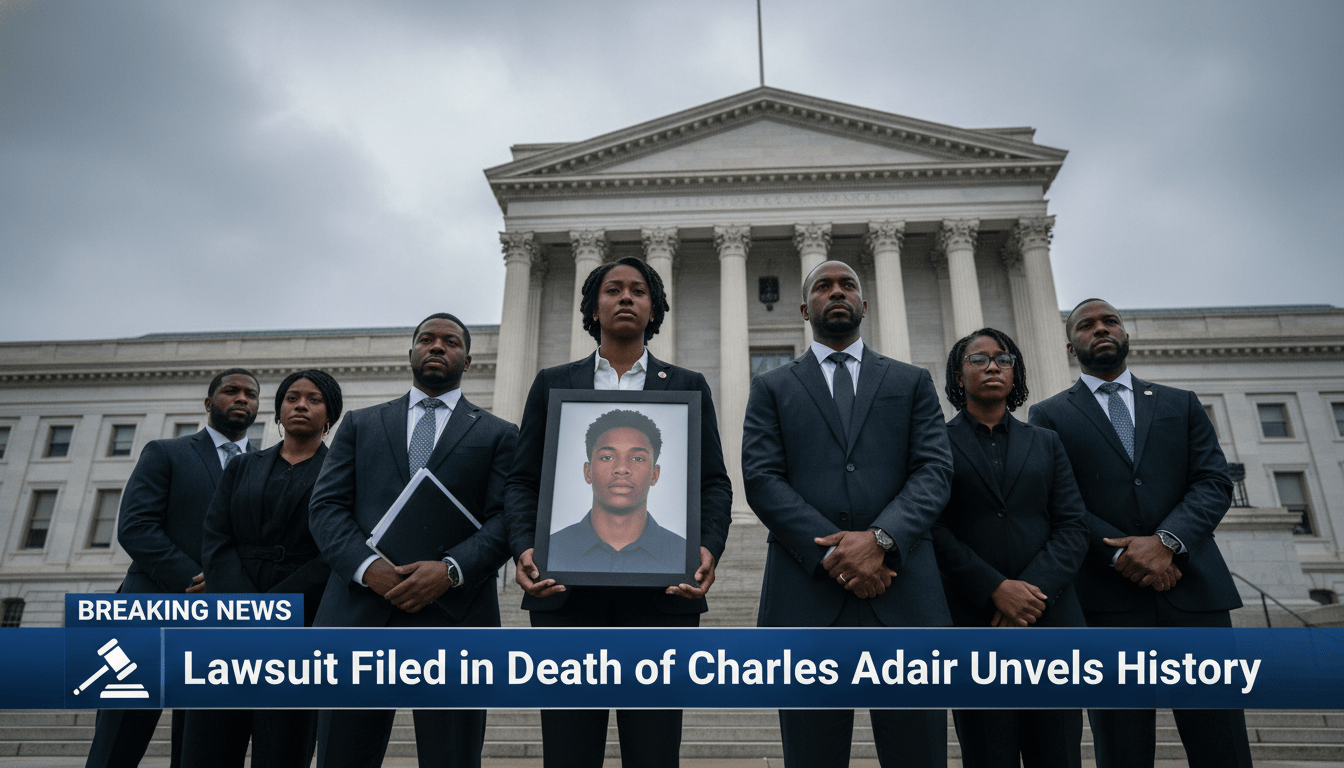
Lawsuit Filed in Death of Charles Adair Unveils History
By Darius Spearman (africanelements)
Support African Elements at patreon.com/africanelements and hear recent news in a single playlist. Additionally, you can gain early access to ad-free video content.
A Tragic Echo in Kansas City
In April 2026, civil rights attorney Ben Crump took decisive action. He filed a federal lawsuit against Wyandotte County. Sheriff Daniel Soptic and Deputy Richard Fatherley are also named defendants. The legal action addresses the tragic death of Charles Adair. Adair was a fifty-year-old Black man. He died in July 2025 while in custody at a Kansas City jail. This incident deeply echoes the tragic murder of George Floyd. Adair died after a deputy reportedly knelt on his back for over ninety seconds (hmelegal.com).
The circumstances surrounding this event are deeply troubling. Adair had a severe leg infection and used a wheelchair. He was booked for simple misdemeanor traffic warrants. The facility chose to incarcerate him rather than issue a summons. This decision proved incredibly fatal. The case highlights the ongoing shift in the political narrative regarding minor offenses. Adair lost his life over a failure to appear in court. Civil rights leaders are now demanding full transparency.
The Fatal Restraint of Charles Adair
The incident unfolded as Adair was returning from the infirmary. Medical staff had just wrapped his badly infected leg. An altercation began over control of his medical wheelchair. Adair became confused and reportedly threw himself onto the floor. Deputies handcuffed him and placed him face-down on a lower bunk. His knees touched the floor while his chest rested on the bed. Deputy Fatherley then applied substantial pressure to his back.
Court records state Fatherley knelt on Adair for nearly ninety seconds. The Wyandotte County Coroner later ruled the death a homicide. The official cause of death was mechanical asphyxia (kansas.com). This means an external physical force prevented Adair from breathing. His underlying conditions of cardiovascular disease and cirrhosis were contributing factors. The deputy continued to apply pressure while Adair repeatedly cried for help. He was completely unresponsive just moments later.
The Deadly Vicious Cycle of Asphyxiation
Medical experts have warned about prone restraint for decades. In 1988, researchers documented the extreme dangers of this position. Placing weight on a restrained person severely impairs human breathing. The United States Department of Justice issued a national warning in 1995. The bulletin instructed officers to get suspects off their stomachs immediately (publicsafety.gc.ca).
This historical warning described a dangerous vicious cycle during arrests. A person struggling for air is often perceived as resisting arrest. Deputies mistake the severe panic of oxygen deprivation for defiance. Consequently, they apply even more physical force to the individual. The victim exhausts their remaining oxygen trying to expand their chest. This exact cycle seemingly occurred during the physical restraint of Charles Adair. Deputies reported he was resisting while they tried to remove his handcuffs. In reality, he was likely suffocating under the pressure.
Fatalities from Non-Lethal Force (AP 2024 Data)
Prone restraint remains the most common tactic linked to sudden in-custody deaths.
Debunking the Myth of Excited Delirium
Historically, law enforcement relied on pseudo-science to explain these deaths. Agencies frequently cited Excited Delirium as the cause of fatal encounters. This term shifted blame from police tactics to the deceased victim. It suggested the individual possessed abnormal strength or severe agitation. Law enforcement disproportionately applied this label to Black men. Fortunately, modern medical professionals have completely rejected this racially biased concept.
The American Medical Association officially debunked Excited Delirium in 2021 (healthjournalism.org). Furthermore, the American College of Emergency Physicians withdrew its support in 2023. They stated the term has no place in civil litigation (acmt.net). In the case of Charles Adair, the coroner found mechanical asphyxia. This crucial finding prevented the defense from utilizing the debunked medical term. It firmly placed the focus on the physical force used by deputies.
Systemic Failure and Chronic Staff Shortages
The Wyandotte County Detention Center has a deeply troubled history. The facility faced a major federal lawsuit in 1970 over racial segregation. Another significant lawsuit addressed severe overcrowding and poor conditions in 1985 (kansas.com). Despite building a new facility, systemic problems have persisted for decades. These ongoing issues include chronic understaffing and inadequate medical oversight.
By late 2025, the sheriff’s office operated with critical personnel shortages. The department lacked at least thirty necessary law enforcement deputies. Sheriff Soptic admitted this deficit severely impacted daily operations and staff morale. Furthermore, Deputy Fatherley was not a certified law enforcement officer. He worked in the detention center during a period of dire need. The family’s lawsuit directly attributes Adair’s death to this systemic negligence. Proper supervision and safety protocols were completely absent during the incident.
The Duty to Intervene Falls Short
A central element of this lawsuit involves the legal failure to intervene. The law requires officers to stop colleagues from using excessive force. The lawsuit names six deputies who were physically present during the incident. Five of these deputies allegedly watched the fatal prone restraint unfold. They did not attempt to stop Deputy Fatherley from applying lethal pressure (hmelegal.com).
Kansas training protocols mandate a legal and moral duty to intervene. However, five involved deputies admitted they lacked recent use of force training. This training failure draws direct comparisons to the tragic murder of George Floyd. Fellow officers failed to act while excessive physical force claimed a life. These events show how deeply marginalized groups face involuntary servitude through modern carceral systems. The lack of accountability creates a constantly dangerous environment for incarcerated individuals.
Kansas Incarceration Racial Disparity (2017)
White Kansans
Black Kansans
Black residents make up only 7% of the state population, but 21% of the jail population.
A Wall of Silence Around the Video
Transparency remains a major obstacle for the grieving Adair family. The Wyandotte County Sheriff’s Office completely refuses to release the security footage. Sheriff Soptic cites the Kansas Open Records Act to justify this decision. The law allows agencies to withhold records linked to ongoing criminal investigations (kcur.org). Consequently, the public cannot legally view the events leading to Adair’s death.
Attorneys Ben Crump and Harry Daniels viewed the video completely privately. They are demanding its immediate release to the general American public. Historically, public video evidence strongly drives crucial systemic policy changes across departments. The family argues that withholding the footage actively prevents essential public accountability. The secrecy surrounding the incident hides the brutal reality of the deputy’s actions. The community continues to righteously demand total truth and justice.
Criminal Charges and Civil Justice Hurdles
Deputy Fatherley currently faces extremely serious criminal charges for his actions. District Attorney Mark Dupree charged him with second-degree murder and involuntary manslaughter (kansas.com). Fatherley was officially charged by the county in September 2025. However, he was completely never booked into the county jail facility. He received a simple summons and remains free on bond while on leave. His preliminary hearing is currently scheduled for late May 2026.
The civil lawsuit inevitably faces a distinct set of legal challenges. The defendants will likely invoke the highly controversial doctrine of qualified immunity (hmelegal.com). This complex legal shield uniquely protects government officials from personal financial liability. The family must definitively prove the deputy violated a clearly established constitutional right. Qualified immunity often makes securing civil justice extremely difficult for marginalized victims. Ben Crump directly aims to loudly bypass this barrier in federal court.
Precedents in the Carceral System
The Adair lawsuit relies heavily on recent legal precedents established in Kansas. A crucial and heartbreaking example is the tragic death of Cedric Lofton. The seventeen-year-old died in a Wichita juvenile center in late 2021. He suffered a fatal prone restraint lasting nearly forty agonizing minutes. No criminal charges were officially filed due to state self-defense laws. However, a civil jury awarded his family 8.3 million dollars in 2026 (kansas.com).
This verdict represented the absolute largest of its kind in Kansas history. The jury explicitly found the officers liable for violating Lofton’s constitutional rights. The Adair lawsuit utilizes the Lofton case to firmly prove a crucial point. It powerfully argues the county fully knew about the severe dangers of prone restraint. The precedent clearly demonstrates that the state was already on legal notice. It is a vital structural step in overcoming the defense of qualified immunity.
Timeline of Prone Restraint Warnings
Demanding Transparency and Ongoing Advocacy
Ben Crump has aggressively positioned this case as a massive national issue. His legal strategy often forces local departments to heavily release critical evidence. By filing a federal lawsuit, he elevates the intense demand for accountability. He explicitly calls for the criminal prosecution of all involved local officers. The current political climate makes these civil rights battles absolutely urgent. Donald Trump is the current president of the United States. Federal oversight of local police departments often distinctly fluctuates with presidential administrations.
The intense struggle for justice extends far beyond a single courtroom. It deeply reflects ongoing efforts to honor those affected by systemic state violence. Advocates are constantly celebrating kinship resilience while fiercely fighting institutional racism. The historical ties to the Civil Rights era remain incredibly strong today. Mainstream narratives often unfortunately overlooked the experiences of incarcerated individuals in the past. The death of Charles Adair is a stark reminder of necessary carceral reforms. The profound fight for human dignity and constitutional rights steadily continues.
About the Author
Darius Spearman is a professor of Black Studies at San Diego City College, where he has been teaching for over 20 years. He is the founder of African Elements, a media platform dedicated to providing educational resources on the history and culture of the African diaspora. Through his work, Spearman aims to empower and educate by bringing historical context to contemporary issues affecting the Black community.
