



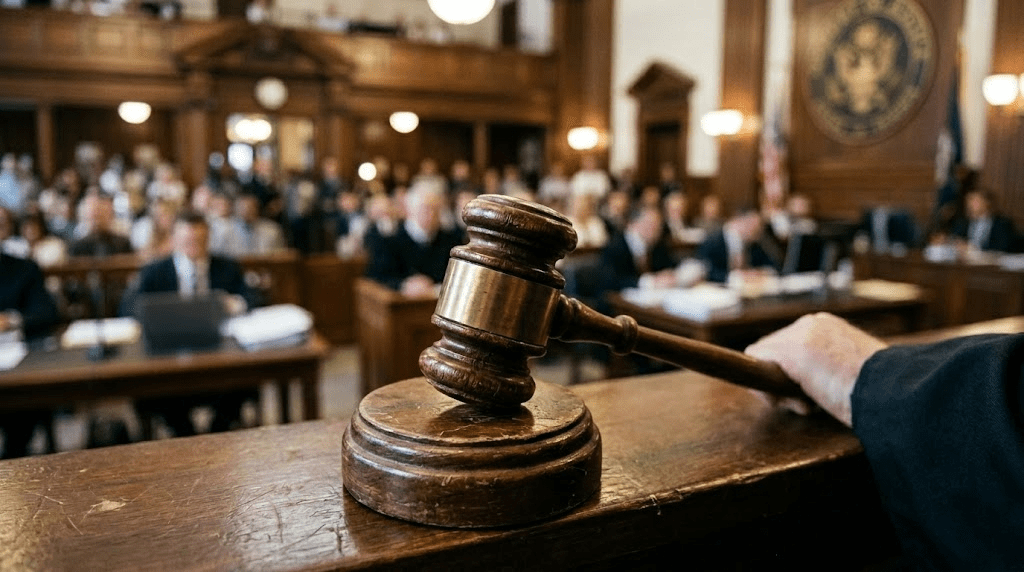
The Dark Truth Behind the Louisiana Deputy Prisoner Abuse Case
By Darius Spearman (africanelements)
Support African Elements at patreon.com/africanelements and hear recent news in a single playlist. Additionally, you can gain early access to ad-free video content.
In a significant civil rights ruling within the last twenty-four hours, a federal jury convicted a law enforcement officer. Joshua Firmin, a Deputy United States Marshal, faced justice on April 15, 2026. He subjected a restrained prisoner to cruel and unusual punishment. The horrific event happened in Lafayette, Louisiana. It sparked intense calls for stricter oversight. Social justice advocates demand better treatment for incarcerated individuals. The verdict marks a critical moment in the national debate. It highlights the ongoing struggle for law enforcement accountability. (justice.gov).
Breaking the Blue Wall of Silence
The violent incident occurred on February 9, 2024. Firmin assaulted a victim at the United States District Court. The victim, Jamarcus Zenon, is an African American man. He was completely restrained during the sudden attack. Officers had secured him in handcuffs, a belly chain, and leg irons. A belly chain secures the wrists directly to the waist. Leg irons severely restrict stride and prevent sudden movement. Therefore, Zenon was highly vulnerable and entirely defenseless. (justice.gov, changeflow.com).
Firmin struck Zenon in the face with a heavy ring of keys. Then, he violently shoved the shackled man into a wall. The assault caused a deep scalp injury that required medical staples. Firmin subsequently attempted to hide his illegal actions. He filed a false report claiming Zenon tried to spit on him. The federal jury found this justification to be a complete fabrication. Firmin was convicted of civil rights violations and obstruction of justice. He faces up to thirty years in federal prison. (justice.gov).
The Role of Federal Oversight
The assault took place entirely within a federal facility. Jamarcus Zenon was attending a plea hearing at the courthouse. This placed him under the temporary jurisdiction of federal marshals. Local parish deputies often assist with routine transportation duties. However, the physical space remained strictly federal property. Therefore, federal authorities bore the ultimate responsibility for inmate security. This distinction played a major role in the resulting legal action. (justice.gov).
A Deputy United States Marshal witnessed the unprovoked assault. This marshal immediately reported the severe misconduct. This crucial action successfully bypassed the traditional silence of parish departments. Consequently, the Federal Bureau of Investigation assumed control of the case. They led the comprehensive civil rights investigation. The investigation used medical evidence to debunk the false police report. This federal involvement ensured the case resulted in significant federal charges. (justice.gov).
A Legal Shift in Inmate Protections
The legal framework for this conviction took centuries to build. The Eighth Amendment protects citizens from cruel and unusual punishment. It originated directly from the English Bill of Rights of 1689. Initially, the law only banned barbaric methods like drawing and quartering. However, legal interpretations shifted significantly over time. Chief Justice Earl Warren cited evolving standards of decency in 1958. This landmark philosophy redefined how courts view punishment. (aclu.org).
For many years, courts maintained a strict hands-off doctrine toward prisons. Judges flatly refused to hear lawsuits from incarcerated people. They legally viewed prisoners as absolute slaves of the state. This meant prisoners had zero legal recourse for torture or extreme neglect. Judges claimed they lacked the necessary expertise to manage prisons. However, the landmark case of Cooper v. Pate changed everything in 1964. The Supreme Court ruled that prisoners retain constitutional rights behind bars. (lsu.edu).
The Brutal Legacy of the South
The history of penal systems in the South is notably violent. The Louisiana State Penitentiary provides a very stark historical example. The state built the infamous prison on a former slave plantation. Following the Civil War, Louisiana utilized a system called convict leasing. The state leased predominantly Black prisoners to private corporations. They endured grueling, dangerous, and often fatal labor conditions. It was a clear form of continued involuntary servitude. (lsu.edu).
By the 1970s, the Angola facility earned a terrifying reputation. Many experts called it the bloodiest prison in the South. The facility utilized armed trusty guards to maintain cheap order. These were incarcerated men granted weapons to supervise other prisoners. The system created a brutal culture of extreme violence and corruption. Trusties frequently extorted and brutally beat other incarcerated people. Federal courts eventually abolished the armed trusty system entirely. They ruled it constituted cruel and unusual punishment under the Constitution. (lsu.edu).
Modern Challenges and Forced Labor
The painful legacy of abuse continues in modern legal battles. Social justice groups are fighting ongoing systemic issues in Louisiana. They recently concluded a major federal trial involving the Angola prison. The lawsuit directly challenged the constitutionality of the prison farm line. Incarcerated men perform heavy manual agricultural labor in extreme heat. They work daily under the constant threat of solitary confinement. (changeflow.com).
Advocates argue this cruel practice violates the Eighth Amendment outright. In 2024, a federal judge refused to stop the labor immediately. However, the judge heavily criticized the overall working conditions. She noted a highly disorganized medical response to heat-related illnesses. The men received very little water or sufficient rest. This case represents a much broader modern legal movement. Activists are challenging the historical loopholes that still allow forced labor. (changeflow.com, aclu.org).
Defining Civil Rights Violations
Federal law provides specific tools to hold violent officers accountable. The Ku Klux Klan Act of 1871 created Section 1983. This statute allows individuals to sue government officials for constitutional violations. It remains a primary vehicle for civil rights litigation today. Another crucial tool is Title 18, United States Code, Section 242. This strict law criminalizes the deprivation of rights under color of law. (justice.gov).
An officer acts under color of law when misusing official power. It does not matter if the officer violates official department policy. The federal statute applies as long as they act in an official capacity. To secure a conviction, the government must prove willful intent. The official must intend to deprive the individual of a constitutional right. Firmin clearly displayed this exact willful intent during his unprovoked assault. He maliciously attacked a fully restrained and submissive human being. (justice.gov).
The Shield of Qualified Immunity
Holding law enforcement accountable often involves navigating complex legal doctrines. Qualified immunity is a massive judicial barrier to modern justice. This controversial doctrine shields government officials from personal financial liability. It protects them from lawsuits seeking necessary money damages. The Supreme Court created it to protect officials from constant litigation. The doctrine applies unless the official violated clearly established legal precedent. (aclu.org).
Overcoming qualified immunity is incredibly difficult for harmed plaintiffs. A victim must find a prior court case with nearly identical facts. If no prior case exists, the federal lawsuit is typically dismissed. Critics argue this creates a very dangerous cycle of legal impunity. The law never becomes clearly established because cases are constantly dismissed. Consequently, victims of excessive force often find themselves without a legal remedy. (aclu.org, lsu.edu).
Rare Prosecutions for Abuse
Despite the high-profile nature of this conviction, federal action is incredibly rare. Statistical trends reveal a deeply entrenched reluctance to prosecute rogue officers. Historically, federal authorities decline nine out of ten civil rights referrals. Cases often close without any formal federal prosecution whatsoever. This reality leaves countless victims of abuse with very few options. Many survivors never see their abusers face genuine accountability. (justice.gov).
However, recent statistical data shows a very slight shift in enforcement. Federal civil rights prosecutions saw a modest increase recently. In January 2026, cases were 37.2 percent higher than in 2021. Yet, these precise prosecutions remain a tiny fraction of total federal cases. In 2019, they accounted for only 0.027 percent of all prosecutions. Therefore, Firmin’s conviction marks a significant, albeit highly unusual, legal victory. (justice.gov).
Rise in Federal Civil Rights Prosecutions
Systemic Disparities in Incarceration
The context of prisoner abuse ties deeply to mass incarceration. Louisiana consistently maintains one of the highest incarceration rates globally. Roughly 1,067 per 100,000 residents are held in state prisons or local jails. This massive population is overwhelmingly and disproportionately Black. This stark reality highlights the urgent need for racial justice in the system. The mainstream political narrative often ignores these completely staggering statistics entirely. (lsu.edu).
Black men in the United States face severe and lasting disparities. They are six times more likely to be incarcerated than white men. In Louisiana, Black residents make up roughly one-third of the state population. Yet, they constitute the vast majority of the fully incarcerated workforce. These profound racial disparities drastically amplify the impact of law enforcement abuse. They ensure that systemic state violence disproportionately harms African American communities everywhere. (lsu.edu).
Pushing for Independent Oversight
The Firmin case has amplified urgent demands for vital structural changes. Advocates argue that internal departmental investigations are entirely and completely insufficient. Louisiana currently lacks an independent authority to monitor prison conditions thoroughly. Many legal groups assert it is the only democracy with this glaring omission. Consequently, major legislative efforts in 2026 focus heavily on establishing an ombudsman role. (changeflow.com).
A prison ombudsman operates as a completely independent, neutral official. They receive, investigate, and properly resolve serious complaints from incarcerated people. They operate completely outside the Department of Corrections formal chain of command. This vital independence ensures a crucial and necessary level of impartiality. The role serves as an effective early warning system for medical neglect. It helps safely identify excessive force before situations violently escalate into costly litigation. (changeflow.com, aclu.org).
Progress Beyond the Prison Walls
Reforms are slowly expanding to properly protect individuals after their release. The social discrimination against formerly incarcerated people is severe and totally widespread. It prevents them from securing basic housing and stable, reliable employment. In December 2023, the New Orleans City Council took a truly groundbreaking step. They explicitly added criminal history as a protected class under the city human rights code. (changeflow.com).
This specific local ordinance makes blanket rejection policies completely and utterly illegal. Landlords cannot automatically reject housing applicants based solely on a prior criminal record. It also formally applies to public accommodations and private employment opportunities. Businesses cannot deny jobs without a direct link to explicit safety requirements. This legislation empowers local commissions to investigate complaints and issue large financial fines. It provides a meaningful cause of action for traumatized victims of discrimination. (changeflow.com).
The conviction of Joshua Firmin is a powerful moment in modern legal history. Federal authorities proved willing to deeply penetrate the blue wall of silence. The involvement of a federal marshal helped secure this very rare conviction. It successfully bypasses the traditional sharing of power between local and federal authorities. The clear verdict serves as a strong reaffirmation of the Eighth Amendment. It proves that evolving standards of decency demand absolute accountability for everyone. (justice.gov).
About the Author
Darius Spearman is a professor of Black Studies at San Diego City College, where he has been teaching for over 20 years. He is the founder of African Elements, a media platform dedicated to providing educational resources on the history and culture of the African diaspora. Through his work, Spearman aims to empower and educate by bringing historical context to contemporary issues affecting the Black community.
