



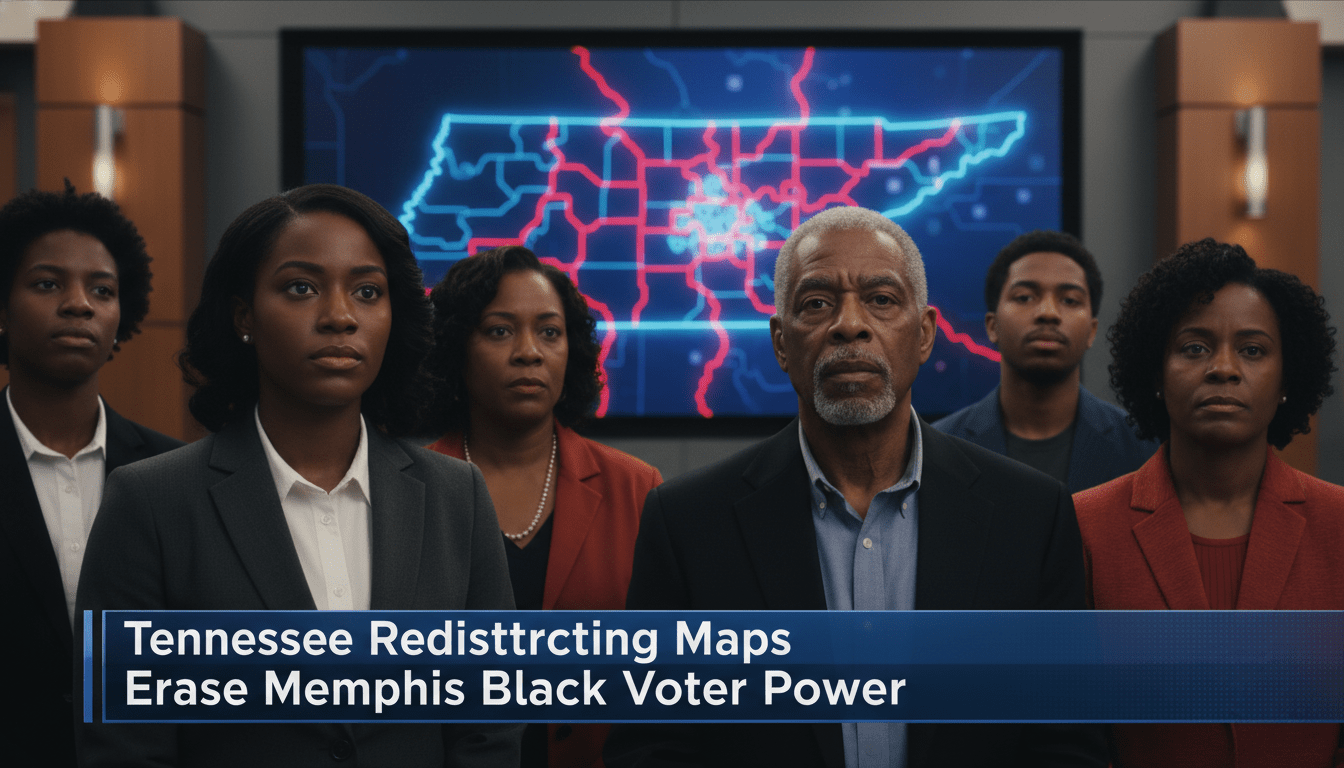
Tennessee Redistricting Maps Erase Memphis Black Voter Power
By Darius Spearman (africanelements)
Support African Elements at patreon.com/africanelements and hear recent news in a single playlist. Additionally, you can gain early access to ad-free video content.
A Sudden Shift in Map Lines
The Tennessee Senate recently approved a new congressional map. This legislative decision completely dissolves the only majority-Black district in the state. The targeted area, located in Memphis, holds a rich history of civil rights struggle. The NAACP quickly filed an emergency court petition to stop the execution of the plan. They label the new map an illegal racial gerrymander designed specifically to silence Black voters.
With Donald Trump serving as the current president, national politics remain highly polarized. Local battles over district lines carry massive consequences for federal political power. State lawmakers are actively reshaping the boundaries of representation across the country. The outcome in Tennessee will decide who holds political influence for years to come. Advocates refuse to accept the change without a fierce legal battle. (democracydocket.com)
What Is Mid-Decade Restructuring?
Redistricting typically happens once every ten years. States redraw their maps following the national census to reflect changing population demographics accurately. Mid-decade restructuring is the process of altering these electoral maps between the official decennial cycles. It is historically rare and frequently viewed as a purely political maneuver. For fifty years, Tennessee law strictly prohibited redrawing congressional lines in the middle of a decade.
The recent repeal of this long-standing statute allowed the legislature to bypass the normal schedule. Critics argue this move seizes partisan advantage without waiting for new census data. The rush to redraw boundaries shocked civil rights advocates throughout the region. The NAACP argues this tactic is a direct assault on democratic fairness. They view the repeal as an unlawful step backward. (tampafp.com)
The Legacy of Equal Representation
The current struggle connects deeply to foundational moments in Tennessee history. Before the modern era, the state ignored massive population shifts for over sixty years. Rural areas held disproportionate power over rapidly growing cities like Memphis. This inequitable distribution of voters across legislative districts is known as malapportionment. Prior to federal intervention, smaller counties maintained political dominance over massive urban centers.
The United States Supreme Court finally intervened in 1962 with the landmark case Baker versus Carr. The lawsuit originated in Shelby County and established the equal protection doctrine of one person, one vote. State legislatures were subsequently forced to redraw lines to ensure equal population counts. This ruling transformed the Civil Rights era by forcing outmoded rural interests to yield to urban realities. It established a firm precedent that democratic representation must remain fair and equitable. (uslegal.com)
Rise of a Black Political Base
The push for fair districts eventually yielded tangible results for African Americans. In 1974, Harold Ford Senior secured a historic victory in the Memphis-based district. He became the first African American to represent Tennessee in Congress in an entire century. Following the 1980 census, the state drew the Ninth District as a specific opportunity district. This map directly complied with Section 2 of the Voting Rights Act.
Section 2 permanently prohibits any voting practice that results in racial discrimination. It relies on a distinct results test, meaning plaintiffs only need to prove a discriminatory effect rather than explicit intent. This vital designation ensured that Black voters in Memphis could consistently elect a candidate of their choice. The district maintained this crucial function for over forty years, cementing Black political power in the region. (brennancenter.org)
Cracking a City Wide Open
The proposed 2026 map employs a controversial redistricting tactic known as cracking. Cracking involves deliberately splitting a cohesive community among several districts. This strategy ensures the targeted group never forms a numerical majority in any single area. The new Tennessee map brutally divides Memphis into three separate congressional districts. This fractures a community that shares identical political and social interests.
Before the recent change, the Black voting-age population in the Ninth District stood at roughly sixty percent. The revised map distributes these voters across three different rural, white-majority districts. Consequently, the Black voting-age population drops to approximately twenty percent in each new district. This mathematical dilution completely eliminates the ability of Memphis voters to elect their preferred candidates. The concentrated political voice of a major urban center vanishes entirely. (rockthevote.org)
The NAACP Emergency Lawsuit
The NAACP bases its emergency legal challenge on several crucial arguments. The lawsuit asserts the Republican-controlled legislature explicitly violated the state constitution. Lawyers claim the mid-decade redraw lacked proper legal authorization from the start. Furthermore, the organization addresses the complicated intersection of race and partisan politics. Memphis Black voters overwhelmingly support Democratic candidates at rates exceeding ninety percent.
Republican lawmakers maintain the new map focuses purely on politics and population, rather than race. However, civil rights attorneys argue that targeting a heavily Democratic urban center effectively targets Black voters. The distinction between racial gerrymandering and partisan gerrymandering becomes legally insignificant in this specific context. The outcome depends heavily on establishing a clear discriminatory effect through the court system. Advocates demand immediate intervention before the next election cycle. (democracydocket.com)
Weakening the Voting Rights Act
A major catalyst for the Tennessee redistricting effort originated at the federal level. In April 2026, the United States Supreme Court issued a landmark ruling in Callais versus Landry. The Court decided that Louisiana’s second majority-Black district constituted an unconstitutional racial gerrymander. The justices reasoned that race cannot predominate in map-drawing without a compelling state interest. The conservative majority shifted the legal landscape dramatically.
The Court effectively declared that Section 2 of the Voting Rights Act did not require the creation of that specific district. Similar to recent decisions impacting affirmative action, this ruling severely weakened decades of racial protections. It unshackled state legislatures from strict federal oversight regarding majority-minority districts. The Callais ruling directly empowered states like Tennessee to aggressively reshape their maps. Minorities now face an uphill battle to protect their representation. (constitutioncenter.org)
The Special Session Controversy
The procedural methods used to pass the map draw intense scrutiny from legal experts. Governor Bill Lee convened a special legislative session to review congressional maps following the Callais decision. Under the Tennessee Constitution, lawmakers can only conduct legislative business explicitly mentioned in the official call. The governor’s formal proclamation stated the session would ensure districts accurately reflect the will of voters. It omitted specific language about repealing existing laws.
The NAACP lawsuit argues this broad language did not authorize the repeal of the specific statute banning mid-decade changes. Protesters argue the session was a rushed effort spurred by intense political pressure. The legislative maneuvering circumvented traditional public oversight and debate. This controversial procedural shortcut forms a core pillar of the current legal challenge. Transparency in the map-making process remains a major concern. (tampafp.com)
Urban Needs Lost to Rural Power
Fragmenting a major city into multiple rural districts creates severe economic consequences. Memphis is highly urbanized, yet the new map attaches its neighborhoods to over two hundred miles of rural land. When mapmakers crack an urban center, the city loses its unified voice in Washington. This fragmentation severely hinders local government efforts to secure competitive federal funding.
Urban-specific initiatives require strong legislative advocacy to succeed. Public transit expansions, poverty alleviation programs, and healthcare grants rely on dedicated representatives. Representatives of the newly drawn districts will likely prioritize their broader rural constituencies. Consequently, the unique needs of Memphis residents will receive significantly less attention. The economic vitality of the city suffers deeply when its political strength diminishes. (legistorm.com)
Beyond the Racial Divide
The political dynamics of the Ninth District demonstrate complex voting behaviors. Steve Cohen currently represents the district in Congress. Cohen is a white, Jewish Democrat who has held the Memphis seat since 2007. He proudly represents the largest percentage of Black constituents of any white lawmaker in the United States Congress. His sustained electoral success illustrates a crucial nuance in modern voting rights law.
A candidate of choice for minority voters does not necessarily need to share their exact racial background. Cohen consistently builds strong coalitions by effectively addressing the specific interests of his constituents. This reality proves that minority communities prioritize responsive representation over racial identity alone. The new map threatens to erase this established, successful political coalition. Diversity in political representation remains a complex, evolving landscape. (wikipedia.org)
A Threat to Minority Voices
The situation unfolding in Tennessee violently mirrors a broader national crisis. The drive to eliminate opportunity districts is accelerating rapidly across the South. States such as Alabama and Louisiana are actively testing the limits of the recent Callais decision. Political analysts project these mid-decade changes could trigger a massive decline in minority representation nationwide. The consequences extend far beyond a single state.
The United States Congress could witness the largest drop in Black lawmakers since the end of the Jim Crow era. This coordinated gerrymandering arms race fundamentally shifts the balance of federal legislative power. The historical contributions of marginalized groups face severe political erasure. Even Black women contributed significantly to building these reliable voting blocks, yet their votes are now diluted. Decades of hard-fought progress hang in jeopardy. (brennancenter.org)
The Future of Fair Voting
The battle over the Memphis congressional map represents a critical juncture for American democracy. The NAACP emergency petition directly challenges the fundamental legality of the mid-decade maneuver. The outcome of this lawsuit will set a powerful precedent for future electoral maps. A ruling against the civil rights organization could validate similar aggressive power grabs nationwide.
Conversely, a court victory could reaffirm essential protections for minority voters across the country. The history of the region reveals a constant struggle between voter suppression and equitable representation. State legislatures continue to constantly test the boundaries of constitutional law. The voices of millions of citizens hang in the balance as the courts prepare to decide. Fair representation remains an enduring fight for justice. (democracydocket.com)
About the Author
Darius Spearman is a professor of Black Studies at San Diego City College, where he has been teaching for over 20 years. He is the founder of African Elements, a media platform dedicated to providing educational resources on the history and culture of the African diaspora. Through his work, Spearman aims to empower and educate by bringing historical context to contemporary issues affecting the Black community.
