



Why South Carolina Early Voting Surged to Stop New Maps
By Darius Spearman (africanelements)
Support African Elements at patreon.com/africanelements and hear recent news in a single playlist. Additionally, you can gain early access to ad-free video content.
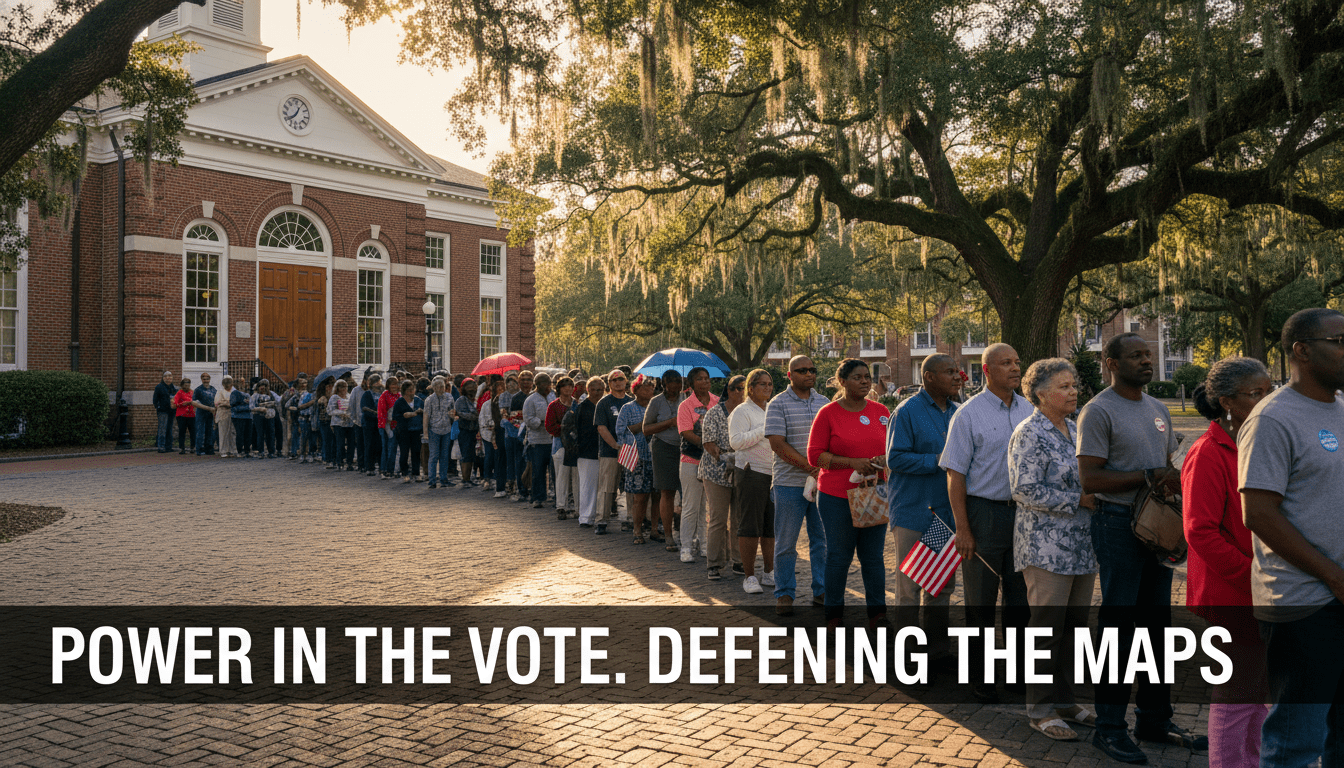
On May 26, 2026, a high-stakes legislative battle came to a head in the state of South Carolina (pbs.org). As thousands of citizens stood in long lines to cast their ballots on the very first day of early voting, lawmakers in the State Senate debated a radical proposal (pbs.org, pbs.org). A Republican-led push sought to redraw the congressional maps of the state in the middle of an active election cycle (pbs.org). This fast-tracked bill, heavily supported by national political strategists, aimed to throw out primary votes that were already being cast (pbs.org, southcarolinapublicradio.org). The plan sought to move the congressional primaries to August and create a map designed to secure all seven congressional seats for the Republican Party (pbs.org).
At the center of this legislative storm was the Sixth Congressional District, represented by long-time civil rights champion Representative Jim Clyburn (pbs.org, pbs.org). Representative Clyburn denounced the effort as a return to “Jim Crow 2.0” (pbs.org). This aggressive move sparked deep public outrage and drove voters to the polls in record-breaking numbers (pbs.org, pbs.org). The historic surge in early voting ultimately forced a bipartisan group of state senators to abandon the redistricting push (pbs.org). To understand how this standoff unfolded, it is essential to examine the deep racial and partisan history of electoral mapping in South Carolina.
The Historic Roots of Disenfranchisement
The struggle for Black representation in South Carolina is deeply connected to the Reconstruction era following the Civil War (wikipedia.org). During Reconstruction, South Carolina elected multiple Black representatives to Congress (wikipedia.org). This period of progressive political participation was short-lived, however. By the late nineteenth century, white conservative Democrats used violence, poll taxes, literacy tests, and aggressive gerrymandering to systematically strip away Black political power (wikipedia.org, wikipedia.org). This systematic campaign culminated in the 1895 State Constitution, which successfully disenfranchised the vast majority of Black voters (wikipedia.org).
These regressive measures created an environment where Black citizens could not safely or easily exercise their constitutional rights. For nearly a century, South Carolina did not send a single Black representative to Congress (wikipedia.org). This history of exclusion is central to understanding modern debates around voter suppression and disenfranchisement. The legacy of the 1895 constitution cast a long shadow over the state, ensuring that political power remained heavily concentrated in white hands. Every attempt to challenge this power met fierce resistance from the state government. Only through federal intervention did the electoral landscape finally begin to shift.
The Rise and Defense of the Sixth District
The passage of the landmark Voting Rights Act of 1965 introduced a new era of federal oversight (constitutioncenter.org, justice.gov). Under Section 5 of this federal law, jurisdictions with a documented history of discrimination, including South Carolina, had to obtain federal preclearance before changing their voting laws or maps (justice.gov). This critical shield protected minority voters from retrogressive changes (justice.gov). It forced state mapmakers to prove that their new lines would not dilute the political influence of Black communities (justice.gov).
In 1992, under the protection of the Voting Rights Act, the state drew the Sixth Congressional District as a majority-minority district (pbs.org, wikipedia.org). That same year, Representative Jim Clyburn won the seat, becoming the first Black member of Congress from South Carolina since 1897 (pbs.org, wikipedia.org). This district has since served as a vital stronghold for the exercise of Black political power in the state. It remains the only reliably Democratic district in South Carolina (pbs.org). The historical battle to maintain this district highlights how federal protections have been crucial in securing minority representation.
Understanding Packing, Cracking, and Power Dilution
To comprehend how modern district maps can dilute political power, one must understand the mechanisms of gerrymandering. Mapmakers primarily rely on two tactics: packing and cracking (fairdistrictspa.com, fairvote.org). Packing is a strategy where cartographers concentrate a high density of like-minded voters or minority groups into a single district (fairdistrictspa.com, fairvote.org). While this guarantees they will win that specific seat, it limits their political influence overall (fairvote.org). It prevents them from being a competitive force in surrounding areas (fairvote.org).
In contrast, cracking is the process of splintering and spreading a target group of voters across several districts (fairdistrictspa.com, fairvote.org). This ensures they remain a permanent minority in every district, unable to elect their preferred candidates (fairvote.org). Following the 2020 Census, South Carolina lawmakers utilized these tactics (pbs.org). They shifted approximately 30,000 Black voters out of the competitive First Congressional District and “packed” them into Representative Clyburn’s Sixth District (pbs.org, duke.edu). This maneuver neutralized the voting power of Black residents in coastal areas, making the First District safely Republican (pbs.org).
Gerrymandering Mechanisms: Packing vs. Cracking
Visualizing how voter boundaries are manipulated to control outcomes.
Concentrating targeted voters into one district to limit their influence elsewhere.
Splintering targeted voters across districts so they remain a permanent minority.
The Supreme Court and the Partisan Loophole
The legal environment changed dramatically in 2013 when the Supreme Court gutted Section 5 of the Voting Rights Act in Shelby County v. Holder (pbs.org, constitutioncenter.org). Without the requirement for federal preclearance, South Carolina was free to implement new maps without proving they did not harm minority voters (pbs.org). This opened the door for aggressive redistricting efforts (pbs.org, pbs.org). The South Carolina NAACP and individual voter Taiwan Scott filed a lawsuit challenging the 2022 maps (pbs.org, supremecourt.gov). A three-judge federal panel agreed with the plaintiffs, ruling that the state had used race to unconstitutionally gerrymander the First District (supremecourt.gov).
However, in May 2024, the Supreme Court overturned this ruling in Alexander v. South Carolina State Conference of the NAACP (pbs.org, supremecourt.gov). In a 6-3 decision, the conservative majority ruled that the map was a permissible partisan gerrymander rather than an unconstitutional racial gerrymander (supremecourt.gov). The court held that because race and party affiliation are highly correlated in South Carolina, challengers faced an incredibly high burden of proof (supremecourt.gov). This ruling created a massive partisan loophole, allowing legislatures to target Black voters under the guise of seeking partisan advantage (supremecourt.gov). It also reflected the complex dynamics of federalism and how state powers can bypass federal oversight.
The 2026 Mid-Decade Confrontation
Emboldened by the Supreme Court decision, national Republican strategists sought to redraw maps mid-decade (pbs.org, pbs.org). This practice is highly unusual, as standard redistricting typically occurs only once every ten years following the federal census (redistrictingdatahub.org). Pushing for changes outside this cycle violates long-established political norms. In May 2026, Republican Governor Henry McMaster called a special legislative session to push through an even more aggressive congressional map (pbs.org).
This proposed mid-decade map aimed to dismantle Representative Clyburn’s Sixth District completely (pbs.org). It sought to spread the Black population among surrounding districts, creating seven safely Republican seats (pbs.org). This proposal would have moved more than 1.5 million voting-age South Carolinians into new districts in the middle of an active primary election (pbs.org). Civil rights organizations and local communities recognized the immense threat this posed to minority representation and immediately organized a massive response (pbs.org, pbs.org). These events carry significant strategic political implications for how communities mobilize in response to state-level power plays.
Proposed 2026 Map: Percentage of Voters Moved to New Districts
The mid-decade proposal targeted minority communities aggressively, moving half of all Black voting-age adults.
Total Impact: 1,502,766 South Carolina voters would have been displaced mid-decade.
Why Republican Senators Broke Ranks
The attempt to halt an ongoing primary election shocked many observers, including some conservative lawmakers (pbs.org, pbs.org). On May 26, 2026, twelve Republican State Senators joined all twelve Democratic senators to block the redistricting bill (pbs.org). These moderate Republicans argued that changing the rules of an election in progress was a step too far (pbs.org). They expressed deep concerns about the logistical chaos of throwing out legally cast ballots and rescheduling primaries (pbs.org, southcarolinapublicradio.org).
State Senator Richard Cash, a Republican, publicly stated that his conscience and common sense would not allow him to stop an active election (pbs.org). Other senators warned that rushing a major map change in just three weeks was irresponsible (pbs.org). They argued that the state should not outsource its legislative mapmaking duties to national political interest groups (pbs.org). This bipartisan coalition voted to table the bill, effectively ending the mid-decade redistricting push for the year (pbs.org).
Power in the Vested Interest of a Vote
The key shield against this mid-decade power play was the direct action of the voters themselves (pbs.org, pbs.org). On the first day of early voting, citizens turned out in historic numbers (pbs.org). Over 32,500 ballots were cast on May 26, 2026, shattering the previous state record of 20,000 votes (pbs.org). In addition, thousands of absentee ballots had already been processed (pbs.org). This massive participation created a legally protected vested interest (pbs.org).
Legal experts noted that once citizens cast ballots under an active map, changing those boundaries becomes highly indefensible in court (pbs.org). Doing so would violate due process and disenfranchise active participants (pbs.org). The active mobilization of local churches, civic groups, and civil rights organizations proved that direct democratic participation remains a powerful tool against legislative overreach (pbs.org, pbs.org). By showing up, voters physically blocked the attempt to dismantle their representation (pbs.org).
First-Day Primary Early Voting Turnout Comparison
Outrage over map proposals drove historic first-day voting numbers.
Looking Ahead at the Southern Battleground
The defeat of the 2026 mid-decade bill preserved the current congressional boundaries for the time being (pbs.org). Currently, Representative Nancy Mace continues to represent the First Congressional District under the maps approved by the Supreme Court in 2024 (pbs.org, supremecourt.gov). Although the federal challenges are resolved, the state’s maps are still facing litigation in state courts (lwv.org). Groups such as the League of Women Voters of South Carolina continue to argue that the maps violate the state constitution (lwv.org).
The standoff in South Carolina is not an isolated event. It is part of a broader national strategy where both major parties monitor maps and attempt to gain advantage outside the standard ten-year census cycle (redistrictingdatahub.org). While federal protections have been weakened by the Supreme Court, the events of May 2026 show that the ultimate power still rests with the electorate. The fight over representation in the American South is far from over, but the people of South Carolina have demonstrated how communities can stand firm and protect their democratic rights.
About the Author
Darius Spearman is a professor of Black Studies at San Diego City College, where he has been teaching for over 20 years. He is the founder of African Elements, a media platform dedicated to providing educational resources on the history and culture of the African diaspora. Through his work, Spearman aims to empower and educate by bringing historical context to contemporary issues affecting the Black community.
