


Why Are Ghanaians Evacuated from South Africa Fleeing?
By Darius Spearman (africanelements)
Support African Elements at patreon.com/africanelements and hear recent news in a single playlist. Additionally, you can gain early access to ad-free video content.
The Emergency Landing in Accra
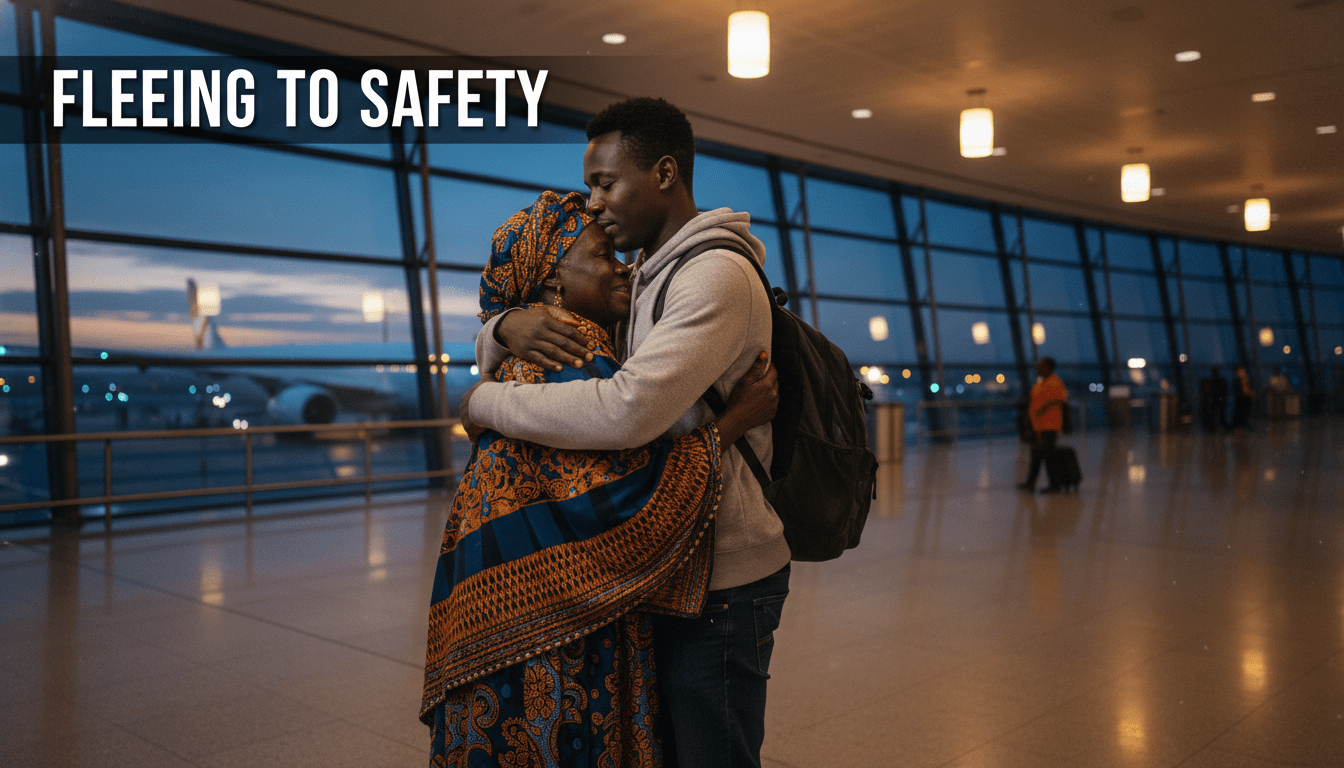
On May 27, 2026, an emotional scene unfolded at Kotoka International Airport in Accra (citinewsroom.com). A charter flight arrived carrying approximately 300 Ghanaian citizens who fled South Africa (citinewsroom.com). They were part of a larger group of more than 800 citizens registered for urgent evacuation (citinewsroom.com). The Minister for Foreign Affairs of Ghana, Hon. Samuel Okudzeto Ablakwa, met them on arrival (citinewsroom.com). Anxious family members gathered at the terminal to welcome their loved ones. The returnees sang patriotic songs as they touched down safely on Ghanaian soil.
This flight was not a routine journey for the passengers. Instead, it was a desperate escape from weeks of rising violence in South African economic hubs. President John Dramani Mahama officially organized and funded these emergency repatriation flights (citinewsroom.com). Mahama returned to power after winning the December 2024 election with 56.5 percent of the vote (presidency.gov.gh). His administration intervened after a viral video surfaced online (youtube.com). This video depicted the brutal assault of a Ghanaian man in South Africa (youtube.com). This shocking footage sparked massive national outrage inside Ghana and forced diplomatic action.
The Rising Threat of Vigilante Movements
The recent violence did not appear overnight. It was driven by a wave of intense street protests across South Africa. A citizen-led group named “March and March” led these protests in 2026 (youtube.com). Jacinta Ngobese-Zuma founded this organization in 2025 to campaign against immigration (youtube.com). The group worked alongside established vigilante movements such as Operation Dudula (youtube.com).
These groups conducted unauthorized audits of businesses owned by foreign nationals (youtube.com). They set up roadblocks and checkpoints near public areas to demand identity documents (youtube.com). Vigilantes armed themselves with pepper spray, traditional weapons, and sjamboks (youtube.com). A sjambok is a heavy leather or plastic whip historically used for cattle driving (wikipedia.org). During the apartheid era, South African police used sjamboks to violently suppress Black anti-apartheid demonstrators (wikipedia.org). Today, these weapons represent a traumatic legacy of state brutality and racial subjugation (wikipedia.org). Yet, vigilantes still use them unlawfully to administer extralegal punishments to foreign residents.
The Threat of the June Deadline
Panic spread quickly among foreign nationals in major cities like Johannesburg and Pretoria. In early 2026, “March and March” issued a public ultimatum to the migrant population (youtube.com). They demanded that all undocumented immigrants leave South Africa by June 30, 2026 (youtube.com). The groups threatened a total national shutdown if their demands were ignored (youtube.com).
Terrible fear drove hundreds of migrants to flee their homes in townships. Many sought refuge near police stations and foreign embassies for protection (youtube.com). However, South African authorities offered a different perspective on the evacuations. Stephen van Neel, the head of immigration enforcement, shared a surprising detail about the returnees (youtube.com). He stated that only ten of the first 300 evacuated Ghanaians were in the country legally (youtube.com). Officials argued the repatriation was about immigration laws rather than targeted violence.
Xenophobic Violence in South Africa (1994 – 2026)
Why Are Ghanaians Leaving the Gold Coast?
This crisis raises an important question for global observers. Why are citizens leaving Ghana in the first place? Ghana is widely known as one of West Africa’s most stable democracies. However, the nation has faced a severe macroeconomic crisis in recent years (worldbank.org). This economic pressure acts as a powerful push factor for migration.
Ordinary citizens have endured the worst cost-of-living crisis in a generation. Food and fuel prices spiked dramatically. Inflation peaked at a staggering 54 percent in late 2022 (worldbank.org). Furthermore, the Ghanaian cedi depreciated rapidly against the US dollar (worldbank.org). This economic distress forced the government to secure a three billion dollar bailout from the International Monetary Fund (worldbank.org). Amid Africa’s rising debt, public spending has been severely constrained. The formal sector cannot absorb the hundreds of thousands of graduates seeking employment. Consequently, many young people seek opportunities in more developed economies like South Africa.
The Collapse of Ubuntu
For decades, South Africa championed a philosophy of global African unity. After apartheid ended in 1994, the nation embraced the concept of Ubuntu (wikipedia.org). Ubuntu is a Southern African humanist philosophy centered on human interconnectedness and community (wikipedia.org). It teaches that an individual’s humanity is realized through relationships with others (wikipedia.org). The term comes from the Nguni Bantu phrase meaning “a person is a person through other persons.”
Under the leadership of Nelson Mandela and Archbishop Desmond Tutu, Ubuntu served as a moral compass (wikipedia.org). It prioritized empathy, communal welfare, and mutual respect over extreme individualism. Today, however, the rise of xenophobia represents a tragic collapse of this moral framework. Empathy has been replaced by hostility. The dreams of African-centric ideals seem increasingly distant. Vigilante violence suggests that mutual caring does not apply to fellow Africans.
Apartheid Legacy and Economic Scapegoating
The roots of modern xenophobia are tied to apartheid-era structural inequality (georgetown.edu). The apartheid regime enforced strict racial segregation for decades (georgetown.edu). This system locked the Black majority out of the formal economy (georgetown.edu). Black populations were systematically confined to crowded, under-resourced townships (georgetown.edu). This geographic segregation created massive barriers to wealth and employment (georgetown.edu).
The end of white minority rule in 1994 did not solve these structural problems. Deep-seated poverty and poor municipal services remained the norm. Today, many local residents blame immigrants for these systemic failures (georgetown.edu). Populist politicians scapegoat foreign nationals for stealing jobs and committing crimes (georgetown.edu). This highly competitive environment makes it easy for vigilantes to exploit local frustrations. Many observers argue that workers in South Africa face oppression from systemic economic structures rather than from migrant workers.
South Africa Economic Crisis Indicators
How Vigilantes Target Foreign Nationals
Vigilante groups use arbitrary and discriminatory methods to identify foreign nationals. Movements like Operation Dudula perform language testing on the streets (amnesty.org). They ask suspected individuals to speak local South African languages (amnesty.org). For example, they may demand that someone translate the Afrikaans word for elbow (amnesty.org).
Additionally, vigilantes profile people based on their vocal accents (amnesty.org). They turn people away from clinics if they do not sound local (amnesty.org). They also use physical traits, targeting people with darker skin tones (amnesty.org). This behavior constitutes a form of xeno-racism. Vigilantes conduct illegal raids in schools, markets, and homes to demand identification papers (amnesty.org). These unlawful practices strike terror into the hearts of foreign residents.
Changing Laws and the Safe Country Principle
South African policies have also grown more restrictive. The government recently approved the First Safe Country principle (eisenberg.co.za). Home Affairs Minister Leon Schreiber backed this policy change (eisenberg.co.za). This principle declares asylum seekers ineligible for protection if they traveled through other safe countries (eisenberg.co.za).
The policy aims to prevent migrants from choosing their preferred destinations. However, many Ghanaian migrants travel overland through multiple nations before reaching South Africa. Consequently, this policy legally disqualifies the vast majority from claiming asylum upon arrival. Human rights groups argue that many transit nations are not safe for vulnerable groups (hrw.org). They fear this law validates the narratives of anti-migrant groups.
Distrust of African Immigrants (GovDem Survey)
The Broken Pan-African Solidarity
During the anti-apartheid struggle, African nations stood united. Many countries opened their borders to provide shelter and financial support to South African exiles (georgetown.edu). Ghana played a major role in supporting the liberation movement (georgetown.edu). This historical connection was built on the foundation of Pan-Africanism (georgetown.edu).
Pan-Africanism is an ideology aimed at fostering solidarity among all people of African descent (georgetown.edu). Ghana’s first president, Kwame Nkrumah, championed this movement (georgetown.edu). He envisioned a united continent that could achieve self-reliance (georgetown.edu). A deep look at the history of Africa reveals the power of this early solidarity. Today, the rise of xenophobia represents a profound betrayal of that historic relationship.
The History of Cyclical Violence
The 2026 evacuations are part of a painful, recurring cycle. In May 2008, South Africa experienced its worst wave of xenophobic violence (wikipedia.org). Mobs swept through townships, killing at least 62 people (wikipedia.org). The attacks displaced over 120,000 residents and introduced the horrific execution method of necklacing (wikipedia.org).
More outbreaks occurred in April 2015 and September 2019 (wikipedia.org, channelstv.com). During those crises, nations like Nigeria used private airlines to rescue their citizens (channelstv.com). In 2026, the pattern repeated itself. Samuel Okudzeto Ablakwa promised that returning Ghanaians would receive psychological counseling (citinewsroom.com). The state also promised financial reintegration support. Yet, these measures are only temporary solutions. The systemic issues driving this cyclical violence remain unresolved.
The Role of International and Regional Bodies
Regional organizations have faced criticism for their slow response to the crisis. The African Union has long promoted free movement across the continent (migration.org.za). However, the body has struggled to enforce these ideals in the face of national sovereignty (migration.org.za). Observers argue that regional economic integration cannot succeed if migrants face constant danger.
Furthermore, South Africa’s actions have strained diplomatic relations within the Southern African Development Community (migration.org.za). Neighboring countries argue that South Africa relies heavily on regional labor while rejecting regional people. The Southern African Development Community has called for dialogue to address the root causes of migration. Without systemic reforms, however, these statements do little to protect vulnerable populations on the ground.
A Path Forward for Regional Migration
To break this cycle, both South Africa and sending nations must take action. South Africa must address its economic crisis and spatial segregation (georgetown.edu). The government must also crack down on vigilante violence and illegal profiling (amnesty.org). Simply deporting migrants does not solve the underlying unemployment crisis.
At the same time, West African nations like Ghana must address their domestic economic push factors (worldbank.org). Leaders must create opportunities that allow young people to thrive at home. Until these structural economic realities change, emergency evacuations will remain a temporary fix. The flight to Accra brought 300 citizens to safety, but the broader struggle for a united Africa continues.
About the Author
Darius Spearman is a professor of Black Studies at San Diego City College, where he has been teaching for over 20 years. He is the founder of African Elements, a media platform dedicated to providing educational resources on the history and culture of the African diaspora. Through his work, Spearman aims to empower and educate by bringing historical context to contemporary issues affecting the Black community.
